Within Politics
When Majority Support Becomes Fake Proof
Majority support can be politically important, but it does not prove that a claim is true or a policy is sound.
On this page
- Why popularity feels relevant in democratic argument
- How appeal to majority bypasses evidence
- How to weigh public opinion without treating it as proof
Page outline Jump by section
Introduction
In parliamentary debate, public opinion matters. Elected representatives are expected to pay attention to voters, explain how policies reflect public concerns and consider the legitimacy that comes from democratic support. The problem arises when popularity is treated not as a political consideration but as proof that a claim is true or that a policy is sound. This is the logical fallacy known as an appeal to popularity, or argumentum ad populum. It occurs when a speaker argues that a proposition should be accepted simply because many people believe it, support it or favour it. Popularity may be politically relevant, but it is not evidence that a factual claim is correct or that a policy will achieve its intended outcomes.[Scribbr]scribbr.comad populum fallacyWhat Is Ad Populum Fallacy? | Definition & Examples20 Jun 2023 — Ad populum fallacy is arguing that a claim is true simply because that's…[Scholarly Publications]scholarlypublications.universiteitleiden.nlScholarly PublicationsAd populum arguments in a political contextAn appeal to the opinion of a lot of people or even to the majority of p…
 Within legislatures, this fallacy is especially important because parliamentary arguments often blend questions of democratic legitimacy with questions of evidence. Distinguishing between those two issues is essential for high-quality public debate.
Why Popularity Feels Relevant in Democratic Argument
Parliamentary debate differs from many other forms of argument because legislators are not merely discussing abstract truths. They are also making collective decisions on behalf of citizens. As a result, references to public opinion are often appropriate.
A member of parliament may legitimately argue that a proposal deserves consideration because it reflects the preferences of a large portion of the electorate. Democratic systems require representatives to take citizens’ interests, values and priorities seriously. Scholars of political argumentation note that appeals to majority preferences can play a role in establishing the political legitimacy of a policy position.[Springer]link.springer.comThe Case of European Parliamentary Committees of Inquiryby C Andone · 2016 · Cited by 22 — By treating appeals to the majority in…
This democratic context explains why popularity-based arguments can sound persuasive. Statements such as:
- “Most voters support this reform.”
- “The public clearly wants action.”
- “A majority of citizens agree with this position.”
may be relevant when discussing political mandates or electoral accountability.
However, relevance to political legitimacy is not the same as proof of correctness. A majority can support a policy that is ineffective, misunderstand factual evidence or hold beliefs that later prove mistaken. The logical mistake occurs when popularity is presented as if it settles questions that require independent evidence.[Scribbr]scribbr.comad populum fallacyWhat Is Ad Populum Fallacy? | Definition & Examples20 Jun 2023 — Ad populum fallacy is arguing that a claim is true simply because that's…[Scribbr]scribbr.comad populum fallacyWhat Is Ad Populum Fallacy? | Definition & Examples20 Jun 2023 — Ad populum fallacy is arguing that a claim is true simply because that's…
How Appeal to Majority Bypasses Evidence
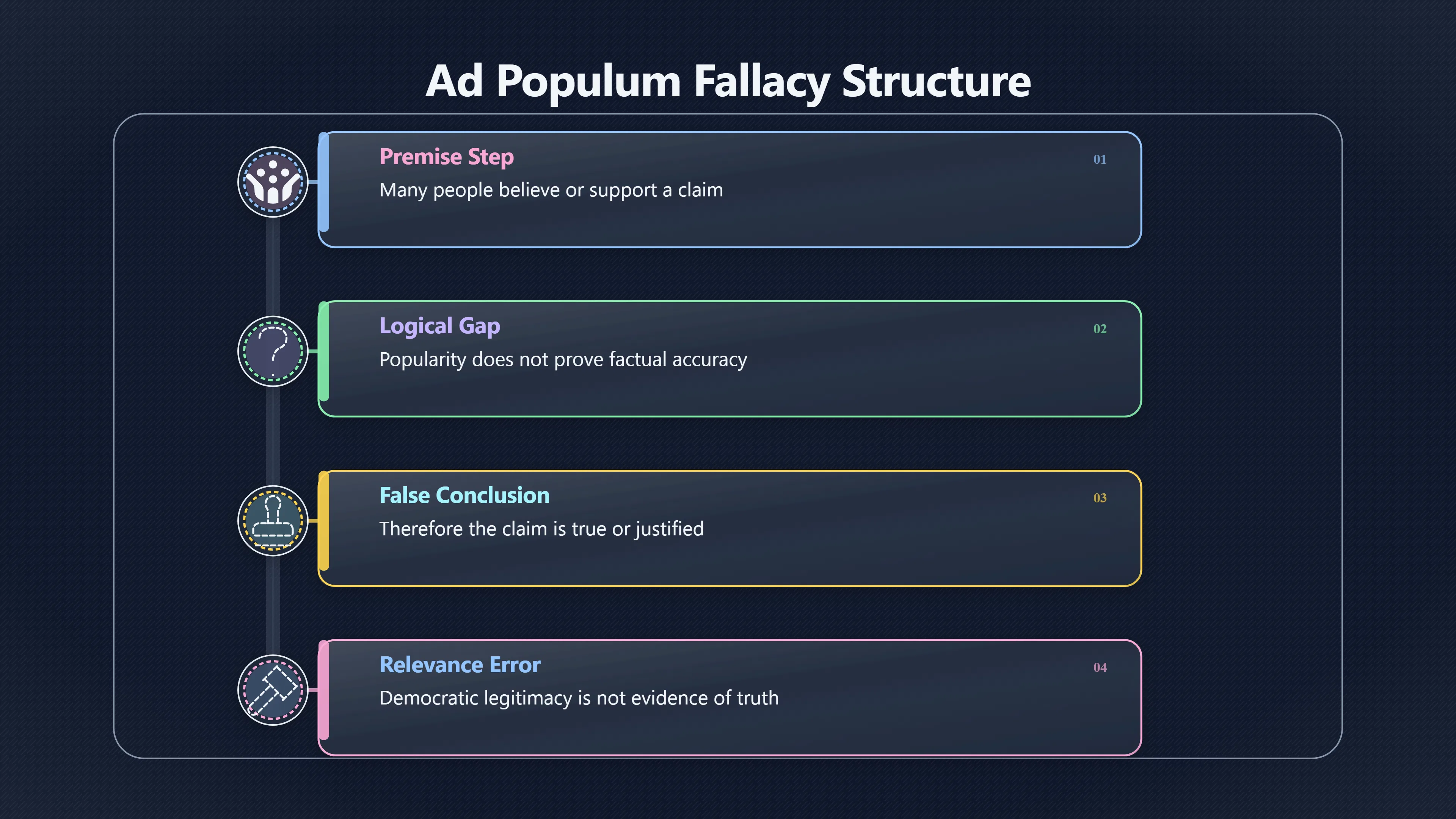
The structure of the fallacy is straightforward:
- Many people believe or support a claim.
- Therefore, the claim is true or the policy is justified.
The conclusion does not logically follow from the premise. Whether a claim is widely accepted and whether it is true are separate questions. Logic scholars classify appeal to popularity as a relevance fallacy because the popularity of a belief does not itself provide evidence for its accuracy.[Scribbr]scribbr.comad populum fallacyWhat Is Ad Populum Fallacy? | Definition & Examples20 Jun 2023 — Ad populum fallacy is arguing that a claim is true simply because that's…[2philosophy.lander.edu]philosophy.lander.eduAd Populum: Appeal to PopularityThe ad populum argument claims a conclusion is true because most, all, or even an elite group people irre…
In parliamentary settings, the fallacy often appears in more sophisticated forms than the textbook example. Rather than explicitly saying “the majority believes it, therefore it is true”, speakers may imply that public support eliminates the need for further justification.
For example:
- A legislator cites polling data as proof that a policy will work.
- A minister argues that widespread public approval demonstrates the factual accuracy of a claim.
- A speaker dismisses criticism by stating that “the people have already decided”.
In each case, evidence about effectiveness, costs, risks or consequences is replaced by evidence about popularity.
This substitution can be especially powerful because parliamentary audiences are sensitive to democratic legitimacy. The argument invites listeners to equate disagreement with opposition to the public itself rather than engagement with the merits of the policy.
How the Fallacy Appears in Parliamentary Speech
Research on parliamentary discourse shows that appeals to majority opinion are a recurring feature of legislative argumentation. Studies examining parliamentary debates in different countries have identified argumentum ad populum alongside other common political fallacies such as ad hominem attacks and straw-man arguments.[rozenbergquarterly.com]rozenbergquarterly.comAnalysis Of Fallacies in Croatian Parliamentary Debateby G Kišiček — This fallacy is often accompanied by words like: “Everybody knows th…
Several recurring patterns appear:
The mandate argument stretched too far.
A government claims that electoral victory proves the correctness of every policy proposal associated with its platform. Winning an election may provide authority to govern, but it does not automatically demonstrate that every policy choice is wise or factually justified.
The common-sense claim.
Speakers invoke phrases such as “everybody knows”, “ordinary people understand” or “it is obvious to the public”. Research on parliamentary fallacies notes that such language frequently accompanies appeals to popularity because it discourages scrutiny and suggests that dissent is unreasonable.[rozenbergquarterly.com]rozenbergquarterly.comAnalysis Of Fallacies in Croatian Parliamentary Debateby G Kišiček — This fallacy is often accompanied by words like: “Everybody knows th…
The polling shortcut.
Opinion surveys are used as substitutes for policy analysis. Polls may reveal public preferences, but they do not establish whether a proposal is constitutional, affordable, effective or factually grounded.
The consensus shield.
A speaker responds to criticism not by addressing evidence but by pointing to widespread support. The focus shifts from evaluating the argument to evaluating how many people agree with it.
In each case, numbers replace reasons.

When Majority Support Is Relevant—and When It Is Not
One reason appeal-to-popularity arguments are difficult to evaluate is that public opinion is sometimes genuinely relevant.
A useful distinction is between two questions:
Who should decide?
In a democracy, majority preferences often matter when determining collective choices. Legislators may reasonably argue that policy should reflect the wishes of citizens because democratic institutions exist to represent them.[Springer]link.springer.comThe Case of European Parliamentary Committees of Inquiryby C Andone · 2016 · Cited by 22 — By treating appeals to the majority in…
What is true or effective?
Questions of fact require evidence beyond public belief. Whether a tax policy increases revenue, whether a public-health measure reduces harm, or whether a forecast is accurate cannot be determined solely by counting supporters. These questions require data, analysis and reasoning.[Scribbr]scribbr.comad populum fallacyWhat Is Ad Populum Fallacy? | Definition & Examples20 Jun 2023 — Ad populum fallacy is arguing that a claim is true simply because that's…
Confusion arises when answers to the first question are used to settle the second. Democratic legitimacy and factual validity are related but distinct concepts.
A Practical Test for Parliamentary Arguments
A simple way to identify the fallacy is to ask what would happen if public opinion changed overnight.
If the argument loses all force once majority support disappears, it may be relying entirely on popularity.
Consider the contrast:
Weak argument:
“Most citizens support this policy, so it is the correct solution.”
Stronger argument:
“Most citizens support this policy, and evidence from comparable programmes shows that it achieves the intended outcome.”
The second argument still mentions public opinion, but popularity is not doing all the logical work. Independent evidence supports the conclusion.
This distinction reflects a broader principle of parliamentary reasoning: democratic preferences help determine what governments ought to consider, while evidence helps determine what policies are likely to succeed.

Why the Distinction Matters for Public Debate
Parliamentary debate serves several purposes. It represents citizens, tests competing claims and provides public justification for government action. Political theorists and scholars of parliamentary rhetoric have long argued that debate is valuable precisely because it exposes proposals to criticism and scrutiny rather than treating support alone as decisive.[journal-redescriptions.org]journal-redescriptions.org“What Is the Point of Parliamentary Debate?” Deliberation,This article seeks to open up debate about Parliamentary debate by exploring the history of ideas about Parliamentary debate and rhetoric…
When appeal-to-popularity arguments dominate, that deliberative function weakens. Speakers can avoid addressing inconvenient evidence by pointing to polls, election results or public sentiment. Opponents may then respond with rival claims about popularity instead of examining the substance of the issue.
The result is a debate focused on who has the larger following rather than on which arguments are better supported.
Recognising the appeal to popularity fallacy does not require ignoring public opinion. Democratic debate depends on understanding what citizens want. The critical point is that majority support can indicate political importance, legitimacy or urgency, but it cannot by itself prove that a claim is true or that a policy is sound. Evidence must still do that work.[Scribbr]scribbr.comad populum fallacyWhat Is Ad Populum Fallacy? | Definition & Examples20 Jun 2023 — Ad populum fallacy is arguing that a claim is true simply because that's…[Scholarly Publications]scholarlypublications.universiteitleiden.nlScholarly PublicationsAd populum arguments in a political contextAn appeal to the opinion of a lot of people or even to the majority of p…
Amazon book picks
Further Reading
Books and field guides related to When Majority Support Becomes Fake Proof. Use these as the next step if you want deeper reading beyond the article.
The Wisdom of Crowds
Directly explores when collective opinion is informative and when it is not proof.
Thinking, Fast and Slow
Explains cognitive shortcuts that make majority opinion feel like evidence.
Asking the Right Questions
Provides tools for distinguishing evidence from popularity-based claims.
eBay marketplace picks
Marketplace Samples
Example marketplace items related to this page. Use the search link to explore similar finds on eBay.




Endnotes
1.
Source: philosophy.lander.edu
Link:https://philosophy.lander.edu/logic/popular.html
Source snippet
Ad Populum: Appeal to PopularityThe ad populum argument claims a conclusion is true because most, all, or even an elite group people irre...
2.
Source: link.springer.com
Link:https://link.springer.com/article/10.1007/s10503
Source snippet
The Case of European Parliamentary Committees of Inquiryby C Andone · 2016 · Cited by 22 — By treating appeals to the majority in...
3.
Source: scribbr.com
Title: ad populum fallacy
Link:https://www.scribbr.com/fallacies/ad-populum-fallacy/
Source snippet
What Is Ad Populum Fallacy? | Definition & Examples20 Jun 2023 — Ad populum fallacy is arguing that a claim is true simply because that's...
4.
Source: rozenbergquarterly.com
Link:https://rozenbergquarterly.com/issa-proceedings-2010-analysis-of-fallacies-in-croatian-parliamentary-debate/
Source snippet
Analysis Of Fallacies in Croatian Parliamentary Debateby G Kišiček — This fallacy is often accompanied by words like: “Everybody knows th...
5.
Source: journal-redescriptions.org
Title: “What Is the Point of Parliamentary Debate?” Deliberation,
Link:https://journal-redescriptions.org/articles/49/files/submission/proof/49-1-94-1-10-20190828.pdf
Source snippet
This article seeks to open up debate about Parliamentary debate by exploring the history of ideas about Parliamentary debate and rhetoric...
6.
Source: parliament.uk
Link:https://www.parliament.uk/about/how/business/debates/
7.
Source: scribbr.co.uk
Title: Scribbr What Is Ad Populum Fallacy? | Definition & Examples
Link:https://www.scribbr.co.uk/fallacy/the-ad-populum-fallacy/
Source snippet
What Is Ad Populum Fallacy? | Definition & Examples - ScribbrJune 20, 2023 — 20 Jun 2023 — Ad populum fallacy is arguing that a cl...
Published: June 20, 2023
8.
Source: scholarlypublications.universiteitleiden.nl
Link:https://scholarlypublications.universiteitleiden.nl/access/item%3A3458708/view
Source snippet
Scholarly PublicationsAd populum arguments in a political contextAn appeal to the opinion of a lot of people or even to the majority of p...
9.
Source: Wikipedia
Title: Argumentum ad populum
Link:https://en.wikipedia.org/wiki/Argumentum_ad_populum
Source snippet
Argumentum ad populumIn argumentation theory, an argumentum ad populum is an informal fallacy that asserts a claim is true, good, or c...
10.
Source: uvm.edu
Title: Parliamentary debate
Link:https://www.uvm.edu/~debate/meanyparli.html
Source snippet
rs do not...Read more...
Additional References
11.
Source: researchgate.net
Title: 281112603 Parrying Ad Hominem Arguments in Parliamentary Debates
Link:https://www.researchgate.net/publication/281112603_Parrying_Ad_Hominem_Arguments_in_Parliamentary_Debates
Source snippet
José Plug published Parrying Ad Hominem Arguments in Parliamentary Debates | Find, read and cite all the research you need on...
12.
Source: icar.cnrs.fr
Link:https://icar.cnrs.fr/dicoplantin/political-arguments-eng/
Source snippet
Political Arguments: Two Collections6 Aug 2021 — Bentham focuses exclusively on fallacious arguments in parliamentary debates...
13.
Source: facebook.com
Link:https://www.facebook.com/charles.ebune/posts/argumentum-ad-populum-also-known-as-the-appeal-to-the-people-or-[bandwagon
Source snippet
Argumentum ad populum, also known as the "appeal to...Argumentum ad populum is a logical fallacy that argues a claim is true because a l...
14.
Source: youtube.com
Title: STAR TREK Logical Thinking #1
Link:https://www.youtube.com/watch?v=xkoMdnCS6Og
Source snippet
What is argumentum ad populum? [Logical Fallacies]({{ 'logical-fallacies/' | relative_url }}) Explained #7...
15.
Source: pmc.ncbi.nlm.nih.gov
Link:https://pmc.ncbi.nlm.nih.gov/articles/PMC5712170/
Source snippet
appeal to popularity... There has been discussion whether ad populum would be reasonable and not fallacious in the political debate [32...
16.
Source: files.eric.ed.gov
Link:https://files.eric.ed.gov/fulltext/ED299644.pdf
Source snippet
This paper reviews the newly emergent trend of audience-centered debate paradigms, such as the narrative and the issues-agenda paradigms...
17.
Source: youtube.com
Title: Ad Populum (Appeal to Popularity): Lesson and Activity
Link:https://www.youtube.com/watch?v=8zg2dpimhNQ
Source snippet
STAR TREK Logical Thinking #1 - Argumentum Ad Populum (Appeal to the Majority)...
18.
Source: youtube.com
Title: CRITICAL THINKING
Link:https://www.youtube.com/watch?v=aF6EHTtyYqw
Source snippet
Don't Be a Sheep: The Ad Populum Fallacy Explained...
19.
Source: youtube.com
Title: Don’t Be a Sheep: The Ad Populum Fallacy Explained
Link:https://www.youtube.com/watch?v=n14qsp2C9Tw
Source snippet
Ad Populum (Appeal to Popularity): Lesson and Activity...
20.
Source: assignnmentinneed.com
Title: what is an example of ad populum fallacy in [politics]({{ ‘politics/’ | relative_url }})
Link:https://www.assignnmentinneed.com/blog/what-is-an-example-of-ad-populum-fallacy-in-politics
Source snippet
Instead of presenting...Read more...
Topic Tree