Within Tone
The four tests every argument faces
A single statement can be logically strong, socially harmful, ethically poor, or strategically unpersuasive at the same time.
On this page
- Logical support versus conversational norms
- Ethical respect and practical persuasion
- How moderators can address tone without dodging claims
Page outline Jump by section
Introduction
When people argue, they often ask a single question: “Is this argument good or bad?” In practice, that question hides at least four different evaluations. An argument can be logically strong yet rude, ethically troubling yet factually correct, or persuasive despite weak reasoning. Confusing these judgments is one of the main reasons disputes about logical fallacies become muddled.
 In discussions about ad hominem attacks, tone policing, and relevance, the central mistake is often treating a failure on one dimension as a failure on all dimensions. A speaker who insults an opponent may still provide strong evidence. A courteous speaker may still commit a fallacy. A statement may be true but expressed in a way that damages trust or cooperation. Evaluating arguments well therefore requires four separate tests: logical support, conversational conduct, ethical respect, and practical effectiveness. Argumentation scholars have long noted that argument quality, dialogue norms, and persuasion are related but distinct forms of assessment.[RUG AI]ai.rug.nlThe New Dialectic….12 Jul 2001 — A central topic in the theory of argumentation is argument evaluation. For any particular argument, t…
The four tests every argument faces
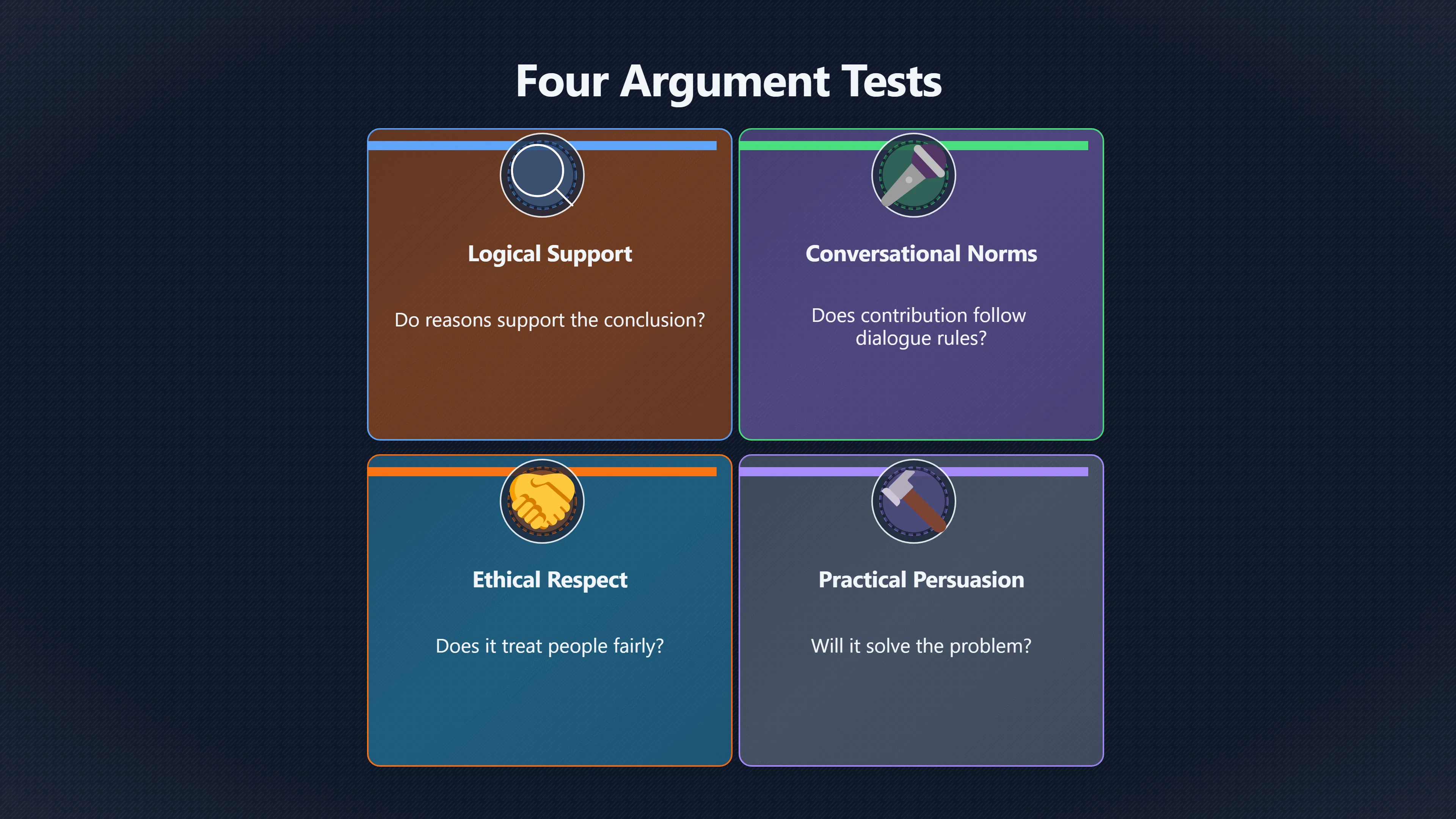
The easiest way to avoid confusion is to ask four different questions rather than one.
TestCore questionTypical failureLogicalDo the reasons support the conclusion?Fallacies, irrelevance, invalid inferenceConversationalDoes the contribution follow the norms of productive dialogue?Interruptions, abuse, refusal to engageEthicalDoes it treat people fairly and respectfully?Humiliation, prejudice, dehumanisationPracticalWill it persuade or solve the problem?Alienating the audience, strategic failure
These tests often point in different directions. A public-health expert may present accurate evidence while speaking impatiently. The reasoning may pass the logical test while failing the conversational one. Conversely, a polished spokesperson may speak courteously yet rely on irrelevant authority or emotional manipulation. That argument may pass the conversational test while failing the logical one.[read.aupress.ca]read.aupress.caChapter 15. Fallacies of Emotional BiasThe fallacy of appeal to pity occurs when we attempt to evoke feelings of pity or compassion in or…
The distinction matters because logical fallacies belong primarily to the first category. A fallacy concerns the relationship between premises and conclusion. It is not automatically a judgment about politeness, morality, or effectiveness.[Internet Encyclopedia of Philosophy]iep.utm.eduInternet Encyclopedia of PhilosophyFallaciesThe major difficulty with labeling a piece of reasoning an Ad Hominem Fallacy is deciding whe…
Logical support versus conversational norms
The most common confusion arises when people mistake bad manners for bad reasoning.
Consider the statement:
“The company should release the safety report because independent testing found significant defects. Anyone still hiding the report is being irresponsible.”
Many listeners may object to the accusation of irresponsibility. That objection concerns conversational conduct. Yet the argument’s logical strength depends on the evidence about defects and the connection between transparency and public safety. The insult neither proves nor disproves the conclusion.
By contrast:
“Don’t listen to her safety concerns. She’s irresponsible.”
This shifts attention from evidence to the speaker. If the personal criticism is irrelevant to the claim, the reasoning becomes an ad hominem fallacy because it substitutes a personal attack for engagement with the issue. The logical problem is irrelevance, not rudeness itself. Philosophers and logic texts repeatedly emphasise that a personal attack becomes fallacious when it replaces examination of the claim under discussion.[Philosophy Home Page]philosophy.lander.eduPhilosophy Home PageAd HominemThe ad hominem fallacy occurs whenever the character or circumstances of an individual who is advancing an…[Internet Encyclopedia of Philosophy]iep.utm.eduInternet Encyclopedia of PhilosophyFallaciesThe major difficulty with labeling a piece of reasoning an Ad Hominem Fallacy is deciding whe…
The reverse error also occurs. Someone may politely avoid the issue:
“I appreciate your concern, but our organisation has always acted responsibly.”
This response may sound civil while contributing little evidence. Courtesy does not guarantee argumentative quality.
Conversation therefore requires two independent assessments:
- Did the speaker provide relevant support?
- Did the speaker follow reasonable dialogue norms?
The answers can differ.
Ethical respect and practical persuasion
Logical evaluation is not the only legitimate concern in public discussion.
An argument can be logically valid while still raising ethical concerns. Imagine a campaign that accurately identifies a social problem but does so through ridicule or humiliation. The evidence may be sound, yet many people would judge the method ethically objectionable because it treats individuals as targets rather than participants in discussion.
Likewise, ethical concerns are not identical to practical concerns. A communication strategy may be respectful but ineffective. Another may persuade large audiences while encouraging prejudice or hostility. Research on persuasion consistently shows that emotional cues, credibility signals, and rhetorical framing can influence people independently of strict argumentative quality.[Springer]link.springer.comDeveloping persuasive systems for marketing: the interplay of…by A Braca · 2023 · Cited by 118 — This paper presents a compreh…
This distinction explains why people can disagree about an argument without actually disagreeing about its logic.
For example:
- One critic may say, “The evidence is sound, but the language is cruel.”
- Another may say, “The language is acceptable, but the reasoning is weak.”
- A third may say, “The reasoning is sound, but this approach will never persuade undecided people.”
All three may be discussing different dimensions of the same statement.
Recognising these separate judgments prevents debates from collapsing into confusion over whether criticism concerns truth, behaviour, morality, or strategy.
Why tone disputes often become fallacy disputes
Many contemporary disagreements involve accusations of tone policing. The concern is that people sometimes shift attention from the substance of a claim to the emotional manner in which it is expressed. When that shift is used to dismiss the claim without addressing its content, it can function as a diversion from the argument itself.[Wikipedia]WikipediaTone policingTone policing
However, not every discussion of tone is fallacious.
A moderator who says:
“Your evidence is relevant, but please stop insulting other participants.”
is not rejecting the claim because of its tone. The moderator is making a separate conversational judgment.
The crucial distinction is whether criticism of tone replaces engagement with the argument or accompanies it.
Compare:
- “You’re angry, so your argument is wrong.”
- “Your argument may be correct, but the insults violate our discussion rules.”
The first attempts to use emotion as evidence against the claim. The second separates argumentative assessment from behavioural standards.
Keeping those judgments distinct allows communities to maintain civility without pretending that civility determines truth.
How moderators can address tone without dodging claims
Moderators, teachers, editors, and community managers often face the practical challenge of enforcing conduct standards while preserving substantive debate.
A useful approach is to issue separate rulings for separate dimensions.
Assess the claim and the conduct independently
Instead of declaring a contribution wholly acceptable or unacceptable, moderators can distinguish between content and behaviour:
- The factual claim may remain open for discussion.
- The reasoning may be strong or weak.
- The language may violate community rules.
- The contribution may still require editing or removal.
This prevents moderation from becoming an implicit judgment about truth.
State which rule is being enforced
Clear moderation identifies the category involved:
- “Off-topic.”
- “Personal attack.”
- “Unsupported claim.”
- “Harassment.”
- “Evidence requested.”
Each label refers to a different kind of problem. Combining them obscures what actually went wrong.
Research on online argumentation and moderation increasingly treats appropriateness, argument quality, and civility as related but distinct dimensions, precisely because communities struggle when all forms of evaluation are collapsed together.[arXiv]arxiv.orgarXiv Modeling Appropriate Language in ArgumentationModeling Appropriate Language in ArgumentationMay 24, 2023…
Avoid treating persuasion as proof
Arguments sometimes gain support because they are emotionally compelling or socially popular. Conversely, strong arguments may fail to persuade. Practical success is important in politics, advocacy, and negotiation, but persuasion alone is not evidence of logical soundness. Critical-thinking traditions distinguish between reasons that justify a conclusion and techniques that merely encourage acceptance of it.[read.aupress.ca]read.aupress.caChapter 15. Fallacies of Emotional BiasThe fallacy of appeal to pity occurs when we attempt to evoke feelings of pity or compassion in or…
A simple diagnostic for difficult disputes
When an argument becomes controversial, ask four separate questions:
- Logical: Do the reasons support the conclusion?
- Conversational: Was the contribution made in a way that supports productive dialogue?
- Ethical: Does it treat people fairly and with appropriate respect?
- Practical: Is it likely to persuade the intended audience or solve the problem?
A single statement can pass one test and fail another. That possibility is not a flaw in evaluation; it is a reflection of how real argument works. The study of logical fallacies focuses on the first test, but real-world disagreements often require all four. Separating them helps people criticise poor reasoning without confusing it with rudeness, and address harmful conduct without pretending that conduct alone settles whether a claim is true.
eBay marketplace picks
Marketplace Samples
Example marketplace items related to this page. Use the search link to explore similar finds on eBay.






Endnotes
1.
Source: ai.rug.nl
Link:https://www.ai.rug.nl/~verheij/publications/pdf/walton2001.pdf
Source snippet
The New Dialectic....12 Jul 2001 — A central topic in the theory of argumentation is argument evaluation. For any particular argument, t...
2.
Source: read.aupress.ca
Link:https://read.aupress.ca/read/critical-thinking-logic-and-argument/section/d25311a8-3222-4d6a-97da-2797dfecbabf
Source snippet
Chapter 15. Fallacies of Emotional BiasThe fallacy of appeal to pity occurs when we attempt to evoke feelings of pity or compassion in or...
3.
Source: link.springer.com
Link:https://link.springer.com/article/10.1007/s43039-023-00077-0
Source snippet
Developing persuasive systems for marketing: the interplay of...by A Braca · 2023 · Cited by 118 — This paper presents a compreh...
4.
Source: Wikipedia
Title: Tone policing
Link:https://en.wikipedia.org/wiki/Tone_policing
5.
Source: arxiv.org
Title: arXiv Modeling Appropriate Language in Argumentation
Link:https://arxiv.org/abs/2305.14935
Source snippet
Modeling Appropriate Language in ArgumentationMay 24, 2023...
Published: May 24, 2023
6.
Source: arxiv.org
Link:https://arxiv.org/abs/2212.07425
7.
Source: Wikipedia
Title: Ad hominem
Link:https://en.wikipedia.org/wiki/Ad_hominem
Source snippet
Ad hominemAd hominem short for argumentum ad hominem refers to when a speaker attacks the character, motive, or some other attribute o...
8.
Source: Wikipedia
Title: Argumentation theory
Link:https://en.wikipedia.org/wiki/Argumentation_theory
Source snippet
Argumentation theoryArgumentation theory is the interdisciplinary study of how conclusions can be supported or undermined by premises...
9.
Source: link.springer.com
Link:https://link.springer.com/article/10.1007/s13194-025-00707-8
Source snippet
hominem arguments in scientific discoursesby LP Schäfer · 2026 — Ad hominem arguments have no bearing on the truth-values of scientific t...
10.
Source: arxiv.org
Link:https://arxiv.org/html/2604.07028v2
Source snippet
Strategic Persuasion with Trait-Conditioned Multi-Agent...25 May 2026 — In this paper, we introduce the Strategic Courtroom Framework, a...
Published: May 2026
11.
Source: iep.utm.edu
Link:https://iep.utm.edu/fallacy/
Source snippet
Internet Encyclopedia of PhilosophyFallaciesThe major difficulty with labeling a piece of reasoning an Ad Hominem Fallacy is deciding whe...
12.
Source: philosophy.lander.edu
Link:https://philosophy.lander.edu/logic/person.html
Source snippet
Philosophy Home PageAd HominemThe ad hominem fallacy occurs whenever the character or circumstances of an individual who is advancing an...
13.
Source: ebsco.com
Link:https://www.ebsco.com/research-starters/religion-and-philosophy/ad-hominem
14.
Source: trendsettercase.wordpress.com
Link:https://trendsettercase.wordpress.com/2017/05/20/fighting-fallacies-the-abusive-ad-hominem/
Source snippet
Fallacies | The Abusive Ad Hominem20 May 2017 — The abusive ad hominem fallacy is another informal fallacy, and like the straw man, it's...
Published: May 2017
15.
Source: scribbr.com
Title: ad hominem fallacy
Link:https://www.scribbr.com/fallacies/ad-hominem-fallacy/
Source snippet
Definition & Examples21 Apr 2023 — The ad hominem fallacy is a logical fallacy, specifically a fallacy of relevance, i.e, the argument ra...
16.
Source: utminers.utep.edu
Link:https://utminers.utep.edu/omwilliamson/engl1311/fallacies.htm
Source snippet
List of Logical FallaciesThe Ad Hominem Argument (also, "Personal attack," "Poisoning the well"): The fallacy of attempting to refute an...
Additional References
17.
Source: facebook.com
Link:https://www.facebook.com/groups/VBpolitics/posts/2952836414888048/
Source snippet
Analyzing tone and conduct in public conflictIf others would like their own tone, conduct, or public engagement evaluated using this same...
18.
Source: assets.cambridge.org
Link:https://assets.cambridge.org/97805218/86178/excerpt/9780521886178_excerpt.pdf
Source snippet
Cambridge AssetsArgument as reasoned dialogueThe goal of this book is to help the reader use critical methods to impar- tially and reason...
19.
Source: psupress.org
Link:https://www.psupress.org/books/titles/978-0-271-02177-5.html?srsltid=AfmBOooCy5W-4j0YojYjjPR3Efu7TfPB53rIfQTYJZHIVdhIOzJQfINd
Source snippet
Legal Argumentation and Evidence By Douglas WaltonA leading expert in [informal logic]({{ 'informal-logic/' | relative_url }}), Douglas Walton turns his attention in this new book...
20.
Source: britannica.com
Link:https://www.britannica.com/topic/ad-hominem
21.
Source: humanities.mcmaster.ca
Link:https://www.humanities.mcmaster.ca/~hitchckd/adhominemissa.htm
Source snippet
It is said to consist generically in a response to someone's statement or argument by an attack on that...Read more...
22.
Source: markmanson.net
Link:https://markmanson.net/logical-fallacies
Source snippet
Correlation Is Not Causation · 2. [Slippery Slope]({{ 'slippery-slope/' | relative_url }}) Fallacy · 3. False Dichotomies · 4. Begging the Question · 5. Red...Read more...
23.
Source: slacowan.com
Title: compassionate commenting vs tone policing a case study and rebuttal
Link:https://slacowan.com/2023/11/02/compassionate-commenting-vs-tone-policing-a-case-study-and-rebuttal/
Source snippet
Compassionate Commenting vs Tone Policing2 Nov 2023 — Tone policing is a form of egoism, a protecting of the self and one's own feelings...
24.
Source: thinkingispower.com
Link:https://thinkingispower.com/logical-fallacies/
Source snippet
legitimate expert makes claims contrary to the consensus. But if you're...Read more...
25.
Source: blog.apaonline.org
Title: tone policing and the assertion of authority
Link:https://blog.apaonline.org/2022/05/10/tone-policing-and-the-assertion-of-authority/
Source snippet
apaonline.orgTone-Policing and the Assertion of Authority | Blog of the APA10 May 2022 — Tone policing is when someone (usually a privile...
Published: May 2022
26.
Source: sciencedirect.com
Title: Act as you preach!
Link:https://www.sciencedirect.com/science/article/pii/S0148296324003722
Source snippet
Authentic brand purpose versus “woke...by N Walter · 2024 · Cited by 59 — Therefore, the aim of this research is to investigate how diff...
Topic Tree