Within False Dilemma
Is It Really Pay More or Collapse?
Budget claims like raise prices or face ruin often hide implementation choices about spending, timing, reserves, and safeguards.
On this page
- The forced budget frame
- Hidden implementation levers
- How bundled decisions change the argument
Page outline Jump by section
Introduction
Arguments about university tuition and institutional budgets often arrive in a dramatic form: either tuition rises or the institution faces severe decline, programme closures, or even collapse. This framing can contain a genuine financial concern, but it frequently illustrates a false dilemma. The debate is presented as though only two options exist when, in reality, budget decisions usually involve multiple implementation choices about spending priorities, reserves, borrowing, efficiency measures, staffing plans, enrolment strategies, government funding, and the timing of changes. The key question is not whether financial pressures are real. It is whether the proposed “pay more or collapse” framing accurately reflects the range of available responses. Evidence from higher education finance shows that institutions facing revenue pressure often have several possible adjustment mechanisms rather than a single unavoidable path. House of Commons Library[Institute for Fiscal Studies]ifs.org.ukInstitute for Fiscal StudiesHigher education finances: how have they fared, and what…by K Ogden · Cited by 13 — The next government fa…

Is It Really Pay More or Collapse?
The false dilemma appears when a speaker compresses a complex financial situation into a binary choice:
- Raise tuition or close programmes.
- Accept higher fees or lose educational quality.
- Increase student charges or face bankruptcy.
Such claims can be persuasive because universities and colleges do face genuine financial constraints. In England, concerns about institutional sustainability have increased as tuition fee caps have lagged behind inflation while operating costs have risen. Regulators and parliamentary briefings have warned about growing financial pressures across the sector. House of Commons Library[Economics Observatory]economicsobservatory.comuk higher education finance whats the problem and what can be doneUK higher education finance: what's the problem and what…29 Oct 2024 — England's once world-leading higher education system has become…
Yet acknowledging financial pressure is different from accepting that only one response exists. A budget shortfall does not automatically dictate a specific solution. The reasoning becomes fallacious when the conclusion assumes that every other implementation option has already been exhausted or shown to be impossible.
A useful test is to ask whether the argument has demonstrated that alternative measures are unavailable, inadequate, or more harmful than the proposed tuition increase. If that demonstration is missing, the audience may be looking at a false dilemma rather than a genuine necessity.
The Forced Budget Frame
Budget debates often simplify a chain of decisions into a single headline demand. The audience sees the final proposal but not the many choices embedded within it.
Consider a university that announces a projected deficit. The public discussion may immediately become:
Either approve a tuition increase or accept major cuts.
However, the actual budget process may involve numerous decisions about expenditure categories, capital projects, staffing patterns, programme restructuring, administrative costs, fundraising, partnership income, debt management, or the use of financial reserves. The binary framing obscures those intermediate choices.
Research on higher education finance repeatedly shows that institutions respond to funding pressures through combinations of strategies rather than a single mechanism. Universities may reduce expenditures, seek new revenue sources, alter enrolment mixes, restructure operations, or combine several approaches simultaneously.[Bipartisan Policy Center]bipartisanpolicy.orgstate funding and college costs reviewing the evidenceBipartisan Policy CenterState Funding and College Costs: Reviewing the Evidence16 Dec 2024 — When confronted with reduced state funding…
The existence of these alternatives does not prove that tuition increases are unnecessary. It demonstrates only that the debate should compare competing responses rather than assume one response is inevitable.
Hidden Implementation Levers
The strongest antidote to a false dilemma is identifying the implementation levers hidden behind the headline choice.
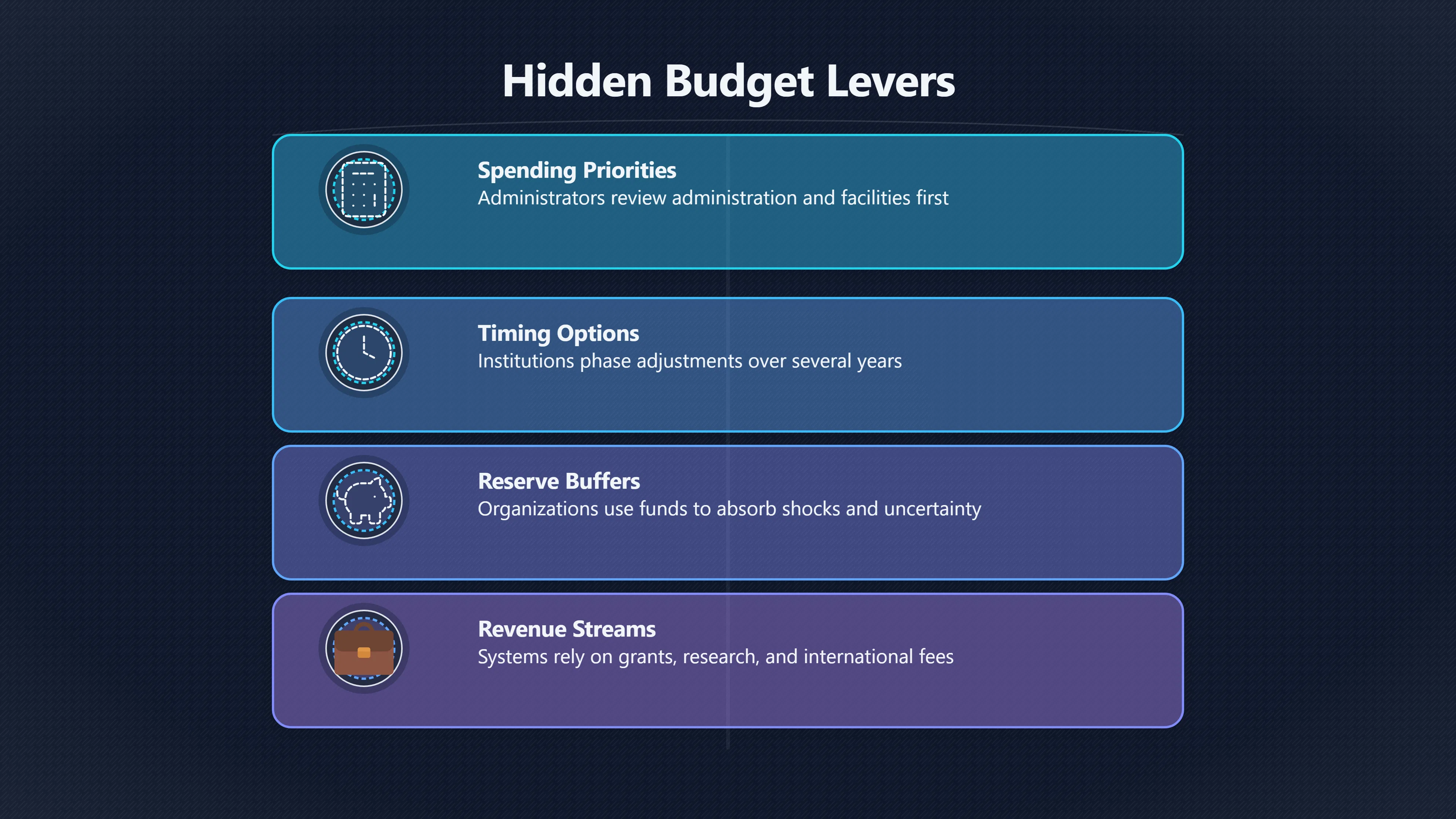
Spending Priorities
A budget is not a single number. It is a collection of priorities. When administrators claim that tuition must rise, critics often ask which expenditures were reviewed first and whether all categories received equal scrutiny.
Different institutions may make different choices regarding administration, facilities, technology investments, marketing, capital projects, or programme portfolios. Alternative budgeting frameworks, including zero-based and activity-based approaches, exist precisely because organisations can allocate resources in different ways.[Hanover Research]hanoverresearch.comHanover Research6 Alternative Budget Models for Colleges and UniversitiesNovember 25, 2025 — 25 Nov 2025 — Carefully weigh these higher education budget models to promote both the financial and academic wellnes…
Timing and Phasing
Another hidden lever is timing.
The public debate may imply that a full increase must happen immediately. Yet institutions sometimes have options to phase adjustments over several years, pair increases with financial aid expansions, or introduce temporary measures while longer-term reforms are implemented.
Once timing becomes part of the discussion, the simple either-or structure begins to break down.
Reserves and Financial Buffers
Organisations frequently maintain reserves to absorb shocks and uncertainty. Whether reserves should be used, and to what extent, is a legitimate policy question.
A university may reasonably argue that reserves cannot permanently solve a structural deficit. Nevertheless, the existence of reserves can create additional options such as gradual transitions, targeted investments, or delayed increases. The presence of these possibilities weakens claims that only an immediate tuition rise can prevent institutional failure.

Revenue Diversification
Higher education systems often rely on multiple income streams, including government grants, research funding, philanthropy, commercial partnerships, housing income, and international student fees.
Recent analyses of higher education finance have highlighted both the benefits and risks of dependence on particular revenue sources, especially international enrolment. The broader point is that revenue strategy itself is a policy choice. A debate framed solely around tuition can obscure other revenue considerations.[House of Commons Library]commonslibrary.parliament.ukcbp 10037House of Commons LibraryHigher education finances and funding in England6 Jun 2025 — This briefing covers how higher education is funded…
How Bundled Decisions Change the Argument
False dilemmas frequently arise because several decisions are bundled together and presented as one.
Imagine a claim:
Without a 10% tuition increase, we will have to eliminate academic programmes.
This statement appears to compare only two outcomes. Yet it may actually bundle together many assumptions:
- Existing spending priorities remain unchanged.
- Current staffing structures remain unchanged.
- Capital projects continue as planned.
- Reserve policies remain unchanged.
- Alternative revenue sources are unavailable.
- No phased implementation is possible.
If any of those assumptions can be reconsidered, the apparent dilemma becomes a broader policy discussion.
The debate then shifts from “tuition increase versus collapse” to questions such as:
- Which combination of measures is least harmful?
- Which costs should be reduced first?
- How much burden should fall on current students?
- What risks justify using reserves?
- Which reforms are temporary and which are structural?
Those questions are harder to communicate in a slogan, but they are usually closer to the real decision being made.
When the Dilemma Is Not Entirely False
Not every tuition debate involves a fallacy.
There are circumstances in which options genuinely narrow. An institution facing severe liquidity problems, legal obligations, declining enrolment, and limited reserves may have very few practical choices remaining. Financial sustainability concerns documented across parts of the higher education sector are real, and some institutions operate under substantial constraints. House of Commons Library[Institute for Fiscal Studies]ifs.org.ukInstitute for Fiscal StudiesHigher education finances: how have they fared, and what…by K Ogden · Cited by 13 — The next government fa…
The crucial distinction is evidence. A legitimate argument demonstrates why alternative measures are insufficient, exhausted, or disproportionately damaging. A false dilemma merely assumes this without showing it.
The question is not whether a tuition increase can ever be justified. The question is whether the argument has earned the right to present that increase as the only viable path.
Spotting the Missing Middle
When encountering claims that students must pay more or institutions will fail, several questions help reveal whether a false dilemma is at work:
- What alternative cost-saving measures were evaluated?
- Which spending categories are protected, and why?
- Can changes be phased rather than imposed immediately?
- What role do reserves or contingency funds play?
- Are there alternative revenue sources under consideration?
- Have multiple combinations of measures been compared publicly?
These questions do not automatically refute the proposal. They expand the choice set.
That expansion is the central lesson of false dilemmas in tuition and budget debates. Financial realities may be unavoidable, but the route through them is rarely a single dramatic choice between paying more and collapse. Most budget decisions involve a series of implementation choices, and recognising those hidden choices is often the difference between accepting a forced narrative and evaluating the full range of policy options.

eBay marketplace picks
Marketplace Samples
Example marketplace items related to this page. Use the search link to explore similar finds on eBay.






Endnotes
1.
Source: commonslibrary.parliament.uk
Title: cbp 10037
Link:https://commonslibrary.parliament.uk/research-briefings/cbp-10037/
Source snippet
House of Commons LibraryHigher education finances and funding in England6 Jun 2025 — This briefing covers how higher education is funded...
2.
Source: ifs.org.uk
Link:https://ifs.org.uk/publications/higher-education-finances-how-have-they-fared-and-what-options-will-incoming
Source snippet
Institute for Fiscal StudiesHigher education finances: how have they fared, and what...by K Ogden · Cited by 13 — The next government fa...
3.
Source: bipartisanpolicy.org
Title: state funding and college costs reviewing the evidence
Link:https://bipartisanpolicy.org/explainer/state-funding-and-college-costs-reviewing-the-evidence/
Source snippet
Bipartisan Policy CenterState Funding and College Costs: Reviewing the Evidence16 Dec 2024 — When confronted with reduced state funding...
4.
Source: economicsobservatory.com
Title: uk higher education finance whats the problem and what can be done
Link:https://www.economicsobservatory.com/uk-higher-education-finance-whats-the-problem-and-what-can-be-done
Source snippet
UK higher education finance: what's the problem and what...29 Oct 2024 — England's once world-leading higher education system has become...
5.
Source: hanoverresearch.com
Title: Hanover Research6 Alternative Budget Models for Colleges and Universities
Link:https://www.hanoverresearch.com/insights-blog/higher-education/6-alternative-budget-models-for-colleges-and-universities/
Source snippet
November 25, 2025 — 25 Nov 2025 — Carefully weigh these higher education budget models to promote both the financial and academic wellnes...
Published: November 25, 2025
6.
Source: Wikipedia
Link:https://en.wikipedia.org/wiki/Higher
Source snippet
HigherHigher may refer to: Contents. 1 Music. 1.1 Albums; 1.2 Songs. 2 Other uses; 3 See also. Music. edit · The Higher, a 2002–2012 A...
7.
Source: dictionary.cambridge.org
Link:https://dictionary.cambridge.org/dictionary/english/higher
Source snippet
English meaning - Cambridge DictionaryHIGHER definition: 1. comparative of high 2. used to refer to an advanced level of education: 3...
Additional References
8.
Source: en.wiktionary.org
Link:https://en.wiktionary.org/wiki/higher
Source snippet
1-syllable words · English terms with audio pronunciation · English terms with homophones · Rhymes:English/aɪə(ɹ) · English non-lemma for...
9.
Source: timeshighereducation.com
Title: further teaching grant cuts would undermine tuition fee rise
Link:https://www.timeshighereducation.com/news/further-teaching-grant-cuts-would-undermine-tuition-fee-rise
Source snippet
Further teaching grant cuts 'would undermine tuition fee rise'12 May 2026 — Universities have warned the government against further reduc...
Published: May 2026
10.
Source: sceptical.scot
Title: lets debate different models for student fees and grants
Link:https://sceptical.scot/2017/05/lets-debate-different-models-for-student-fees-and-grants/
Source snippet
Let's debate different models for student fees and grants15 May 2017 — It seems common to assume that we're faced with a straight choice...
Published: May 2017
11.
Source: hepi.ac.uk
Title: HEPIwhy universities cannot survive on goodwill alone
Link:https://www.hepi.ac.uk/2026/01/24/weekend-reading-death-by-a-thousand-cuts-why-universities-cannot-survive-on-goodwill-alone/
Source snippet
why universities cannot survive on goodwill alone - HEPI24 Jan 2026 — A key cause of underfunding is the historical stagnation of tuition...
12.
Source: researchbriefings.files.parliament.uk
Link:https://researchbriefings.files.parliament.uk/documents/CBP-10155/CBP-10155.pdf
Source snippet
fees in England: History, debates, and international...4 Nov 2024 — Universities UK argued cuts to teaching grants, the 2012 tuition fee...
13.
Source: hepi.ac.uk
Title: HEPI’Overstretched and under-resourced’?
Link:https://www.hepi.ac.uk/2025/05/03/overstretched-and-under-resourced-uk-higher-education-on-the-cusp-of-the-spending-review/
Source snippet
UK higher education on...3 May 2025 — According to Mark Corver of DataHE, the maximum full-time undergraduate tuition fee, which was rai...
Published: May 2025
14.
Source: badgerherald.com
Link:https://badgerherald.com/features/2020/09/08/the-tuition-dilemma-students-universities-grapple-with-budget-cuts-increased-tuition/
Source snippet
The Tuition Dilemma: students, universities grapple with...8 Sept 2020 — The Tuition Dilemma: students, universities grapple with budget...
15.
Source: facebook.com
Link:https://www.facebook.com/heraldscotland/posts/the-question-isnt-whether-international-tuition-is-being-used-to-cover-gaps-in-u/936303161850342/
Source snippet
ps in university budgets. The question is how long it can...
16.
Source: universitiesuk.ac.uk
Title: financial impact government policy
Link:https://www.universitiesuk.ac.uk/latest/insights-and-analysis/financial-impact-government-policy
Source snippet
The financial impact of government policy decisions on...25 Feb 2026 — Our analysis shows that government policy decisions lead to an es...
17.
Source: arch.astate.edu
Title: As a result, budget cuts loom
Link:https://arch.astate.edu/cgi/viewcontent.cgi?article=1008&[context
Source snippet
Trends in Higher Education that Have Significant...by WR Stripling · 2025 · Cited by 2 — Reducing financial resources has left many univ...
Topic Tree