Within Wet Pavement
When Bad Logic Still Feels Sensible
Some effect-to-cause guesses are useful in real life, but they are not deductive proof unless other causes are ruled out.
On this page
- Why common causes make the leap tempting
- Deductive proof versus practical inference
- When context can make a guess reasonable
Page outline Jump by section
Introduction
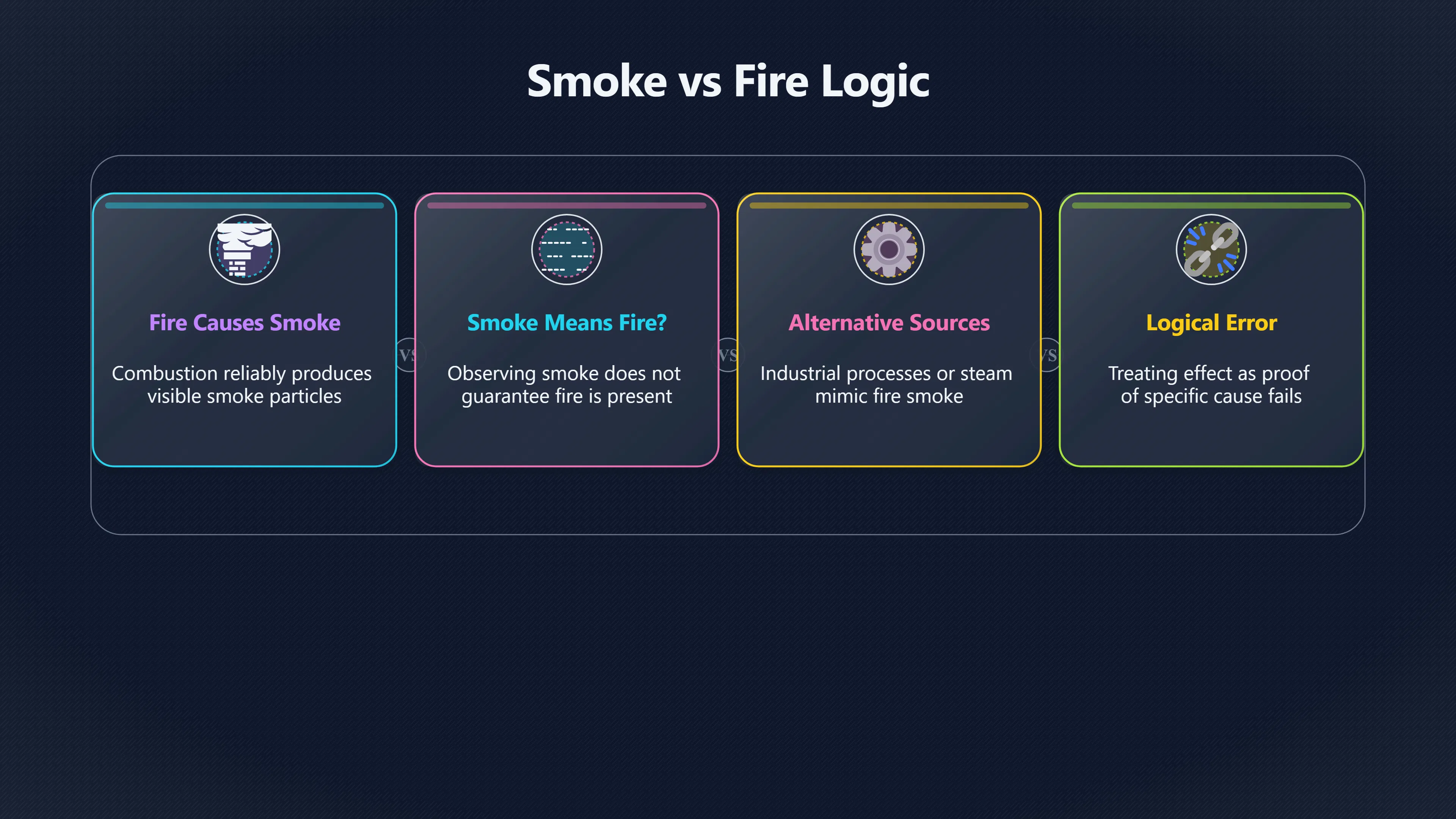
The classic smoke-and-fire example shows why affirming the consequent is both a logical mistake and an understandable human habit. If we know that fire produces smoke, it can seem natural to conclude that smoke proves the existence of fire. Yet the conclusion does not follow with deductive certainty. Smoke may come from a machine, a controlled industrial process, steam mistaken for smoke, or some other source. The effect is real, but the cause has not been uniquely established. This tension explains why affirming the consequent remains one of the most persistent logical fallacies: it often resembles a sensible guess even when it falls short of proof.[Wikipedia]WikipediaAffirming the consequentAffirming the consequent

Why Common Causes Make the Leap Tempting
People routinely reason backwards from observations to explanations. Historically, smoke has been one of the most reliable signs of fire, so the association becomes deeply ingrained. In many practical situations, treating smoke as evidence of fire is not only reasonable but useful. A person who notices smoke on a hillside does not wait for deductive certainty before investigating or raising an alarm.
The problem is that the original conditional statement is one-directional. “If there is fire, there is smoke” does not automatically mean “if there is smoke, there is fire.” Logic distinguishes between a condition that is sufficient and one that is necessary. Fire may be sufficient to explain smoke, but smoke does not guarantee fire because other explanations may exist. This is the same structural error seen in the wet-pavement example, where rain is one possible cause among several.[Philosophy A Level]philosophyalevel.comif p then q modus ponens modus tollensIf A then B: Modus Ponens, Modus Tollens, Affirming the…28 May 2023 — Affirming the consequent is a logical fallacy that occurs when s…
The appeal of the smoke-and-fire inference comes from experience. Many everyday relationships appear to work in both directions. If a person sees a kettle boiling, there is usually heat involved; if they see smoke, there is often combustion somewhere. Because these associations are frequently successful, people can begin treating a common explanation as though it were the only possible explanation.[stanford]plato.stanford.eduEncyclopedia of Philosophy FallaciesThe fallacy of secundum… Encyclopedia of Philosophy
Deductive Proof Versus Practical Inference
The smoke-and-fire example highlights an important distinction between two different goals of reasoning.
Deductive reasoning asks what must be true
In deductive logic, a conclusion is valid only if it cannot be false while the premises remain true. Under this standard, observing smoke does not prove fire. The existence of alternative causes is enough to defeat the deduction. Even if fire is the most common explanation, logical validity requires certainty, not likelihood.[Wikipedia]WikipediaList of fallaciesList of fallaciesAffirming the consequent – the antecedent in an indicative conditional is claimed to be true because the consequent i…
A structurally identical argument makes the weakness easier to see:
- If a person lives in Edinburgh, they live in Scotland.
- This person lives in Scotland.
- Therefore, this person lives in Edinburgh.
The conclusion might be correct, but it does not logically follow because many other locations satisfy the observed condition. The smoke-and-fire argument has the same form.[Wikipedia]WikipediaAffirming the consequentAffirming the consequent

Practical reasoning asks what is most likely
Outside formal logic, people often seek the best explanation rather than certainty. Philosophers and researchers commonly describe this process as abductive reasoning or inference to the best explanation. Instead of asking whether a conclusion must be true, it asks which explanation best accounts for the evidence available.[arXiv]arxiv.orgarXiv Abductive Commonsense ReasoningAbductive Commonsense ReasoningAugust 15, 2019…
Under this practical standard, smoke can legitimately increase confidence that fire is present. The observation does not prove the cause, but it may make that cause more probable. This helps explain why the fallacy can feel persuasive. The conclusion is often plausible even though the argument form remains deductively invalid.[stanford]plato.stanford.eduEncyclopedia of Philosophy FallaciesThe fallacy of secundum… Encyclopedia of Philosophy

When Context Can Make a Guess Reasonable
The strength of a smoke-to-fire inference depends heavily on context.
Imagine three situations:
- Smoke rising from a remote forest during a dry summer.
- Smoke emerging from a theatre stage during a performance.
- Smoke appearing from a factory chimney designed to release emissions.
In all three cases, the observation is similar, but the likelihood of fire differs dramatically. Background knowledge changes the quality of the inference. The same logical form can therefore range from highly informative to highly misleading depending on what else is known.[stanford]plato.stanford.eduEncyclopedia of Philosophy FallaciesThe fallacy of secundum… Encyclopedia of Philosophy
This is why experienced investigators, scientists, doctors, and engineers rarely stop at the first explanation. They look for competing causes and additional evidence. Smoke may prompt a hypothesis of fire, but confirmation requires further observations. The initial inference serves as a starting point rather than a final proof.[diales.com]diales.comThe fallacy of affirming the consequentThe 'affirming the consequent' fallacy can occur within expert testimony when a subject matter exp…
In historical terms, this reflects a broader difference between formal logic and everyday reasoning. Formal logic evaluates whether conclusions necessarily follow from premises. Real-world decision-making often proceeds under uncertainty, where waiting for certainty may be impossible or costly. The challenge is recognising when a useful clue has been mistaken for conclusive evidence.[stanford]plato.stanford.eduEncyclopedia of Philosophy FallaciesThe fallacy of secundum… Encyclopedia of Philosophy
The Lesson of Smoke and Fire
The smoke-and-fire example survives in discussions of logical fallacies because it captures a genuine tension in human thinking. People are often rewarded for identifying likely causes from visible effects. That habit is practical, efficient, and frequently correct. Yet it can also encourage the mistaken belief that a likely explanation is a proven one.
Affirming the consequent occurs when the leap from effect to cause is treated as certainty rather than possibility. Smoke can be evidence for fire. It is not, by itself, proof of fire. Recognising that distinction helps separate deductive validity from reasonable suspicion and explains why bad logic can sometimes feel perfectly sensible.[Stanford Encyclopedia of Philosophy]plato.stanford.eduEncyclopedia of Philosophy FallaciesThe fallacy of secundum…
Amazon book picks
Further Reading
Books and field guides related to When Bad Logic Still Feels Sensible. Use these as the next step if you want deeper reading beyond the article.
Thinking, Fast and Slow
Explains why plausible guesses feel stronger than they logically are.
How to Win Every Argument
Provides the logical framework behind affirming the consequent.
eBay marketplace picks
Marketplace Samples
Example marketplace items related to this page. Use the search link to explore similar finds on eBay.



Endnotes
1.
Source: Wikipedia
Title: Affirming the consequent
Link:https://en.wikipedia.org/wiki/Affirming_the_consequent
2.
Source: plato.stanford.edu
Title: Encyclopedia of Philosophy Fallacies
Link:https://plato.stanford.edu/entries/fallacies/
Source snippet
The fallacy of secundum...
3.
Source: plato.stanford.edu
Link:https://plato.stanford.edu/entries/argument/
Source snippet
Stanford Encyclopedia of PhilosophyArgument and Argumentationby C Dutilh Novaes · 2021 · Cited by 105 — For example, deductively invalid...
4.
Source: arxiv.org
Title: arXiv Abductive Commonsense Reasoning
Link:https://arxiv.org/abs/1908.05739
Source snippet
Abductive Commonsense ReasoningAugust 15, 2019...
Published: August 15, 2019
5.
Source: arxiv.org
Link:https://arxiv.org/abs/1703.03254
6.
Source: plato.stanford.edu
Title: Encyclopedia of Philosophy [Informal Logic]({{ ‘informal-logic/’ | relative_url }})
Link:https://plato.stanford.edu/entries/logic-informal/
Source snippet
Stanford Encyclopedia of PhilosophyInformal Logic - Stanford Encyclopedia of Philosophyby L Groarke · 1996 · Cited by 97 — Informal logic...
7.
Source: diales.com
Link:https://www.diales.com/nl/news/the-fallacy-of-affirming-the-consequent
Source snippet
The fallacy of affirming the consequentThe 'affirming the consequent' fallacy can occur within expert testimony when a subject matter exp...
8.
Source: plato.stanford.edu
Title: logic conditionals
Link:https://plato.stanford.edu/entries/logic-conditionals/
Source snippet
We review the problems of a two-valued analysis and examine logics based on...
9.
Source: plato.stanford.edu
Title: logic classical
Link:https://plato.stanford.edu/entries/logic-classical/
Source snippet
Logic - Stanford Encyclopedia of Philosophyby S Shapiro · 2000 · Cited by 195 — A logic consists of a formal or informal language togethe...
10.
Source: plato.stanford.edu
Link:https://plato.stanford.edu/entries/conditionals/
Source snippet
Stanford Encyclopedia of Philosophyby D Edgington · 2001 · Cited by 148 — A theory of conditionals aims to give an account of the conditi...
11.
Source: Wikipedia
Title: List of fallacies
Link:https://en.wikipedia.org/wiki/List_of_fallacies
Source snippet
List of fallaciesAffirming the consequent – the antecedent in an indicative conditional is claimed to be true because the consequent i...
12.
Source: youtube.com
Title: Affirming the Consequent: A Formal Fallacy
Link:https://www.youtube.com/watch?v=85QJZdbgEoc
Source snippet
Logical Fallacies - Affirming the consequent...
13.
Source: youtube.com
Title: Logical Fallacies
Link:https://www.youtube.com/watch?v=m9hjWTe33Wk
Source snippet
Affirming the Consequent...
14.
Source: youtube.com
Title: Affirming the Consequent
Link:https://www.youtube.com/watch?v=_WDDVz-EWFw
15.
Source: philosophyalevel.com
Title: if p then q modus ponens modus tollens
Link:https://philosophyalevel.com/posts/if-p-then-q-modus-ponens-modus-tollens/
Source snippet
If A then B: Modus Ponens, Modus Tollens, Affirming the...28 May 2023 — Affirming the consequent is a logical fallacy that occurs when s...
Published: May 2023
16.
Source: stat.berkeley.edu
Link:https://www.stat.berkeley.edu/~stark/SticiGui/Text/reasoning.htm
17.
Source: iep.utm.edu
Link:https://iep.utm.edu/fallacy/
Source snippet
Hominem, Appeal to Pity, and Affirming the Consequent are all fallacies of [relevance]({{ 'relevance/' | relative_url }}). (2) Accent, Amphiboly and Equivocation are examples...
18.
Source: fallacyfiles.org
Title: Affirming the Consequent
Link:https://www.fallacyfiles.org/afthecon.html
Source snippet
Logical Fallacy22 Jun 2023 — To affirm the consequent of a conditional statement is, of course, to assert or claim that the consequent is...
Additional References
19.
Source: logicallyfallacious.com
Link:https://www.logicallyfallacious.com/logicalfallacies/Affirming-the-Consequent
Source snippet
Affirming the ConsequentDescription: An error in formal logic where if the consequent is said to be true, the antecedent is said to be tr...
20.
Source: scribd.com
Link:https://www.scribd.com/document/857970393/Module-Finals
Source snippet
Logical Fallacies in Argumentation | PDF | Logic | InferenceThe document discusses the logical relations between propositions using the S...
21.
Source: reddit.com
Link:https://www.reddit.com/r/philosophy/comments/3wxz64/logical_fallacy_affirming_the_consequent/
Source snippet
Logical Fallacy: affirming the consequent: r/philosophyMy thesis is that "'affirming the consequent' reasoning isn't fallacious when one...
22.
Source: study.com
Link:https://study.com/academy/lesson/affirming-the-consequent-fallacy-definition-examples.html
Source snippet
Affirming the Consequent Overview, Fallacy & ExamplesThe fallacy of affirming the consequent is a formal fallacy in which a reasoner make...
23.
Source: facebook.com
Link:https://www.facebook.com/groups/1807497022844338/posts/2578496059077760/
Source snippet
rains, the ground is wet. The ground is wet. Therefore...Read more...
24.
Source: khanacademy.org
Link:https://www.khanacademy.org/partner-content/wi-phi/wiphi-critical-thinking/wiphi-fallacies/v/affirming-the-consequent
Source snippet
onditional statement from the truth of the conditional...
25.
Source: yandoo.wordpress.com
Title: where there is smoke there is fire
Link:https://yandoo.wordpress.com/2025/01/09/where-there-is-smoke-there-is-fire/
Source snippet
wordpress.com“Where there is smoke there is fire” | The Logical Place9 Jan 2025 — The aphorism “Where there is smoke there is fire” sugge...
26.
Source: philosophy.stackexchange.com
Title: are if smoke then fire arguments deductive or inductive
Link:https://philosophy.stackexchange.com/questions/46118/are-if-smoke-then-fire-arguments-deductive-or-inductive
Source snippet
inductive reasoning: I'm told that "John ate a strange plant in the forest and got...
27.
Source: youtube.com
Title: Deductive Fallacies
Link:https://www.youtube.com/watch?v=LV1vkT6QrlE
Source snippet
Logic 101 (#48): Affirming the Consequent...
28.
Source: digitalcommons.odu.edu
Link:https://digitalcommons.odu.edu/cgi/viewcontent.cgi?article=1046&context=philosophy_fac_pubs
Source snippet
Antecedents and Affirming Consequentsby D Godden · 2015 · Cited by 14 — Abstract: Recent work on condi- tional reasoning argues that deny...
Topic Tree