Within Formal Logic
The Fallacy That Rules Out Too Much
The absence of one sufficient condition does not prove that the expected result cannot happen another way.
On this page
- Why one way conditionals are not guarantees
- Server crashes, wet pavements, and alternate explanations
- Checklist for spotting premature dismissal
Page outline Jump by section
Introduction
Denying the antecedent is a formal fallacy that occurs when someone assumes that because one condition is absent, the outcome must also be absent. Its basic form is simple:
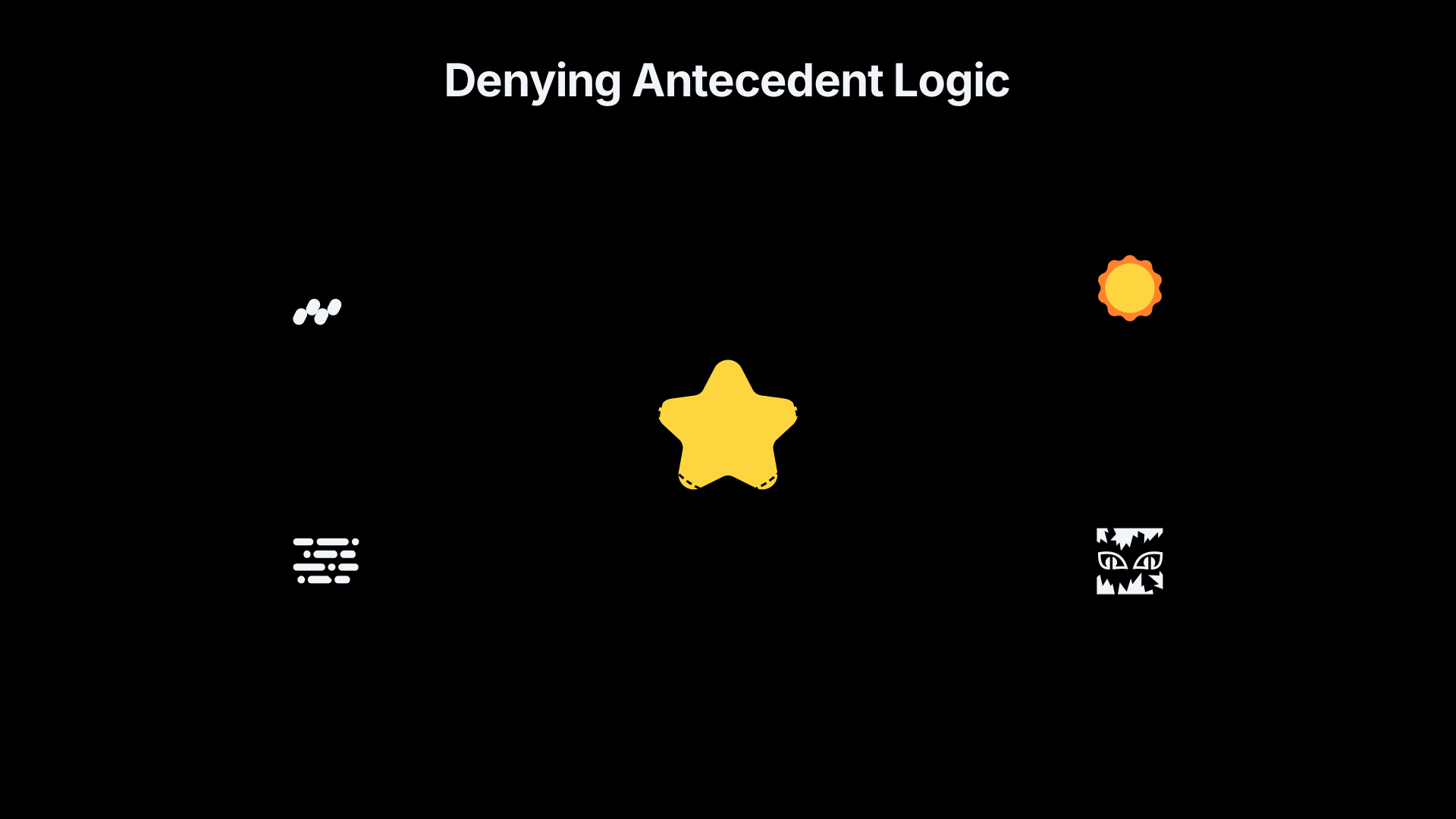 If P, then Q.
Not P.
Therefore, not Q.
The reasoning fails because the original statement identifies a sufficient condition, not necessarily the only way the outcome can occur. In practice, the fallacy often appears as a failure to consider other causes, routes, or explanations. A person hears one possible explanation for an event, rules it out, and then wrongly concludes that the event itself could not have happened. Logic texts consistently classify this pattern as an invalid argument form because the conclusion does not follow from the premises.[Internet Encyclopedia of Philosophy]iep.utm.eduInternet Encyclopedia of PhilosophyFallaciesYou are using this fallacy if you deny the antecedent of a conditional and then suppose that… OpenStax This mistake matters far beyond classroom logic. It appears in troubleshooting[openstax.org]openstax.orgOpen Stax5.4 Types of Inferences5.4 Types of Inferences - Introduction to Philosophy15 Jun 2022 — Here are two common invalid inference forms: Affirming the Consequent…, scientific reasoning, policy debates, legal arguments, and everyday decision-making whenever one possible cause is treated as the only possible cause.
Why One-Way Conditionals Are Not Guarantees
The core problem is misunderstanding what an “if–then” statement actually says.
When we say, “If it rains, the pavement will be wet,” rain is presented as a sufficient condition for wet pavement. The statement does not say that rain is the only possible cause of wet pavement. A sprinkler system, a burst water main, street cleaning, or melting ice could produce the same result.
The fallacy arises when someone reasons:
If it rains, the pavement will be wet.
It did not rain.
Therefore, the pavement is not wet.
The conclusion excludes possibilities that were never ruled out by the premises. Logic references describe denying the antecedent precisely as the mistake of treating the absence of the antecedent as sufficient reason to reject the consequent.[Internet Encyclopedia of Philosophy]iep.utm.eduInternet Encyclopedia of PhilosophyFallaciesYou are using this fallacy if you deny the antecedent of a conditional and then suppose that…[Logically Fallacious]logicallyfallacious.comDenying the AntecedentThe arguer has committed a formal fallacy, and the argument is invalid because the truth of the premises does not g…
A useful way to think about the issue is the distinction between sufficient and necessary conditions. A sufficient condition guarantees an outcome when present, but the outcome may still occur through other mechanisms. Only a necessary condition would allow us to infer that the outcome cannot occur when the condition is absent.[Wikipedia]WikipediaDenying the antecedentDenying the antecedent
Why the Pattern Feels Persuasive
The fallacy often sounds reasonable because people silently assume additional premises that are never stated.
Consider:
If the server loses power, the website will go offline.
The server did not lose power.
Therefore, the website did not go offline.
The conclusion seems plausible only if we quietly add another claim:
The server losing power is the only way the website can go offline.
But that extra premise was never provided. Software bugs, network failures, configuration errors, or cyberattacks could produce the same result.
In many real-world discussions, the hidden assumption of exclusivity is what makes denying the antecedent persuasive. The speaker presents one route to an outcome and implicitly treats it as the only route.
Server Crashes, Wet Pavements, and Alternate Explanations
The easiest way to spot the fallacy is to ask whether the outcome could arise through another cause.
Server outages
Suppose a technician says:
If the database crashes, customers cannot log in.
The database did not crash.
Therefore, customers can log in.
This reasoning ignores alternative failure points. Authentication services, networking equipment, application code, and third-party providers can all prevent login access. The absence of one cause does not establish the absence of the problem.
The error is not merely theoretical. Troubleshooting guides in engineering often emphasise investigating multiple failure modes precisely because complex systems rarely have a single point of causation.
Wet pavements
The wet-pavement example remains popular because it exposes the structure clearly:
If it rains, the pavement becomes wet.
It did not rain.
Therefore, the pavement is not wet.
The reasoning collapses the moment another explanation is considered. The fallacy is essentially a refusal to keep the causal field open long enough to examine alternatives.
Medical reasoning
Medical diagnosis provides another common setting.
If a patient has influenza, they may develop a fever.
The patient does not have influenza.
Therefore, the patient cannot have a fever.
The conclusion is obviously unsafe because fever has many possible causes. Sound diagnostic reasoning requires considering alternative explanations rather than eliminating a symptom simply because one suspected cause has been ruled out.
Workplace decisions
Managers sometimes make similar mistakes:
If sales are declining because of price increases, lowering prices will help.
Prices were not increased.
Therefore, pricing cannot explain declining sales.
Even if prices did not recently increase, pricing relative to competitors, changing customer expectations, or perceived value may still affect sales performance. Excluding one route does not eliminate all related possibilities.
The Mechanism: Missing Other Causes
The phrase “missing other causes” captures the practical heart of denying the antecedent.[Wikipedia]WikipediaDenying the antecedentDenying the antecedent
Formally, the fallacy concerns conditional logic. Operationally, it is often a failure of causal imagination. Someone identifies one pathway to an outcome and treats it as exhaustive.
The reasoning process typically unfolds like this:
- A known cause is identified.
- That cause is shown to be absent.
- The outcome is assumed impossible.
- Alternative causes are never examined.
This pattern creates blind spots because the argument prematurely closes investigation.
In everyday reasoning, people often prefer a single explanation because it reduces uncertainty. Yet many real systems—technical, social, biological, and economic—are characterised by multiple interacting causes. A conclusion becomes unreliable when it depends on ignoring those alternatives.
Research in reasoning and logic education notes that people frequently draw invalid conditional inferences in ordinary thinking even though those inferences are not deductively valid. Human reasoning often fills gaps with background assumptions that are not explicitly stated.[arXiv]arxiv.orgarXiv Human Conditional Reasoning in Answer Set ProgrammingHuman Conditional Reasoning in Answer Set ProgrammingNovember 8, 2023…
Denying the Antecedent Versus Valid Reasoning
The fallacy is frequently confused with a valid argument form called modus tollens.[Wikipedia]WikipediaModus tollensModus tollens
Valid reasoning:
If P, then Q.
Not Q.
Therefore, not P.
Example:[quillbot.com]quillbot.comdenying the antecedentExamples & Definition22 Jul 2024 — Denying the antecedent is the fallacy of assuming that if the initial condition (P) is not met, the ex…
If the server is online, users can reach the website.
Users cannot reach the website.
Therefore, the server is not online.
Whether the premises are factually true is a separate question, but the logical structure is valid. Modus tollens works because it denies the consequent, not the antecedent. Logic texts routinely contrast this valid form with denying the antecedent.[Wikipedia]WikipediaNecessity and sufficiencyMay 1, 2026 — Example 1: "John is a king" implies that John is male. · Example 2: A number's being divisible by 4 is sufficient (but not…
By contrast:
If the server is online, users can reach the website.
The server is not online.
Therefore, users cannot reach the website.
This second argument may or may not be true in practice, but the conclusion is not guaranteed by the premises. Some other system configuration might still permit access.
The difference seems small, yet it separates deductively valid reasoning from an invalid inference.

Checklist for Spotting Premature Dismissal
When evaluating an argument, the following questions help expose denying the antecedent and related “missing other causes” errors:
- Does the argument move from “not P” directly to “not Q”?
- Was P presented as merely one way for Q to occur, or as the only way?
- Are there plausible alternative causes that could still produce Q?
- Has the speaker explicitly established that no other routes exist?
- Would the conclusion fail if even one alternative explanation were possible?
A practical shortcut is to ask:
“What else could cause the same result?”
If reasonable alternatives exist and have not been ruled out, the argument is probably excluding too much.
Why This Fallacy Matters
Denying the antecedent is more than a technical mistake in symbolic logic. It encourages premature certainty. Once one explanation has been eliminated, people may wrongly believe the issue itself has been resolved.
In investigations, this can stop useful inquiry. In troubleshooting, it can delay finding the real fault. In public debates, it can create false either-or choices. The common thread is the same: one sufficient condition is mistaken for the only possible path.
The safest corrective is to remember that an “if–then” statement usually identifies a route to an outcome, not the entire map. When one route is blocked, the outcome may still arrive by another road.[Internet Encyclopedia of Philosophy]iep.utm.eduInternet Encyclopedia of PhilosophyFallaciesYou are using this fallacy if you deny the antecedent of a conditional and then suppose that…
Amazon book picks
Further Reading
Books and field guides related to The Fallacy That Rules Out Too Much. Use these as the next step if you want deeper reading beyond the article.
A Concise Introduction to Logic
Directly covers denying the antecedent and conditional logic.
Attacking Faulty Reasoning
Uses practical examples of alternative causes and explanations.
eBay marketplace picks
Marketplace Samples
Example marketplace items related to this page. Use the search link to explore similar finds on eBay.



Endnotes
1.
Source: openstax.org
Title: Open Stax5.4 Types of Inferences
Link:https://openstax.org/books/introduction-philosophy/pages/5-4-types-of-inferences
Source snippet
5.4 Types of Inferences - Introduction to Philosophy15 Jun 2022 — Here are two common invalid inference forms: Affirming the Consequent...
2.
Source: Wikipedia
Title: Denying the antecedent
Link:https://en.wikipedia.org/wiki/Denying_the_antecedent
3.
Source: Wikipedia
Title: Necessity and sufficiency
Link:https://en.wikipedia.org/wiki/Necessity_and_sufficiency
Source snippet
May 1, 2026 — Example 1: "John is a king" implies that John is male. · Example 2: A number's being divisible by 4 is sufficient (but not...
Published: May 1, 2026
4.
Source: Wikipedia
Title: Modus tollens
Link:https://en.wikipedia.org/wiki/Modus_tollens
5.
Source: arxiv.org
Title: arXiv Human Conditional Reasoning in Answer Set Programming
Link:https://arxiv.org/abs/2311.04412
Source snippet
Human Conditional Reasoning in Answer Set ProgrammingNovember 8, 2023...
Published: November 8, 2023
6.
Source: openstax.org
Title: 7.4 Critical Thinking
Link:https://openstax.org/books/college-success/pages/7-4-critical-thinking
Source snippet
College Success27 Mar 2020 — One component to keep in mind to guide your critical thinking is to determine the situation. What problem ar...
7.
Source: openstax.org
Title: 2.7 Logical Arguments
Link:https://openstax.org/books/contemporary-mathematics/pages/2-7-logical-arguments
Source snippet
Contemporary Mathematics22 Mar 2023 — The conditional statement can also be described as, “If antecedent, then consequent.”This is where...
8.
Source: openstax.org
Title: Ch. 2 Key Concepts
Link:https://openstax.org/books/contemporary-mathematics/pages/2-key-concepts
9.
Source: openstax.org
Title: 5.5 Informal Fallacies
Link:https://openstax.org/books/introduction-philosophy/pages/5-5-informal-fallacies
Source snippet
Introduction to Philosophy15 Jun 2022 — In fallacies of [relevance]({{ 'relevance/' | relative_url }}), the arguer presents evidence that is not relevant for logically establ...
10.
Source: openstax.org
Title: If Giacomo works with Faheem, then Faheem is not a software engineer.Read more
Link:https://openstax.org/books/contemporary-mathematics/pages/2-4-truth-tables-for-the-conditional-and-biconditional
11.
Source: openstax.org
Title: 2.5 Equivalent Statements
Link:https://openstax.org/books/contemporary-mathematics/pages/2-5-equivalent-statements
Source snippet
Contemporary MathematicsMar 22, 2023 — The inverse has the form, “if ~ p ~ p, then ~ q ~ q,” so the inverse is: "If Harry is not a wiza...
12.
Source: Wikipedia
Title: Affirming the consequent
Link:https://en.wikipedia.org/wiki/Affirming_the_consequent
Source snippet
Affirming the consequentA related fallacy is denying the antecedent. Two related valid forms of logical argument include modus tollens...
13.
Source: iep.utm.edu
Link:https://iep.utm.edu/fallacy/
Source snippet
Internet Encyclopedia of PhilosophyFallaciesYou are using this fallacy if you deny the antecedent of a conditional and then suppose that...
14.
Source: logicallyfallacious.com
Link:https://www.logicallyfallacious.com/logicalfallacies/Denying-the-Antecedent
Source snippet
Denying the AntecedentThe arguer has committed a formal fallacy, and the argument is invalid because the truth of the premises does not g...
15.
Source: quillbot.com
Title: denying the antecedent
Link:https://quillbot.com/blog/reasoning/denying-the-antecedent/
Source snippet
Examples & Definition22 Jul 2024 — Denying the antecedent is the fallacy of assuming that if the initial condition (P) is not met, the ex...
16.
Source: research.ed.ac.uk
Link:https://www.research.ed.ac.uk/files/28378747/Duarte_DAlmeida_MacDonald_2016_IL_denying_the_antecedent.pdf
Source snippet
the antecedent - Edinburgh Research Explorerby LD D'Almeida · 2016 · Cited by 3 — Abstract: In this paper we examine two challenges to th...
17.
Source: informallogic.ca
Link:https://informallogic.ca/index.php/informal_logic/article/view/4469/3777
Source snippet
Denying the Antecedent - Informal Logicby LD d’Almeida · 2016 · Cited by 3 — Abstract: In this paper we examine two challenges to the ort...
18.
Source: afterall.net
Link:https://afterall.net/illogic/non-sequitur/denying-the-antecedent/
Source snippet
Denying the Antecedent | Illogic at Afterall.netJan 1, 2026 — Any argument of the following form is invalid: (1) If A then B (2) Not A (3...
19.
Source: fiveable.me
Title: Denying the Antecedent
Link:https://fiveable.me/formal-logic-ii/key-terms/denying-the-antecedent
Source snippet
[Formal Logic]({{ 'formal-logic/' | relative_url }}) IIDenying the antecedent is a formal fallacy that occurs when one assumes that if the antecedent of a conditional statement...
Additional References
20.
Source: britannica.com
Link:https://www.britannica.com/topic/denial-of-the-antecedent
Source snippet
Denial of the antecedent | logicAmong the best known are denying the antecedent (“If A, then B; not-A; therefore, not-B”) and affirming t...
21.
Source: homeworkforyou.com
Link:https://www.homeworkforyou.com/static_media/uploadedfiles/1733569814_39407__391..pdf
Source snippet
Denying The Antecedent FallacyIt is essential to know this fallacy to grasp the root of such wrong conclusions; misleading causal inferen...
22.
Source: philosophicalsociety.com
Link:https://www.philosophicalsociety.com/HTML/LogicalFallacies.html
Source snippet
Logical FallaciesA fallacy is an invalid form of argument, an instance of incorrect reasoning. Below is a list of common fallacies.Read more...
23.
Source: diales.com
Link:https://www.diales.com/fr/news/the-fallacy-of-affirming-the-consequent
Source snippet
The fallacy of affirming the consequentThe 'affirming the consequent' fallacy can occur within expert testimony when a subject matter exp...
24.
Source: oercollective.caul.edu.au
Link:https://oercollective.caul.edu.au/howtothinkcritically/chapter/basic-structural-fallacies/
Source snippet
structural fallacies – How to Think CriticallyThis section looks at three common structural fallacies: The fallacy of affirming the conse...
25.
Source: youtube.com
Link:https://www.youtube.com/watch?v=h83bzYAfgrM
Source snippet
Contrapositive of a Conditional StatementThe contrapositive of "p implies q" is "not q implies not p". It looks quite different, but in f...
26.
Source: study.com
Link:https://study.com/learn/lesson/denying-antecedent-fallacy-examples.html
27.
Source: reddit.com
Link:https://www.reddit.com/r/askphilosophy/comments/x8qa2z/i_do_not_understand_logic_and_arguments_modus/
Source snippet
ng the Consequent (invalid!): if P, then Q. Q. Therefore, P.Read more...
28.
Source: helpfulprofessor.com
Link:https://helpfulprofessor.com/denying-the-antecedent-fallacy-examples/
Source snippet
cy is understood as a logical error involving an if-then statement...
29.
Source: khanacademy.org
Link:https://www.khanacademy.org/partner-content/wi-phi/wiphi-critical-thinking/wiphi-fallacies/v/denying-the-antecedent
Source snippet
firming the consequent means asserting John will want to marry...
Topic Tree