Within Circularity
Can a Source Prove Its Own Reliability?
Media reliability claims become circular when accuracy is proved by trust and trust is proved by accuracy.
On this page
- The reliability accuracy loop
- What independent checks would add
- How circular trust claims mislead readers
Page outline Jump by section
Introduction
Can a news source prove its own reliability? Logically, no. A source may claim that it is accurate, impartial, or trustworthy, but those claims become circular if the only evidence offered is the source’s own record as described by itself. The reasoning loop looks simple: “This outlet is reliable because its reporting is accurate, and we know its reporting is accurate because the outlet is reliable.” The conclusion and the evidence end up supporting each other without any independent check. This is a specific form of circular reasoning, a fallacy in which an argument never leaves its own assumptions.
 In everyday media use, this matters because trust decisions often depend on whether evidence comes from outside the claim itself. A source may genuinely be reliable, but reliability is established through verification, transparency, correction records, independent scrutiny, and corroboration—not merely through self-assertion.[Reuters Agency]reutersagency.comReuters AgencyReuters Journalistic StandardsFollow the Trust Principles in all activities related to Reuters News · Hold accuracy sacrosa…[Thomson Reuters]thomsonreuters.comThe Trust PrinciplesThe Trust Principles imposed obligations on Reuters and its employees to act at all times with integrity, independenc…
The Reliability-Accuracy Loop
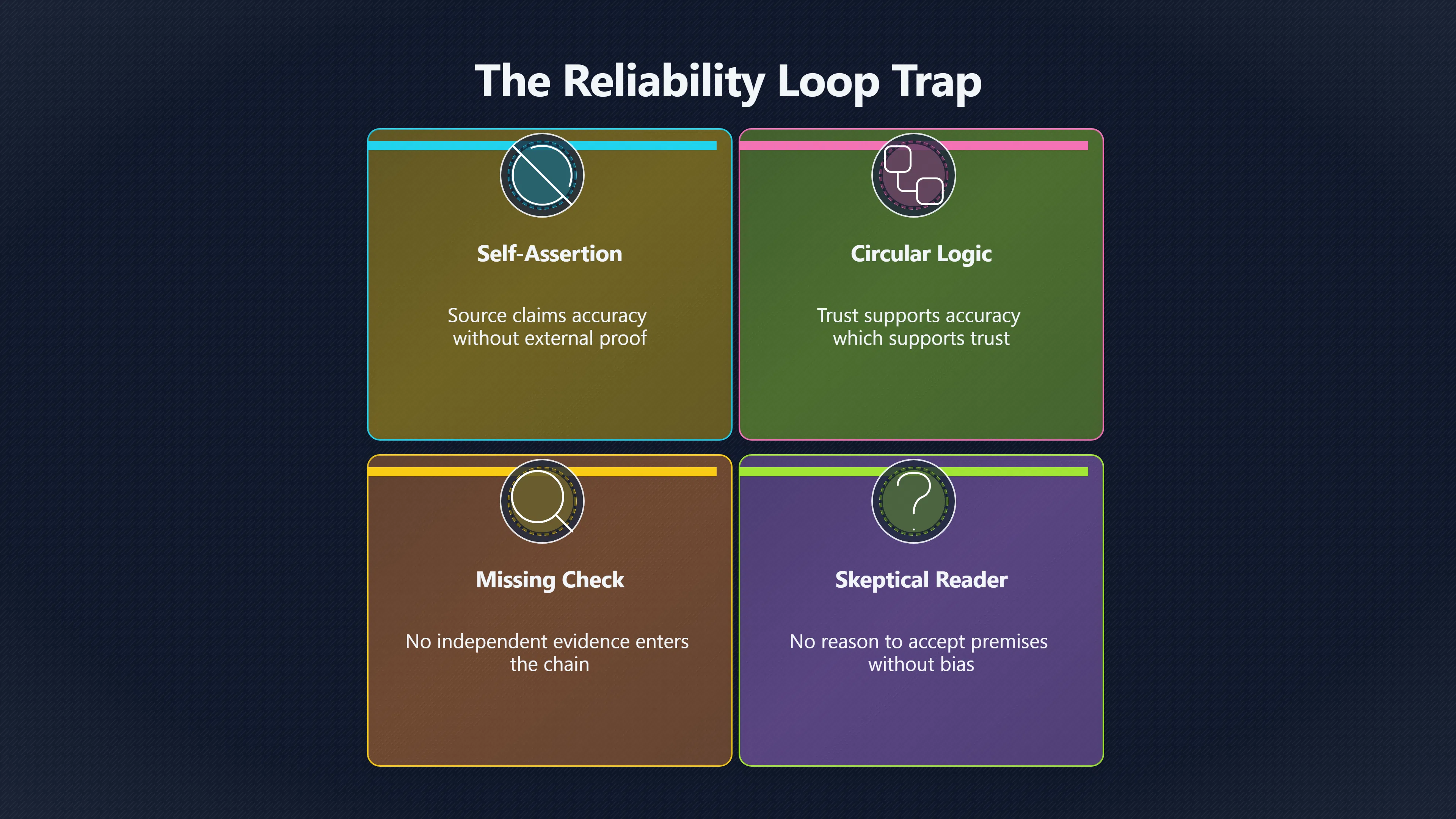
The most common news-trust loop links two ideas: reliability and accuracy.
A circular version of the argument runs as follows:
- The source is trustworthy.
- Therefore its stories are accurate.
- The stories are accurate.
- Therefore the source is trustworthy.
Each statement appears to support the next, but no independent evidence enters the chain. Someone who already accepts the source may find the argument convincing, yet a sceptical reader has been given no external reason to accept either premise.
This distinction becomes clearer when compared with genuine evidence. A source’s reliability is not demonstrated merely because it says it follows high standards. Rather, reliability depends on whether those standards can be observed, tested, and evaluated from outside the organisation. Reuters, for example, publishes detailed standards emphasising accuracy, corrections, independence, and verification procedures. Those standards are not proof by themselves; they become meaningful when readers, competitors, researchers, and watchdogs can examine whether the organisation actually follows them.[Reuters Agency]reutersagency.comReuters AgencyReuters Journalistic StandardsFollow the Trust Principles in all activities related to Reuters News · Hold accuracy sacrosa…[Reuters Agency]reutersagency.comReuters AgencyReuters Journalistic StandardsFollow the Trust Principles in all activities related to Reuters News · Hold accuracy sacrosa…
The logical mistake occurs when standards are treated as self-validating. “We are accurate because we say we follow accurate practices” remains a circular claim unless supported by evidence beyond the statement itself.
What Independent Checks Would Add
The way out of the evidence loop is independent verification. Instead of asking whether a source claims reliability, readers can ask what evidence exists outside the source’s own assertions.
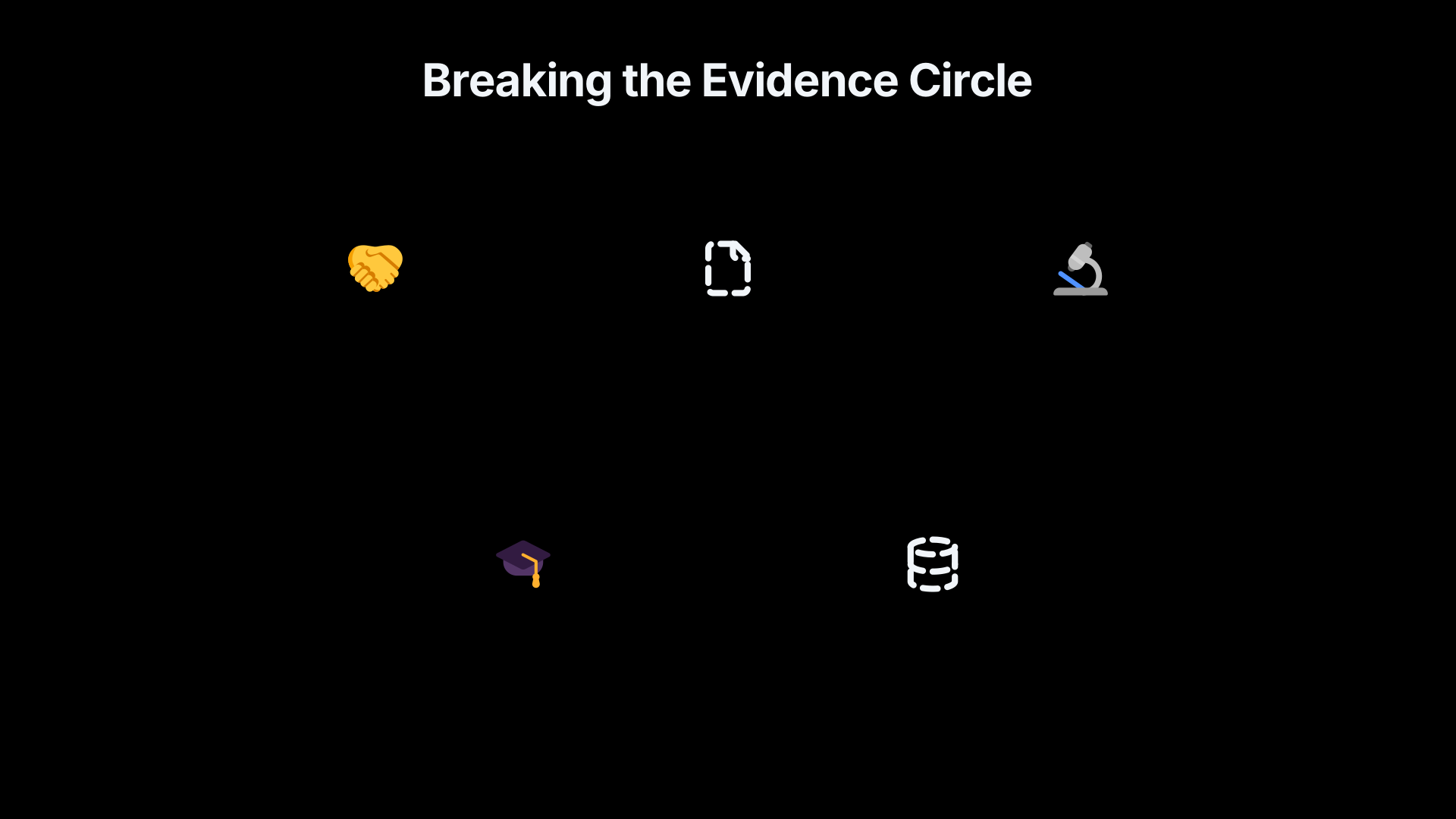
Several forms of independent checking break the circle:
- Corroboration by unrelated outlets. If multiple organisations with different ownership structures, editorial teams, and incentives independently confirm the same facts, confidence can increase.
- Transparent corrections. A visible record of corrections allows outsiders to assess how frequently errors occur and how they are handled.
- External fact-checking. Independent fact-checking organisations provide a separate layer of evaluation rather than relying on the source’s self-assessment.[Taylor & Francis Online]tandfonline.comThe first…Read more…
- Academic and professional assessment. Researchers and media analysts often evaluate accuracy, reliability, bias, and verification practices using criteria that are not controlled by the news organisation itself.[glassmanlab.seas.harvard.edu]glassmanlab.seas.harvard.eduWe identify reliability criteria, We discuss 11 widely recognized criteria,Reliability Criteria for News WebsitesFebruary 1, 2024 — by H HEUER · 2024 · Cited by 15 — Reliability criteria for news websites can hel…
- Primary-source access. When documents, transcripts, datasets, or recordings are made available, readers can compare reporting against underlying evidence.
Notice that each of these checks introduces information from outside the original claim. That external evidence is what prevents the reasoning from becoming circular.
A useful test is to ask: “If I temporarily ignored the source’s opinion about itself, what evidence would remain?” If little remains, the argument may depend more on reputation than on demonstrated reliability.
Why Trust and Trustworthiness Are Not the Same Thing
A further complication is that public trust and actual trustworthiness are different concepts.
People often trust sources because those sources feel familiar, align with existing beliefs, or consistently reinforce a preferred worldview. Researchers studying media trust have noted that trust can be influenced by social identity and prior attitudes rather than by objective measures of accuracy alone. [reutersinstitute.politics. ox.ac.uk+2arXiv]
This creates another potential evidence loop:
- People trust a source because it confirms what they already believe.
- Confirmation strengthens their trust.[reutersinstitute.politics.ox.ac.uk]reutersinstitute.politics.ox.ac.ukrebuilding trust journalisms role ai driven worldPeople often place trust in sources that affirm their worldview, even when they lack accuracy or integrity.Read more…
- Increased trust leads them to view the source as more accurate.
The source may or may not actually be accurate. The key point is that trust itself becomes part of the evidence chain. In such cases, confidence can grow even when independent verification is weak.
This distinction explains why public trust surveys and reliability assessments measure different things. Polls may reveal how much confidence people place in media organisations, but they do not automatically demonstrate whether those organisations are accurate. Recent polling shows substantial variation and decline in public trust toward media institutions, yet trust levels alone cannot determine journalistic quality.[Gallup.com]news.gallup.comtrust media new low.aspxin Media at New Low of 28% in U.S.October 2, 2025 — 2 Oct 2025 — Americans' trust in newspapers, television and radio to report the news…[Gallup.com]news.gallup.comtrust media new low.aspxin Media at New Low of 28% in U.S.October 2, 2025 — 2 Oct 2025 — Americans' trust in newspapers, television and radio to report the news…
How Circular Trust Claims Mislead Readers
Circular trust claims are persuasive because they imitate the structure of genuine evidence without providing its substance.
Several patterns commonly appear:
Reputation Treated as Proof
An outlet may be presented as reliable solely because it is well known or historically respected. Reputation can be relevant evidence, but if reputation is justified only by repeated assertions of reliability, the argument becomes self-reinforcing rather than evidential.
Accuracy Assumed Rather Than Demonstrated
Statements such as “this source has always been right” often rely on selective memory unless accompanied by documented performance records, correction histories, or independent evaluations.
Fact-Checking Used as a Badge Rather Than a Process
Fact-checking can strengthen credibility when it is transparent and open to scrutiny. However, simply declaring that material has been fact-checked does not automatically prove accuracy. The value comes from the methodology, evidence, and accountability behind the verification process. Taylor & Francis Online[PMC]pmc.ncbi.nlm.nih.govby DM Markowitz · 2023 · Cited by 32 — The current study assessed agreement among two independent fact-checkers, The Washington Post a…
Source-to-Source Echoes
A network of outlets may repeatedly cite one another until a claim appears well supported. If all reports ultimately trace back to the same unverified origin, apparent corroboration may be little more than a larger circular loop. The number of repetitions does not substitute for independent evidence.
A Practical Reader’s Test
When evaluating claims about a news source’s reliability, a simple question often exposes circular reasoning:
What evidence would convince someone who does not already trust this source?
If the answer is merely “the source says it is trustworthy” or “its reporting is trustworthy because the source is trustworthy,” the argument remains trapped in a logical loop.
By contrast, evidence such as transparent sourcing, correction records, independent fact-checks, corroboration from unrelated organisations, and external audits gives readers something beyond the claim itself. That external support is what transforms trust from an assumption into a reasoned judgement. trust.org 3Reuters Agency[3glassmanlab.seas.harvard.edu]glassmanlab.seas.harvard.eduWe identify reliability criteria, We discuss 11 widely recognized criteria,Reliability Criteria for News WebsitesFebruary 1, 2024 — by H HEUER · 2024 · Cited by 15 — Reliability criteria for news websites can hel…
Amazon book picks
Further Reading
Books and field guides related to Can a Source Prove Its Own Reliability?. Use these as the next step if you want deeper reading beyond the article.
The Fallacy Detective
Provides practical tools for identifying circular arguments and weak evidence.
eBay marketplace picks
Marketplace Samples
Example marketplace items related to this page. Use the search link to explore similar finds on eBay.


Endnotes
1.
Source: reuters.com
Link:https://www.reuters.com/fact-check/about/
Source snippet
Reuters ha establecido una unidad de fact-checking que revisa material visual y declaraciones en redes sociales. Los hallazgos se publica...
2.
Source: glassmanlab.seas.harvard.edu
Title: We identify reliability criteria, We discuss 11 widely recognized criteria,
Link:https://glassmanlab.seas.harvard.edu/papers/reliability_criteria.pdf
Source snippet
Reliability Criteria for News WebsitesFebruary 1, 2024 — by H HEUER · 2024 · Cited by 15 — Reliability criteria for news websites can hel...
Published: February 1, 2024
3.
Source: arxiv.org
Link:https://arxiv.org/abs/2404.09565
4.
Source: reutersinstitute.politics.ox.ac.uk
Title: rebuilding trust journalisms role ai driven world
Link:https://reutersinstitute.politics.ox.ac.uk/rebuilding-trust-journalisms-role-ai-driven-world
Source snippet
People often place trust in sources that affirm their worldview, even when they lack accuracy or integrity.Read more...
5.
Source: arxiv.org
Link:https://arxiv.org/abs/2012.01663
6.
Source: pmc.ncbi.nlm.nih.gov
Link:https://pmc.ncbi.nlm.nih.gov/articles/PMC8869166/
Source snippet
nih.govTrust, Media Credibility, Social Ties, and the Intention to Share...by P Majerczak · 2022 · Cited by 183 — This study expands on...
7.
Source: news.gallup.com
Title: trust media new low.aspx
Link:https://news.gallup.com/poll/695762/trust-media-new-low.aspx
Source snippet
in Media at New Low of 28% in U.S.October 2, 2025 — 2 Oct 2025 — Americans' trust in newspapers, television and radio to report the news...
Published: October 2, 2025
8.
Source: news.gallup.com
Title: americans trust media remains trend low.aspx
Link:https://news.gallup.com/poll/651977/americans-trust-media-remains-trend-low.aspx
Source snippet
Gallup.comAmericans' Trust in Media Remains at Trend Low14 Oct 2024 — Americans continue to register record-low trust in the mass media...
9.
Source: news.gallup.com
Link:https://news.gallup.com/topic/media.aspx
Source snippet
Gallup Topic30 Apr 2026 — Americans' trust in the media to report the news fully, accurately and fairly has edged down four points to 3...
10.
Source: pmc.ncbi.nlm.nih.gov
Link:https://pmc.ncbi.nlm.nih.gov/articles/PMC10368232/
Source snippet
by DM Markowitz · 2023 · Cited by 32 — The current study assessed agreement among two independent fact-checkers, The Washington Post a...
11.
Source: reutersinstitute.politics.ox.ac.uk
Title: Nic Newman and Richard Fletcher Bias, Bullshit and Lies Report
Link:https://reutersinstitute.politics.ox.ac.uk/sites/default/files/2017-11/Nic%20Newman%20and%20Richard%20Fletcher%20-%20Bias%2C%20Bullshit%20and%20Lies%20-%20Report.pdf
Source snippet
Bias, Bullshit and Lies16 Nov 2017 — Fact-checking approaches have been widely adopted by mainstream media companies such as the Washingt...
12.
Source: trust.org
Title: world press freedom day 2026
Link:https://www.trust.org/2026/04/29/world-press-freedom-day-2026/
Source snippet
4 days ago — We equip journalists with the tools they need to maintain editorial best practice in their reporting, such as sourcing, veri...
13.
Source: news.gallup.com
Title: americans misinformation bias inaccuracy news.aspx
Link:https://news.gallup.com/opinion/gallup/235796/americans-misinformation-bias-inaccuracy-news.aspx
Source snippet
gallup.comAmericans: Much Misinformation, Bias, Inaccuracy in News20 Jun 2018 — Americans estimate 62% of the news they see in newspapers...
14.
Source: news.gallup.com
Title: media use evaluation.aspx
Link:https://news.gallup.com/poll/1663/media-use-evaluation.aspx
Source snippet
Use and Evaluation | Gallup Historical TrendsHow much trust and confidence do you have in the mass media, such as newspapers, TV and radi...
15.
Source: news.gallup.com
Title: americans reliance trust media news sources trends.aspx
Link:https://news.gallup.com/poll/265808/americans-reliance-trust-media-news-sources-trends.aspx
Source snippet
gallup.comAmericans' Reliance on and Trust in Media News Sources...We'd like to know whether or not you can trust the accuracy of the ne...
16.
Source: trust.org
Link:https://www.trust.org/our-journalism/
Source snippet
Our JournalismWe adhere to the Thomson Reuters Trust Principles of integrity, independence and freedom from bias.... accurate and impart...
17.
Source: trust.org
Link:https://www.trust.org/about-us/
18.
Source: trust.org
Link:https://www.trust.org/legal/trust-principles/
Source snippet
Trust PrinciplesThe Trust Principles imposed obligations on Reuters and its employees to act at all times with integrity, independence, a...
19.
Source: reutersagency.com
Link:https://reutersagency.com/about/standards-values/
Source snippet
Reuters AgencyReuters Journalistic StandardsFollow the Trust Principles in all activities related to Reuters News · Hold accuracy sacrosa...
20.
Source: thomsonreuters.com
Link:https://www.thomsonreuters.com/en/about-us/trust-principles
Source snippet
The Trust PrinciplesThe Trust Principles imposed obligations on Reuters and its employees to act at all times with integrity, independenc...
21.
Source: reutersagency.com
Link:https://reutersagency.com/about/our-trust-principles/
Source snippet
Reuters: Our Trust PrinciplesAlongside our Trust Principles, our journalists adhere to strict journalistic standards and values in everyt...
22.
Source: tandfonline.com
Link:https://www.tandfonline.com/doi/full/10.1080/21670811.2022.2031240
Source snippet
The first...Read more...
23.
Source: Wikipedia
Link:https://en.wikipedia.org/wiki/Reuters
Source snippet
ReutersReuters is an international news agency wholly owned by Thomson Reuters, which is a multinational information conglomerate.Read...
Additional References
24.
Source: spj.org
Link:https://www.spj.org/what-the-codes-say-code-provisions-by-subject/
Source snippet
Society of Professional JournalistsWhat the Codes Say: Code provisions by subjectThe good news organization is fair, accurate, responsibl...
25.
Source: thebaron.info
Title: Reuters tops accuracy and impartiality scores
Link:https://www.thebaron.info/news/article/2019/07/01/reuters-tops-accuracy-and-impartiality-scores-study
Source snippet
study1 Jul 2019 — Reuters has the highest accuracy score of all publications in a recent study and tracks almost dead centre on a bias sc...
26.
Source: facebook.com
Link:https://www.facebook.com/WHOSEARO/posts/how-do-you-spot-the-difference-between-news-vs-fake-news-information-vs-[rumours
Source snippet
How do you spot the difference between news vs fake...🛠️ DIY Tip: Use fact-checking sites like Snopes, Africa Check, or Google Fact Check...
27.
Source: researchgate.net
Link:https://www.researchgate.net/publication/330710636_Fighting_misinformation_on_social_media_using_crowdsourced_judgments_of_news_source_quality
Source snippet
rces independently influence participants' credibility judgments...
28.
Source: researchgate.net
Link:https://www.researchgate.net/publication/290347859_Reuters_Principles_Of_Trust_Or_Propaganda
Source snippet
East conflict published on the Reuters proprietary websites...
29.
Source: ifcncodeofprinciples.poynter.org
Link:https://ifcncodeofprinciples.poynter.org/application/public/reuters/661a8b04ba7689d4814192d8
Source snippet
IFCN Code of Principles - PoynterThe principles of with integrity, independence, and freedom from bias guide all journalism at Reuters...
30.
Source: slideshare.net
Link:https://www.slideshare.net/slideshow/reuters-journalism-handbook/14063121
Source snippet
ding accuracy, freedom from bias, independence...
31.
Source: mediareform.org.uk
Link:https://www.mediareform.org.uk/wp-content/uploads/2015/12/Reuters_Handbook_of_Journalism.pdf
Source snippet
Media Reform CoalitionReuters Handbook of Journalism Standards and ValuesEverything we do as Reuters journalists has to be independent, f...
32.
Source: youtube.com
Link:https://www.youtube.com/watch?v=8UHoY0B48uM
Source snippet
Introduction to Media Literacy: Crash Course Media Literacy #1...
33.
Source: ebooks.inflibnet.ac.in
Link:https://ebooks.inflibnet.ac.in/aep08/chapter/sources-in-media-checking-for-truth-reliability/
Source snippet
Sources in Media – Checking for truth & reliability18 Mar 2012 — Objectives. To identify reliable sources of information; To identify fak...
Topic Tree