Within Debate
The Fairer Way to Win Arguments
Charitable reconstruction makes a rebuttal stronger by answering the best reasonable version of the opposing point.
On this page
- Find the strongest intended claim
- Avoid mislabelling weak wording
- Preserve the opponent's burden
Page outline Jump by section
Introduction
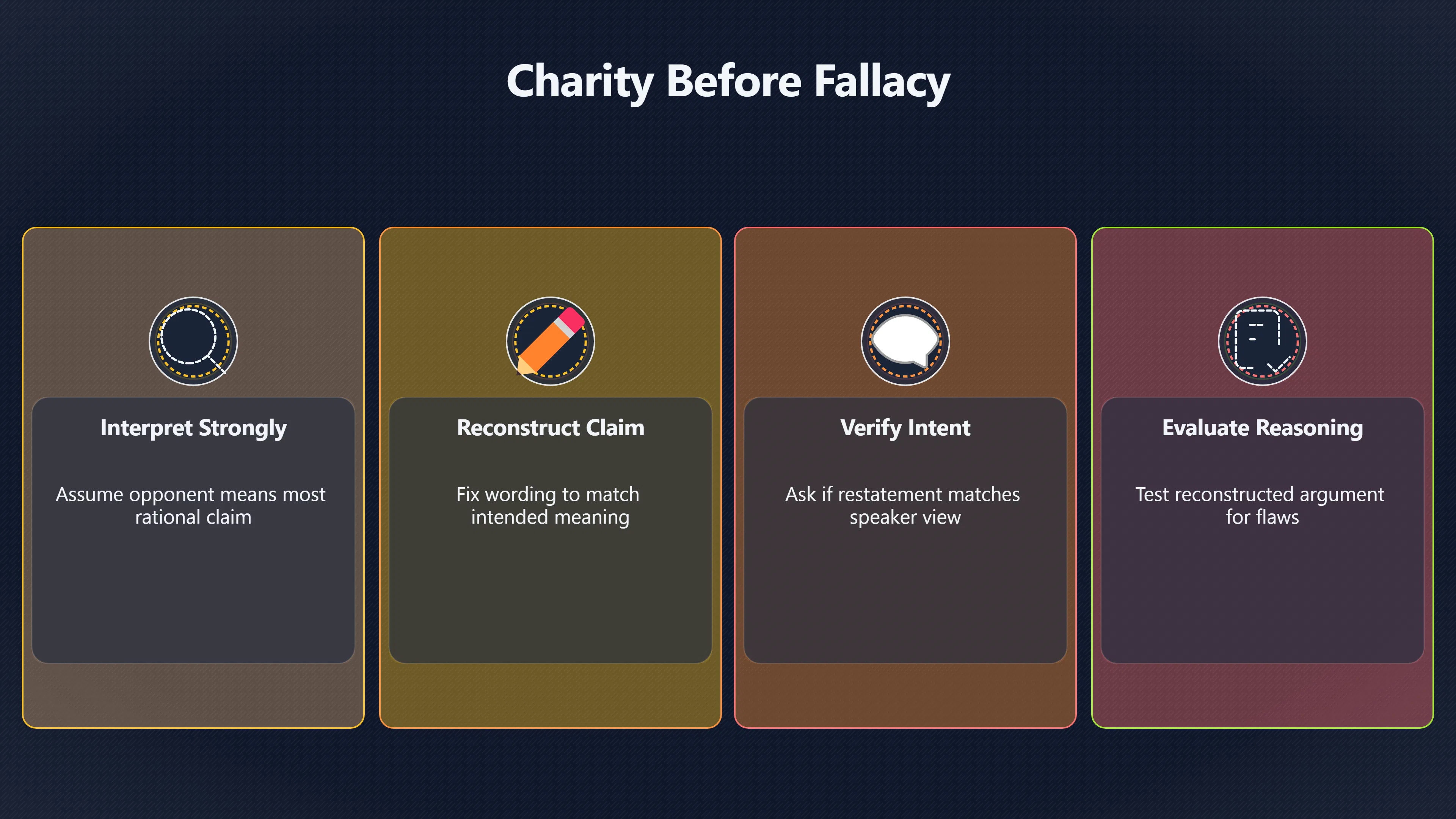
Before accusing an opponent of using a logical fallacy, a skilled debater should first apply the principle of charity: interpret the opponent’s argument in its strongest reasonable form. This is not merely a matter of courtesy. It is a safeguard against misrepresenting the argument and then claiming victory over a weaker version that was never intended. In argumentation theory, charitable interpretation is widely treated as a core discipline of fair criticism because many alleged fallacies arise from misunderstanding, ambiguity, or careless reconstruction rather than from genuine defects in reasoning.[Open Textbook Platform]opentextbooks.rug.nlThis is the opposite of what weOpen Textbook PlatformPrinciple of Charity – Migration: A Philosophical Toolkitby F de Rijk · 2024 · Cited by 1 — This is often referred…[Routledge Encyclopedia of Philosophy]rep.routledge.comroutledge.comCharity, principle ofThe principle of charity governs the interpretation of the beliefs and utterances of others. It urges c…
 Within live debate, this principle has special importance. Time pressure encourages participants to seize on awkward wording, incomplete phrasing, or poorly expressed examples. Yet a fallacy charge is strongest when it survives charitable reconstruction. If an argument still fails after being interpreted in its most reasonable form, the criticism is far more persuasive and much harder to dismiss as unfair.[informallogic.ca]informallogic.caARTICLE SARTICLES - Informal LogicApril 9, 2009 — by D Jacquette · 1996 · Cited by 23 — The principle of charity enjoins us to critically evaluate…[Springer]link.springer.comThe Dialectical Principle of Charity: A Procedure for a Critical…24 Apr 2023 — This paper aims to discuss a well-known concept…
Why Charity Comes Before Fallacy Labels
The principle of charity instructs listeners and critics to interpret another person’s statements in the most rational and coherent way reasonably available before evaluating them. Philosophers and argumentation theorists have long treated it as a foundational rule of interpretation rather than a mere debating tactic.[stanford]plato.stanford.eduEncyclopedia of Philosophy Donald DavidsonStanford Encyclopedia of PhilosophyDonald Davidson - Stanford Encyclopedia of PhilosophyMay 29, 1996 — Charity is, in this respect, both… Encyclopedia of Philosophy[routledge]rep.routledge.comroutledge.comCharity, principle ofThe principle of charity governs the interpretation of the beliefs and utterances of others. It urges c… Encyclopedia of Philosophy
In practical debate, this means asking a simple question before announcing a fallacy:
- Is this really the argument the speaker intended to make?
Many fallacy accusations fail at this stage. A speaker may have expressed an idea imprecisely, omitted a premise, or used shorthand that an audience can reasonably reconstruct. Jumping immediately to “straw man”, “false dilemma”, or “hasty generalisation” risks attacking an interpretation that the speaker would reject. Charitable reconstruction reduces this risk. informallogic.ca PhilPapers The result is a higher standard of criticism. Instead of asking whether the weakest reading is flawed[philpapers.org]philpapers.orgThe rules are based on Grice'sDouglas Walton, New Dialectical Rules For Ambiguityby D Walton · 2000 · Cited by 19 — A set often rules is proposed for dealing…, the critic asks whether the strongest reasonable reading is flawed.
Find the Strongest Intended Claim
The most important charitable practice is distinguishing between what was literally said and what was probably meant.
Consider a speaker who says:
“Social media causes political polarisation.”
Taken literally, this sounds like a universal claim about causation. A critic might immediately accuse the speaker of oversimplification. But charitable reconstruction may reveal that the intended claim is narrower:
“Social media contributes significantly to political polarisation under certain conditions.”
The revised version is more precise and often closer to what the speaker actually intended. Only after identifying that stronger interpretation should a critic evaluate whether the supporting evidence is sufficient.[Open Textbook Platform]opentextbooks.rug.nlThis is the opposite of what weOpen Textbook PlatformPrinciple of Charity – Migration: A Philosophical Toolkitby F de Rijk · 2024 · Cited by 1 — This is often referred… 2philosophy.lander.edu
This approach aligns with broader traditions in informal logic and argumentation theory, which emphasise reconstructing arguments before judging them. An argument cannot be fairly assessed until its premises, conclusion, and implicit assumptions have been identified as accurately as possible.[ResearchGate]researchgate.netNon-technical in.Read moreInformal Logic: A PRAGMATIC APPROACH, Second EditionJuly 2, 2008 — Informal Logic is an introductory guidebook to the basic p…[Stanford Encyclopedia of Philosophy]plato.stanford.eduEncyclopedia of Philosophy Donald DavidsonStanford Encyclopedia of PhilosophyDonald Davidson - Stanford Encyclopedia of PhilosophyMay 29, 1996 — Charity is, in this respect, both…
In live debates, a useful test is:
- Restate the opponent’s point in your own words.
- Ask whether they would recognise that restatement as fair.
- Only then evaluate its strengths or weaknesses.
If the opponent would reject the reconstruction, the criticism is probably aimed at the wrong target.
Avoid Mislabelling Weak Wording
Many apparent fallacies emerge from poor wording rather than poor reasoning.
A speaker under time pressure may use absolute language such as “always”, “never”, or “everyone” when their actual position is more qualified. Treating every verbal slip as a formal commitment can create a distorted exchange where participants debate wording instead of substance.
This is particularly relevant when identifying straw man arguments. A straw man occurs when someone attacks a weakened or altered version of another person’s position rather than the position itself. Research in argumentation and discourse analysis shows that misrepresentation often arises through subtle shifts in interpretation rather than outright fabrication.[folia.unifr.ch]folia.unifr.chPragmatics, cognitive heuristics and the straw man fallacyby M Lewiński · Cited by 48 — cognitive “mistake” that makes an unreasonable st…
For example:
- Original statement: “We should reduce some military spending.”
- Reconstructed unfairly: “You want to eliminate national defence.”
- Fallacy accusation follows.
The problem is not merely the incorrect rebuttal. The critic has created the very distortion that a fallacy analysis is supposed to detect.
A charitable approach instead asks what the statement most reasonably means in context. Only after that reconstruction can one determine whether a genuine fallacy exists. Douglas Walton’s work on ambiguity and interpretation similarly stresses the importance of resolving uncertainty through contextual evidence before evaluating an argument’s quality.[informallogic.ca]informallogic.caNew Dialectical Rules For AmbiguityInformal Logicby D Walton · 2000 · Cited by 19 — The rules are meant to be applied to a given argument used in a given case, and to resol…
Preserve the Opponent’s Burden
Charity does not mean rescuing an argument from every weakness. A common misunderstanding is that charitable interpretation requires inventing better arguments on an opponent’s behalf.
The principle has limits.
A critic should reconstruct an argument reasonably, but should not add premises, evidence, or qualifications that the speaker never suggested. Otherwise the critic begins defending a position that the speaker has not actually established.[Springer]link.springer.commore…
This distinction matters because every debate involves a burden of proof. The person making a claim remains responsible for providing adequate support. Charity prevents unfair distortion, but it does not transfer that responsibility to the critic.[Wikipedia]WikipediaOpen source on wikipedia.org.
A useful rule is:
- Clarify ambiguity in the speaker’s favour.
- Do not manufacture missing evidence in the speaker’s favour.
For example, if a speaker cites one example and concludes that a policy works everywhere, a charitable critic may interpret the claim in its strongest plausible form. However, if the argument still relies on insufficient evidence after that reconstruction, pointing out the evidential gap remains entirely legitimate.
When a Fallacy Charge Becomes Stronger
Many debaters believe that charity makes criticism softer. In practice, it often makes criticism more decisive.
A fallacy accusation that follows charitable reconstruction has several advantages:
- It is harder for the opponent to dismiss as unfair.
- It demonstrates intellectual confidence rather than point-scoring.
- It keeps the audience focused on reasoning rather than personality conflict.
- It reduces the chance of becoming trapped in arguments about what someone “really meant”.[THE ETHICS CENTRE]ethics.org.auethics explainer the principle of charityTHE ETHICS CENTREEthics explainer: The principle of charityAug 5, 2024 — The principle of charity suggests we should assume good intentio…[Springer]link.springer.comunreasonable discussion moves, and legitimate personal attacks are invariably considered reasonable. The “disguised” abusive attacks pres…
Pragma-dialectical approaches to argumentation emphasise that reasonable discussion depends on accurate interpretation of another participant’s position. One of the discussion rules explicitly requires parties to interpret each other’s formulations carefully and accurately. Violations of such standards can themselves contribute to unreasonable argumentative exchanges.[Wikipedia]WikipediaPrinciple of charityPrinciple of charityThe principle of charity or charitable interpretation requires interpreting a speaker's statements in the most rat…
Consequently, the strongest rebuttal often sounds like this:
“Even if we interpret your argument in the most reasonable way, the evidence still does not support the conclusion.”
That statement carries more force than a quick fallacy label because it shows the audience that the critic has already granted every reasonable advantage before reaching a negative judgment.

The Fairer Way to Win Arguments
The principle of charity is a discipline of interpretation that precedes evaluation. Before identifying a fallacy, the critic first reconstructs the strongest reasonable version of the opposing claim, resolves obvious ambiguities, and preserves the speaker’s actual burden of proof.[Open Textbook Platform]opentextbooks.rug.nlThis is the opposite of what weOpen Textbook PlatformPrinciple of Charity – Migration: A Philosophical Toolkitby F de Rijk · 2024 · Cited by 1 — This is often referred…[Routledge Encyclopedia of Philosophy]rep.routledge.comroutledge.comCharity, principle ofThe principle of charity governs the interpretation of the beliefs and utterances of others. It urges c…
In debate strategy, this practice serves both fairness and effectiveness. It prevents critics from committing the very distortions they condemn, strengthens the credibility of fallacy accusations, and keeps disagreement focused on the real issue rather than on verbal missteps. A rebuttal that survives charitable reconstruction is not merely more polite; it is usually more convincing.[informallogic.ca]informallogic.caCritical Review - Advances in Pragma-Dialectics - Informal Logicby D Hitchcock · 2003 · Cited by 4 — 64, on a 7-point scale with 1 as ver…[Wikipedia]WikipediaPrincipleA principle may relate to a fundamental truth or proposition that serves as the foundation for a system of beliefs or behavio…
Amazon book picks
Further Reading
Books and field guides related to The Fairer Way to Win Arguments. Use these as the next step if you want deeper reading beyond the article.
A Rulebook for Arguments
Teaches fair interpretation, strong argument reconstruction, and responsible criticism.
Attacking Faulty Reasoning
Emphasizes evaluating arguments fairly before applying fallacy labels.
Being Logical
Promotes disciplined reasoning and avoiding unfair argumentative shortcuts.
eBay marketplace picks
Marketplace Samples
Example marketplace items related to this page. Use the search link to explore similar finds on eBay.
Endnotes
1.
Source: rep.routledge.com
Link:https://www.rep.routledge.com/articles/thematic/charity-principle-of/v-1
Source snippet
routledge.comCharity, principle ofThe principle of charity governs the interpretation of the beliefs and utterances of others. It urges c...
2.
Source: philosophy.lander.edu
Link:https://philosophy.lander.edu/intro/charity.shtml
Source snippet
The Principle of CharityThe principle of charity is a presumption often made in philosophy whereby preconceptions about an argument, a to...
3.
Source: informallogic.ca
Title: ARTICLE S
Link:https://informallogic.ca/index.php/informal_logic/article/view/2364/1806
Source snippet
ARTICLES - Informal LogicApril 9, 2009 — by D Jacquette · 1996 · Cited by 23 — The principle of charity enjoins us to critically evaluate...
Published: April 9, 2009
4.
Source: link.springer.com
Link:https://link.springer.com/article/10.1007/s10503-023-09615-8
Source snippet
The Dialectical Principle of Charity: A Procedure for a Critical...24 Apr 2023 — This paper aims to discuss a well-known concept...
5.
Source: link.springer.com
Link:https://link.springer.com/article/10.1007/s10503-023-09605-w
Source snippet
more...
6.
Source: plato.stanford.edu
Title: Encyclopedia of Philosophy Donald Davidson
Link:https://plato.stanford.edu/archives/fall1999/entries/davidson/
Source snippet
Stanford Encyclopedia of PhilosophyDonald Davidson - Stanford Encyclopedia of PhilosophyMay 29, 1996 — Charity is, in this respect, both...
Published: May 29, 1996
7.
Source: informallogic.ca
Title: New Dialectical Rules For Ambiguity
Link:https://informallogic.ca/index.php/informal_logic/article/view/2280
Source snippet
Informal Logicby D Walton · 2000 · Cited by 19 — The rules are meant to be applied to a given argument used in a given case, and to resol...
8.
Source: philpapers.org
Title: The rules are based on Grice’s
Link:https://philpapers.org/rec/WALNDR
Source snippet
Douglas Walton, New Dialectical Rules For Ambiguityby D Walton · 2000 · Cited by 19 — A set often rules is proposed for dealing...
9.
Source: researchgate.net
Title: Non-technical in.Read more
Link:https://www.researchgate.net/profile/Douglas_Walton/publication/243765154_Informal_Logic_A_Handbook_for_Critical_Argumentation/links/5fc39613299bf104cf90477c/Informal-Logic-A-Handbook-for-Critical-Argumentation.pdf
Source snippet
Informal Logic: A PRAGMATIC APPROACH, Second EditionJuly 2, 2008 — Informal Logic is an introductory guidebook to the basic p...
Published: July 2, 2008
10.
Source: plato.stanford.edu
Link:https://plato.stanford.edu/entries/argument/
Source snippet
Stanford Encyclopedia of PhilosophyArgument and Argumentationby C Dutilh Novaes · 2021 · Cited by 101 — Argumentation can be defined as t...
11.
Source: Wikipedia
Link:https://en.wikipedia.org/wiki/Pragma-dialectics
12.
Source: folia.unifr.ch
Link:https://folia.unifr.ch/documents/323882/files/2014-oswaldlewinski-lang.pdf?download=
Source snippet
Pragmatics, cognitive heuristics and the straw man fallacyby M Lewiński · Cited by 48 — cognitive “mistake” that makes an unreasonable st...
13.
Source: researchgate.net
Link:https://www.researchgate.net/publication/263381133_Frans_van_Eemeren_Bart_Garssen_Bert_Meuffels_Fallacies_and_Judgments_of_Reasonableness_Empirical_Research_Concerning_the_Pragma-Dialectical_Discussion_Rules
Source snippet
ResearchGate(PDF) Frans van Eemeren, Bart Garssen, & Bert Meuffelsproaches, pragma-dialectics does not regard fallacies as formally inval...
14.
Source: ethics.org.au
Title: ethics explainer the principle of charity
Link:https://ethics.org.au/ethics-explainer-the-principle-of-charity/
Source snippet
THE ETHICS CENTREEthics explainer: The principle of charityAug 5, 2024 — The principle of charity suggests we should assume good intentio...
15.
Source: link.springer.com
Link:https://link.springer.com/rwe/10.1007/978
Source snippet
unreasonable discussion moves, and legitimate personal attacks are invariably considered reasonable. The “disguised” abusive attacks pres...
16.
Source: Wikipedia
Title: Principle of charity
Link:https://en.wikipedia.org/wiki/Principle_of_charity
Source snippet
Principle of charityThe principle of charity or charitable interpretation requires interpreting a speaker's statements in the most rat...
17.
Source: Wikipedia
Link:https://en.wikipedia.org/wiki/Principle
Source snippet
PrincipleA principle may relate to a fundamental truth or proposition that serves as the foundation for a system of beliefs or behavio...
18.
Source: researchgate.net
Link:https://www.researchgate.net/publication/368474532_The_Pragma-Dialectical_Approach_to_the_Fallacies_Revisited
Source snippet
The Pragma-Dialectical Approach to the Fallacies RevisitedFeb 13, 2023 — This culminates in a discussion of the exploitation of hidden fa...
19.
Source: philosophy.lander.edu
Title: nature fall
Link:https://philosophy.lander.edu/logic/nature_fall.html
Source snippet
Nature of FallaciesA fallacy is a mistake in reasoning: an argument which either does not prove, or does not provide evidence for, its co...
20.
Source: plato.stanford.edu
Title: logic informal
Link:https://plato.stanford.edu/entries/logic-informal/
Source snippet
Logic - Stanford Encyclopedia of Philosophyby L Groarke · 1996 · Cited by 97 — Ad hominem is a case in point, for there are many instance...
21.
Source: informallogic.ca
Link:https://informallogic.ca/index.php/informal_logic/article/view/2156/1600
Source snippet
Critical Review - Advances in Pragma-Dialectics - Informal Logicby D Hitchcock · 2003 · Cited by 4 — 64, on a 7-point scale with 1 as ver...
22.
Source: youtube.com
Title: Principle of Charity | Giving Reasons Ch 6
Link:https://www.youtube.com/watch?v=AOBEOsUuFBQ
Source snippet
4 The Principle of Charity...
23.
Source: youtube.com
Title: The Principle of Charity
Link:https://www.youtube.com/watch?v=LZZ7tQnI2-M
Source snippet
5 The Principle of Charity...
24.
Source: youtube.com
Title: The Principle of Charity
Link:https://www.youtube.com/watch?v=Ix1VTiMXph4
25.
Source: opentextbooks.rug.nl
Title: This is the opposite of what we
Link:https://opentextbooks.rug.nl/philosophymigration/chapter/principle-of-charity/
Source snippet
Open Textbook PlatformPrinciple of Charity – Migration: A Philosophical Toolkitby F de Rijk · 2024 · Cited by 1 — This is often referred...
26.
Source: dictionary.cambridge.org
Link:https://dictionary.cambridge.org/dictionary/english/principle
Source snippet
English meaning - Cambridge Dictionarya basic idea or rule that explains or controls how something happens or works: the principles of...
27.
Source: intelligentspeculation.com
Title: the principle of charity
Link:https://www.intelligentspeculation.com/blog/the-principle-of-charity
Source snippet
Principle of CharityApr 16, 2019 — The Principle of Charity demands that one interprets a speaker's statement(s) in the most rational way...
Additional References
28.
Source: merriam-webster.com
Link:https://www.merriam-webster.com/dictionary/principle
Source snippet
PRINCIPLE Definition & MeaningThe meaning of PRINCIPLE is a comprehensive and fundamental law, doctrine, or assumption. How to use princi...
29.
Source: anekawarnapendidikan.wordpress.com
Title: a systematic theory of argumentation by frans h van eemeren1
Link:https://anekawarnapendidikan.wordpress.com/wp-content/uploads/2014/04/a-systematic-theory-of-argumentation-by-frans-h-van-eemeren1.pdf
Source snippet
Systematic Theory of Argumentation: The pragma-...for a reasonable discussion.6 It is the task of argumentation theorists to explain how...
30.
Source: effectiviology.com
Link:https://effectiviology.com/principle-of-charity/
Source snippet
interpreting someone's statement, you should assume that the best possible...Read more...
31.
Source: donaldrobertson.name
Title: ad hominem arguments and the principle of charity
Link:https://donaldrobertson.name/2016/12/24/ad-hominem-arguments-and-the-principle-of-charity/
Source snippet
Dec 24, 2016 — The Principle of Charity involves giving other people the benefit of the doubt, assuming they're not stupid, and interpret...
32.
Source: reddit.com
Link:https://www.reddit.com/r/askphilosophy/comments/8t1hko/what_is_the_origin_of_the_principle_of/
Source snippet
ntary of someone else's argument, you should criticize the best...Read more...
33.
Source: lesswrong.com
Title: don t apply the principle of charity to yourself
Link:https://www.lesswrong.com/posts/DwtsDbtPCzr9ArcxH/don-t-apply-the-principle-of-charity-to-yourself
Source snippet
Don't Apply the Principle of Charity to Yourself19 Nov 2011 — In philosophy, the Principle of Charity is a technique in which you evaluat...
34.
Source: youtube.com
Link:https://www.youtube.com/watch?v=-M2BIh-cqz4
Source snippet
Frans van Eemeren, Plenary, CADAAD 2008. 1.9K views · 11 years ago...more...
35.
Source: apologetics315.com
Title: book review informal logic by douglas walton
Link:https://apologetics315.com/2009/05/book-review-informal-logic-by-douglas-walton/
Source snippet
When arguments or meanings are not clearly communicated, charity should be involved...Read more...
36.
Source: youtube.com
Title: Principal VS Principle
Link:https://www.youtube.com/watch?v=LO6WFZ9XwNw
Source snippet
Commonly Confused English Words...A principal is a basic rule or belief that guides how we act or how we make decisions...
37.
Source: bmartin.cc
Link:https://www.bmartin.cc/pubs/09-4apcei/4apcei-Robinson.pdf
Source snippet
It may be more...Read more...
Topic Tree