Within Debate
Should You Name the Fallacy?
A fallacy label helps only when the audience also hears exactly what reasoning step failed.
On this page
- When labels save time
- When jargon loses the room
- Turn labels into plain tests
Page outline Jump by section
Introduction
In live debate, naming a fallacy is often less important than explaining the mistake. A label such as “straw man”, “false dilemma”, or “ad hominem” can be useful shorthand, but it only helps an audience if they also understand what reasoning step failed and why that failure matters. Argumentation scholars generally treat fallacies as defects in the process of resolving a disagreement, not as magic words that end a discussion. A fallacy label identifies a problem; an explanation shows the audience the problem.[Springer]link.springer.comThe Pragma-Dialectical Theory of ArgumentationThis chapter discusses the pragma-dialectical approach developed in the Netherlands…[Springer]link.springer.commore…
 This distinction matters because public debates are judged by listeners who may not know technical terminology. A speaker who merely announces “that’s a fallacy” can sound evasive or pedantic. A speaker who explains the missing evidence, unsupported assumption, or mistaken inference gives the audience a reason to change its assessment of the argument. The practical question is therefore not whether fallacy names are correct, but whether they improve understanding.[stanford]plato.stanford.eduEncyclopedia of Philosophy FallaciesStanford Encyclopedia of PhilosophyFallacies - Stanford Encyclopedia of Philosophyby H Hansen · 2015 · Cited by 427 — Two competing conce… Encyclopedia of Philosophy
When Labels Save Time
Fallacy labels have genuine value. They compress a recurring pattern of reasoning into a familiar term. Among people who already understand the vocabulary—judges, philosophy students, debate coaches, lawyers, or experienced arguers—a label can quickly signal what sort of problem is being discussed.
For example, if everyone in the room understands what a straw man is, saying “that is a straw man” may instantly communicate that one side has attacked a weaker version of the opponent’s position rather than the actual claim. The label functions as efficient shorthand.
Labels can also help organise analysis. Argumentation theory often classifies recurring reasoning errors because identifying patterns makes evaluation easier. In pragma-dialectical theory, fallacies are understood as moves that violate the rules of a reasonable critical discussion. Categorising those violations helps analysts recognise where a discussion has gone off track. Springer[PhilPapers In practice]philpapers.orgVANFIP 2Fallacies in pragma-dialectical perspective.by FH Van Eemeren · 1987 · Cited by 319 — In the pragma-dialectical approach, fallacies are c…, labels are most useful when:
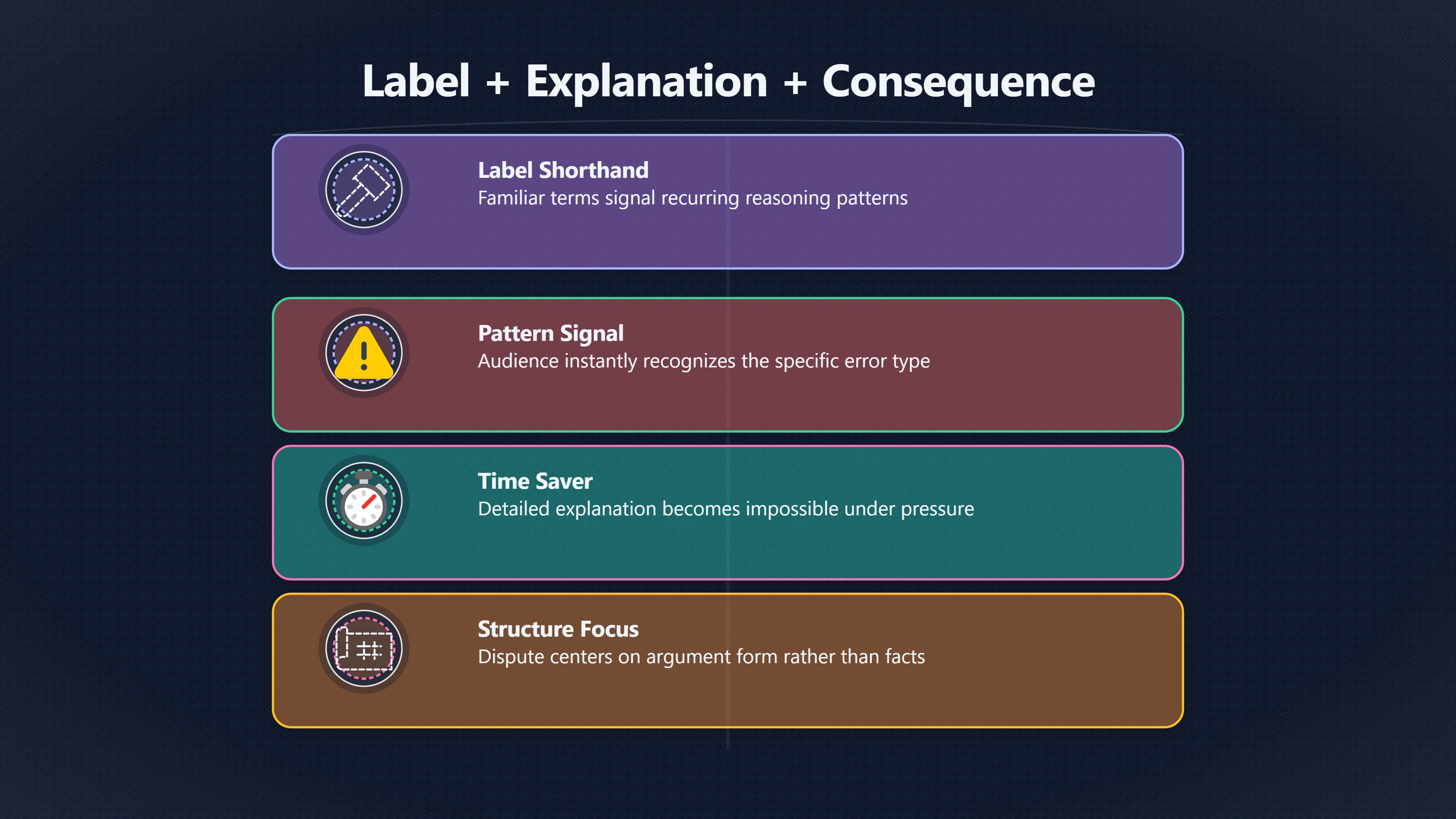
- The audience already knows the terminology.
- Time is limited and detailed explanation is impossible.
- The label is immediately followed by a brief explanation.
- The dispute concerns the structure of the argument rather than the underlying facts.
A useful formula is:
Label + explanation + consequence
For example:
“That is a hasty generalisation. One example is not enough to support a nationwide conclusion, so the evidence does not justify the claim.”
The label saves time; the explanation does the persuasive work.
When Jargon Loses the Room
Outside specialist settings, technical language can create more problems than it solves.
Many people recognise a few famous fallacy names but do not know their precise meaning. As a result, the label may be interpreted as little more than “I disagree”. The audience hears a term but never learns what reasoning mistake allegedly occurred.
There is also a strategic risk. Public arguments sometimes turn into disputes about labels rather than reasoning. Instead of discussing whether the evidence supports the conclusion, participants begin arguing over whether a particular statement is “really” a straw man or “really” an ad hominem. The conversation shifts from the substance of the claim to classification disputes.
This risk is especially clear with commonly misunderstood fallacies. The ad hominem label, for example, is often applied too broadly. Not every criticism of a person is fallacious. The key question is whether the personal criticism is being used as a substitute for answering the argument. Determining that requires explanation, not merely naming the category.[Internet Encyclopedia of Philosophy]iep.utm.eduInternet Encyclopedia of PhilosophyFallaciesThe major difficulty with labeling a piece of reasoning an Ad Hominem Fallacy is deciding whe…
Research and theory on argumentation repeatedly emphasise that the central issue is whether a move advances or obstructs reasonable discussion. Simply attaching a fallacy name does not demonstrate that the move actually failed that test.[Springer]link.springer.comThe Pragma-Dialectical Theory of ArgumentationThis chapter discusses the pragma-dialectical approach developed in the Netherlands…[Springer]link.springer.commore…
In live debate, jargon can also create an image problem. Audiences may perceive repeated fallacy-calling as scorekeeping rather than reasoning. A speaker who constantly announces labels can appear more interested in winning technical points than answering the underlying issue.
Turn Labels into Plain Tests
The most effective debaters often translate technical concepts into simple questions.
Instead of saying:
“That is a false dilemma.”
They ask:
“Why are those the only two options?”
Instead of saying:
“That is an appeal to popularity.”
They ask:
“How does the number of people who believe it show that it is true?”
Instead of saying:
“That is an ad hominem.”
They say:
“That criticism is about the person. What is the answer to the argument?”
These plain-language versions perform the same analytical function while remaining accessible to audiences with no training in logic.
A useful approach is to convert every fallacy label into a test:
Fallacy labelPlain-language testStraw manIs this actually the claim being made?Hasty generalisationIs there enough evidence for that conclusion?False dilemmaAre other realistic options being ignored?Ad hominemDoes this answer the argument or attack the person?Slippery slopeWhat evidence shows the later outcome will happen?Appeal to popularityWhy does popularity make it true?
The audience does not need to memorise terminology. They only need to understand the reasoning test.
Why Explanations Persuade Better
Persuasion depends on showing the audience a defect, not merely naming one.
A fallacy label functions like a diagnosis. A plain-language explanation functions like evidence for that diagnosis. Without the second step, listeners must trust the speaker’s expertise rather than see the problem for themselves.
This distinction mirrors a broader insight from argumentation theory. The goal is not merely to identify violations but to demonstrate how those violations interfere with the evaluation of a claim. A discussion advances when participants make reasoning visible. It stalls when participants trade accusations.[Springer]link.springer.commore…[ResearchGate]researchgate.netA Pragma-Dialectical Procedure for a Critical DiscussionPDF | According to the pragma-dialectical ideal of reasonableness, in case of a d…
Consider two responses:
Response A:
“That’s a slippery slope fallacy.”
Response B:
“You have shown that step one could happen, but you have not shown why step one inevitably leads to steps two, three, and four.”
The second response gives the audience a concrete reason to doubt the argument. Even listeners who have never heard the phrase “slippery slope” can follow the logic.

The Best Debate Practice
In most live disagreements, the strongest approach is neither to avoid labels nor to rely on them.
Use the label if it helps orient the audience. Then immediately explain the reasoning failure in ordinary language.
A concise pattern is:
- Identify the problem.
- Explain the missing link.
- Return to the central issue.
For example:
“That’s a straw man. We are arguing that the policy should be limited in specific circumstances, but you responded as if we wanted it applied everywhere. That means your criticism does not address our actual position.”
The audience learns both the name and the reason.
The practical lesson is simple: a fallacy label is a shortcut, not an argument. In live debate, audiences are usually persuaded less by hearing the name of a mistake than by seeing exactly how the reasoning went wrong. Labels can save time, but explanations change minds.
Amazon book picks
Further Reading
Books and field guides related to Should You Name the Fallacy?. Use these as the next step if you want deeper reading beyond the article.
A Rulebook for Arguments
Focuses on explaining reasoning clearly rather than relying on jargon.
The Thinker's Guide to Fallacies
Shows how fallacy labels connect to underlying reasoning errors.
Attacking Faulty Reasoning
Provides detailed explanations of fallacies beyond their labels.
Critical Thinking
Emphasizes evaluating arguments through clear reasoning and evidence.
eBay marketplace picks
Marketplace Samples
Example marketplace items related to this page. Use the search link to explore similar finds on eBay.


Endnotes
1.
Source: link.springer.com
Link:https://link.springer.com/rwe/10.1007/978
Source snippet
The Pragma-Dialectical Theory of ArgumentationThis chapter discusses the pragma-dialectical approach developed in the Netherlands...
2.
Source: link.springer.com
Link:https://link.springer.com/article/10.1007/s10503-023-09605-w
Source snippet
more...
3.
Source: philpapers.org
Title: VANFIP 2
Link:https://philpapers.org/rec/VANFIP-2
Source snippet
Fallacies in pragma-dialectical perspective.by FH Van Eemeren · 1987 · Cited by 319 — In the pragma-dialectical approach, fallacies are c...
4.
Source: plato.stanford.edu
Title: Encyclopedia of Philosophy Fallacies
Link:https://plato.stanford.edu/entries/fallacies/
Source snippet
Stanford Encyclopedia of PhilosophyFallacies - Stanford Encyclopedia of Philosophyby H Hansen · 2015 · Cited by 427 — Two competing conce...
5.
Source: researchgate.net
Link:https://www.researchgate.net/publication/226696541_A_Pragma-Dialectical_Procedure_for_a_Critical_Discussion
Source snippet
A Pragma-Dialectical Procedure for a Critical DiscussionPDF | According to the pragma-dialectical ideal of reasonableness, in case of a d...
6.
Source: researchgate.net
Link:https://www.researchgate.net/publication/368474532_The_Pragma-Dialectical_Approach_to_the_Fallacies_Revisited
Source snippet
The Pragma-Dialectical Approach to the Fallacies RevisitedFeb 13, 2023 — This article explains the design and development of the pragma-d...
7.
Source: humanities.mcmaster.ca
Link:https://www.humanities.mcmaster.ca/~hitchckd/advances.htm
Source snippet
in Pragma-DialecticsVan Eemeren and Grootendorst (1992) propose ten rules for the conduct of this type of conversation, called a “critica...
8.
Source: iep.utm.edu
Link:https://iep.utm.edu/fallacy/
Source snippet
Internet Encyclopedia of PhilosophyFallaciesThe major difficulty with labeling a piece of reasoning an Ad Hominem Fallacy is deciding whe...
9.
Source: Wikipedia
Title: Ad hominem
Link:https://en.wikipedia.org/wiki/Ad_hominem
Source snippet
Ad hominemAd hominem short for argumentum ad hominem refers to when a speaker attacks the character, motive, or some other attribute o...
10.
Source: utminers.utep.edu
Link:https://utminers.utep.edu/omwilliamson/engl1311/fallacies.htm
Source snippet
List of Logical FallaciesFallacies are fake or deceptive arguments, "junk cognition," that is, arguments that seem irrefutable but prove...
Additional References
11.
Source: logicallyfallacious.com
Link:https://www.logicallyfallacious.com/logicalfallacies/Pseudo-Logical-Fallacies
Source snippet
Pseudo-Logical FallaciesThis is a complex topic in epistemology and too nuanced to call simply label a fallacy. See argument from ignoran...
12.
Source: viva.pressbooks.pub
Link:https://viva.pressbooks.pub/phi220ethics/chapter/identifying-fallacious-reasoning/
Source snippet
We call a fallacy an error of reasoning if it occurs accidentally; we call it a trick of reasoning if a speaker or...Read more...
13.
Source: facebook.com
Link:https://www.facebook.com/ThinkingPowers/posts/ad-hominem-fallacy-latin-for-to-the-person-the-ad-hominem-fallacy-is-a-personal-/421297576259194/
Source snippet
Essentially, instead of addressing the substance of an argument, someone is attempting to discredit the argument...Read more...
14.
Source: anekawarnapendidikan.wordpress.com
Title: a systematic theory of argumentation by frans h van eemeren1
Link:https://anekawarnapendidikan.wordpress.com/wp-content/uploads/2014/04/a-systematic-theory-of-argumentation-by-frans-h-van-eemeren1.pdf
Source snippet
Systematic Theory of Argumentation: The pragma-...In this approach, pragmatic and dialectical insights are combined by con- ceiving a cr...
15.
Source: download.mmag.hrz.tu-darmstadt.de
Link:https://download.mmag.hrz.tu-darmstadt.de/media/FB20/Dekanat/Publikationen/UKP/2018_NAACL_BeforeName_IH-HW-IG-BS.pdf
Source snippet
But even when debating rules are strictly enforced and fallacious...Read more...
16.
Source: youtube.com
Title: Can you outsmart this logical fallacy?
Link:https://www.youtube.com/watch?v=Ghbkv0MKV-w
Source snippet
Naming fallacies versus explaining them debate Logical Fallacy EXPOSED 💣 Daily Dose Of Wisdom...
17.
Source: pmc.ncbi.nlm.nih.gov
Link:https://pmc.ncbi.nlm.nih.gov/articles/PMC4266019/
Source snippet
case of the slippery slope and the ad hominem argumentsby M Lillo-Unglaube · 2014 · Cited by 13 — Following this approach, the ad hominem...
18.
Source: aclanthology.org
Title: 2025.argmining 1.1
Link:https://aclanthology.org/2025.argmining-1.1.pdf
Source snippet
van Eemeren and. Rob Grootendorst. You are specifically concerned with fallacies in Pragma Di-.Read more...
19.
Source: youtube.com
Title: How to Spot [Logical Fallacies]({{ ‘logical-fallacies/’ | relative_url }}) (Featuring Joe Rogan and Ben Shapiro)
Link:https://www.youtube.com/watch?v=P3w6LTkRCZQ
Source snippet
5 Can you outsmart this logical fallacy? - Alex Gendler...
20.
Source: Wikipedia
Title: List of fallacies
Link:https://en.wikipedia.org/wiki/List_of_fallacies
Source snippet
List of fallaciesA fallacy is the use of invalid or otherwise faulty reasoning in the construction of an argument. All forms of human...
Topic Tree