Within Wet Pavement
What Else Could Make Pavement Wet?
Wet pavement can point to rain, but street cleaning, sprinklers, leaks, or flooding can make the same observation misleading.
On this page
- Rain as a sufficient but not necessary cause
- Everyday alternatives that create the same effect
- How alternative causes weaken the conclusion
Page outline Jump by section
Introduction
A wet pavement may make rain seem like the obvious explanation, but it does not prove that rain occurred. This simple observation illustrates one of the key weaknesses behind the logical fallacy known as affirming the consequent: seeing an effect and treating one possible cause as the only possible cause. In the familiar pattern “If it rains, the pavement gets wet; the pavement is wet; therefore it rained”, the mistake lies in overlooking alternative explanations. The pavement’s wetness is consistent with rain, but it is also consistent with many other causes. The existence of those alternatives is enough to prevent the conclusion from following with certainty.[Wikipedia]WikipediaAffirming the consequentAffirming the consequent
What Else Could Make Pavement Wet?
The wet-pavement example remains useful because the alternatives are easy to imagine. Most people have personally observed roads becoming wet without any rainfall at all.
Rain as a Sufficient but Not Necessary Cause
Rain is a sufficient cause of wet pavement: if it rains heavily enough, the pavement will normally become wet. However, the statement “if it rains, the pavement gets wet” does not imply that rain is the only route to that outcome. Confusing a sufficient condition with a necessary condition is at the heart of affirming the consequent.[James Fodor]jamesfodor.comJames Fodor Affirming the ConsequentJames FodorAffirming the ConsequentDecember 9, 2020 — Explanation: this fallacy involves reasoning that since one thing implies a second…[Khan Academy]khanacademy.orgFallacies: Affirming the Consequent (video)If you confuse sufficient and necessary conditions, you get the fallacy of affirming the conse…
The logical structure allows multiple paths to the same result. Wet pavement can occur whether rain happened or not. Once that possibility is recognised, the conclusion “therefore it rained” becomes an overreach rather than a deduction.[Wikipedia]WikipediaAffirming the consequentAffirming the consequent
Everyday Alternatives That Create the Same Effect
Several ordinary mechanisms can leave pavement wet:
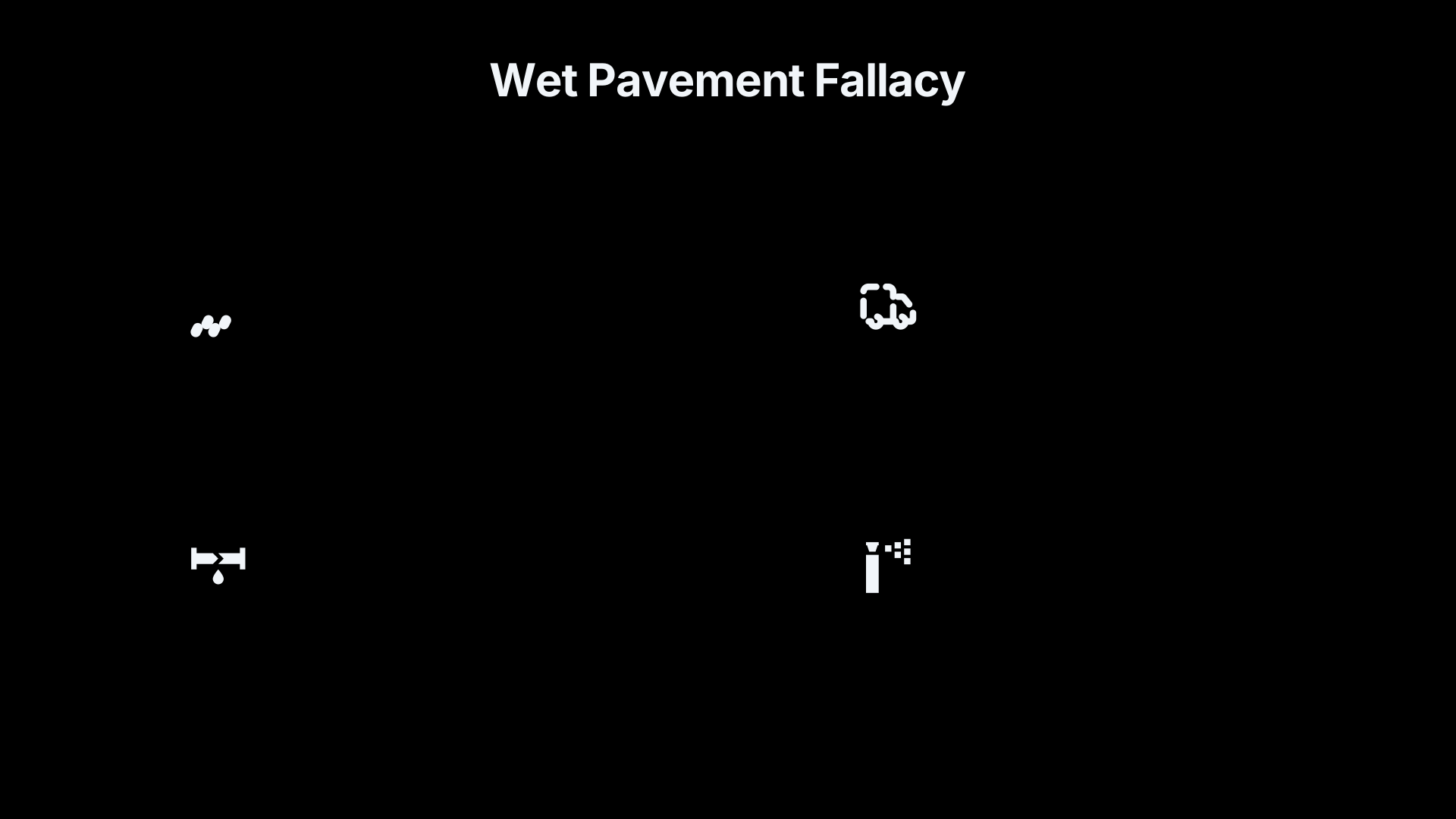
- Street cleaning vehicles often spray and wash road surfaces as part of maintenance operations. Municipal street-cleaning and sweeping programmes routinely use water during cleaning activities.[samenvoorzuiverelucht.eu]samenvoorzuiverelucht.euProvide adequate street cleaningStreet cleaning, especially sweeping and then spraying, helps to temporarily lower the concentrations of…[Aerosol and Air Quality Research]aaqr.orgAerosol and Air Quality ResearchDo the Street Sweeping and Washing Work for Reducing…by SL Lin · 2023 · Cited by 13 — This study suppo…
- Lawn sprinklers and irrigation systems can spray water onto nearby pavements, footpaths, and roads.
- Water-main leaks or broken pipes can release substantial amounts of water onto streets.
- Overflow and flooding from drains, rivers, or stormwater systems can leave surfaces wet long after rainfall has stopped elsewhere.
- Vehicle washing or industrial cleaning operations may discharge water onto surrounding paved areas.
The important point is not the exact number of alternatives. Even a single plausible alternative is enough to show that wet pavement does not uniquely identify rain as its cause.[Wikipedia]WikipediaAffirming the consequentAffirming the consequent
Why Alternative Causes Matter
The presence of multiple possible causes changes the logical status of the observation.
Suppose a person sees wet pavement at dawn. Rain is one explanation. A municipal cleaning crew that passed through during the night is another. If both explanations fit the evidence, then the observation alone cannot establish which one occurred. The effect underdetermines the cause.
This is precisely why affirming the consequent fails. The original conditional statement identifies one route from cause to effect, but it says nothing about whether other routes exist. When people jump from the observed effect back to a preferred cause, they silently add an extra premise: “and no other cause could have produced this result.” That additional premise is usually unstated and often unsupported.[Wikipedia]WikipediaAffirming the consequentAffirming the consequent[James Fodor]jamesfodor.comJames Fodor Affirming the ConsequentJames FodorAffirming the ConsequentDecember 9, 2020 — Explanation: this fallacy involves reasoning that since one thing implies a second…
How Causal Overreach Happens
Causal overreach occurs when an observation is treated as stronger evidence than it really is. In the wet-pavement example, rain is a familiar and common cause, so the mind tends to favour it automatically. Familiarity can make an explanation feel certain even when competing explanations remain possible.
The risk increases when:
- One cause is especially common or memorable.
- Alternative causes are less visible.
- People stop searching once they find a plausible explanation.
- The conclusion matches prior expectations.
In these situations, a reasonable guess can gradually be mistaken for a logical proof. The inference may still be correct by chance, but correctness and validity are different issues. A valid deduction guarantees its conclusion; affirming the consequent does not.[Wikipedia]WikipediaAffirming the consequentAffirming the consequent[2diales.com]diales.comThe reasoning is flawed, which often leads…Read more…

From Observation to Better Reasoning
The lesson of the wet-pavement example is not that rain should never be inferred. In everyday life, rain may well be the most likely explanation. The lesson is narrower and more important: an observed effect does not automatically identify its cause.
A careful reasoner asks what else could have produced the same outcome. If several plausible mechanisms exist—street cleaning, sprinklers, leaks, flooding, or rain—then the observation supports multiple explanations rather than proving one of them. Recognising those alternatives prevents causal overreach and helps distinguish a plausible hypothesis from a logically certain conclusion.[Wikipedia]WikipediaAffirming the consequentAffirming the consequent
Amazon book picks
Further Reading
Books and field guides related to What Else Could Make Pavement Wet?. Use these as the next step if you want deeper reading beyond the article.
An Illustrated Book of Bad Arguments
Uses simple examples similar to the wet-pavement case.
eBay marketplace picks
Marketplace Samples
Example marketplace items related to this page. Use the search link to explore similar finds on eBay.


Endnotes
1.
Source: Wikipedia
Title: Affirming the consequent
Link:https://en.wikipedia.org/wiki/Affirming_the_consequent
2.
Source: diales.com
Link:https://www.diales.com/nl/news/the-fallacy-of-affirming-the-consequent
Source snippet
The reasoning is flawed, which often leads...Read more...
3.
Source: samenvoorzuiverelucht.eu
Link:https://samenvoorzuiverelucht.eu/en/inspiratie/provide-adequate-street-cleaning
4.
Source: youtube.com
Title: Affirming the Consequent
Link:https://www.youtube.com/watch?v=_WDDVz-EWFw
Source snippet
Deductive Fallacies - Affirming the Consequent & Denying the Antecedent...
5.
Source: jamesfodor.com
Title: James Fodor Affirming the Consequent
Link:https://jamesfodor.com/affirming-the-consequent/
Source snippet
James FodorAffirming the ConsequentDecember 9, 2020 — Explanation: this fallacy involves reasoning that since one thing implies a second...
Published: December 9, 2020
6.
Source: khanacademy.org
Link:https://www.khanacademy.org/partner-content/wi-phi/wiphi-critical-thinking/wiphi-fallacies/v/affirming-the-consequent
Source snippet
Fallacies: Affirming the Consequent (video)If you confuse sufficient and necessary conditions, you get the fallacy of affirming the conse...
7.
Source: aaqr.org
Link:https://aaqr.org/articles/aaqr-22-09-oa-0338
Source snippet
Aerosol and Air Quality ResearchDo the Street Sweeping and Washing Work for Reducing...by SL Lin · 2023 · Cited by 13 — This study suppo...
8.
Source: dictionary.cambridge.org
Link:https://dictionary.cambridge.org/dictionary/english/logical
Source snippet
English meaning - Cambridge Dictionary6 days ago — LOGICAL definition: 1. using reason: 2. using reason: 3. reasonable and based on goo...
Additional References
9.
Source: pubmed.ncbi.nlm.nih.gov
Title: It has been well documented that street dust washes into local watersheds
Link:https://pubmed.ncbi.nlm.nih.gov/25367134/
Source snippet
dust: implications for stormwater and air quality, and...by SJ Calvillo · 2015 · Cited by 74 — Street dust represents a source of dual p...
10.
Source: merriam-webster.com
Link:https://www.merriam-webster.com/dictionary/logical
Source snippet
LOGICAL Definition & Meaning1. a (1): of, relating to, involving, or being in accordance with logic a logical conclusion (2): skilled i...
11.
Source: stormwatercenter.net
Link:https://www.stormwatercenter.net/Pollution_Prevention_Factsheets/ParkingLotandStreetCleaning.htm
Source snippet
Pollution Prevention: Parking Lot and Street CleaningIn colder climates, street sweeping is used during the spring snowmelt to reduce pol...
12.
Source: sustainabletechnologies.ca
Link:https://sustainabletechnologies.ca/home/urban-runoff-green-infrastructure/pollution-prevention/street-cleaning/
Source snippet
Street CleaningThe practice of street cleaning has long been used as a method to reduce road pollution and enhance the aesthetic appeal o...
13.
Source: ditext.com
Link:https://www.ditext.com/fearnside/44.html
14.
Source: reddit.com
Link:https://www.reddit.com/r/philosophy/comments/3wxz64/logical_fallacy_affirming_the_consequent/
15.
Source: reddit.com
Link:https://www.reddit.com/r/philosophy/comments/rm0m7/what_makes_logic_logical/
16.
Source: airuse.eu
Link:https://airuse.eu/wp-content/uploads/2013/11/B7-3-ES_road-cleaning.pdf
Source snippet
effect of road sweeping and washing (separately or combined) on reducing emissions and PM...Read more...
17.
Source: collinsdictionary.com
Title: LOGICA L definition and meaning | Collins English Dictionary1
Link:https://www.collinsdictionary.com/dictionary/english/logical
Source snippet
relating to, used in, or characteristic of logic 2. using, according to, or deduced from the principles of logic a logical conclusion.Rea...
18.
Source: psychotricks.com
Title: Psycho Tricks Understanding the Ground-Consequent Fallacy
Link:https://psychotricks.com/ground-consequent-fallacy/
Source snippet
Understanding the Ground-Consequent Fallacy - PsychoTricks8 Jul 2025 — The ground-consequent fallacy, also known as affirming the consequ...
Topic Tree