Within False Cause
The One Question False Causes Avoid
Asking what probably would have happened without the supposed cause helps reveal whether timing is doing too much work.
On this page
- The basic counterfactual test for causation
- How trends and normal recovery change the answer
- Limits of counterfactual thinking in real cases
Page outline Jump by section
Introduction
False cause claims often survive because they tell a convincing story: one event happened, and shortly afterwards another event followed. The missing step is whether the outcome would have occurred anyway. Counterfactual thinking addresses that gap by asking a simple question: What would probably have happened if the supposed cause had never occurred?
 This approach is central to modern thinking about causation. In philosophy, law, epidemiology, and causal inference, a causal claim becomes more credible when the outcome would likely have been different without the alleged cause. If the outcome probably would have happened regardless, the apparent cause loses much of its explanatory power.[stanford]plato.stanford.eduEncyclopedia of Philosophy Causation in the LawSuch a test asks a counterfactual question: “but for the defendant's action, would the victim have…Read more… Encyclopedia of Philosophy[Stanford Encyclopedia of Philosophy]plato.stanford.educausation counterfactualStanford Encyclopedia of PhilosophyCounterfactual Theories of Causationby P Menzies · 2001 · Cited by 605 — The basic idea of counterfact…
Within post hoc reasoning, counterfactual questions matter because they shift attention away from sequence alone. Instead of asking whether A came before B, they ask whether A actually changed the course of events.
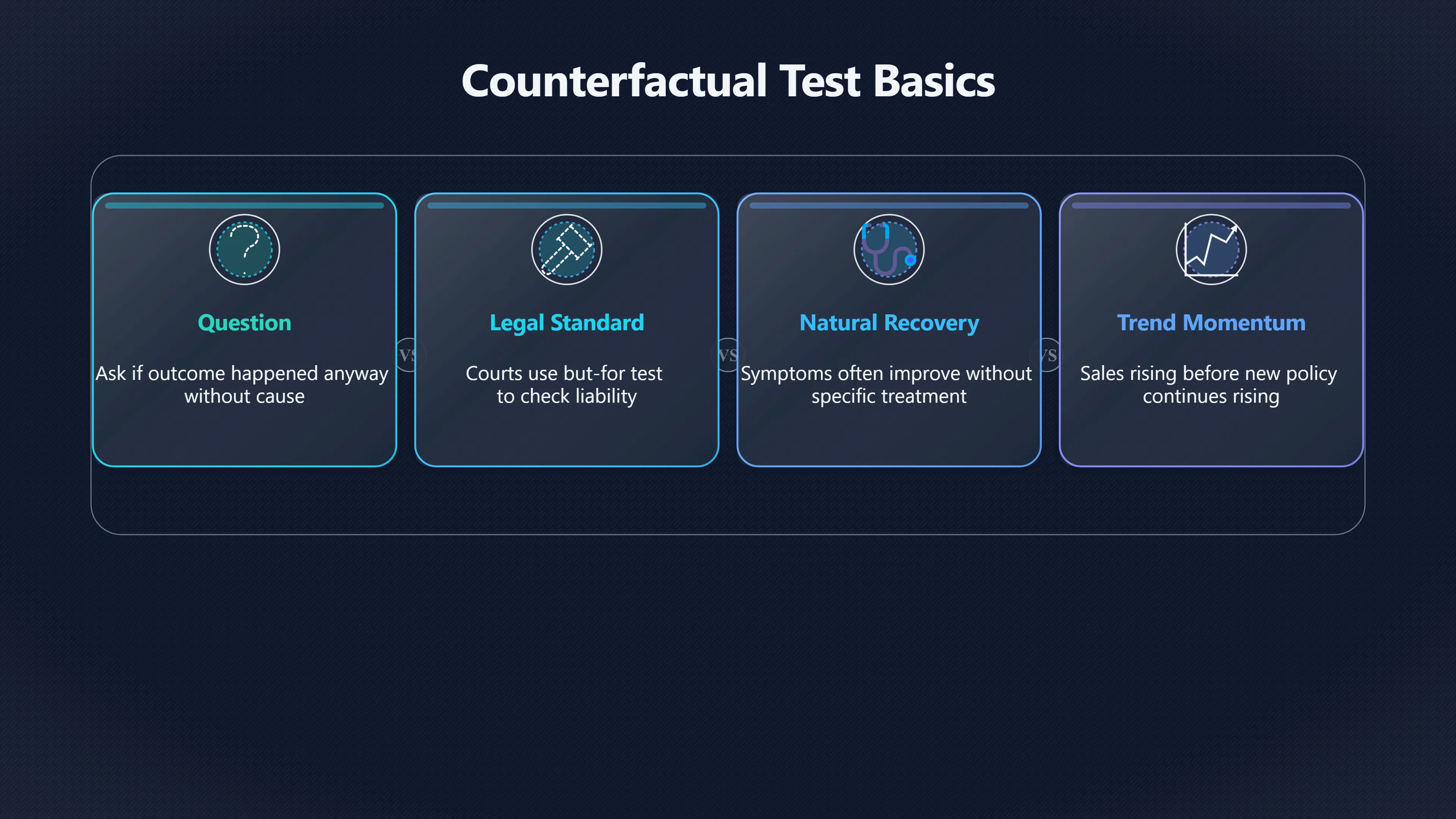
The Basic Counterfactual Test for Causation
The core test can be expressed in one sentence:
If the supposed cause had not happened, would the outcome probably still have occurred?
Counterfactual theories of causation are built around this idea. A cause is important when its absence would have made a meaningful difference to what followed. Philosophers often describe this through a conditional relationship: if the cause had not occurred, the effect would not have occurred in the same way.[stanford]plato.stanford.eduEncyclopedia of Philosophy Causation in the LawSuch a test asks a counterfactual question: “but for the defendant's action, would the victim have…Read more… Encyclopedia of Philosophy[Stanford Encyclopedia of Philosophy]plato.stanford.educausation counterfactualStanford Encyclopedia of PhilosophyCounterfactual Theories of Causationby P Menzies · 2001 · Cited by 605 — The basic idea of counterfact…
The same logic appears in legal reasoning through the familiar “but-for” test. Courts frequently ask whether a harmful outcome would have occurred but for the defendant’s action. The purpose is not merely to establish chronology but to determine whether the action actually contributed to the result.[stanford]plato.stanford.eduEncyclopedia of Philosophy Causation in the LawSuch a test asks a counterfactual question: “but for the defendant's action, would the victim have…Read more… Encyclopedia of Philosophy
Consider three common situations:
- Someone takes a supplement and feels better a few days later.
- A city introduces a new policy and crime falls the following month.
- A sports team changes manager and begins winning matches.
A post hoc argument treats the sequence as evidence of causation. A counterfactual question asks whether recovery, improvement, or success was already likely for other reasons. If the answer is yes, the timing becomes much less persuasive.
The strength of this approach is that it forces a comparison between reality and a plausible alternative reality. Rather than accepting the first explanation that fits the timeline, it asks whether the alleged cause actually changed expectations about the outcome.
How Trends and Normal Recovery Change the Answer
Many false cause claims become less convincing once natural trends are considered.
Improvement that was already likely
People often seek treatment, make changes, or take action when a problem is at its worst. Because many conditions fluctuate naturally, improvement may occur even without intervention.
A person with severe back pain may begin a new therapy during a particularly painful episode. If symptoms improve a week later, the therapy may receive full credit. Yet some of that improvement may have occurred anyway because the episode was already likely to ease.
This problem is closely related to regression to the mean, a statistical phenomenon in which unusually extreme measurements tend to move closer to average on subsequent observations. Researchers have repeatedly warned that regression to the mean can create the illusion that an intervention caused improvement when the apparent improvement would have occurred naturally.[PMC]pmc.ncbi.nlm.nih.govPMCAssessing regression to the mean effects in health careby A Linden · 2013 · Cited by 238 — This statistical phenomenon is known as “regression to the mean” (RTM) and often leads to an inacc…[2J Epidemiol Community Health]jech.bmj.comJ Epidemiol Community HealthOP89 Quantifying bias due to regression to the mean in…by SC Gadd · 2016 — Methods used to analyse these r…
A useful counterfactual question is:[plato.stanford.edu]plato.stanford.eduEncyclopedia of Philosophy Causation in the LawSuch a test asks a counterfactual question: “but for the defendant's action, would the victim have…Read more…
If nothing had been done, how much improvement would we reasonably expect to see anyway?
The more likely natural recovery becomes, the weaker a simple before-and-after causal claim appears.
Trends that began before the alleged cause
False cause arguments often ignore momentum.
Imagine that a company’s sales have increased steadily for six months. A new management initiative is introduced in month seven, and sales continue rising. A post hoc argument may credit the initiative. A counterfactual analysis asks whether the upward trend would probably have continued without it.
The same issue appears in politics, economics, education, and public health. When a trend is already moving in a particular direction, later events can receive credit for changes that were already underway.
A practical question is:
Did the outcome start changing before the supposed cause appeared?
If the answer is yes, the alleged cause may be less influential than the timeline suggests.

Competing explanations
Counterfactual reasoning also helps compare alternative causes.
Suppose a student begins using a study application and later achieves higher marks. The application may deserve some credit. But other possibilities exist: more study time, better teaching, increased motivation, improved health, or easier assessments.
The key issue is not whether the application could have helped. The question is whether removing the application from the story would substantially change expectations about the outcome.
By comparing realistic alternatives rather than focusing on a single sequence of events, counterfactual thinking reduces the risk of accepting a false cause claim.
Practical Counterfactual Questions to Ask
Counterfactual reasoning becomes most useful when translated into concrete checks.
When evaluating a causal claim, ask:
- Would the outcome probably have happened anyway?
- Was the outcome already moving in the same direction before the alleged cause appeared?
- What happened in similar cases where the supposed cause was absent?
- Are there alternative explanations that fit the evidence equally well or better?
- If the alleged cause were removed, would the outcome likely change?
- Does the claim depend entirely on timing, or is there independent evidence of causation?
These questions do not guarantee the correct answer. Their value lies in forcing a comparison between competing explanations rather than allowing sequence alone to decide the issue.
Why Timing Alone Is Not Enough
A genuine cause must usually occur before its effect. However, temporality is only a starting point, not a conclusion.
In epidemiology, temporality is considered a necessary condition for causation, but researchers evaluate causal claims using a broader pattern of evidence. The widely used Bradford Hill framework treats timing as important while recognising that causal conclusions require more than sequence alone.[rtihs.org]rtihs.orgause did not precede the effect, that indeed is indisputable.Read more…[PMC]pmc.ncbi.nlm.nih.govPMCAssessing regression to the mean effects in health careby A Linden · 2013 · Cited by 238 — This statistical phenomenon is known as “regression to the mean” (RTM) and often leads to an inacc… HealthKnowledge This distinction matters because many unrelated events occur in sequence purely by chance. If timing were enough[youtube.com]youtube.comCausation # 1Counterfactual Theories of Causation | Philosopher Friends…, countless coincidental patterns would qualify as causes.
Counterfactual questions help reveal when timing is carrying more evidential weight than it deserves. They encourage investigation of background trends, comparison groups, alternative explanations, and natural variation rather than treating chronology as proof.
Limits of Counterfactual Thinking in Real Cases
Counterfactual questions are powerful, but they are not infallible.
The main difficulty is that the alternative world being imagined cannot be observed directly. Nobody can rerun history and remove a single event while keeping everything else unchanged. Counterfactual reasoning therefore depends on evidence, judgement, and comparison rather than certainty.[stanford]plato.stanford.eduEncyclopedia of Philosophy Causation in the LawSuch a test asks a counterfactual question: “but for the defendant's action, would the victim have…Read more… Encyclopedia of Philosophy[Stanford Encyclopedia of Philosophy]plato.stanford.educausation counterfactualStanford Encyclopedia of PhilosophyCounterfactual Theories of Causationby P Menzies · 2001 · Cited by 605 — The basic idea of counterfact…
Complex events also have multiple causes. A business success may result from marketing, pricing, product quality, economic conditions, and luck acting together. Removing one factor may not eliminate the outcome entirely, even if that factor contributed to it.
In addition, poorly chosen counterfactuals can be misleading. An imagined alternative must be realistic. Asking what would have happened if an event never occurred is useful only when the proposed alternative is plausible and grounded in evidence.
For that reason, counterfactual thinking works best as a challenge to weak causal claims rather than as a standalone proof of causation.
The One Question False Causes Avoid
False cause arguments depend on a simple narrative: first A happened, then B happened. Counterfactual reasoning interrupts that narrative by introducing a competing possibility.
The decisive question is not merely whether the events occurred in sequence. It is whether the outcome would probably have been different without the supposed cause.
When a claim survives that test, it becomes more credible. When the outcome appears likely to have occurred anyway, the persuasive power of timing alone begins to disappear. That is why counterfactual questions are among the most effective tools for exposing post hoc reasoning and separating genuine causal evidence from a convincing sequence of events.
eBay marketplace picks
Marketplace Samples
Example marketplace items related to this page. Use the search link to explore similar finds on eBay.


Endnotes
1.
Source: plato.stanford.edu
Title: causation counterfactual
Link:https://plato.stanford.edu/entries/causation-counterfactual/
Source snippet
Stanford Encyclopedia of PhilosophyCounterfactual Theories of Causationby P Menzies · 2001 · Cited by 605 — The basic idea of counterfact...
2.
Source: plato.stanford.edu
Title: Encyclopedia of Philosophy Causation in the Law
Link:https://plato.stanford.edu/entries/causation-law/
Source snippet
Such a test asks a counterfactual question: “but for the defendant's action, would the victim have...Read more...
3.
Source: plato.stanford.edu
Title: causation counterfactual
Link:https://plato.stanford.edu/archives/win2018/entries/causation-counterfactual/
Source snippet
Stanford Encyclopedia of PhilosophyCounterfactual Theories of CausationJan 10, 2001 — The basic idea of counterfactual theories of causat...
4.
Source: pmc.ncbi.nlm.nih.gov
Title: PMCAssessing regression to the mean effects in health care
Link:https://pmc.ncbi.nlm.nih.gov/articles/PMC3849564/
Source snippet
by A Linden · 2013 · Cited by 238 — This statistical phenomenon is known as “regression to the mean” (RTM) and often leads to an inacc...
5.
Source: pmc.ncbi.nlm.nih.gov
Link:https://pmc.ncbi.nlm.nih.gov/articles/PMC4589117/
Source snippet
Applying the Bradford Hill criteria in the 21st century: how data...by KM Fedak · 2015 · Cited by 889 — In 1965, Sir Austin Bradford...
6.
Source: pmc.ncbi.nlm.nih.gov
Link:https://pmc.ncbi.nlm.nih.gov/articles/PMC8206235/
Source snippet
Assessing causality in epidemiology: revisiting Bradford Hill to...by M Shimonovich · 2020 · Cited by 219 — Temporality is considered...
7.
Source: rtihs.org
Link:https://www.rtihs.org/sites/default/files/26902%20Rothman%201998%20The%20encyclopedia%20of%20biostatistics.pdf
Source snippet
ause did not precede the effect, that indeed is indisputable.Read more...
8.
Source: plato.stanford.edu
Title: Encyclopedia of Philosophy Counterfactuals
Link:https://plato.stanford.edu/entries/counterfactuals/
Source snippet
What if Martin Luther King had died when he was stabbed in 1958...Read more...
9.
Source: plato.stanford.edu
Title: causation counterfactual
Link:https://plato.stanford.edu/archives/fall2019/entries/causation-counterfactual/
Source snippet
Theories of Causation10 Jan 2001 — The counterfactuals state dependences of whether, when, and how one event occurs on whether, when, and...
10.
Source: plato.stanford.edu
Title: causation counterfactual
Link:https://plato.stanford.edu/archives/win2006/entries/causation-counterfactual/
Source snippet
Theories of Causation10 Jan 2001 — The theory assumes that causation is an absolute relation whose nature does not vary from one [context]({{ 'context/' | relative_url }})...
11.
Source: plato.stanford.edu
Link:https://plato.stanford.edu/entries/causation-regularity/
Source snippet
and Inferential Theories of Causationby H Andreas · 2021 · Cited by 37 — Since then, counterfactual theories of causation have risen and...
12.
Source: plato.stanford.edu
Title: causation physics
Link:https://plato.stanford.edu/entries/causation-physics/
Source snippet
in Physics - Stanford Encyclopedia of Philosophyby M Frisch · 2020 · Cited by 49 — A lively and active philosophical [debate]({{ 'debate/' | relative_url }}) on whether ca...
13.
Source: plato.stanford.edu
Title: causation counterfactual
Link:https://plato.stanford.edu/archives/fall2003/entries/causation-counterfactual/
Source snippet
Theories of Causation12 Jan 2001 — The basic idea of counterfactual theories of causation is that the meaning of a singular causal claim...
14.
Source: youtube.com
Title: Causation # 1
Link:https://www.youtube.com/watch?v=dUFXhQfh24Y
Source snippet
Counterfactual Theories of Causation | Philosopher Friends...
15.
Source: youtube.com
Title: Counterfactual Theories of Causation | Philosopher Friends
Link:https://www.youtube.com/watch?v=qHkWZUBNJbE
16.
Source: jech.bmj.com
Link:https://jech.bmj.com/content/70/Suppl_1/A49.1
Source snippet
J Epidemiol Community HealthOP89 Quantifying bias due to regression to the mean in...by SC Gadd · 2016 — Methods used to analyse these r...
17.
Source: research.manchester.ac.uk
Title: manchester.ac.uk Counterfactual Theories of Causation
Link:https://research.manchester.ac.uk/en/publications/counterfactual-theories-of-causation
Source snippet
Theories of Causation - Research Explorerby H Beebee · 2019 · Cited by 8 — The basic idea of counterfactual theories of causation is that...
19.
Source: linkedin.com
Link:https://www.linkedin.com/posts/richard-hahn-a1096050_the-so-called-bradford-hill-criteria-are-activity-7432457882136244224-7vEb
Source snippet
Bradford Hill Criteria for Causal Inference in MedicineThe so-called “Bradford Hill criteria” are a set of nine desiderata that were prop...
20.
Source: healthknowledge.org.uk
Link:https://www.healthknowledge.org.uk/e-learning/epidemiology/practitioners/causation-epidemiology-[association
Source snippet
Causation in epidemiology: association and causationThe Bradford-Hill criteria are widely used in epidemiology as providing a framework a...
21.
Source: benlengerich.medium.com
Link:https://benlengerich.medium.com/inverse-bradford-hill-criteria-how-association-flirts-with-causality-in-real-world-evidence-and-93db480c48fe
Source snippet
Bradford Hill Criteria: How Association Flirts with...Let's look at how Mendelian Randomization applies these principles to use the natu...
22.
Source: embryo.asu.edu
Title: environment and disease association or causation 1965 austin bradford hill
Link:https://embryo.asu.edu/pages/environment-and-disease-association-or-causation-1965-austin-bradford-hill
Source snippet
or Causation?" (1965), by Austin Bradford Hill23 Mar 2017 — The fourth criterion is temporality, which he defines as determining whether...
23.
Source: usablebuildings.co.uk
Link:https://www.usablebuildings.co.uk/UsableBuildings/Unprotected/BradfordHillCriteria.pdf
Source snippet
ocial programs, feedback loops might mean causality is bi- directional and possibly multi-...Read more...
24.
Source: drbenvincent.medium.com
Title: In other words, the cause should come before the effect
Link:https://drbenvincent.medium.com/bradford-hills-criteria-for-causation-14fcffdef333
Source snippet
medium.comBradford-Hill's criteria for causation - Benjamin Vincent - MediumTemporal precedence: The exposure should precede the developm...
25.
Source: jove.com
Link:https://www.jove.com/science-education/v/17608/criteria-for-causality-bradford-hill-criteria-i
Source snippet
Video: Criteria for Causality: Bradford Hill Criteria - I9 Jan 2025 — The temporality criterion suggests that the cause must precede the...
26.
Source: philpapers.org
Title: Phil Papers Counterfactual theories of causation
Link:https://philpapers.org/rec/MENCTO
Source snippet
Peter Menziesby P Menzies · 2008 · Cited by 605 — The basic idea of counterfactual theories of causation is that the meaning of causal cl...
27.
Source: fiveable.me
Title: Bradford Hill Criteria Definition
Link:https://fiveable.me/introduction-epidemiology/key-terms/bradford-hill-criteria
Source snippet
Intro to Epidemiology...Temporality is a vital aspect of the Bradford Hill Criteria because it establishes that the cause must occur befo...
28.
Source: researchgate.net
Link:https://www.researchgate.net/publication/395544485_Regression_adjustment_for_causal_inference
Source snippet
The standard approach, logistic...Read more...
Topic Tree