Within Fallacy Lab
Is Tone the Same as Logic?
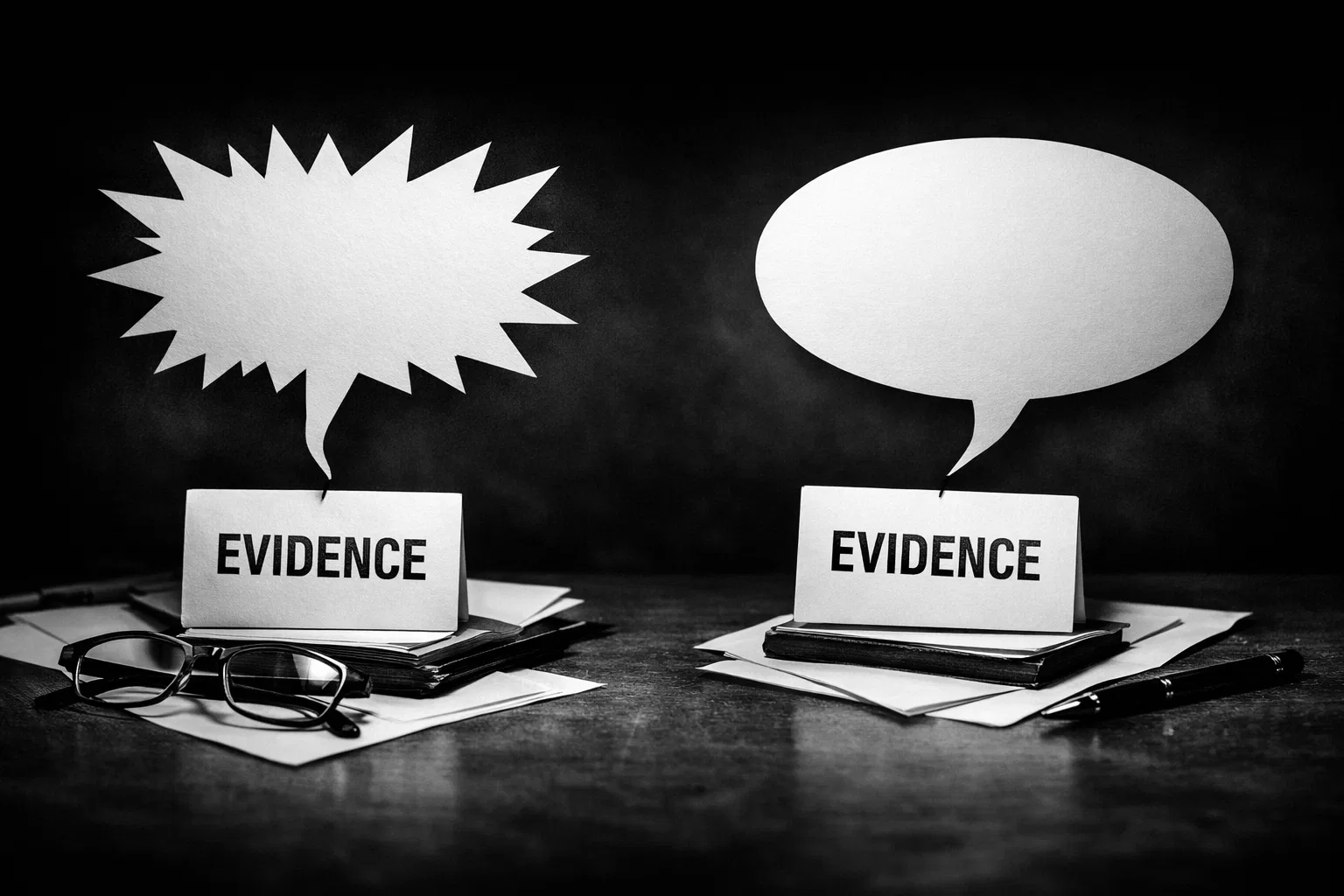
An argument can be impolite yet relevant, or polite yet logically weak, so tone alone is not the test.
On this page
- Emotion and relevance
- Rudeness without fallacy
- Polished weak arguments
Page outline Jump by section
Introduction
Tone is not the same as logic. A harsh argument can still give relevant reasons, and a polite argument can still dodge the point, distort the evidence or lean on a weak inference. In the study of logical fallacies, the central test is not “Was the speaker nice?” but “Do the reasons actually support the conclusion?” This distinction matters because arguments about fallacies often go wrong in two opposite ways: people dismiss a sound criticism because it sounds rude, or they excuse a bad argument because it sounds calm and civil.
The most common confusion sits near the ad hominem fallacy. An ad hominem becomes fallacious when it attacks a person instead of addressing the claim or evidence. But not every unpleasant personal remark is doing that logical work. Some insults are merely uncivil add-ons; some criticisms of a speaker’s conduct are directly relevant; and some polished, respectful comments are still fallacious because they avoid the issue. The practical skill is to separate tone, relevance and argumentative support.[Internet Encyclopedia of Philosophy]iep.utm.eduInternet Encyclopedia of PhilosophyFallaciesThe major difficulty with labeling a piece of reasoning an Ad Hominem Fallacy is deciding whe…[Philosophy Home Page]philosophy.lander.eduPhilosophy Home PageAd HominemOften the fallacy is characterized simply as a personal attack. However, a personal attack is a claim, not…
Why emotion is not automatically a fallacy
A fallacy is a problem in reasoning, not simply a strong feeling. Anger, frustration, sarcasm or grief can make an exchange harder to hear, but none of them proves that the argument is logically defective. Informal logic scholars have long argued that real-life argument is not just a sequence of neat propositions; emotion can signal urgency, perceived injustice, danger, commitment or the human stakes behind a claim. Michael Gilbert’s work on emotion and informal logic, for example, argues that everyday argumentation should not treat emotion as automatically outside rational exchange.[informallogic.ca]informallogic.caEmotion, Argumentation and Informal Logic*April 9, 2009 — by MA Gilbert · 2004 · Cited by 109 — In particular, I examine the role of emotion in everyday argumentation, and how Inf…
The same point appears in discussions of appeal to emotion. Emotional language becomes fallacious when it replaces relevant evidence or distracts from the issue that needs to be proved. A person saying “This policy is cruel because it will leave these named groups without housing, according to the eligibility rules” may be emotional, but the argument is still offering a relevant reason. By contrast, “Support this policy or you do not care about children” uses emotional pressure to shortcut the actual question. The difference is not emotional versus unemotional; it is evidentially connected versus evasive.[Wikipedia]WikipediaAppeal to emotionAppeal to emotion
That is why “calm down” can be a poor reply to an argument. If the speaker has made a factual claim, cited evidence, or offered a relevant objection, the listener has not answered it by criticising the speaker’s volume, mood or wording. Tone may matter for whether a conversation remains productive, but it does not by itself settle whether the reasoning is sound.
When rudeness is not the fallacy
Rudeness and fallacy can overlap, but they are not identical. A rude remark may be logically irrelevant, logically relevant, or not part of the argument at all. Lander University’s logic materials make this distinction sharply: a personal attack by itself is a claim, not automatically an ad hominem fallacy; it becomes the fallacy when it is used in place of addressing the truth or support of the argument.[Philosophy Home Page]philosophy.lander.eduPhilosophy Home PageAd HominemOften the fallacy is characterized simply as a personal attack. However, a personal attack is a claim, not…
Consider three different replies to the same claim: “The council should publish the pollution data.”
“Only an idiot would hide public-health data, and the council should publish it because residents need exposure figures to assess risk.” This is rude, but the reason is relevant: residents need the figures to judge the risk.
“Only an idiot would say that.” This is rude and weak, because it attacks the speaker without answering the claim.
“With respect, the council has always acted responsibly, so there is no need to publish anything further.” This is polite but logically weak if it substitutes vague reassurance for evidence about the data.
The ad hominem issue is especially sensitive because some personal criticism is relevant. The Internet Encyclopedia of Philosophy notes that the hard question is often whether the personal fact is relevant to the issue: private misconduct is irrelevant to someone’s reasoning about astronomy, but it may be relevant when judging fitness for a role where that conduct bears on trust or duty.[Internet Encyclopedia of Philosophy]iep.utm.eduInternet Encyclopedia of PhilosophyFallaciesThe major difficulty with labeling a piece of reasoning an Ad Hominem Fallacy is deciding whe…
This is the mechanism behind the “rude but relevant” category. A complaint may be blunt, even insulting, while still pointing to evidence that matters. “The witness lied under oath last year, so we should corroborate this testimony” may sound severe, but credibility is relevant in a testimonial setting. “The scientist is unpleasant, so the measurements are wrong” is different: the personal attack does not engage the method, data or inference.

Tone policing as a relevance mistake
Tone policing is the move of shifting attention from what is being argued to how it is being expressed, especially when the shift is used to avoid the substance. It is often discussed as a form of ad hominem because it targets the speaker’s manner, anger or emotional state rather than the truth or relevance of the claim.[Wikipedia]WikipediaTone policingTone policing
The fallacy risk lies in substitution. A listener may reasonably say, “I want to continue this discussion without insults,” because civility can protect the conditions for dialogue. But that is not the same as saying, “Your argument is invalid because you sound angry.” The first is a conversational boundary; the second is a logical dismissal. If the argument contains evidence, the evidence still needs to be answered.
This distinction matters in public arguments about inequality, workplace mistreatment, politics and institutional failure. People directly affected by a problem may speak with anger because the stakes are high. Treating that anger as disqualifying can turn tone into a gatekeeping device: the complaint is never reached because the speaker’s manner becomes the topic. The mistake is not caring about civility; it is using civility as a substitute for engagement with the claim.
A useful test is to ask: if the same argument were delivered calmly, would the objection still apply? If yes, the issue may be substantive. If no, the objection is probably about presentation rather than reasoning.
Civility can improve dialogue without proving logic
Tone is not irrelevant to communication. Incivility can make people defensive, discourage participation, and damage trust in a discussion. Research on online and political communication often defines incivility as disrespectful behaviour that can undermine deliberation, though studies vary in whether they include insults, emotional displays, accusations or stronger forms of hostility.[Frontiers]frontiersin.orgFrontiers Perceptions and Evaluations of Incivility in Public OnlineFrontiers Perceptions and Evaluations of Incivility in Public Online
That social effect is real, but it should not be confused with logical assessment. An argument may be rude enough to violate a discussion norm while still containing a good reason. A meeting chair, teacher or moderator may need to address the manner of speech to keep the exchange usable. But after doing so, the original claim remains to be evaluated.
This produces two separate judgements:
- Logical judgement: Does the reason support the conclusion?
- Conversational judgement: Is the way it is expressed fair, safe and useful for this setting?
- Ethical judgement: Does the speaker treat others with appropriate respect?
- Practical judgement: Will this style persuade, alienate or silence people?
A single statement can pass one test and fail another. “Your figures are nonsense because they double-count the same survey group” is abrasive, but it gives a checkable logical criticism. “Your argument is beautifully phrased and inclusive, so it must be right” is socially pleasant, but the compliment does not establish the conclusion.
Polished weak arguments can be more dangerous than obvious insults
A crude insult is easy to spot. A polished weak argument can travel further because it carries the signals of reasonableness: calm voice, tidy structure, formal vocabulary and respectful phrasing. But those signals are not proof of validity. Purdue OWL’s fallacy guide describes ad hominem as attacking character rather than engaging the argument; the same logic applies to many polished diversions, where the surface is civil but the reasoning still avoids the issue.[Purdue OWL]owl.purdue.eduOWLLogical FallaciesPurdue OWLLogical Fallacies - Purdue OWLAd hominem: This is an attack on the character of a person rather than his or her opinions or arg…
For example, a speaker might say: “I appreciate your passion, but serious people understand that this proposal is unrealistic.” The sentence sounds courteous, yet it may still commit a relevance error if it offers no reason the proposal is unrealistic. The phrase “serious people” functions as a social filter rather than evidence. In another setting, “Experts reject this” may be strong if it names relevant experts and their reasons; it is weak if it merely borrows the prestige of expertise without showing fit, evidence or agreement.
Polished weak arguments often rely on substitutions:
- Respectful dismissal instead of refutation: “That concern is understandable, but we must be practical.”
- Status language instead of evidence: “No responsible analyst would take that view.”
- Procedural calm instead of substance: “This is not the right tone for a productive discussion.”
- Vague balance instead of accuracy: “Both sides make good points,” even when one side has not supported its claim.
The danger is that listeners may mistake social fluency for logical strength. A cleanly phrased argument can still be a red herring, a straw man, an appeal to irrelevant authority, or an ad hominem in softened language.

How to tell the difference in practice
The simplest method is to separate the argument from its packaging before judging either. Start by identifying the claim, then the reason offered for it, then the connection between the two. Only after that should tone be assessed as a separate conversational matter.
A practical sequence is:
- State the claim neutrally. What is the speaker asking the audience to believe or do?
- Extract the reason. What evidence, principle or example is being offered?
- Test relevance. Would this reason make the claim more likely, more justified or more credible?
- Check substitution. Is the speaker answering the point, or replacing it with a comment about personality, mood, manners or status?
- Assess tone separately. Is the expression needlessly hostile, exclusionary or obstructive, even if the logic has some force?
This avoids two common errors. The first is the “rudeness equals fallacy” error, where people dismiss a relevant objection because they dislike the delivery. The second is the “politeness equals reason” error, where smooth phrasing conceals a missing link in the argument.
The distinction is especially important in debates about credibility. Personal facts can be relevant when the argument depends on trust, testimony, expertise, conflict of interest or consistency between words and actions. Douglas Walton’s work on ad hominem reasoning is often cited for this more nuanced view: some ad hominem arguments are fallacious diversions, but some raise legitimate critical questions about a speaker’s position, especially where inconsistency or credibility is directly at issue.[ScienceDirect]sciencedirect.comSource details in endnotes.[PhilPapers]philpapers.orgWALTAH 2WALTAH 2
The best rule: criticise reasoning, not merely temperature
The safest way to handle rude but relevant arguments is to answer the relevant part and, if needed, address the rudeness separately. “Your point about the missing data is important; the insult is not” is much stronger than “You were rude, so I reject your argument.” It preserves the logical issue without rewarding hostility.
Likewise, the best way to handle polished weak arguments is to ask for the missing link. “What evidence shows the proposal is unrealistic?” or “How does the speaker’s tone affect the truth of the claim?” brings the discussion back to relevance. This is the core skill behind fallacy-spotting: not naming the nastiest sentence, but identifying whether the reasons offered actually bear on the conclusion.
Tone matters for human conversation. Logic matters for whether a claim is supported. The two often interact, but they are not the same test. A good critic can say both things at once: the argument may be badly mannered, and it may still need an answer; the argument may be beautifully mannered, and it may still fail.
eBay marketplace picks
Marketplace Samples
Example marketplace items related to this page. Use the search link to explore similar finds on eBay.




Endnotes
1.
Source: philosophy.lander.edu
Link:https://philosophy.lander.edu/logic/person.html
Source snippet
Philosophy Home PageAd HominemOften the fallacy is characterized simply as a personal attack. However, a personal attack is a claim, not...
2.
Source: owl.purdue.edu
Title: OWLLogical Fallacies
Link:https://owl.purdue.edu/owl/general_writing/academic_writing/logic_in_argumentative_writing/fallacies.html
Source snippet
Purdue OWLLogical Fallacies - Purdue OWLAd hominem: This is an attack on the character of a person rather than his or her opinions or arg...
3.
Source: informallogic.ca
Title: Emotion, Argumentation and Informal Logic*
Link:https://informallogic.ca/index.php/informal_logic/article/view/2147/1591
Source snippet
April 9, 2009 — by MA Gilbert · 2004 · Cited by 109 — In particular, I examine the role of emotion in everyday argumentation, and how Inf...
Published: April 9, 2009
4.
Source: Wikipedia
Title: Appeal to emotion
Link:https://en.wikipedia.org/wiki/Appeal_to_emotion
5.
Source: Wikipedia
Title: Tone policing
Link:https://en.wikipedia.org/wiki/Tone_policing
6.
Source: sciencedirect.com
Link:https://www.sciencedirect.com/science/article/pii/S1570868308000384
7.
Source: philpapers.org
Title: WALTAH 2
Link:https://philpapers.org/rec/WALTAH-2
8.
Source: Wikipedia
Title: Ad hominem
Link:https://en.wikipedia.org/wiki/Ad_hominem
9.
Source: Wikipedia
Title: Walton Group
Link:https://en.wikipedia.org/wiki/Walton_Group
10.
Source: informallogic.ca
Title: Woods Correct Paper
Link:https://informallogic.ca/index.php/informal_logic/article/view/467/436
11.
Source: informallogic.ca
Link:https://informallogic.ca/index.php/informal_logic/article/view/2990/2442
12.
Source: informallogic.ca
Title: Emotions and Argumentation
Link:https://informallogic.ca/index.php/informal_logic/article/view/2407/1849
13.
Source: philosophy.lander.edu
Link:https://philosophy.lander.edu/scireas/personal.html
14.
Source: philosophy.lander.edu
Title: fallacy answers
Link:https://philosophy.lander.edu/logic/fallacy_answers.html
15.
Source: philosophy.lander.edu
Link:https://philosophy.lander.edu/logic/popular.html
16.
Source: philosophy.lander.edu
Title: fallacies answers
Link:https://philosophy.lander.edu/logic/fallacies_answers.html
17.
Source: philosophy.lander.edu
Title: nature fall
Link:https://philosophy.lander.edu/logic/nature_fall.html
18.
Source: philosophy.lander.edu
Link:https://philosophy.lander.edu/logic/authority.html
19.
Source: philosophy.lander.edu
Link:https://philosophy.lander.edu/scireas/popular.html
20.
Source: philosophy.lander.edu
Link:https://philosophy.lander.edu/logic/complex.html
21.
Source: philosophy.lander.edu
Link:https://philosophy.lander.edu/logic/ignoratio.html
22.
Source: web.ics.purdue.edu
Title: Logical Fallacies
Link:https://web.ics.purdue.edu/~drkelly/LogicalFallacies.pdf
23.
Source: owl.purdue.edu
Title: rhetorical strategies
Link:https://owl.purdue.edu/owl/general_writing/academic_writing/establishing_arguments/rhetorical_strategies.html
24.
Source: web.ics.purdue.edu
Title: Russell Reimer 2018
Link:https://web.ics.purdue.edu/~treimer/assets/files/Russell%20Reimer%202018.pdf
25.
Source: web.ics.purdue.edu
Title: Russell Reimer 2020
Link:https://web.ics.purdue.edu/~treimer/assets/files/Russell%20Reimer%202020.pdf
26.
Source: walton.com
Link:https://walton.com/
27.
Source: walton.com
Link:https://walton.com/contact-us/
28.
Source: walton.com
Link:https://walton.com/leadership/
29.
Source: iep.utm.edu
Link:https://iep.utm.edu/fallacy/
Source snippet
Internet Encyclopedia of PhilosophyFallaciesThe major difficulty with labeling a piece of reasoning an Ad Hominem Fallacy is deciding whe...
30.
Source: scribbr.com
Title: appeal to emotion
Link:https://www.scribbr.com/fallacies/appeal-to-emotion/
Source snippet
Appeal to Emotion Fallacy | Definition & Examples26 Jul 2023 — Appeal to emotion fallacy occurs when someone tries to win an argum...
31.
Source: frontiersin.org
Title: Frontiers Perceptions and Evaluations of Incivility in Public Online
Link:https://www.frontiersin.org/journals/political-science/articles/10.3389/fpos.2022.812145/full
32.
Source: scribbr.com
Title: ad hominem fallacy
Link:https://www.scribbr.com/fallacies/ad-hominem-fallacy/
33.
Source: anecdotal.app
Link:https://anecdotal.app/fallacy/tone-policing/
34.
Source: logical-fallacy.com
Title: Ad Hominem
Link:https://www.logical-fallacy.com/articles/ad-hominem/
35.
Source: plato.stanford.edu
Link:https://plato.stanford.edu/archives/fall2020/entries/fallacies/
36.
Source: ebsco.com
Link:https://www.ebsco.com/research-starters/religion-and-philosophy/ad-hominem
37.
Source: utminers.utep.edu
Link:https://utminers.utep.edu/omwilliamson/engl1311/fallacies.htm
Additional References
38.
Source: youtube.com
Title: Not Every Insult is an Ad Hominem Fallacy!!! [SUB ESP] #logic #fallacy #insult
Link:https://www.youtube.com/watch?v=ZPI8olxv7UQ
Source snippet
The Ad Hominem Fallacy: Distracting Attacks...
39.
Source: researchgate.net
Link:https://www.researchgate.net/publication/227141322_The_ad_Hominem_argument_as_an_informal_fallacy
40.
Source: markmanson.net
Link:https://markmanson.net/logical-fallacies
41.
Source: emerald.com
Link:https://www.emerald.com/omj/article/17/1/43/314420/Do-you-pass-it-on-An-examination-of-the
42.
Source: reddit.com
Link:https://www.reddit.com/r/askphilosophy/comments/400vk7/how_can_i_show_that_a_tone_argument_tone_policing/
43.
Source: reddit.com
Link:https://www.reddit.com/r/askphilosophy/comments/ebsi7k/is_there_such_a_thing_as_a_valid_ad_hominem/
44.
Source: facebook.com
Link:https://www.facebook.com/AutisticTyping/posts/tone-policing-can-be-a-heated-topic-and-many-people-have-questions-about-what-it/489483281652075/
45.
Source: uapress.ua.edu
Link:https://www.uapress.ua.edu/9780817391140/ad-hominem-arguments/
46.
Source: theinclusionsolution.me
Link:https://theinclusionsolution.me/unpacking-the-conversations-that-matter-if-you-werent-so-angry-people-would-listen-and-the-problem-with-tone-policing/
47.
Source: linkedin.com
Link:https://www.linkedin.com/company/walton-global
Topic Tree