Within Circularity
Would the Premise Convince a Skeptic?
A simple test for circular reasoning is whether the premises could persuade someone who does not already accept the conclusion.
On this page
- The skeptic test for premises
- How to separate support from repetition
- Repairing a circular argument
Page outline Jump by section
Introduction
A quick way to detect circular reasoning is to ask a simple question: would the premises give a reasonable sceptic any new reason to accept the conclusion? If the answer is no, the argument may be relying on the conclusion itself rather than offering independent support for it. Philosophers and argumentation theorists often treat the absence of independent support as the central defect in circular arguments and question-begging reasoning. An argument may be logically valid in form, yet still fail as persuasion because anyone who doubts the conclusion will have equal reason to doubt the premises that supposedly establish it.[Internet Encyclopedia of Philosophy]iep.utm.eduInternet Encyclopedia of PhilosophyFallacies… circular reasoning in which a conclusion is derived from premises that presuppose the con…
 This “support test” is valuable because circularity is not always obvious. Sometimes the conclusion is repeated directly; in other cases it is hidden behind synonyms, assumptions, or a chain of mutually supporting claims. The key issue remains the same: are the premises standing on their own, or are they merely echoing the claim they are meant to prove? Encyclopedia Britannica[Philosophy Home Page]philosophy.lander.eduPhilosophy Home PagePetitio Principii, Circular Argument, Begging the QuestionPetitio principii is a logical fallacy where the conclusion…
Would the Premise Convince a Sceptic?
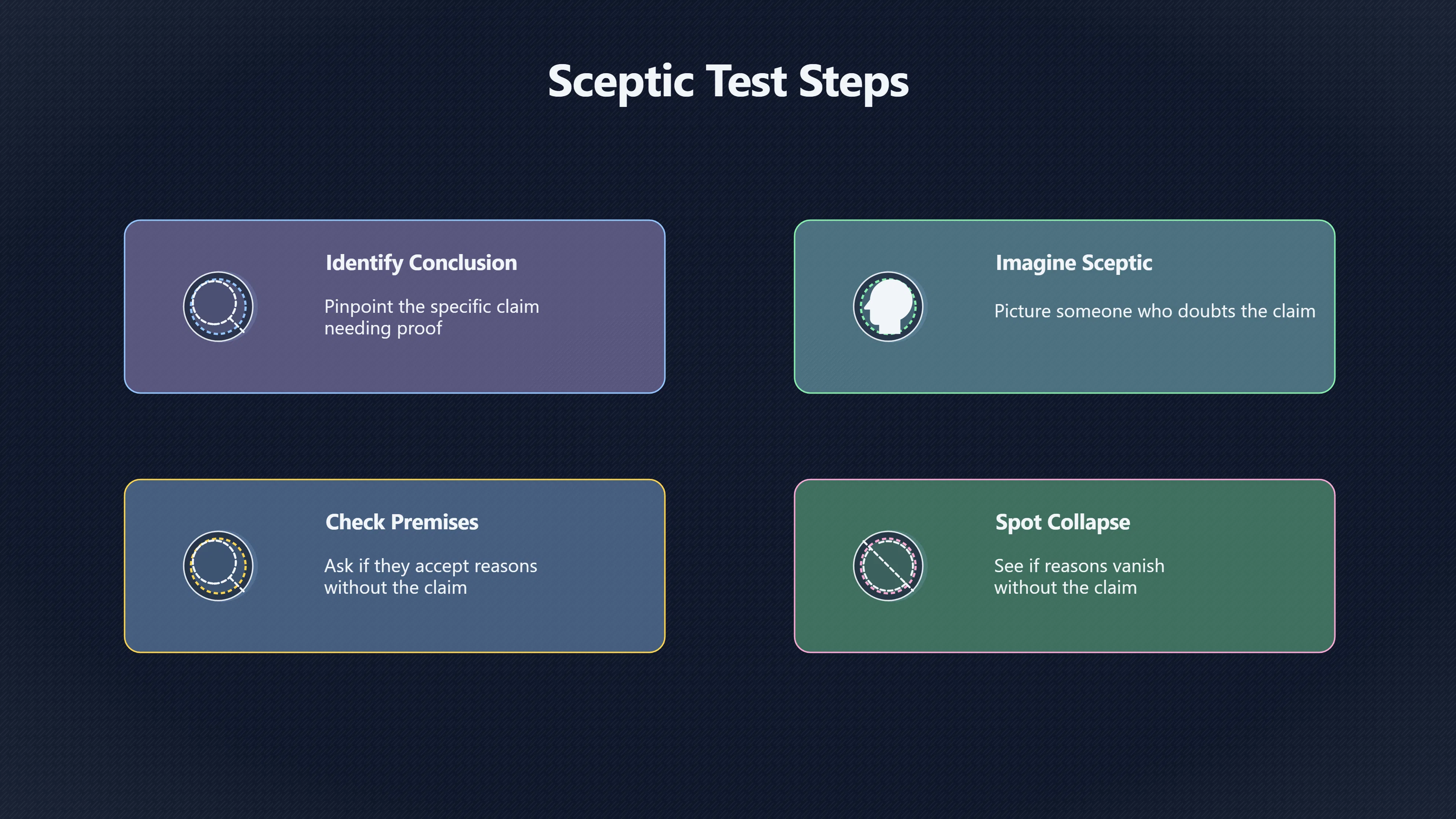
The most practical test for circular reasoning is sometimes called the sceptic test. Imagine a person who does not yet accept the conclusion. Now ask whether that person could reasonably accept the premises without already accepting the conclusion.
If accepting the premises requires accepting the conclusion first, the argument has not provided independent support. This is why circular arguments are often described as unpersuasive rather than merely invalid. The problem is not always that the conclusion fails to follow from the premises; the problem is that the premises offer no new grounds for believing it.[Wikipedia]WikipediaCircular reasoningCircular reasoning[Wikipedia]WikipediaBegging the questionBegging the question
Consider this argument:
This news outlet is trustworthy because it reports accurate information. We know its information is accurate because the outlet is trustworthy.
A sceptic who doubts the outlet’s trustworthiness gains no independent evidence from the second sentence. Each claim depends on the other. The reasoning moves in a circle rather than outward toward evidence.[Wikipedia]WikipediaCircular reasoningCircular reasoning
The test can be applied in a few seconds:
- Identify the conclusion.
- Imagine someone who does not accept it.
- Ask whether that person could still accept the premises.
- If the premises collapse when the conclusion is rejected, the support is probably circular.
The Difference Between Support and Repetition
Many circular arguments sound informative because they use different words. The support test helps reveal whether genuine evidence has been added.
Take the statement:
This medicine works because it is effective.
The premise appears to explain the conclusion, but “effective” and “works” communicate essentially the same idea. The argument has changed vocabulary without adding support.[Wikipedia]WikipediaBegging the questionBegging the question
A useful distinction is:
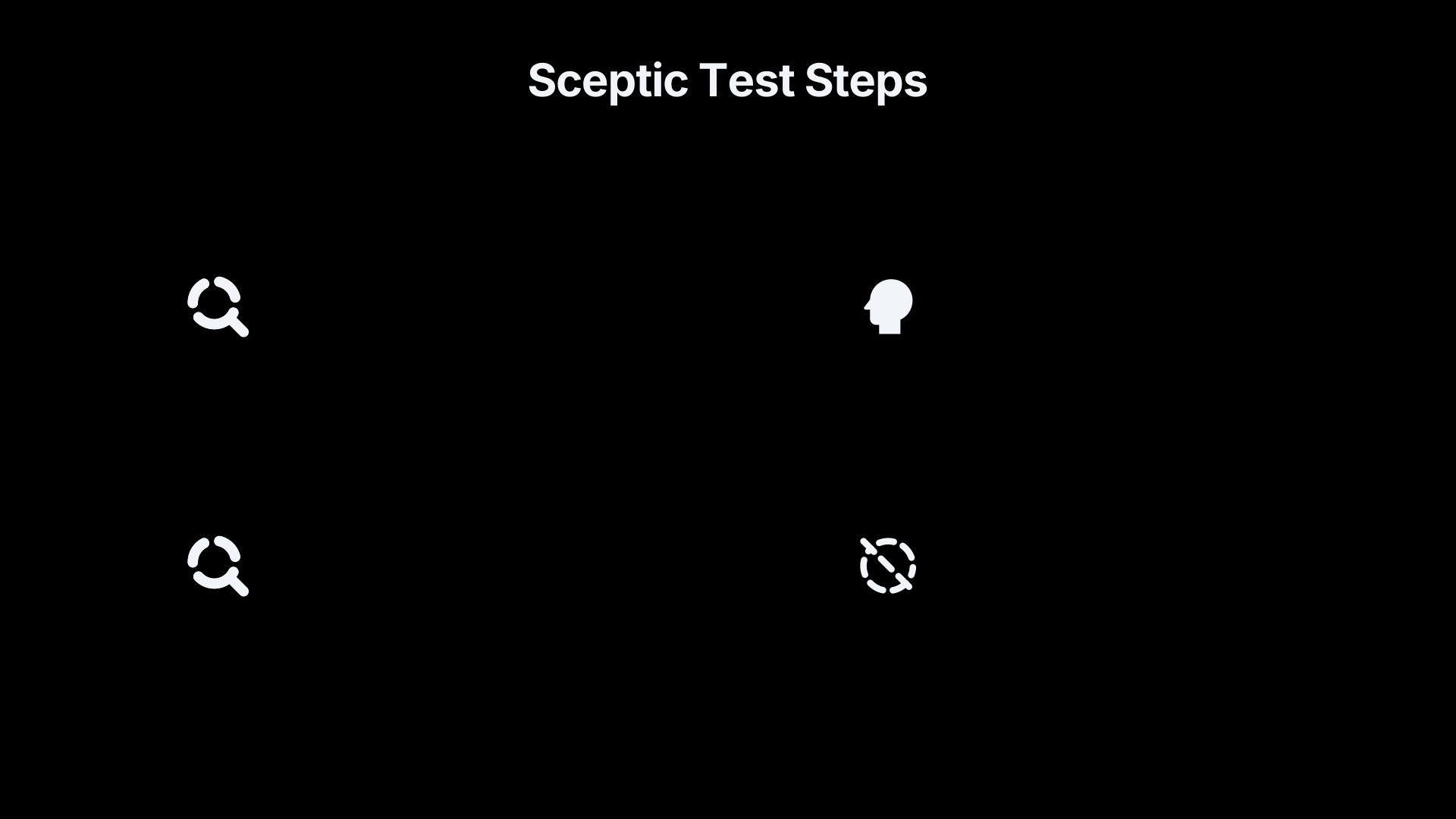
- Independent support introduces information that could be checked, observed, measured, or justified separately from the conclusion.
- Repetition merely restates the conclusion directly or indirectly.
For example:
The witness is reliable because her account matched video footage recorded at the scene.
The supporting reason can be examined independently. A sceptic may still disagree, but the premise does not depend on first assuming the witness is reliable.
Compare that with:
The witness is reliable because she always gives trustworthy testimony.
Here, “trustworthy testimony” simply restates reliability in different language. The argument offers no independent basis for the claim.[Philosophy Home Page]philosophy.lander.eduPhilosophy Home PagePetitio Principii, Circular Argument, Begging the QuestionPetitio principii is a logical fallacy where the conclusion…[Encyclopedia]plato.stanford.eduEncyclopedia of Philosophy FallaciesThe major premise can be deduced from other universal premises…
Hidden Circularity: When the Test Matters Most
The support test becomes especially useful when circularity is concealed.
Some arguments disguise the conclusion through definitions, labels, or intermediate claims. For instance:
This policy is fair because it treats people justly.
If “fair” and “just” are being used interchangeably, the premise may contribute nothing beyond a restatement of the conclusion.
Another common pattern is a chain of dependency:
- Claim A is true because of Claim B.
- Claim B is true because of Claim C.
- Claim C is true because of Claim A.
Each individual step appears to provide support, yet the entire structure ultimately loops back to its starting point. Without an independent premise entering the chain, the argument never escapes circularity.[Wikipedia]WikipediaBegging the questionBegging the question
The sceptic test cuts through the complexity. Ask whether any point in the chain could be justified without relying on the conclusion. If not, the loop remains unbroken.
Repairing a Circular Argument
Circular arguments are often repairable. The goal is to replace self-supporting premises with evidence that stands independently of the conclusion.
Replace Restatements with Evidence
Instead of:
The programme is successful because it achieves success.
Use:
The programme is successful because employment among participants increased by 20% after completion.
The revised premise provides information that can be evaluated separately from the conclusion.
Identify Hidden Assumptions
Many circular arguments depend on unstated premises. Bringing them into the open makes evaluation easier.
For example:
The regulation is necessary because responsible governments adopt necessary regulations.
Once unpacked, the argument’s weakness becomes easier to see. The crucial question becomes why this particular regulation is necessary, not whether responsible governments adopt necessary measures.
Seek External Verification
Independent support often comes from sources outside the argument itself:
- Direct observation
- Empirical studies
- Historical records
- Expert analysis supported by evidence
- Measurable outcomes
The stronger the connection to independently verifiable information, the less vulnerable the argument is to circularity.[stanford]plato.stanford.eduEncyclopedia of Philosophy FallaciesThe major premise can be deduced from other universal premises… Encyclopedia of Philosophy
A Practical Checklist for Evaluating Premises
When assessing whether an argument avoids circular reasoning, ask:(#endnote-1 “Endnote 1”)[Wikipedia]WikipediaCircular reasoningCircular reasoning
- Could someone reject the conclusion yet still reasonably accept the premise?
- Does the premise provide information beyond a rewording of the conclusion?
- Can the premise be verified independently?
- Does the argument ultimately rely on a claim that traces back to itself?
- If the conclusion were removed, would the premise still have support?
A “yes” to the first three questions and a “no” to the last two usually indicates genuine support rather than circular repetition.
Why the Support Test Matters
The independent-support test focuses on what arguments are supposed to accomplish: provide reasons that move a discussion forward. Good arguments create a bridge from accepted premises to a disputed conclusion. Circular arguments merely walk in a loop. As several philosophical accounts of fallacies emphasise, the central failure is not simply repetition but the absence of new grounds for belief. An argument that cannot persuade a reasonable sceptic has not yet supplied the independent support that rational persuasion requires.
Amazon book picks
Further Reading
Books and field guides related to Would the Premise Convince a Skeptic?. Use these as the next step if you want deeper reading beyond the article.
Being Logical
Explains how premises support conclusions and how to detect weak or circular reasoning.
A Rulebook for Arguments
Focuses on constructing arguments with independent support rather than repetition.
The Fallacy Detective
Includes accessible treatments of circular reasoning and premise evaluation.
Think Again
Encourages skepticism and testing assumptions rather than accepting claims at face value.
eBay marketplace picks
Marketplace Samples
Example marketplace items related to this page. Use the search link to explore similar finds on eBay.






Endnotes
1.
Source: Wikipedia
Title: Circular reasoning
Link:https://en.wikipedia.org/wiki/Circular_reasoning
2.
Source: plato.stanford.edu
Title: Encyclopedia of Philosophy Fallacies
Link:https://plato.stanford.edu/entries/fallacies/
Source snippet
The major premise can be deduced from other universal premises...
3.
Source: britannica.com
Title: circular argument
Link:https://www.britannica.com/topic/circular-argument
Source snippet
Encyclopedia BritannicaCircular argument | Definition, History, Examples, & Facts1 Apr 2026 — A circular argument's premise explicitly or...
4.
Source: Wikipedia
Title: Begging the question
Link:https://en.wikipedia.org/wiki/Begging_the_question
5.
Source: plato.stanford.edu
Link:https://plato.stanford.edu/entries/argument/
Source snippet
Stanford Encyclopedia of PhilosophyArgument and Argumentationby C Dutilh Novaes · 2021 · Cited by 104 — Argumentation can be defined as t...
6.
Source: iep.utm.edu
Link:https://iep.utm.edu/fallacy/
Source snippet
Internet Encyclopedia of PhilosophyFallacies... circular reasoning in which a conclusion is derived from premises that presuppose the con...
7.
Source: philosophy.lander.edu
Link:https://philosophy.lander.edu/logic/circular.html
Source snippet
Philosophy Home PagePetitio Principii, Circular Argument, Begging the QuestionPetitio principii is a logical fallacy where the conclusion...
Additional References
8.
Source: reddit.com
Link:https://www.reddit.com/r/askphilosophy/comments/ldb0x2/are_all_deductively_valid_arguments/
Source snippet
Are all deductively valid arguments circular/question...TIL that "begs the question" doesn't mean 'asks the question', and instead...
9.
Source: youtube.com
Title: What is The Circular Reasoning Fallacy? | Critical Thinking Basics
Link:https://www.youtube.com/watch?v=lGNgsmGwJ6E
Source snippet
Critical Thinking: The Fallacy of Circular Argument...
10.
Source: youtube.com
Title: Begging The Question Fallacy (Definition & Easiest Explanation)
Link:https://www.youtube.com/watch?v=VXoSHv1GP4I
Source snippet
What Is Circular Reasoning? - Law School Prep Hub...
11.
Source: youtube.com
Title: Critical Thinking: The Fallacy of Circular Argument
Link:https://www.youtube.com/watch?v=0P79dctCEZU
Source snippet
Begging The Question Fallacy (Definition & Easiest Explanation)...
12.
Source: youtube.com
Title: Fallacies: Begging the Question (narrow sense)
Link:https://www.youtube.com/watch?v=qSWCi_-qIME
Source snippet
What is The Circular Reasoning Fallacy? | Critical Thinking Basics...
13.
Source: logicallyfallacious.com
Link:https://www.logicallyfallacious.com/logicalfallacies/Begging-the-Question
14.
Source: youtube.com
Title: What Is Circular Reasoning?
Link:https://www.youtube.com/watch?v=w8Yk3qb6qbs
Topic Tree