Within Bad Samples
What Personal Experience Can Prove
Personal stories can identify real harms and useful leads, but they do not automatically measure how common a problem is.
On this page
- What anecdotes are good evidence for
- Where personal stories stop measuring prevalence
- Turning experience into a testable claim
Page outline Jump by section
Introduction
Personal experience is powerful evidence that something happened. If a person says they were overcharged, experienced discrimination, suffered a side effect, or benefited from a service, that testimony may provide strong evidence about their own case. The mistake begins when a single experience is treated as proof of how common, typical, or widespread a phenomenon is. That move turns a useful observation into a hasty generalisation.
 Within the broader family of weak-sample fallacies, personal anecdotes are especially persuasive because they are vivid, memorable, and emotionally engaging. Research on anecdotal evidence consistently finds that personal stories can strongly influence beliefs and decisions, sometimes even when broader statistical evidence points in a different direction.[PMC]pmc.ncbi.nlm.nih.govPMCWhen and why do people act on flawed science?Effects of…by AL Michal · 2021 · Cited by 39 — In particular, the presence of anecdotal evidence can serve as a powerful barrier for s…[PMC]pmc.ncbi.nlm.nih.govimpact medical decisions even when presented…by EN Line · 2024 · Cited by 9 — We found that reading anecdotes for either artificial or… The challenge is not to ignore experience, but to use it appropriately.
What Anecdotes Are Good Evidence For
A personal story can establish that an event occurred, or at least that someone sincerely reports it occurred. In many contexts, this is valuable information.
If a customer reports that a product failed, the anecdote is evidence that at least one customer encountered a problem. If a patient describes an unexpected reaction to a treatment, the account may identify a possible issue worth investigating. If multiple people independently report similar experiences, those reports can help researchers, journalists, regulators, or organisations identify patterns that deserve further study.[PubMed]pubmed.ncbi.nlm.nih.govUsing anecdotal information in evidence-based health careby MW Enkin · 1998 · Cited by 146 — Anecdotal information should not be co…
This is why personal experience often plays an important role in discovering problems. Many investigations begin with individual reports rather than large datasets. An anecdote can function as:
- A warning sign.
- A source of hypotheses.
- A clue that a hidden problem may exist.
- A description of a real human consequence.
In these roles, personal experience is not weak evidence. It is simply evidence about a narrower question than people sometimes assume.
Consider the difference:
- Supported by the anecdote: “This happened to me.”
- Possibly suggested by the anecdote: “This might happen to others.”
- Not established by the anecdote alone: “This happens to most people.”
The first claim concerns a specific event. The last concerns a population.
Where Personal Stories Stop Measuring Prevalence
The key limitation of personal experience is that it usually tells us little about frequency.
Suppose someone says, “I had three delayed trains this week, so the rail system is unreliable.” The experience may be entirely genuine. The problem is that the evidence comes from one traveller during one period of time. It does not reveal whether thousands of other journeys ran on schedule.
A similar issue appears in debates about healthcare, education, policing, consumer products, and public policy. Individual experiences can reveal what is possible. They do not automatically reveal what is typical.
Researchers distinguish between evidence that demonstrates occurrence and evidence that estimates prevalence. To know how common something is, we need information about a wider population, collected in a way that is not dominated by unusual cases or selective reporting.[arXiv]arxiv.orgarXiv We need to talk about nonprobability samplesWe need to talk about nonprobability samplesOctober 13, 2022…
A useful comparison is:
QuestionWhat personal experience can tell usDid this happen?Often quite a lotCould this happen?Often quite a lotHow often does this happen?Usually very little by itselfHow many people are affected?Usually requires broader evidenceIs this the typical outcome?Usually requires representative data
The fallacy occurs when evidence suited to the first two questions is treated as if it answered the last three.
Why Our Own Experiences Feel More Representative Than They Are
People naturally place great weight on personal experience because it is direct and emotionally meaningful. Psychological research suggests that vivid and easily recalled examples often influence judgments more strongly than abstract statistics. This tendency is closely related to the availability heuristic, a mental shortcut in which people estimate likelihood based on how easily examples come to mind.[Simply Psychology]simplypsychology.orgavailability heuristicand Decision Making10 Jul 2023 — The availability heuristic is a mental shortcut where individuals judge the likelihood of an event based…[The Decision Lab]thedecisionlab.comThe Decision Lab Availability HeuristicThe Decision LabAvailability Heuristic - The Decision…The availability heuristic describes our tendency to think that whatever is easi…[scribbr]scribbr.co.ukScribbr The Availability Heuristic | Example & DefinitionThe Availability Heuristic | Example & Definition - Scribbr7 Dec 2022 — The availability heuristic occurs when we judge the likelihood of… That creates several common errors.
Unusual events become mentally prominent. A dramatic failure is often remembered more clearly than dozens of ordinary successes.
Recent experiences feel more significant. Three bad encounters in a short period may seem like evidence of a long-term trend.
Emotion increases perceived frequency. Experiences involving fear, anger, embarrassment, or excitement often feel more representative than they actually are. PMC[forbes]forbes.comavailability heuristic what it is and how to overcome itAvailability Heuristic: What It Is And How To Overcome ItApr 6, 2024 — The availability heuristic (or availability bias) refers to our te… This does not mean people are irrational for trusting their experiences. It means that personal experience is an incomplete sample, and human memory tends to amplify its importance.
Turning Experience Into a Testable Claim
A better approach is to treat personal experience as the beginning of an investigation rather than the end of one.
Instead of moving directly from experience to conclusion, move through a series of increasingly careful questions.
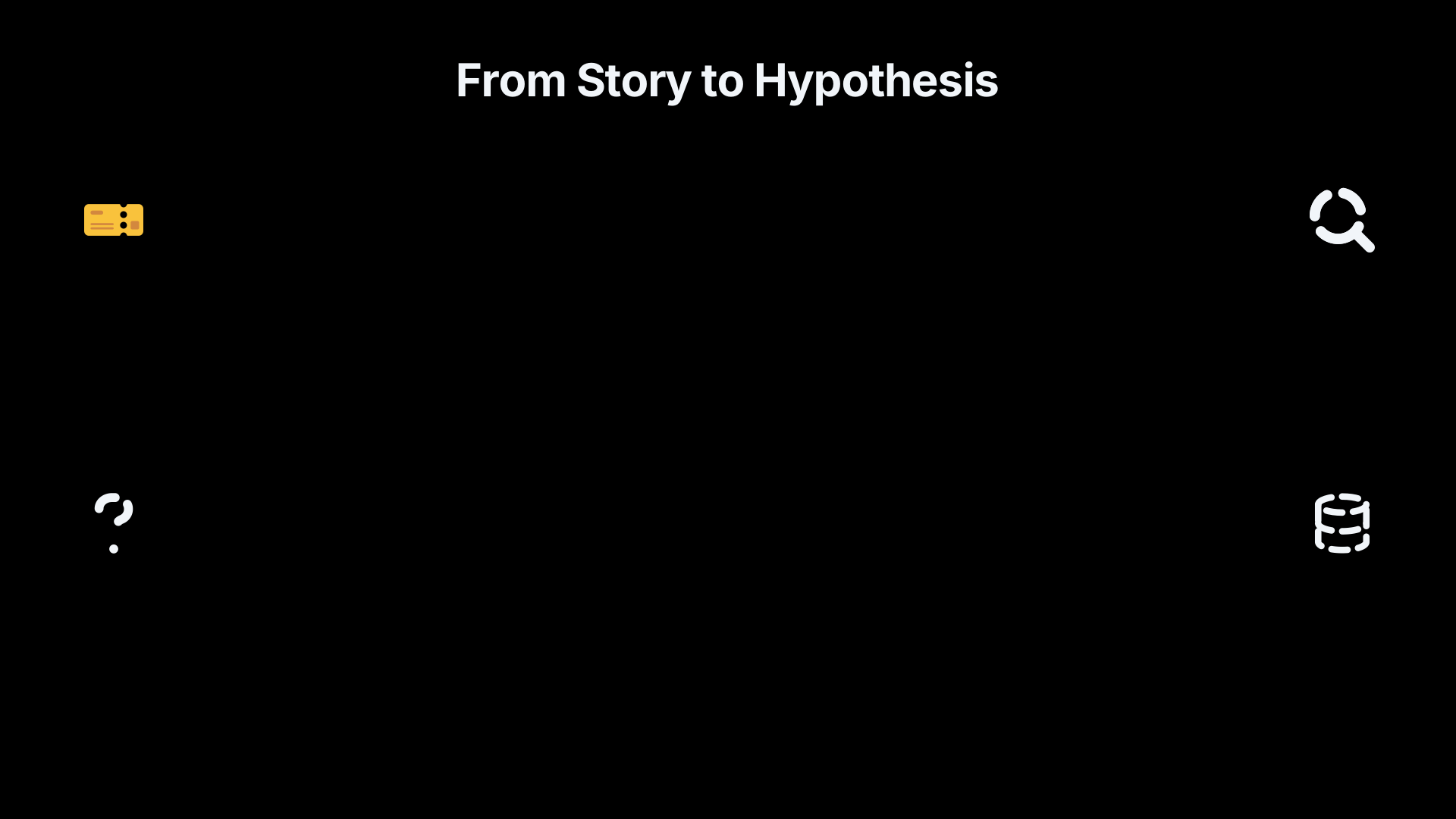
Step 1: State the experience accurately
Begin with the narrowest claim.
“I experienced poor customer service.”
This is a claim about a specific event and may be well supported.
Step 2: Convert the experience into a hypothesis
Ask what broader question the experience raises.
“Does this company have a customer-service problem?”
Now the anecdote is functioning as a lead rather than a conclusion.
Step 3: Look for wider evidence
Search for information beyond the original experience:
- Larger surveys.
- Complaint statistics.
- Independent reports.
- Representative studies.
- Organisational records.
The goal is to determine whether the anecdote reflects a broader pattern.
Step 4: Adjust the claim to fit the evidence
If broader evidence confirms the pattern, a stronger conclusion becomes justified. If broader evidence does not support it, the original experience may still be real while remaining atypical.
This distinction is important. An experience can be genuine without being representative.

When Many Anecdotes Still Do Not Settle the Question
People sometimes respond to criticism of anecdotal reasoning by saying, “But I have heard hundreds of stories.”
A large collection of stories can certainly be more informative than a single story. However, quantity alone does not solve the sampling problem.
For example, online reviews, complaint forums, activist groups, support communities, and social-media discussions often gather people who have strong reasons to participate. Such collections may reveal important problems, but they do not automatically represent everyone affected by an issue. A thousand reports drawn from a highly selective group can still produce misleading estimates of prevalence.[arXiv]arxiv.orgarXiv We need to talk about nonprobability samplesWe need to talk about nonprobability samplesOctober 13, 2022…
The critical question is not merely how many stories exist, but how those stories were collected.
A Practical Rule for Avoiding Overgeneralisation
When evaluating personal experience, ask two separate questions:
- What does this story tell me about the person who experienced it?
- What does it tell me about the wider population?
The first question is often answered directly by the anecdote itself.
The second usually requires additional evidence.
Keeping those questions separate prevents a common form of hasty generalisation. Personal experience remains valuable because it identifies real events, real harms, and real benefits. Yet understanding how common those experiences are requires moving beyond the anecdote and examining the broader population. That distinction allows personal stories to inform reasoning without allowing them to dominate it.
Amazon book picks
Further Reading
Books and field guides related to What Personal Experience Can Prove. Use these as the next step if you want deeper reading beyond the article.
Thinking, Fast and Slow
Explains why vivid anecdotes often outweigh stronger evidence.
The Scout Mindset
Shows how to separate personal experience from broader truth claims.
eBay marketplace picks
Marketplace Samples
Example marketplace items related to this page. Use the search link to explore similar finds on eBay.





Endnotes
1.
Source: pmc.ncbi.nlm.nih.gov
Title: PMCWhen and why do people act on flawed science?
Link:https://pmc.ncbi.nlm.nih.gov/articles/PMC8023527/
Source snippet
Effects of...by AL Michal · 2021 · Cited by 39 — In particular, the presence of anecdotal evidence can serve as a powerful barrier for s...
2.
Source: pmc.ncbi.nlm.nih.gov
Link:https://pmc.ncbi.nlm.nih.gov/articles/PMC11345347/
Source snippet
impact medical decisions even when presented...by EN Line · 2024 · Cited by 9 — We found that reading anecdotes for either artificial or...
3.
Source: pmc.ncbi.nlm.nih.gov
Link:https://pmc.ncbi.nlm.nih.gov/articles/PMC6867225/
Source snippet
Should we continue pairing the term 'anecdotal' with evidence?by R Atenstaedt · 2019 · Cited by 3 — Generally, anecdotal evidence is r...
4.
Source: arxiv.org
Title: arXiv We need to talk about nonprobability samples
Link:https://arxiv.org/abs/2210.07298
Source snippet
We need to talk about nonprobability samplesOctober 13, 2022...
Published: October 13, 2022
5.
Source: pmc.ncbi.nlm.nih.gov
Title: PMCHow do People Judge Risk?
Link:https://pmc.ncbi.nlm.nih.gov/articles/PMC9292208/
Source snippet
Availability may Upstage Affect in...by E Efendić · 2021 · Cited by 15 — We found that availability‐by‐recall had a stronger impact in c...
6.
Source: forbes.com
Title: availability heuristic what it is and how to overcome it
Link:https://www.forbes.com/sites/brycehoffman/2024/04/06/availability-heuristic-what-it-is-and-how-to-overcome-it/
Source snippet
Availability Heuristic: What It Is And How To Overcome ItApr 6, 2024 — The availability heuristic (or availability bias) refers to our te...
7.
Source: pubmed.ncbi.nlm.nih.gov
Link:https://pubmed.ncbi.nlm.nih.gov/9818068/
Source snippet
Using anecdotal information in evidence-based health careby MW Enkin · 1998 · Cited by 146 — Anecdotal information should not be co...
8.
Source: thedecisionlab.com
Title: The Decision Lab Availability Heuristic
Link:https://thedecisionlab.com/biases/availability-heuristic
Source snippet
The Decision LabAvailability Heuristic - The Decision...The availability heuristic describes our tendency to think that whatever is easi...
9.
Source: scribbr.co.uk
Title: Scribbr The Availability Heuristic | Example & Definition
Link:https://www.scribbr.co.uk/bias-in-research/availability-bias/
Source snippet
The Availability Heuristic | Example & Definition - Scribbr7 Dec 2022 — The availability heuristic occurs when we judge the likelihood of...
10.
Source: sciencedirect.com
Title: ScienceDirect Availability Heuristic
Link:https://www.sciencedirect.com/topics/computer-science/availability-heuristic
Source snippet
Availability Heuristic - an overviewThe availability heuristic refers to the tendency to assess the probability of an event based on the...
11.
Source: simplypsychology.org
Title: availability heuristic
Link:https://www.simplypsychology.org/availability-heuristic.html
Source snippet
and Decision Making10 Jul 2023 — The availability heuristic is a mental shortcut where individuals judge the likelihood of an event based...
12.
Source: Wikipedia
Title: Anecdotal evidence
Link:https://en.wikipedia.org/wiki/Anecdotal_evidence
Source snippet
Anecdotal evidenceAnecdotal evidence (or anecdata [1]) is evidence based on descriptions and reports of individual, personal experien...
13.
Source: Wikipedia
Title: Availability heuristic
Link:https://en.wikipedia.org/wiki/Availability_heuristic
Source snippet
Availability heuristicThe availability heuristic, also known as availability bias, is a mental shortcut that relies on immediate examp...
14.
Source: study.com
Title: Availability Heuristic | Definition & Examples
Link:https://study.com/academy/lesson/availability-heuristic-examples-definition-quiz.html
Source snippet
LessonThe availability heuristic means bias occurring based on the most available memories and experiences one has.Read more...
Additional References
15.
Source: merriam-webster.com
Link:https://www.merriam-webster.com/dictionary/availability
Source snippet
AVAILABILITY Definition & Meaning5 days ago — 1. The quality or state of being available; trying to improve the availability of affordabl...
16.
Source: reddit.com
Link:https://www.reddit.com/r/changemyview/comments/n9dl9s/cmv_anecdotal_evidence_is_very_much_valid_evidence/
Source snippet
CMV: Anecdotal evidence is very much *valid* evidence.The trendy sentiment that any anecdotal evidence MUST be invalid and the only valid...
17.
Source: researchgate.net
Link:https://www.researchgate.net/publication/360499820_Risk_and_Availability_Heuristic_The_Role_of_Availability_in_Risk_Perception_and_Management
Source snippet
The Role of Availability in Risk Perception and ManagementThe availability heuristic is a common mental shortcut, indicating that when pe...
18.
Source: facebook.com
Link:https://www.facebook.com/unbiasedscipod/posts/anecdotal-evidence-is-data-collected-in-a-non-scientific-manner-to-assert-specif/403464464775223/
19.
Source: thinkinsights.net
Link:https://thinkinsights.net/strategy/availability-heuristic
Source snippet
Availability HeuristicAvailability heuristic describes our tendency to judge events by the ease with which we can recall similar events...
20.
Source: buildingthemind.com
Link:https://buildingthemind.com/the-availability-heuristic-why-vivid-events-feel-more-probable-than-they-actually-are/
Source snippet
Why Vivid Events Feel More Probable Than They Actually AreApr 30, 2026 — The availability heuristic is one of the most pervasive and cons...
21.
Source: research-portal.uu.nl
Title: when is statistical evidence superior to anecdotal evidence in su
Link:https://research-portal.uu.nl/en/publications/when-is-statistical-evidence-superior-to-anecdotal-evidence-in-su/
Source snippet
Utrecht UniversityWhen is Statistical Evidence Superior to Anecdotal...by H Hoeken · 2009 · Cited by 178 — Under certain conditions, sta...
22.
Source: deanfrancispress.com
Title: The Impact of the Availability Heuristic on Decision-Making
Link:https://www.deanfrancispress.com/index.php/hc/article/download/2210/HC004102.pdf/9032
Source snippet
Abstract: The present essay will consider the availability heuristic, a cognitive bias whereby individuals' judgment regarding the likeli...
23.
Source: vaia.com
Link:https://www.vaia.com/en-us/explanations/psychology/cognitive-psychology/availability-heuristic/
Source snippet
Availability Heuristic: Psychology & Examples | VaiaNov 27, 2024 — How can the availability heuristic affect decision-making?...
24.
Source: linkedin.com
Link:https://www.linkedin.com/posts/sathishsampath_availabilityheuristic-cognitivebias-riskperception-activity-7429531631138549760–83C
Source snippet
bility Heuristic is a cognitive bias where we estimate the...
Topic Tree