Within Tone
Why polite arguments can still be bad
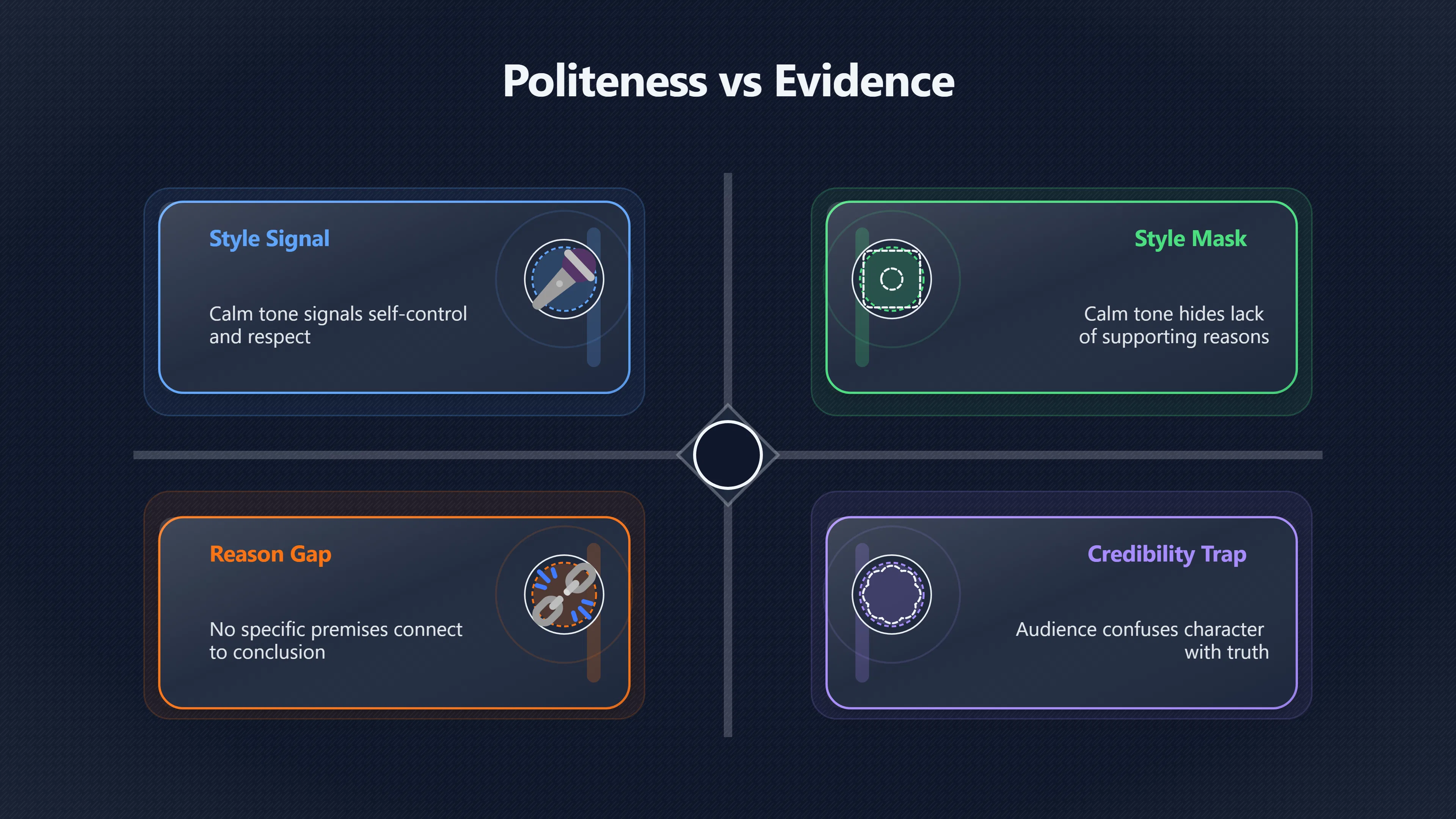
Civil phrasing can disguise weak reasoning when status words, reassurance, or vague authority replace evidence for the conclusion.
On this page
- Respectful language as a credibility signal
- Common polished substitutions for evidence
- How to test calm claims for actual support
Page outline Jump by section
Introduction
Politenely expressed arguments often receive more credit than they deserve. In discussions of logical fallacies, people sometimes assume that calm, measured language signals careful reasoning. Yet an argument can sound balanced, respectful and thoughtful while offering little actual support for its conclusion. The key question is not whether a speaker sounds reasonable but whether the reasons given genuinely justify what is being claimed. Argumentation research consistently distinguishes between the style of an argument and its logical strength: arguments require claims supported by reasons and evidence, not merely a persuasive presentation.[comm.pitt.edu]comm.pitt.eduArgument: The Basics | Department of CommunicationArguments are claims backed by reasons that are supported by evidence. There are five h…
 This matters because weak arguments frequently borrow the appearance of rationality. They use moderation, courtesy, references to expertise, or appeals to consensus as substitutes for evidence. Such arguments are often more difficult to detect than openly emotional or aggressive fallacies because they resemble the language of good reasoning while avoiding its substance.
Why polite language feels convincing
A civil tone provides useful social signals. It can indicate self-control, willingness to listen and respect for others. In many contexts these are valuable traits. The problem arises when audiences unconsciously treat those traits as proof that the underlying reasoning is sound.
Argumentation scholars distinguish between an argument’s logical support and its rhetorical presentation. Rhetorical appeals involving credibility and character can influence how persuasive a claim appears even when they do not strengthen the evidence for the claim itself. A speaker who sounds measured may therefore benefit from a credibility boost that exceeds the actual quality of the reasoning offered.[Pressbooks@MSL]pressbooks.ulib.csuohio.eduPressbooks@MSL6.4 Rhetorical Appeals: Logos, Pathos, and Ethos DefinedEthical appeals have two facets: audience values and authorial cred…[purdue]owl.purdue.eduOWLUsing Rhetorical Strategies for PersuasionPurdue OWLUsing Rhetorical Strategies for Persuasion - Purdue OWLThere are three types of rhetorical appeals, or persuasive strategies, u… Research on persuasion also shows that people often rely on shortcuts when evaluating arguments. Rather than analysing every premise in depth, audiences frequently use cues that suggest trustworthiness or acceptability. This tendency helps explain why fallacious reasoning can remain persuasive despite being logically weak.[dwc.knaw.nl]dwc.knaw.nlFallacies and heuristicsNovember 18, 2010 — by S Jackson · Cited by 89 — In this paper, an explanation is proposed for the persuasiveness…
The result is a common mistake: confusing a reasonable manner with a well-supported conclusion.
Respectful language as a credibility signal
Polite weak arguments often operate by transferring credibility from the speaker’s style to the speaker’s conclusion.
Consider the difference between these two claims:
- “The proposal should be adopted because the cost projections show a ten-year savings of 15%.”
- “With respect, I think most sensible observers would agree that the proposal is the responsible option.”
The first provides a reason that can be examined. The second mainly signals moderation and social acceptability. The phrase “with respect” does not strengthen the evidence. Nor does referring vaguely to “sensible observers”.
This mechanism resembles what argumentation theorists describe as reliance on ethos, or speaker credibility, rather than direct support for the claim. Credibility can be relevant, especially when expertise genuinely matters, but it cannot replace the need for reasons.[Pressbooks@MSL]pressbooks.ulib.csuohio.eduPressbooks@MSL6.4 Rhetorical Appeals: Logos, Pathos, and Ethos DefinedEthical appeals have two facets: audience values and authorial cred…
A useful warning sign is when removing the polite framing leaves little behind. If the argument becomes weak after deleting phrases such as “I say this respectfully”, “reasonable people recognise”, or “surely we can agree”, then the politeness may be carrying more persuasive weight than the evidence.
Common polished substitutions for evidence
Polite weak arguments often use recurring patterns that imitate rational discussion.
Vague authority
One common form replaces evidence with references to respected figures or institutions:
“Experts generally believe this approach is best.”
Expert opinion can be relevant, but only when the expertise is genuine, relevant to the question, and connected to supporting evidence. Merely invoking experts without explaining their reasoning or evidence risks becoming an appeal to authority. Critical-thinking literature repeatedly emphasises that authority alone does not prove a claim.[QuillBot]quillbot.comappeal to authority fallacyExamples & Definition26 Jun 2024 — The appeal to authority fallacy (or argument from authority) is the mistake of relying on expert opini…[Wikipedia]WikipediaArgumentation theoryArgumentation theory is the interdisciplinary study of how conclusions can be supported or undermined by premises…[3read.aupress.ca]read.aupress.caChapter 16Fallacies of Expertise | Critical Thinking, Logic…The appeal to authority is a fallacy where we take something as fact just because an…
The weakness is often disguised by courteous wording:
“I hesitate to disagree with leading experts, but…”
The politeness encourages deference while leaving the actual support unspecified.
Vague consensus
Another pattern appeals to unnamed agreement:
“Most thoughtful people recognise that this is the only realistic option.”
The phrase sounds measured and inclusive. Yet it often provides no evidence regarding whether the conclusion is correct. The argument depends on the audience’s desire to belong to the category of “thoughtful people” rather than on reasons supporting the claim.

Reassuring moderation
Some arguments rely on sounding balanced:
“I am not taking an extreme position. I am simply suggesting a common-sense approach.”
Whether a position is moderate or extreme does not determine whether it is true. A moderate-sounding conclusion can be poorly supported, just as a controversial conclusion can be well supported.
The appearance of balance may therefore function as a substitute for justification rather than as justification itself.
Respectful dismissal
A particularly subtle form combines courtesy with avoidance:
“I appreciate your concerns, but I do not think they are especially persuasive.”
This may sound constructive, yet it does not answer the concerns. Appreciation of an objection is not a rebuttal. Unless the speaker explains why the objection fails, the argument remains incomplete.
Why these arguments are often harder to spot than rude fallacies
Openly rude reasoning attracts attention. Personal attacks, insults and obvious hostility make audiences more likely to scrutinise what is being said.
Polite weak arguments create the opposite effect. Because they follow the social norms of reasoned discussion, listeners may lower their guard. The argument inherits an aura of seriousness even when the supporting reasons are thin.
Research on argument evaluation suggests that people do not always assess claims at maximum analytical depth. Instead, they often evaluate arguments selectively, paying closer attention only when they detect signs of trouble. A polished presentation can reduce those warning signals, allowing weak reasoning to pass with less scrutiny.[dwc.knaw.nl]dwc.knaw.nlFallacies and heuristicsNovember 18, 2010 — by S Jackson · Cited by 89 — In this paper, an explanation is proposed for the persuasiveness…
This helps explain why a calm but unsupported claim may sometimes persuade more effectively than an aggressive claim containing equally weak reasoning.
How to test calm claims for actual support
The most effective defence is to separate presentation from justification.
When evaluating a polite argument, ask three questions:
- What exactly is the conclusion?
Remove the reassuring language and identify the claim being advanced.
- What reasons are offered?
Look for specific premises rather than signals of credibility, consensus or moderation.
- Would the argument still work without the tone cues?
If phrases such as “respectfully”, “reasonable people”, “common sense”, or “experts say” disappeared, would there still be evidence supporting the conclusion?
A related technique is to reconstruct the argument in plain form. Argumentation theory emphasises identifying the premises that connect reasons to conclusions. Once these supporting links are made explicit, weak reasoning often becomes easier to recognise.[Scholarly Publications]scholarlypublications.universiteitleiden.nlScholarly Publications Argumentation: What It Is & How to Do ItScholarly PublicationsArgumentation: What It Is & How to Do ItABSTRACT: Starting form a review of three theories of argumentation (the di…
For example:
“With respect, experienced professionals support this policy.”
becomes:
“Experienced professionals support this policy; therefore the policy is correct.”
Once stripped down, the need for further support becomes obvious.
The central lesson
Within the study of logical fallacies, politeness is neither evidence nor proof. Respectful language can improve discussion, reduce conflict and encourage cooperation. Those are genuine virtues. However, they do not strengthen a conclusion unless they are accompanied by relevant reasons and evidence.
The danger of polite weak arguments is precisely that they imitate the surface features of rational inquiry. They sound measured, careful and fair-minded while relying on vague authority, implied consensus, reassuring moderation or courteous dismissal instead of substantive support. Evaluating arguments therefore requires looking past the style of reasonableness to the actual structure of the reasoning beneath it. Arguments stand or fall on their support, not on how politely that support is presented.[comm.pitt.edu]comm.pitt.eduArgument: The Basics | Department of CommunicationArguments are claims backed by reasons that are supported by evidence. There are five h…[Wikipedia]WikipediaArgument from authorityArgument from authority
Amazon book picks
Further Reading
Books and field guides related to Why polite arguments can still be bad. Use these as the next step if you want deeper reading beyond the article.
How to Win Every Argument
Illustrates how weak reasoning can hide behind persuasive language.
eBay marketplace picks
Marketplace Samples
Example marketplace items related to this page. Use the search link to explore similar finds on eBay.
Endnotes
1.
Source: comm.pitt.edu
Link:https://www.comm.pitt.edu/argument-basics
Source snippet
Argument: The Basics | Department of CommunicationArguments are claims backed by reasons that are supported by evidence. There are five h...
2.
Source: Wikipedia
Link:https://en.wikipedia.org/wiki/Argumentation_theory
Source snippet
Argumentation theoryArgumentation theory is the interdisciplinary study of how conclusions can be supported or undermined by premises...
3.
Source: owl.purdue.edu
Title: OWLUsing Rhetorical Strategies for Persuasion
Link:https://owl.purdue.edu/owl/general_writing/academic_writing/establishing_arguments/rhetorical_strategies.html
Source snippet
Purdue OWLUsing Rhetorical Strategies for Persuasion - Purdue OWLThere are three types of rhetorical appeals, or persuasive strategies, u...
4.
Source: dwc.knaw.nl
Link:https://dwc.knaw.nl/DL/publications/PU00010682.pdf
Source snippet
Fallacies and heuristicsNovember 18, 2010 — by S Jackson · Cited by 89 — In this paper, an explanation is proposed for the persuasiveness...
Published: November 18, 2010
5.
Source: Wikipedia
Title: Argument from authority
Link:https://en.wikipedia.org/wiki/Argument_from_authority
6.
Source: read.aupress.ca
Title: Chapter 16
Link:https://read.aupress.ca/read/critical-thinking-logic-and-argument/section/37569f83-38fb-40e0-9575-ede2c97e5753
Source snippet
Fallacies of Expertise | Critical Thinking, Logic...The appeal to authority is a fallacy where we take something as fact just because an...
7.
Source: ecampusontario.pressbooks.pub
Link:https://ecampusontario.pressbooks.pub/criticalthinking1234/chapter/unknown-4/
Source snippet
E3. Has the expert properly attended to the question at hand? E4. Is the expert's opinion backed by plausible arguments and evidence?Read...
8.
Source: quillbot.com
Title: appeal to authority fallacy
Link:https://quillbot.com/blog/reasoning/appeal-to-authority-fallacy/
Source snippet
Examples & Definition26 Jun 2024 — The appeal to authority fallacy (or argument from authority) is the mistake of relying on expert opini...
9.
Source: pressbooks.ulib.csuohio.edu
Link:https://pressbooks.ulib.csuohio.edu/csu-fyw-rhetoric/chapter/rhetorical-strategies-building-compelling-arguments/
Source snippet
Pressbooks@MSL6.4 Rhetorical Appeals: Logos, Pathos, and Ethos DefinedEthical appeals have two facets: audience values and authorial cred...
10.
Source: scholarlypublications.universiteitleiden.nl
Title: Scholarly Publications Argumentation: What It Is & How to Do It
Link:https://scholarlypublications.universiteitleiden.nl/access/item%3A4107796/view
Source snippet
Scholarly PublicationsArgumentation: What It Is & How to Do ItABSTRACT: Starting form a review of three theories of argumentation (the di...
11.
Source: scribbr.com
Title: appeal to authority fallacy
Link:https://www.scribbr.com/fallacies/appeal-to-authority-fallacy/
Source snippet
Definition & Examples15 Jun 2023 — Appeal to authority fallacy occurs when we accept a claim merely because someone tells us that an auth...
Additional References
12.
Source: researchgate.net
Link:https://www.researchgate.net/publication/303793872_Arguments_from_authority_and_expert_opinion_in_computational_argumentation_systems
Source snippet
(PDF) Arguments from authority and expert opinion in...16 Jul 2018 — In this paper we show that an essential aspect of solving the probl...
13.
Source: logicallyfallacious.com
Link:https://www.logicallyfallacious.com/logicalfallacies/Appeal-to-Authority
Source snippet
Appeal to AuthorityInsisting that a claim is true simply because a valid authority or expert on the issue said it was true, without any o...
14.
Source: miamioh.edu
Link:https://miamioh.edu/howe-center/hwc/writing-resources/handouts/types-of-writing/rhetorical-analyses.html
15.
Source: researchgate.net
Link:https://www.researchgate.net/figure/Types-of-argument-and-types-of-reasoning_fig1_300562431
Source snippet
Types of argument and types of reasoningAim: The aim of this chapter is to theoretically substantiate the relationship between argumentat...
16.
Source: yourlogicalfallacyis.com
Link:https://yourlogicalfallacyis.com/appeal-to-authority
Source snippet
Your logical fallacy is appeal to authorityAppeals to authority are not valid arguments, but nor is it reasonable to disregard the claims...
17.
Source: thedecisionlab.com
Link:https://thedecisionlab.com/reference-guide/philosophy/ethos-pathos-and-logos
Source snippet
Ethos, Pathos and LogosEthos, pathos and logos are three methods of persuasion: rhetorical appeals that influence decision-making. Ethos...
18.
Source: pub.uni-bielefeld.de
Title: ELumer Ph DThesis Linguistic Perspectives On Politenessin HRI
Link:https://pub.uni-bielefeld.de/download/3005058/3005071/ELumer_PhDThesis_LinguisticPerspectivesOnPolitenessinHRI.pdf
Source snippet
perspectives on politeness in human–robot interactionby E Lumer · 2025 — This interdisciplinary work combines theoretical and methodologi...
19.
Source: researchgate.net
Link:https://www.researchgate.net/publication/309722309_Argument_Strength_and_the_Persuasiveness_of_Stories
Source snippet
This main effect was qualified by a two-way interaction with baseline...Read more...
20.
Source: ses.edu
Title: The fallacy occurs when someone claims a certain conclusion is true.Read more
Link:https://ses.edu/logical-fallacies-101-appeal-to-authority-ad-verecundiam/
Source snippet
Logical Fallacies 101: Appeal to Authority | Ad Verecundiam3 Apr 2017 — The fallacy ad verecundiam is an appeal to an unqualified authority...
21.
Source: researchgate.net
Link:https://www.researchgate.net/publication/316975875_The_fluency_principle_Why_foreign_accent_strength_negatively_biases_language_attitudes
Source snippet
e evaluated more negatively than mild foreign-accented speakers.Read more...
Topic Tree