Within Red Herring
Is It Context or a Dodge?
Context is useful only when it helps answer the original question instead of replacing it with an easier one.
On this page
- Pin down the original question
- Test whether the new point changes the answer
- Examples where context is and is not relevant
Page outline Jump by section
Introduction
In arguments about public policy, science, workplace decisions, or everyday disagreements, background information is often necessary. The challenge is that not all background information serves the same purpose. Useful context helps answer the question being discussed. A red herring shifts attention to a different question, often one that is easier, safer, or more emotionally appealing to discuss. The key test is not whether the new information is true or interesting, but whether it changes the answer to the original issue. Philosophers of argumentation classify red herrings as fallacies of relevance because they divert discussion away from the point at issue rather than resolving it.[PhilPapers]philpapers.orgWALCOF 5Douglas Walton, Classification of Fallacies of Relevanceby D Walton · 2003 · Cited by 31 — A key difference cited is that in a…[Internet Encyclopedia of Philosophy]iep.utm.eduInternet Encyclopedia of PhilosophyFallaciesArguing for a conclusion that is not relevant to the current issue. Also called Irrelevant Co…
 This distinction matters because many persuasive diversions are built from genuine facts. A speaker may introduce accurate history, personal circumstances, broader social concerns, or related examples. The question is whether those facts help evaluate the claim under discussion or merely redirect attention elsewhere.
Is It Context or a Dodge?
The simplest way to tell context from a red herring is to identify the exact question that still needs an answer.
Suppose the question is: “Did the company conceal safety data?” A response about the company’s charitable donations may be true and important, but it does not help determine whether safety data were concealed. The discussion has moved from one issue to another.
By contrast, if someone explains that the alleged safety data were already publicly released before the accusation was made, that background directly affects the original claim. The added information changes how the claim should be assessed.
A useful rule is:
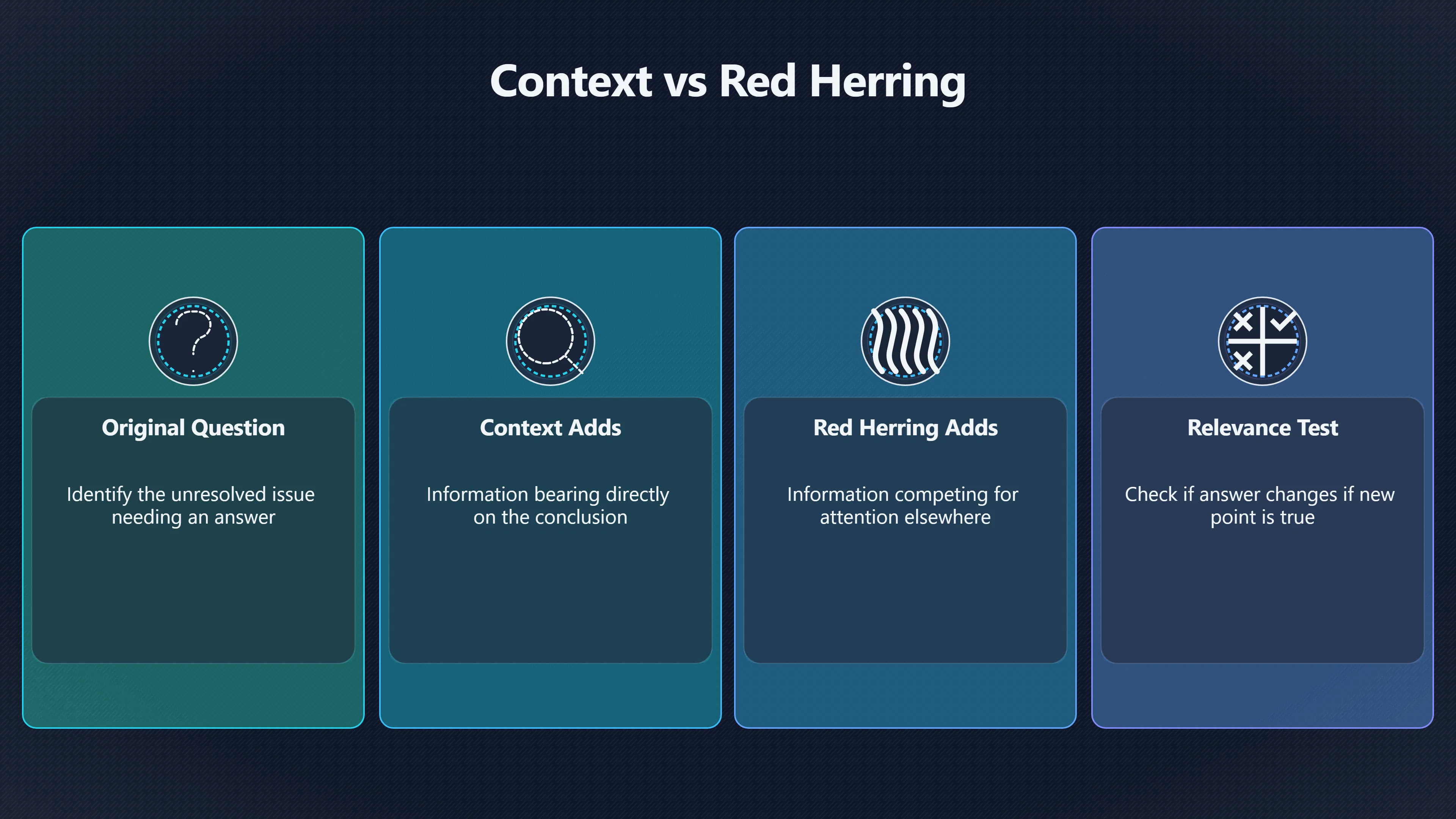
- Context adds information that bears on the conclusion.
- A red herring adds information that competes for attention.
The distinction is based on relevance, not on truthfulness, emotional force, or complexity. A completely accurate statement can still function as a red herring if it diverts the discussion from the issue that remains unresolved.[Routledge]routledge.comRelevance in ArgumentationRelevance in Argumentation - 1st Edition - Douglas WaltonIn Relevance in Argumentation, author Douglas Walton presents a new met…[ScienceDirect]sciencedirect.comScienceDirect Argument relevance and structureAssessing and…by F Macagno · 2016 · Cited by 77 — The purpose of this paper is to show whether the two crucial dimensions used for ass…
Pin Down the Original Question
Many diversions succeed because participants stop tracking what was originally being debated.
Before evaluating new information, state the unresolved question in one sentence. For example:
- “Did the evidence support the conclusion?”
- “Was the rule followed?”
- “Did the policy achieve its stated goal?”
- “Is the accusation true?”
Once that question is fixed, every new point can be tested against it.
Argumentation theorists describe red herrings as diversions that redirect a dialogue away from its proper issue. The problem is not merely reaching a wrong conclusion; it is changing the direction of the discussion so that the original burden of proof fades from view.[PhilPapers]philpapers.orgWALCOF 5Douglas Walton, Classification of Fallacies of Relevanceby D Walton · 2003 · Cited by 31 — A key difference cited is that in a…[Informal Logic]informallogic.caInformal Logic Classification of Fallacies of Relevance!Informal Logicby D Walton · 2004 · Cited by 31 — A key difference cited is that in a case where the red herring fallacy has been committe…
A practical technique is to ask: “Even if this new point is correct, what happens to the original question?”
If the original question remains unanswered, the new point may be functioning as a distraction rather than a contribution.
Test Whether the New Point Changes the Answer
The most reliable relevance test is a counterfactual one.
Ask:
If I accepted this new information completely, would it materially change my answer to the original question?
If the answer is yes, the information is probably context.
If the answer is no, the information is probably a red herring.
Consider these examples:
Likely Context
Question: “Was the experiment conducted properly?”
New information: “The measurement instrument was later found to be defective.”
If true, this directly affects confidence in the experiment’s results.
Likely Red Herring
Question: “Was the experiment conducted properly?”
New information: “The researchers have won several prestigious awards.”
The awards may be impressive, but they do not determine whether the experiment was conducted correctly.
The same principle appears in critical-thinking approaches that emphasise relevance as a central criterion for evaluating arguments. Information that does not help establish, weaken, explain, or qualify the conclusion is not doing argumentative work, even if it is interesting.[peterellerton.substack.com]peterellerton.substack.comWhat critical thinking is (and is notthe education contrarianDecember 14, 2025 — This involves applying established norms—such as clarity, relevance, and logical consistency—…[The Open]open.eduThe Open University4 The importance of critical thinking and analysis in…When you think critically, you weigh up all sides of an argum…
Examples Where Context Is Relevant
Some information looks like a diversion at first glance but is genuinely relevant.
Providing Missing Conditions
Question: “Why did emergency response times increase?”
Relevant context: “A major storm disabled several transport routes that day.”
The background explains circumstances directly related to the outcome.
Clarifying Definitions
Question: “Did the organisation miss its target?”
Relevant context: “The target was revised midway through the reporting period.”
Understanding the definition of the target affects the assessment.
Identifying Alternative Causes
Question: “Did policy X cause the change?”
Relevant context: “A second policy affecting the same population took effect at the same time.”
This information bears directly on causal evaluation.
In each case, the additional material helps answer the original question rather than replacing it.
Examples Where Context Becomes a Red Herring
The same kinds of information can become distractions when they no longer connect to the issue being examined.

Reputation Instead of Evidence
Question: “Did the official make the statement?”
Diversion: “The official has served the public for thirty years.”
Experience may influence credibility assessments, but it does not establish whether the statement was made.
Broader Problems Instead of Specific Ones
Question: “Did this department violate the rules?”
Diversion: “The entire industry has problems.”
That broader claim may be true while leaving the original allegation untouched.
Motives Instead of Facts
Question: “Is the report accurate?”
Diversion: “The critics have political motives.”
Motives may matter in some contexts, but they do not by themselves determine the accuracy of the report.
These moves often feel persuasive because they introduce emotionally significant or socially meaningful concerns. However, relevance requires a demonstrable connection to the claim under examination, not merely a thematic connection.[Philosophy Home Page]philosophy.lander.eduPhilosophy Home PageIgnoratio Elenchi (Irrelevant Conclusion); Straw ManIgnoratio Elenchi is the fallacy of reaching an irrelevant conclu…[Logically Fallacious]logicallyfallacious.comRed HerringThe red herring is a deliberate diversion of attention with the intention of trying to abandon the original argument.Read more…
Common Warning Signs
Several patterns frequently signal that context may be turning into a red herring.
- The conversation changes from a specific question to a broader one.
- The speaker never returns to the original claim.
- The new point is easier to defend than the original issue.
- The audience becomes focused on character, motives, or side issues rather than evidence.
- Agreement on the new point would not resolve the initial dispute.
None of these signs proves a red herring on its own. They are indicators that relevance should be checked more carefully.
The Context Test
A compact way to evaluate any suspected diversion is to run three questions in sequence:
- What exactly is the original question?
- How does this new information bear on that question?
- If the new information were accepted as true, would it change the answer?
If a clear connection exists and the answer could change, the information is functioning as context.
If the connection is weak or missing, and the original issue remains unresolved, the information is functioning as a red herring.
The goal is not to reject background information. Good reasoning often depends on context. The goal is to ensure that context illuminates the issue under discussion rather than leading attention away from it. In the study of logical fallacies, that difference marks the boundary between relevant explanation and argumentative diversion.[Routledge]routledge.comRelevance in ArgumentationRelevance in Argumentation - 1st Edition - Douglas WaltonIn Relevance in Argumentation, author Douglas Walton presents a new met…[PhilPapers]philpapers.orgWALCOF 5Douglas Walton, Classification of Fallacies of Relevanceby D Walton · 2003 · Cited by 31 — A key difference cited is that in a…
Amazon book picks
Further Reading
Books and field guides related to Is It Context or a Dodge?. Use these as the next step if you want deeper reading beyond the article.
The Skeptics' Guide to the Universe
Provides methods for testing whether information changes the conclusion.
eBay marketplace picks
Marketplace Samples
Example marketplace items related to this page. Use the search link to explore similar finds on eBay.








Endnotes
1.
Source: philpapers.org
Title: WALCOF 5
Link:https://philpapers.org/rec/WALCOF-5
Source snippet
Douglas Walton, Classification of Fallacies of Relevanceby D Walton · 2003 · Cited by 31 — A key difference cited is that in a...
2.
Source: routledge.com
Title: Relevance in Argumentation
Link:https://www.routledge.com/Relevance-in-Argumentation/Walton/p/book/9780805847604
Source snippet
Relevance in Argumentation - 1st Edition - Douglas WaltonIn Relevance in Argumentation, author Douglas Walton presents a new met...
3.
Source: sciencedirect.com
Title: ScienceDirect Argument relevance and structure
Link:https://www.sciencedirect.com/science/article/abs/pii/S0883035516300386
Source snippet
Assessing and...by F Macagno · 2016 · Cited by 77 — The purpose of this paper is to show whether the two crucial dimensions used for ass...
4.
Source: peterellerton.substack.com
Title: What critical thinking is (and is not)
Link:https://peterellerton.substack.com/p/what-critical-thinking-is-and-is
Source snippet
the education contrarianDecember 14, 2025 — This involves applying established norms—such as clarity, relevance, and logical consistency—...
Published: December 14, 2025
5.
Source: open.edu
Link:https://www.open.edu/openlearn/ocw/mod/oucontent/view.php?id=51387§ion=4
Source snippet
The Open University4 The importance of critical thinking and analysis in...When you think critically, you weigh up all sides of an argum...
6.
Source: youtube.com
Title: Red Herring (Logical Fallacy)
Link:https://www.youtube.com/watch?v=ZggiwS7iv2A
Source snippet
Red Herring - Critical Thinking Fallacies | WIRELESS PHILOSOPHY...
7.
Source: youtube.com
Title: Red Herring
Link:https://www.youtube.com/watch?v=Af0STrY58i4
Source snippet
The "Red Herring" Fallacy...
8.
Source: iep.utm.edu
Link:https://iep.utm.edu/fallacy/
Source snippet
Internet Encyclopedia of PhilosophyFallaciesArguing for a conclusion that is not relevant to the current issue. Also called Irrelevant Co...
9.
Source: logicallyfallacious.com
Link:https://www.logicallyfallacious.com/logicalfallacies/Red-Herring
Source snippet
Red HerringThe red herring is a deliberate diversion of attention with the intention of trying to abandon the original argument.Read more...
10.
Source: informallogic.ca
Title: [Informal Logic]({{ ‘informal-logic/’ | relative_url }}) Classification of Fallacies of Relevance!
Link:https://informallogic.ca/index.php/informal_logic/article/download/2133/1577
Source snippet
Informal Logicby D Walton · 2004 · Cited by 31 — A key difference cited is that in a case where the red herring fallacy has been committe...
11.
Source: ojs.uwindsor.ca
Link:https://ojs.uwindsor.ca/index.php/informal_logic/article/view/2133
Source snippet
Classification of Fallacies of Relevance | Informal Logicby D Walton · 2004 · Cited by 31 — A key difference cited is that in a case wher...
12.
Source: philosophy.lander.edu
Link:https://philosophy.lander.edu/logic/ignoratio.html
Source snippet
Philosophy Home PageIgnoratio Elenchi (Irrelevant Conclusion); Straw ManIgnoratio Elenchi is the fallacy of reaching an irrelevant conclu...
13.
Source: plato.stanford.edu
Link:https://plato.stanford.edu/entries/fallacies/
Source snippet
Stanford Encyclopedia of Philosophyby H Hansen · 2015 · Cited by 426 — Two competing conceptions of fallacies are that they are false but...
14.
Source: iep.utm.edu
Link:https://iep.utm.edu/page/3/?cat=-
Source snippet
Also called Irrelevant Conclusion. It is a form of the Red Herring Fallacy. Biased...Read more...
15.
Source: Wikipedia
Link:https://en.wikipedia.org/wiki/Internet
Source snippet
InternetThe Internet (or internet) is the global system of interconnected computer networks that uses the Internet protocol suite (TCP...
16.
Source: philosophybytheway.blogspot.com
Title: red herring
Link:https://philosophybytheway.blogspot.com/2022/09/red-herring.html
Source snippet
19 Sept 2022 — It can also be intentionally put forward that way, for a red herring often serves as a way of distraction from the questio...
17.
Source: qcc.cuny.edu
Title: Arguments Fallacies
Link:https://www.qcc.cuny.edu/socialSciences/ppecorino/ss610/Arguments-Fallacies.html
Source snippet
FALLACIESIgnoratio Elenchi: (Irrelevant Conclusion); see also Straw Man; Red Herring; Non Sequitur-- any incorrect argument which reaches...
Additional References
18.
Source: academia.edu
Link:https://www.academia.edu/14720925/Relevance_in_Argumentation
Source snippet
(PDF) Relevance in ArgumentationIn Relevance in Argumentation, author Douglas Walton presents a new method for critically evaluating argu...
19.
Source: therapyroute.com
Link:https://www.therapyroute.com/article/critical-thinking-by-therapyroute
Source snippet
Critical ThinkingCritical thinking is the objective analysis and evaluation of information, arguments, and situations to form well-reason...
20.
Source: api.pageplace.de
Link:https://api.pageplace.de/preview/DT0400.9781135618964_A23805656/preview-9781135618964_A23805656.pdf
Source snippet
In ArgumentationThe purpose of this book is to present a method that can be used to assist a user to critically evaluate arguments, and o...
21.
Source: cambridgeassessment.org.uk
Link:https://www.cambridgeassessment.org.uk/Images/109769-critical-thinking-a-definition-and-taxonomy-for-cambridge-assessment-supporting-validity-arguments-about-critical-thinking-assessments-administered-by-cambridge-assessment.pdf
Source snippet
This is less obviously a descendent of MENO, though it does necessarily involve analysis and evaluation of arguments.Read more...
22.
Source: scribd.com
Title: Douglas Walton Relevance in Argumentation 2003 pdf
Link:https://www.scribd.com/document/251680632/Douglas-Walton-Relevance-in-Argumentation-2003-pdf
Source snippet
EXAMPLES OF IRRELEVANT ARGUMENTS. 17. smear themselves with a herring (which turns red or brown when it spoils) in order to throw dogs of...
23.
Source: facebook.com
Link:https://www.facebook.com/groups/352032431893773/posts/2142677289495936/
Source snippet
analyzing information, identifying biases, and evaluating...Read more...
24.
Source: researchmethodscommunity.sagepub.com
Title: critical thinking from two perspectives
Link:https://researchmethodscommunity.sagepub.com/blog/critical-thinking-from-two-perspectives
Source snippet
Perspectives on Critical Thinking and Research14 Jun 2022 — Thinking critically is one of the foundations of research, as it entails maki...
25.
Source: socialdemocracy21stcentury.blogspot.com
Title: Bradley Dowden, “Fallacies,” Internet
Link:https://socialdemocracy21stcentury.blogspot.com/p/these-provide-excellent-introductions.html
Source snippet
A Bibliography on Logic and ReasoningAppeal to nature (argument from nature): Appeal to [Ignorance]({{ 'ignorance/' | relative_url }}) (argumentum ad ignoratiam): Red herring...
26.
Source: monash.edu
Title: University What is critical thinking?
Link:https://www.monash.edu/student-academic-success/sharpen-your-thinking/critical-thinking/what-is-critical-thinking
Source snippet
Student Academic SuccessCritical thinking is a kind of thinking in which you question, analyse, interpret, evaluate and make a judgement...
27.
Source: researcher-development.co.uk
Link:https://researcher-development.co.uk/criticalthinking/what-is-critical-thinking-and-why-is-it-important/
Source snippet
solve a problem or arrive at a conclusion.Read more...
Topic Tree