Within Relevance
The Missing Bridge Between Evidence and Claim
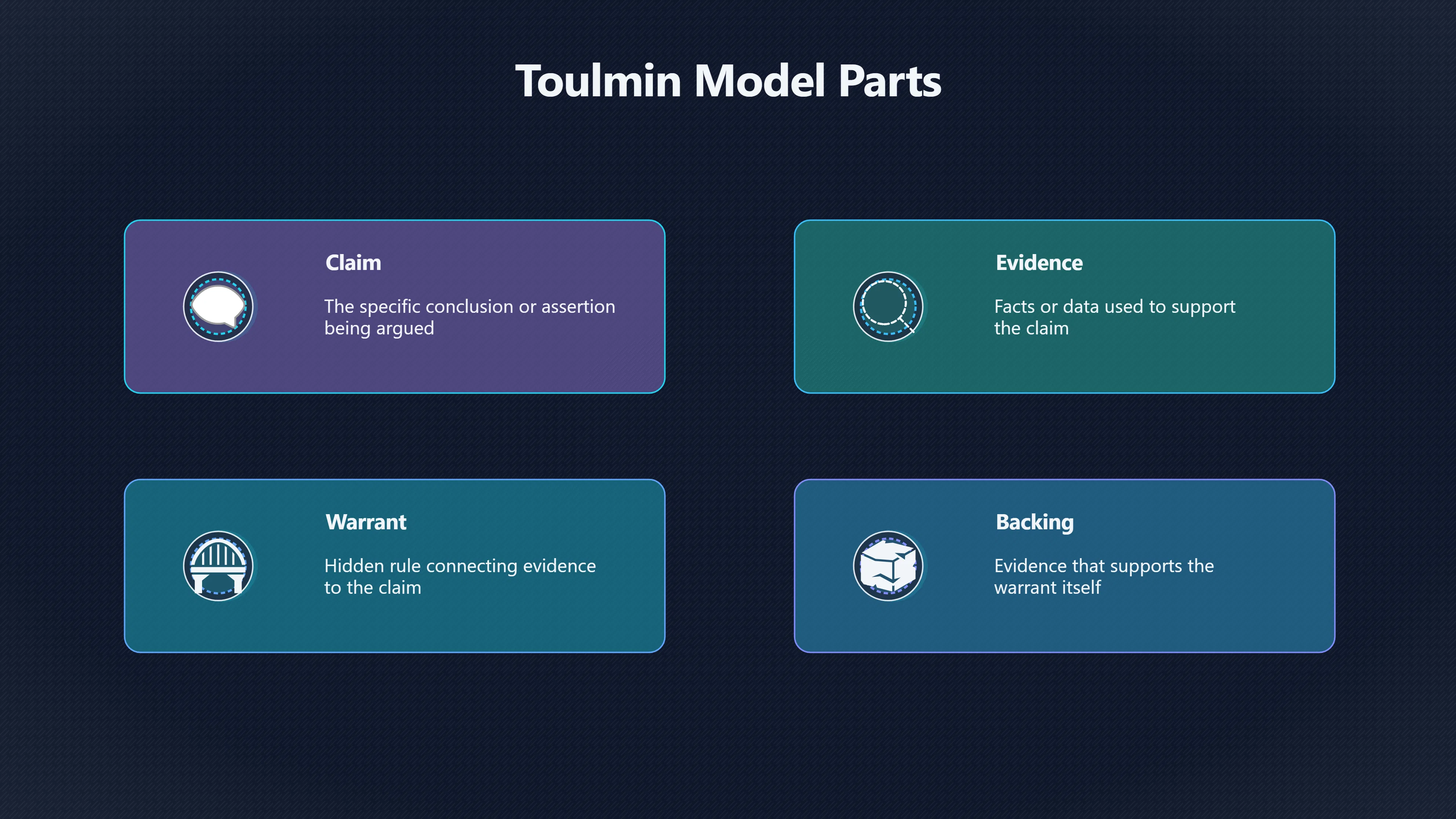
The warrant is the missing bridge that explains why a reason actually supports a conclusion.
On this page
- What a warrant does in an argument
- How to test whether the bridge holds
- When evidence supports a nearby claim instead
Page outline Jump by section
Introduction
A warrant is the missing bridge between evidence and a claim. When people evaluate an argument, they often focus on whether the evidence is true. A stronger test asks a different question: even if the evidence is true, why should it lead us to this conclusion? The answer is the warrant—the usually unstated assumption, rule, principle, or causal link that connects the evidence to the claim. In the Toulmin model of argument, the warrant is the element that explains how grounds (evidence) support a claim.[Purdue OWL]owl.purdue.eduOWLToulmin ArgumentPurdue OWLToulmin Argument - Purdue OWLIn Toulmin's method, every argument begins with three fundamental parts: the claim, the grounds, a…
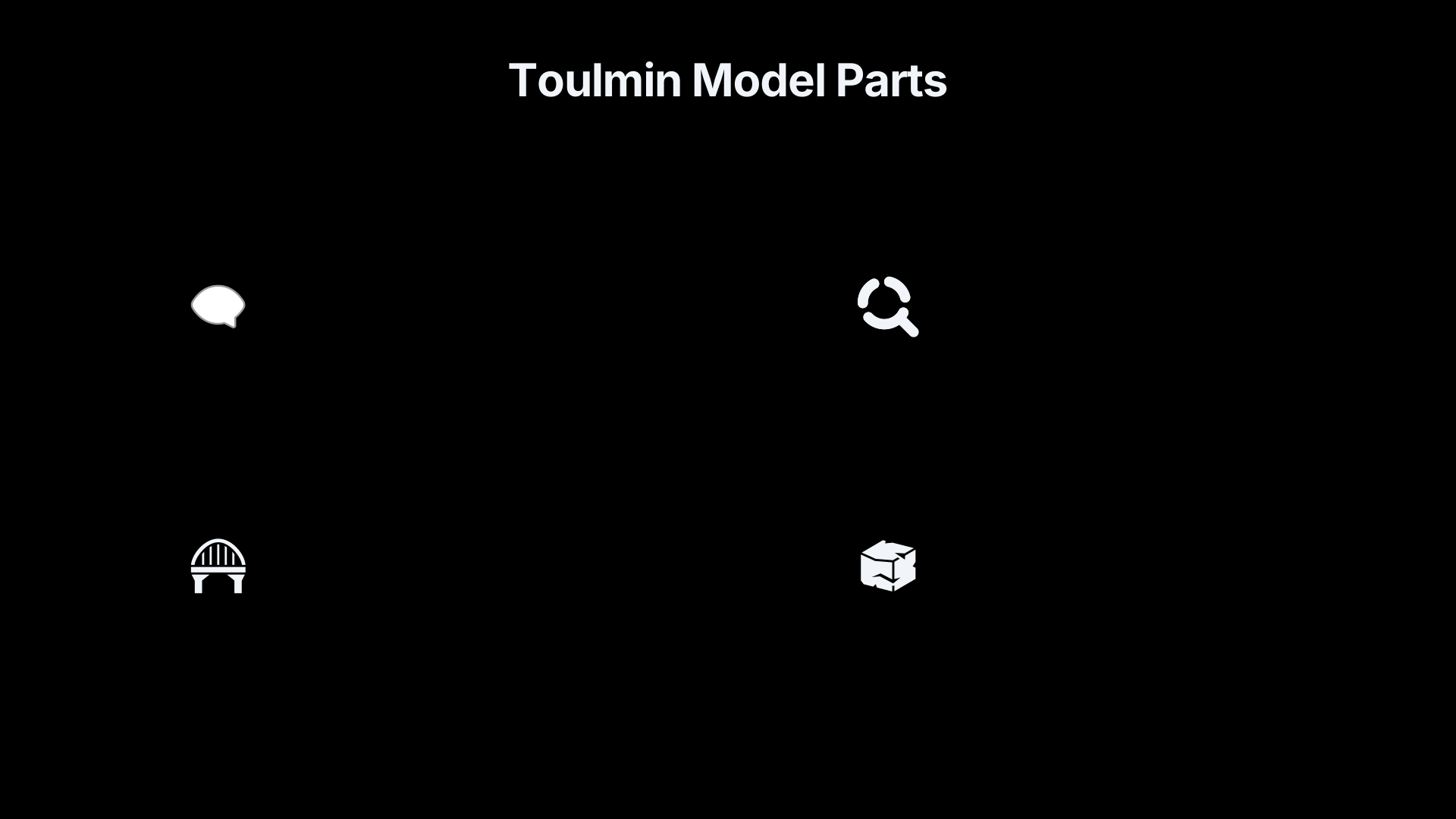 This matters because many logical fallacies arise not from false evidence but from weak, hidden, or unsupported warrants. An argument can sound persuasive while quietly relying on an assumption that does not hold. Warrant tests are therefore a practical relevance check: they expose gaps between what has been shown and what has merely been asserted.[informallogic.ca]informallogic.caUnderstanding Fallacies on Toulmin's Layout of ArgumentThis is because the warrant is the source of relevance between the data and the claim (ibid.Read more…
What a Warrant Does in an Argument
Evidence and claims rarely connect themselves. A warrant supplies the reasoning that makes the connection meaningful.
Consider this argument:
- Evidence: “The candidate managed a successful company.”
- Claim: “The candidate will be an effective mayor.”
The evidence does not automatically prove the claim. The hidden warrant is something like: “Skills that produce success in business tend to produce success in municipal government.”
Once the warrant is stated, the real issue becomes visible. Is that assumption justified? Are business management and public administration similar enough for the inference to work? The quality of the argument depends largely on the answer.[Purdue OWL]owl.purdue.eduOWLToulmin ArgumentPurdue OWLToulmin Argument - Purdue OWLIn Toulmin's method, every argument begins with three fundamental parts: the claim, the grounds, a…
Argumentation guides often describe the warrant as the bridge between data and conclusion. Without it, the audience is left to supply its own assumptions. Sometimes that is harmless because the warrant is widely accepted. In other cases, the hidden assumption is exactly where the reasoning fails. Lincoln University[Miami University]miamioh.eduMiami UniversitySupporting an ArgumentWarrant ("the bridge"): The belief, value, assumption, and/or experience the writer hopes the audie…
A useful way to think about warrants is that they answer the question:
“Why does this evidence make that conclusion more likely?”
If no convincing answer emerges, the argument has an evidence-to-claim gap.[statisticssolutions.com]statisticssolutions.comExpanding on the Basic Toulmin ModelThe Toulmin model of argumentation contains six elements: Claim, Grounds, Warrant, Qualifier, Backing…
How to Test Whether the Bridge Holds
Warrant testing is less about memorising fallacy names and more about inspecting the mechanism that connects evidence to conclusion.
Make the Hidden Assumption Explicit
Many weak arguments become easier to evaluate once their warrant is stated openly.
For example:
- Evidence: “Crime increased after the new mayor took office.”
- Claim: “The mayor caused the increase in crime.”
The warrant is: “If one event follows another, the earlier event is likely the cause.”
Once stated, the weakness becomes obvious. Many other factors could explain the increase. The problem is not the crime statistics; it is the causal warrant connecting them to the mayor. This kind of gap often appears in post hoc reasoning and other causal fallacies.
A practical test is to rewrite the argument in three parts:
- What is the evidence?
- What is the claim?
- What assumption must be true for the evidence to support the claim?[statisticssolutions.com]statisticssolutions.comExpanding on the Basic Toulmin ModelThe Toulmin model of argumentation contains six elements: Claim, Grounds, Warrant, Qualifier, Backing…
If the third step produces an implausible assumption, the bridge is weak.[Purdue OWL]owl.purdue.eduOWLToulmin ArgumentPurdue OWLToulmin Argument - Purdue OWLIn Toulmin's method, every argument begins with three fundamental parts: the claim, the grounds, a…
Ask Whether the Warrant Is Generalisable
A strong warrant usually functions as a broader principle.
For example:
- Evidence: “This medicine reduced symptoms in controlled trials.”
- Claim: “The medicine is likely to help patients.”
The warrant is a broadly accepted principle linking reliable clinical evidence to expectations about treatment effectiveness.
Now compare:
- Evidence: “My neighbour improved after taking the medicine.”
- Claim: “The medicine definitely works.”
Here the warrant relies on a much weaker principle: that a single anecdote can establish effectiveness.
The evidence is not necessarily false. The warrant simply lacks sufficient authority to support the strength of the conclusion. Toulmin-based analyses emphasise that warrants vary in strength and backing; some provide only weak relevance while others provide strong relevance.[informallogic.ca]informallogic.caUnderstanding Fallacies on Toulmin's Layout of ArgumentThis is because the warrant is the source of relevance between the data and the claim (ibid.Read more…
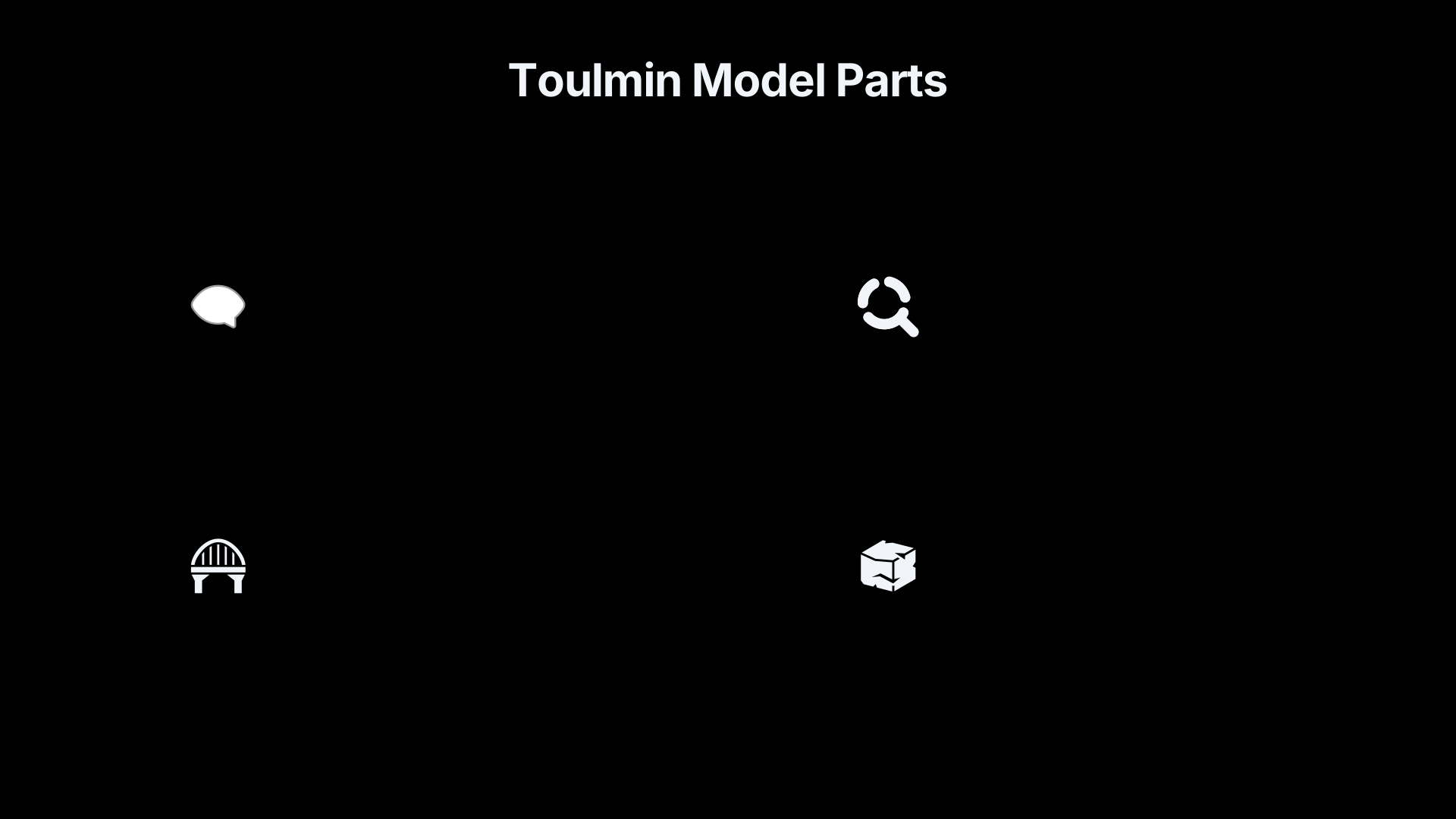
Reverse the Argument
Another useful test is to ask whether the same warrant could support obviously unreasonable conclusions.
Suppose someone argues:
- Evidence: “A famous actor supports this policy.”
- Claim: “The policy is correct.”
The warrant is effectively: “Famous people are reliable authorities on public policy.”
Applying the same warrant elsewhere exposes the weakness. If celebrity endorsement alone justified conclusions, countless contradictory positions would become equally justified. The warrant collapses under broader use.
This test is particularly effective against appeals to irrelevant authority, popularity, or status.
Check the Claim Strength
Evidence often supports a weaker claim than the one being asserted.[statisticssolutions.com]statisticssolutions.comExpanding on the Basic Toulmin ModelThe Toulmin model of argumentation contains six elements: Claim, Grounds, Warrant, Qualifier, Backing…
For example:
- Evidence: “Three studies found an association.”
- Claim: “The relationship is proven.”
The warrant assumes that limited evidence justifies certainty. A better conclusion might be that the relationship is plausible or deserves further investigation.
Recent research on evidence evaluation highlights this problem. Evidence may be relevant to a claim while still failing to warrant the claim’s full strength, scope, certainty, or specificity. The mismatch occurs when conclusions exceed what the evidence can reasonably support.[arXiv]arxiv.orgRelevant Is Not Warranted: Evidence-Force Calibration for Cited RAGMay 27, 2026…
When Evidence Supports a Nearby Claim Instead
One of the most common reasoning failures occurs when evidence genuinely supports something, just not the conclusion being advanced.
This creates the illusion of a strong argument because the evidence is relevant to a neighbouring issue.
Consider:
- Evidence: “The programme is popular with voters.”
- Claim: “The programme is economically effective.”
Popularity may support a claim about public approval. It does not automatically support a claim about economic performance.
Similarly:
- Evidence: “The witness has an excellent reputation.”
- Claim: “The witness’s statement is true.”
A good reputation may increase credibility, but credibility is not identical to truth. The evidence bears on one issue while the claim concerns another.
Warrant testing reveals the shift. The hidden bridge often turns out to be:
- Popularity implies effectiveness.
- Credibility implies truth.
- Legality implies morality.
- Tradition implies correctness.
Each bridge requires separate justification. Without it, the argument commits a relevance error by moving from one type of claim to another without adequate support.[FutureLearn]futurelearn.comHow to Argue Against Common FallaciesThe common fallacies are usefully divided into three categories: Fallacies of Relevance…
Common Warning Signs of an Evidence-to-Claim Gap
Several patterns frequently signal warrant problems:
- The conclusion is much stronger than the evidence. Limited evidence is used to support certainty.
- The argument depends on a hidden causal story. The cause is assumed rather than demonstrated.
- A personal example is treated as universal proof. Anecdotes replace representative evidence.
- The evidence concerns a different issue. Popularity, character, legality, or emotion is substituted for the actual point in dispute.
- The argument becomes unclear when the warrant is stated aloud. Once expressed explicitly, the bridge sounds implausible or controversial.
These warning signs do not automatically prove a fallacy. They indicate places where the warrant deserves scrutiny.
Why Warrant Tests Strengthen Reasoning
The most valuable feature of a warrant test is that it changes the question from “Is this evidence true?” to “Does this evidence justify this conclusion?” An argument may survive the first question and fail the second.
Strong reasoning requires more than facts. It requires a defensible connection between facts and conclusions. Warrants supply that connection, and warrant tests expose whether the connection is genuine, overstated, or missing altogether. In the context of logical fallacies, this makes warrant analysis one of the most effective tools for detecting relevance failures that would otherwise remain hidden beneath persuasive evidence and confident claims.[arXiv]arxiv.orgRelevant Is Not Warranted: Evidence-Force Calibration for Cited RAGMay 27, 2026…[3Purdue OWL 3Purdue Global]youtube.comClaim, Evidence, Warrant | Essay Writing | The Nature of WritingToulmin Model of Argumentation… Success Center](#endnote-10 “Snippet: Purdue Global Success CenterThe Toulmin Model of Argument PodcastThe warrant is the assumption, or belief, the writer has in mind when fo…”)
Amazon book picks
Further Reading
Books and field guides related to The Missing Bridge Between Evidence and Claim. Use these as the next step if you want deeper reading beyond the article.
A Rulebook for Arguments
Shows how to evaluate support, assumptions, and reasoning links.
Thinking, Fast and Slow
Explains cognitive biases that distort evidence-to-claim reasoning.
eBay marketplace picks
Marketplace Samples
Example marketplace items related to this page. Use the search link to explore similar finds on eBay.



Endnotes
1.
Source: owl.purdue.edu
Title: OWLToulmin Argument
Link:https://owl.purdue.edu/owl/general_writing/academic_writing/historical_perspectives_on_argumentation/toulmin_argument.html
Source snippet
Purdue OWLToulmin Argument - Purdue OWLIn Toulmin's method, every argument begins with three fundamental parts: the claim, the grounds, a...
2.
Source: informallogic.ca
Title: Understanding Fallacies on Toulmin’s Layout of Argument
Link:https://informallogic.ca/index.php/informal_logic/article/view/3900/3149
Source snippet
This is because the warrant is the source of relevance between the data and the claim (ibid.Read more...
3.
Source: futurelearn.com
Link:https://www.futurelearn.com/info/courses/logical-and-critical-thinking/0/steps/9131
Source snippet
How to Argue Against Common FallaciesThe common fallacies are usefully divided into three categories: Fallacies of Relevance...
4.
Source: lincoln.edu
Link:https://www.lincoln.edu/_files/_pdfs/Guide-to-Writing-and-Analyzing-an-Argument.pptx
Source snippet
Lincoln UniversityClaim and Evidence WorkshopWarrant (also referred to as a bridge): Explanation of why or how the data supports the clai...
5.
Source: arxiv.org
Link:https://arxiv.org/abs/2605.28044
Source snippet
Relevant Is Not Warranted: Evidence-Force Calibration for Cited RAGMay 27, 2026...
Published: May 27, 2026
6.
Source: arxiv.org
Title: arXiv Grounding Fallacies Misrepresenting Scientific Publications in Evidence
Link:https://arxiv.org/abs/2408.12812
7.
Source: arxiv.org
Link:https://arxiv.org/abs/1708.01425
8.
Source: owl.purdue.edu
Title: organizing your argument
Link:https://owl.purdue.edu/owl/general_writing/academic_writing/establishing_arguments/organizing_your_argument.html
Source snippet
Your Argument - Purdue OWLThe Toulmin Method is a formula that allows writers to build a sturdy logical foundation for their arguments. F...
9.
Source: owl.purdue.edu
Link:https://owl.purdue.edu/owl/general_writing/academic_writing/paragraphs_and_paragraphing/index.%20Two%20lines%20of%20text%2C%20no%20heading%20%3Cstrong%3Eformatting%3C/strong%3E%20apa%20Share%20Improve%20this%20question%20Follow%20asked%20Mar%2020%2C%202017%20at%201%3A44%20Mitch%20Talmadge%20123%204%20Add%20a%20comment%201%20Answer%20%E2%80%A6Make%20a%20claim.%20Provide%20the%20grounds%20%28evidence%29%20for%20the%20claim.%20Explain%20the%20warrant%20%28how%20the%20grounds%20support%20the%20claim%29%20Discuss%20possible%20rebuttals%20to%20the%20claim%2C%20identifying%20the%20limits%20of%20the%20argument%20and%20showing%20that%20you%20have%20considered%20alternative%20perspectives.%20The%20Toulmin%20model%20is%20a%20common%20approach%20in%20academic%20%3Cstrong%3Eessays%3C/strong%3E.For%20up-to-date%20guidance%2C%20see%20the%20ninth%20edition%20of%20the%20MLA%20Handbook.%20Set%20the%20margins%20of%20your%20document%20to%201%20inch%20on%20all%20sides.%20Indent%20the%20first%20line%20of%20each%20%3Cstrong%3Eparagraph%3C/strong%3E%20one%20half-inch%20from%20the%20left%20margin.General%20CMOS%20Guidelines.%20Text%20should%20be%20consistently%20double-spaced%2C%20except%20for%20block%20quotations%2C%20notes%2C%20bibliography%20entries%2C%20table%20titles%2C%20and%20figure%20captions.%20For%20block%20quotations%2C%20which%20are%20also%20called%20extracts%3A%20A%20prose%20quotation%20of%20five%20or%20more%20lines%2C%20or%20more%20than%20100%20words%2C%20should%20be%20blocked.html
Source snippet
ChoicesProvide the grounds (evidence) for the claim. Explain the warrant (how the grounds support the claim) Discuss possible rebuttals t...
10.
Source: youtube.com
Title: Claim, Evidence, Warrant | Essay Writing | The Nature of Writing
Link:https://www.youtube.com/watch?v=1BMnv2oleLo
Source snippet
Toulmin Model of Argumentation...
11.
Source: miamioh.edu
Link:https://miamioh.edu/howe-center/hwc/writing-resources/handouts/writing-process/supporting-an-argument.html
Source snippet
Miami UniversitySupporting an ArgumentWarrant ("the bridge"): The belief, value, assumption, and/or [experience]({{ 'experience/' | relative_url }}) the writer hopes the audie...
12.
Source: nature.com
Link:https://www.nature.com/articles/s41599-024-03151-w
Source snippet
A backing...Read more...
13.
Source: sites.google.com
Link:https://sites.google.com/site/writingwithpete/warrants
Source snippet
Art of Academic Writing - WarrantsThe two key types of claims you will make in writing are thesis statements and topic sentences. A thesi...
14.
Source: utminers.utep.edu
Link:https://utminers.utep.edu/omwilliamson/engl1311/fallacies.htm
Source snippet
List of Logical FallaciesFallacies are fake or deceptive arguments, "junk cognition," that is, arguments that seem irrefutable but prove...
15.
Source: youtube.com
Link:https://www.youtube.com/watch?v=1BMnv2ojkLo
Source snippet
Claim, Evidence, Warrant | Essay Writing | The Nature of WritingClaim, Evidence, Warrant | Essay Writing | The Nature of Writing 81K view...
16.
Source: azhin.org
Link:https://azhin.org/cummings/argument
Source snippet
Writing: Arguments: The Basics9 Mar 2026 — An argument makes a claim and uses evidence to back it up. Arguments all follow the same basic...
Additional References
17.
Source: statisticssolutions.com
Link:https://www.statisticssolutions.com/expanding-on-the-basic-toulmin-model-when-writing-a-literature-review/
Source snippet
Expanding on the Basic Toulmin ModelThe Toulmin model of argumentation contains six elements: Claim, Grounds, Warrant, Qualifier, Backing...
18.
Source: reddit.com
Link:https://www.reddit.com/r/[Debate
Source snippet
Toulmin Method: r/DebateThe tenets he includes are Claim, Ground, Warrant, Backing, Rebuttal, and Qualifier. Can anyone else confirm whe...
19.
Source: sjsu.edu
Link:https://www.sjsu.edu/writingcenter/docs/handouts/Toulmin%20Model%20of%20Argumentative%20Writing.pdf
Source snippet
Toulmin's Model of Argumentative WritingIt consists of six parts: three fundamental elements are the claim, grounds, and warrant; then, t...
20.
Source: ciris.info
Link:https://www.ciris.info/learningcenter/toulmins-model/
Source snippet
Toulmin's model of ArgumentationThe Toulmin model shows how reasoning moves from evidence (grounds) to a conclusion (claim), supported by...
21.
Source: publications.coventry.ac.uk
Link:https://publications.coventry.ac.uk/index.php/joaw/article/download/1154/1126/7568
Source snippet
Students How to Tame the Warrant with...This teaching practice paper deals with some practical ideas of teaching the concept of 'warrant...
22.
Source: mhcc.pressbooks.pub
Link:https://mhcc.pressbooks.pub/2ndwr122/chapter/8/
Source snippet
Analysis (Claims and Data)The Toulmin method is a style of argumentation that breaks arguments down into six component parts: claim, grou...
23.
Source: iep.utm.edu
Link:https://iep.utm.edu/fallacy/
Source snippet
Internet Encyclopedia of PhilosophyFallaciesA fallacy is a kind of error in reasoning. The list of fallacies below contains 231 names of...
24.
Source: learn.academy4sc.org
Title: the toulmin model of argumentation claims data and warrants oh my
Link:https://learn.academy4sc.org/video/the-toulmin-model-of-argumentation-claims-data-and-warrants-oh-my/
Source snippet
Toulmin Model of Argumentation: Claims, Data, and...Toulmin identified six elements of an effective argument: claims, data, warrants, ba...
25.
Source: thequillguy.com
Link:https://www.thequillguy.com/developing-academic-argument-using-claims-reasons-evidence-and-warrants-using-turabians-manual-for-writers/
Source snippet
Developing Academic Argument Using Claims, Reasons...So a warrant tests the relevance of a reason to a claim: it is the bridge between them...
26.
Source: files.eric.ed.gov
Link:https://files.eric.ed.gov/fulltext/ED028180.pdf
Source snippet
ttern for both the evaluation and construction of argument...
Topic Tree