Within Fallacy Lab
Did the Key Word Change Meaning?
Equivocation happens when an argument relies on a word changing meaning without making the shift clear.
On this page
- Meaning shifts
- Ambiguous terms
- Clarifying definitions
Page outline Jump by section
Introduction
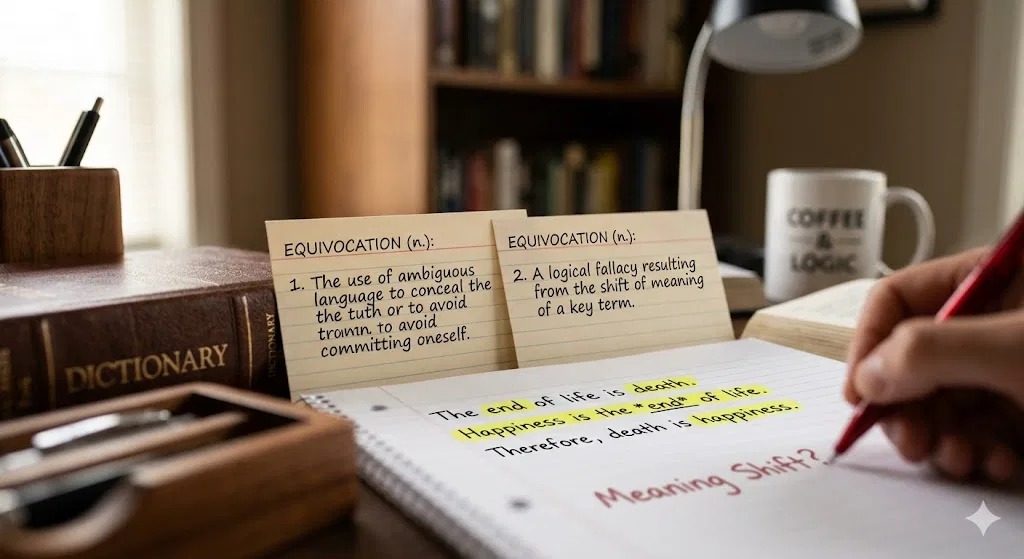
Equivocation is the logical fallacy that occurs when an argument quietly changes the meaning of a key word or phrase while treating it as if it has stayed the same. The problem is not ordinary ambiguity by itself. Many words have more than one legitimate meaning, and most conversations handle that through context. Equivocation becomes fallacious when the argument’s persuasive force depends on sliding from one meaning to another without making the shift visible. The result is an argument that can sound neat, clever or even formally tidy, while its central connection has broken.
A classic pattern is: “The end of life is death. Happiness is the end of life. Therefore, death is happiness.” The word “end” first means termination, then purpose or goal. Once that shift is exposed, the conclusion no longer follows. The fallacy matters because it often hides in familiar, value-loaded words such as “free”, “natural”, “right”, “theory”, “law”, “fair”, “real” or “evidence”, where different meanings can be swapped mid-argument without the audience immediately noticing. The Stanford Encyclopedia of Philosophy defines equivocation as exploiting the ambiguity of a term or phrase that occurs at least twice in an argument, with one meaning in the first occurrence and another in the second.[stanford]plato.stanford.eduEncyclopedia of Philosophy FallaciesThe fallacy of equivocation is an argument which exploits the ambiguity of a term or phrase which has occurred at least twice in an argum… Encyclopedia of Philosophy
How the Meaning Shift Does the Work
The mechanism of equivocation is simple: the argument borrows credibility from one meaning of a word and spends it under another. At first, the word appears in a sense that the audience accepts. Later, the same word reappears in a different sense, but the argument relies on the audience treating it as unchanged. The fallacy is therefore a problem of continuity. The wording is continuous; the meaning is not.
Consider the argument: “Only people with a right to speak should speak. I have a right to free speech. Therefore, I should be allowed to say anything anywhere without consequence.” The word “right” may move between a legal protection against certain government restrictions, a moral entitlement, a social permission and a guarantee of immunity from criticism. The argument may feel forceful because each use sounds connected to the same noble principle. But once the meanings are separated, the inference becomes much weaker.
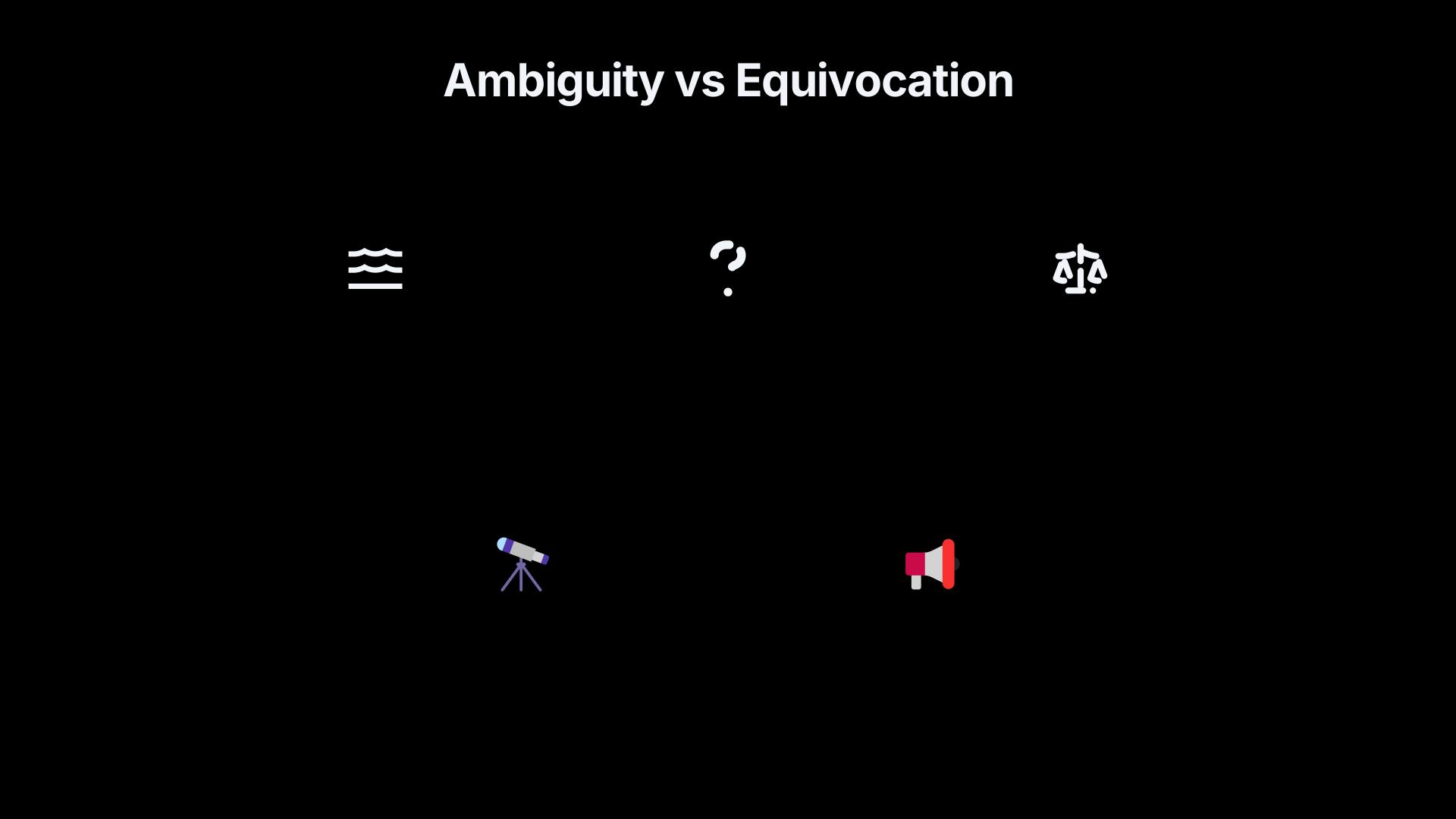
This is why equivocation is usually classed as a fallacy of ambiguity rather than a fallacy of relevance or evidence. The Internet Encyclopedia of Philosophy groups equivocation with ambiguity-based fallacies and distinguishes it from amphiboly and accent: equivocation is ambiguity of semantics, amphiboly is ambiguity of syntax, and accent is ambiguity of emphasis.[internet]internet.comInternet Encyclopedia of PhilosophyFallaciesSee the fallacies of Amphiboly, Accent, and Equivocation. Amphiboly is ambiguity of syntax. E… Encyclopedia of Philosophy In other words, equivocation is not mainly about a poorly arranged sentence or misleading stress on a word. It is about a term’s meaning changing while the argument pretends it has not.
A useful test is to replace the repeated word with its intended meaning each time. If the argument suddenly looks much less convincing, the shared word was probably carrying more weight than the reasoning itself. “Rare novels are valuable” and “exciting novels are rare” do not combine cleanly unless “rare” means the same thing in both places. In one case it may mean scarce in the market; in the other it may mean uncommon as an experience. Philosophy Pages uses this kind of example to show that the inferential link in an argument holds only when the same meaning is preserved across the relevant statements.[Philosophy Pages]philosophypages.comPhilosophy PagesFallacies of AmbiguityThe fallacies of ambiguity all involve a confusion of two or more different senses. Equivocation. A…

Ambiguous Terms Are Not Automatically Fallacious
A common mistake is to treat every ambiguous word as a fallacy. That is too quick. Language is flexible, and a word can carry several legitimate meanings without misleading anyone. “Light” can mean not heavy, not dark, or not serious. “Theory” can mean a casual guess in everyday speech, or a well-supported explanatory framework in science. “Natural” can refer to something not made by humans, something minimally processed, something normal, something healthy, or simply something familiar. Ambiguity becomes fallacious only when an argument depends on moving between such meanings as if they were identical.
The Stanford Encyclopedia of Philosophy’s entry on ambiguity notes that ambiguity is generally a property of signs that have multiple legitimate interpretations. It also warns that ordinary speech often uses “ambiguity” loosely, sometimes to mean mere underspecification rather than a genuine clash of meanings.[stanford]plato.stanford.eduEncyclopedia of Philosophy FallaciesThe fallacy of equivocation is an argument which exploits the ambiguity of a term or phrase which has occurred at least twice in an argum… Encyclopedia of Philosophy That distinction is important for fair argument. A speaker may be vague, imprecise or incomplete without committing equivocation. Equivocation requires a specific argumentative role: the meaning shift must help the conclusion appear to follow.
The difference can be seen in three cases:
- Harmless ambiguity: “The bank is closed.” Context may quickly show whether this means a financial institution or a river bank.
- Vagueness: “This policy is fair.” The word “fair” needs clarification, but the argument has not yet shifted meanings.
- Equivocation: “A fair system treats everyone the same. This tax treats everyone the same percentage-wise. Therefore, it is fair.” Here “fair” may slide from moral justice to mathematical uniformity.
Equivocation is therefore best identified by tracking the argument’s movement, not by spotting a single ambiguous word in isolation. The question is not merely “Could this word mean more than one thing?” but “Does the conclusion depend on quietly changing which meaning is in play?”
The Words Most Likely to Shift
Equivocation is especially common with words that are emotionally attractive, politically powerful, technically specialised or morally loaded. These words invite agreement before their meaning has been pinned down. That makes them useful in persuasion but risky in reasoning.
“Freedom” is a frequent example. It can mean freedom from government interference, freedom from economic pressure, freedom to make personal choices, freedom from discrimination, or freedom from social consequences. An argument may begin with one sense and end with another: “People should be free. Regulation limits freedom. Therefore, regulation is always wrong.” The argument treats freedom as one stable idea, but it may have moved from a broad moral ideal to a narrow account of state restraint.
“Natural” works in a similar way. A product may be called natural because its ingredients come from plants, because it avoids synthetic additives, because it feels traditional, or because the seller wants to imply it is safer. But “natural” does not automatically mean harmless, healthy, ethical or effective. An argument that moves from “this is natural” to “this is therefore good for you” may be trading on a meaning shift rather than supplying evidence.
Technical language creates another common trap. In science, a “theory” can be a robust explanatory framework supported by evidence; in everyday speech, it can mean a hunch. The familiar claim “evolution is only a theory” relies on that contrast: it borrows the scientific term and then evaluates it by the weaker everyday sense. The error is not that ordinary language is forbidden, but that the argument changes the standard without announcing it.
Abstract terms are particularly vulnerable because they do not point to a single visible object. Critical-thinking educators often flag words such as “good”, “logical”, “civilised”, “meaning”, “art” and “life” as prone to equivocation because their use depends heavily on context and background assumptions.[Middle Way Society]middlewaysociety.orgcritical thinking 5 ambiguityMiddle Way SocietyCritical Thinking 5: Ambiguity2 Feb 2014 — Ambiguity that affects the justification of an argument is known as equivoca… The more abstract the term, the more important it is to ask what definition the argument actually needs.
Equivocation Versus Related Ambiguity Fallacies
Equivocation sits in a family of fallacies that arise from unclear language, but it is not the same as every ambiguity problem. The differences matter because each one is fixed in a different way.
In equivocation, a word or phrase changes meaning. The remedy is to define the key term and keep the definition stable. “Noisy children are a headache. Aspirin cures headaches. Therefore, aspirin cures noisy children” turns on “headache” moving from a literal pain to a metaphorical nuisance.
In amphiboly, the sentence structure allows more than one reading. The issue is grammar or syntax, not a single term’s meaning. “I saw the man with the telescope” may mean that the speaker used a telescope, or that the man had one. The fix is to rewrite the sentence so the relationship between its parts is clear.
In accent, emphasis changes interpretation. A sentence can carry different implications depending on which word is stressed or extracted. The problem is not necessarily the dictionary meaning of the words, but the way emphasis guides the audience’s reading.
These distinctions appear in long-running treatments of fallacies of ambiguity, including the Internet Encyclopedia of Philosophy’s separation of equivocation, amphiboly and accent according to semantic, syntactic and emphatic ambiguity.[internet]internet.comInternet Encyclopedia of PhilosophyFallaciesSee the fallacies of Amphiboly, Accent, and Equivocation. Amphiboly is ambiguity of syntax. E… Encyclopedia of Philosophy They also reach back to ancient classifications. Aristotle’s Sophistical Refutations grouped several fallacies as dependent on language, and later discussions identify homonymy or equivocation as one of the core verbal fallacies.[ICAR]icar.cnrs.frfallacies ii aristotles foundational lisfallacies ii aristotles foundational lis
For readers, the practical difference is this: if the sentence can be fixed by rearranging grammar, the issue may be amphiboly; if it can be fixed by restoring the full quotation or intended stress, it may be accent; if it can be fixed by separating two senses of the same term, it is probably equivocation.

Why Equivocation Can Sound Persuasive
Equivocation works because the repeated word gives the argument a surface appearance of consistency. The listener hears the same sound or sees the same spelling and assumes the concept has remained stable. That assumption is usually efficient. In everyday communication, people do not stop to define every word. But in an argument, especially one about values, law, science or policy, this habit can be exploited.
The fallacy also benefits from the “halo” around certain words. A term such as “rights”, “equality”, “choice”, “security”, “science” or “common sense” may carry approval before anyone has specified its meaning. Once that approval is secured, the speaker may move to a narrower or broader sense. For example, “equality” can mean equal treatment under a rule, equal opportunity, equal outcome, equal respect or equal political standing. An argument may defend one meaning and then claim victory for another.
This is not always deliberate. A person can equivocate sincerely because they have not noticed that they are using a word in two ways. In fact, some of the most stubborn disagreements persist because both sides believe they are using the same term while attaching different standards to it. One person says “fair” and means proportional reward; another says “fair” and means equal access; a third means protection for the worst-off. The disagreement is partly substantive, but it is also definitional.
Research on ambiguity in language and reasoning reinforces the broader point that ambiguity is not a rare defect but a normal feature of communication. Work on ambiguity in formal and computational settings notes that different agents may interpret the same information differently, and that standard logical models often need special treatment to represent that fact.[arXiv]arxiv.orgarXiv A logic for reasoning about ambiguityarXiv A logic for reasoning about ambiguity For everyday argument, the lesson is more modest: shared words do not guarantee shared meanings.
How to Spot the Fallacy in Real Arguments
The fastest way to test for equivocation is to identify the key word that appears in both the reason and the conclusion, then ask whether it means exactly the same thing each time. If the argument becomes less convincing when the meanings are written out separately, the word may be doing illicit work.
A practical check looks like this:
- Find the load-bearing term. Look for the word the conclusion depends on: “free”, “natural”, “right”, “real”, “safe”, “fair”, “evidence”, “theory”.
- Paraphrase each occurrence. Replace the repeated word with a fuller phrase that states its meaning in that sentence.
- Compare the meanings. Ask whether the paraphrases are genuinely equivalent or merely related.
- Rebuild the argument. If the conclusion no longer follows, the original argument relied on equivocation.
- Ask for a stable definition. A fair debate can continue only once the parties agree which sense is being used.
This method is more reliable than simply accusing someone of “playing with words”. Equivocation is not a tone problem or a personality flaw. It is a specific break in the relation between premises and conclusion. Texas State University’s student resource states the point plainly: the fallacy occurs when a key term or phrase is used with one meaning in one part of an argument and another meaning elsewhere.[Texas State University]txst.eduSource details in endnotes.
A good challenge therefore sounds like: “When you say ‘free’ here, do you mean free of charge, free from legal restriction, or free from social criticism?” That question does not attack the speaker. It tests whether the argument can survive under a consistent definition.
Clarifying Definitions Without Killing Debate
Definitions can be used badly too. A person may try to win by imposing an eccentric definition, narrowing a word to exclude counterexamples, or expanding it so widely that it proves too much. The aim is not to freeze language permanently, but to make the relevant sense clear enough for the argument at hand.
Good clarification has three qualities. First, it is context-sensitive: the definition should fit the subject being debated. “Force” means one thing in physics, another in law, and another in ordinary conversation. Second, it is stable: once a meaning is chosen for an argument, it should not shift without notice. Third, it is shared or challengeable: other participants should be able to accept it, refine it or reject it openly.
Legal interpretation shows why this matters beyond classroom examples. Ambiguous language in contracts can lead to disputes because parties may later disagree about what a term meant in context. Legal discussions of ambiguity often distinguish mere disagreement from genuine ambiguity: a term is ambiguous when it is reasonably susceptible to more than one interpretation, not simply because one side dislikes the plain meaning.[Freiberger Haber LLP]fhnylaw.comFreiberger Haber LLPSometimes a Contract is Ambiguous, and Sometimes it is NotFreiberger Haber LLPSometimes a Contract is Ambiguous, and Sometimes it is Not That legal point has a useful everyday analogue. The fact that two people disagree about a word does not prove equivocation, but it does signal a need to define the term before drawing conclusions from it.
The best response to suspected equivocation is therefore not a triumphant label, but a repair: “Let’s separate those two meanings.” Once the meanings are separated, the argument may collapse, need revision, or become more precise. Any of those outcomes improves the discussion.
Why This Fallacy Matters in Logical Fallacies
Equivocation is one of the clearest examples of how informal fallacies depend on context rather than bare form. The same sentence pattern may be harmless in one setting and misleading in another. The decisive issue is whether the meaning shift is doing argumentative work.
That makes equivocation especially important for reading essays, adverts, political claims, opinion columns and online arguments. It teaches a habit that applies far beyond one named fallacy: do not let a repeated word substitute for a stable idea. When a conclusion seems to follow mainly because the same attractive term appears in the premises and the conclusion, slow down and ask what the term means in each place.
The fallacy is also a reminder that clarity is not pedantry. Arguments about public policy, ethics, science, education, religion and law often turn on words that carry several meanings at once. Without definition, people can appear to agree while meaning different things, or appear to disagree while using the same word in different senses. Equivocation exploits that gap. Clear definitions close it.
Amazon book picks
Further Reading
Books and field guides related to Did the Key Word Change Meaning?. Use these as the next step if you want deeper reading beyond the article.
Attacking Faulty Reasoning
Includes equivocation and many real-world reasoning errors.
An Illustrated Book of Bad Arguments
Makes ambiguity and fallacy concepts easy to spot.
eBay marketplace picks
Marketplace Samples
Example marketplace items related to this page. Use the search link to explore similar finds on eBay.




Endnotes
1.
Source: plato.stanford.edu
Title: Encyclopedia of Philosophy Fallacies
Link:https://plato.stanford.edu/archives/win2025/entries/fallacies/
Source snippet
The fallacy of equivocation is an argument which exploits the ambiguity of a term or phrase which has occurred at least twice in an argum...
2.
Source: plato.stanford.edu
Title: Encyclopedia of Philosophy Ambiguity
Link:https://plato.stanford.edu/entries/ambiguity/
Source snippet
Stanford Encyclopedia of PhilosophyAmbiguity - Stanford Encyclopedia of Philosophyby A Sennet · 2011 · Cited by 293 — Ambiguity is genera...
3.
Source: icar.cnrs.fr
Title: fallacies ii aristotles foundational lis
Link:https://icar.cnrs.fr/dicoplantin/fallacies-ii-aristotles-foundational-lis/
4.
Source: arxiv.org
Title: arXiv A logic for reasoning about ambiguity
Link:https://arxiv.org/abs/1401.2011
5.
Source: fhnylaw.com
Title: Freiberger Haber LLPSometimes a Contract is Ambiguous, and Sometimes it is Not
Link:https://www.fhnylaw.com/sometimes-a-contract-is-ambiguous-and-sometimes-it-is-not
6.
Source: philosophy.institute
Title: Ambiguity in Logic: The Root of Many Fallacies
Link:https://philosophy.institute/logic/ambiguity-logic-root-fallacies/
7.
Source: plato.stanford.edu
Link:https://plato.stanford.edu/entries/argument/
8.
Source: plato.stanford.edu
Link:https://plato.stanford.edu/archives/spr2016/entries/ambiguity/
9.
Source: web.stanford.edu
Title: [Logical Fallacies]({{ ‘logical-fallacies/’ | relative_url }})
Link:https://web.stanford.edu/~jonahw/PWR1/LogicalFallacies.htm
10.
Source: plato.stanford.edu
Link:https://plato.stanford.edu/archives/fall2013/entries/ambiguity/
11.
Source: plato.stanford.edu
Link:https://plato.stanford.edu/entries/fallacies/
12.
Source: plato.stanford.edu
Title: logic ancient
Link:https://plato.stanford.edu/entries/logic-ancient/
13.
Source: plato.stanford.edu
Title: logic informal
Link:https://plato.stanford.edu/entries/logic-informal/
14.
Source: plato.stanford.edu
Title: category mistakes
Link:https://plato.stanford.edu/entries/category-mistakes/
15.
Source: internet.com
Link:https://www.internet.com/
16.
Source: youtube.com
Title: Equivocation (Logical Fallacy)
Link:https://www.youtube.com/watch?v=kXlIAXx5TXE
Source snippet
Logical Fallacies - Equivocation...
17.
Source: youtube.com
Title: Logical Fallacies
Link:https://www.youtube.com/watch?v=x_8xKrKw19M
Source snippet
Equivocation Fallacy - With Simple, Practical, and Philosophical Examples...
18.
Source: youtube.com
Title: Equivocation Fallacy
Link:https://www.youtube.com/watch?v=lcR4LruYlGk
Source snippet
Fallacy of Equivocation...
19.
Source: youtube.com
Title: Fallacy of Equivocation
Link:https://www.youtube.com/watch?v=oIqoJgvNiqI
Source snippet
Simpsons Logical Fallacies: Equivocation...
20.
Source: iep.utm.edu
Link:https://iep.utm.edu/fallacy/
Source snippet
Internet Encyclopedia of PhilosophyFallaciesSee the fallacies of Amphiboly, Accent, and Equivocation. Amphiboly is ambiguity of syntax. E...
21.
Source: philosophypages.com
Link:https://www.philosophypages.com/lg/e06c.htm
Source snippet
Philosophy PagesFallacies of AmbiguityThe fallacies of ambiguity all involve a confusion of two or more different senses. Equivocation. A...
22.
Source: middlewaysociety.org
Title: critical thinking 5 ambiguity
Link:https://www.middlewaysociety.org/critical-thinking-5-ambiguity/
Source snippet
Middle Way SocietyCritical Thinking 5: Ambiguity2 Feb 2014 — Ambiguity that affects the justification of an argument is known as equivoca...
23.
Source: txst.edu
Link:https://www.txst.edu/philosophy/student-resources/informal-fallacies/equivocation.html
24.
Source: inquiresabound.wordpress.com
Link:https://inquiresabound.wordpress.com/2020/12/03/equivocation/
25.
Source: Wikipedia
Link:https://en.wikipedia.org/wiki/Internet
26.
Source: Wikipedia
Link:https://en.wikipedia.org/wiki/Equivocation
27.
Source: Wikipedia
Title: Sophistical Refutations
Link:https://en.wikipedia.org/wiki/Sophistical_Refutations
28.
Source: scribbr.co.uk
Title: Fallacy of Equivocation | Definition & Examples
Link:https://www.scribbr.co.uk/fallacy/fallacy-of-equivocation/
29.
Source: en.wikiversity.org
Title: Fallacies of Ambiguity
Link:https://en.wikiversity.org/wiki/Recognizing_Fallacies/Fallacies_of_Ambiguity
30.
Source: spectrum.com
Link:https://www.spectrum.com/internet
31.
Source: fiveable.me
Link:https://fiveable.me/critical-thinking/unit-8
32.
Source: ioer.ilsharedlearning.org
Title: Internet Encyclopedia of Philosophy Fallacies
Link:https://ioer.ilsharedlearning.org/resource/170358/Internet_Encyclopedia_of_Philosophy_Fallacies
33.
Source: studocu.com
Title: Fallacies of Ambiguity
Link:https://www.studocu.com/row/messages/question/10453552/fallacies-of-ambiguity-with-examples
34.
Source: idiom.ucsd.edu
Link:https://idiom.ucsd.edu/~schane/law/ambiguity.pdf
35.
Source: logicwrendolf.blogspot.com
Title: fallacies of ambiguity
Link:https://logicwrendolf.blogspot.com/2014/01/fallacies-of-ambiguity.html
36.
Source: holisticapologetics.com
Title: the fallacy of equivocation
Link:https://www.holisticapologetics.com/post/the-fallacy-of-equivocation
37.
Source: askphilosophers.org
Link:https://www.askphilosophers.org/question/26292
38.
Source: britannica.com
Link:https://www.britannica.com/topic/equivocation
39.
Source: britannica.com
Link:https://www.britannica.com/technology/Internet
40.
Source: courses.lumenlearning.com
Title: fallacies of ambiguity
Link:https://courses.lumenlearning.com/elpaso-introphilosophy/chapter/fallacies-of-ambiguity/
41.
Source: philosophybytheway.blogspot.com
Link:https://philosophybytheway.blogspot.com/2024/05/equivocation.html
Additional References
42.
Source: gwmatthews.github.io
Link:https://gwmatthews.github.io/ethics/3-2-ambiguity.html
43.
Source: logicallyfallacious.com
Link:https://www.logicallyfallacious.com/logicalfallacies/Ambiguity-Fallacy
44.
Source: jstor.org
Link:https://www.jstor.org/stable/jj.18254841
45.
Source: facebook.com
Link:https://www.facebook.com/100063988184088/posts/aristotles-sophistical-refutations-de-sophisticis-elenchis-is-a-foundational-wor/1095892012553728/
46.
Source: compareinternet.com
Link:https://www.compareinternet.com/
47.
Source: imperialnepaltreks.com
Link:https://imperialnepaltreks.com/ckfinder/userfiles/files/74e9ac53-6ca1-4d9c-a383-bf2b8fc72181.pdf
48.
Source: khanacademy.org
Link:https://www.khanacademy.org/partner-content/wi-phi/wiphi-critical-thinking/wiphi-fallacies/v/fallacy-of-equivocation
49.
Source: broadbandnow.com
Link:https://broadbandnow.com/
50.
Source: allconnect.com
Link:https://www.allconnect.com/internet
51.
Source: highspeedinternet.com
Link:https://www.highspeedinternet.com/
Topic Tree