Within Informal Logic
When One Story Becomes Too Much Proof
Personal experience can be useful evidence, but it often cannot carry a broad conclusion by itself.
On this page
- Why anecdotes feel more decisive than they are
- Sample size, bias and representativeness
- How to shrink claims to match the evidence
Page outline Jump by section
Introduction
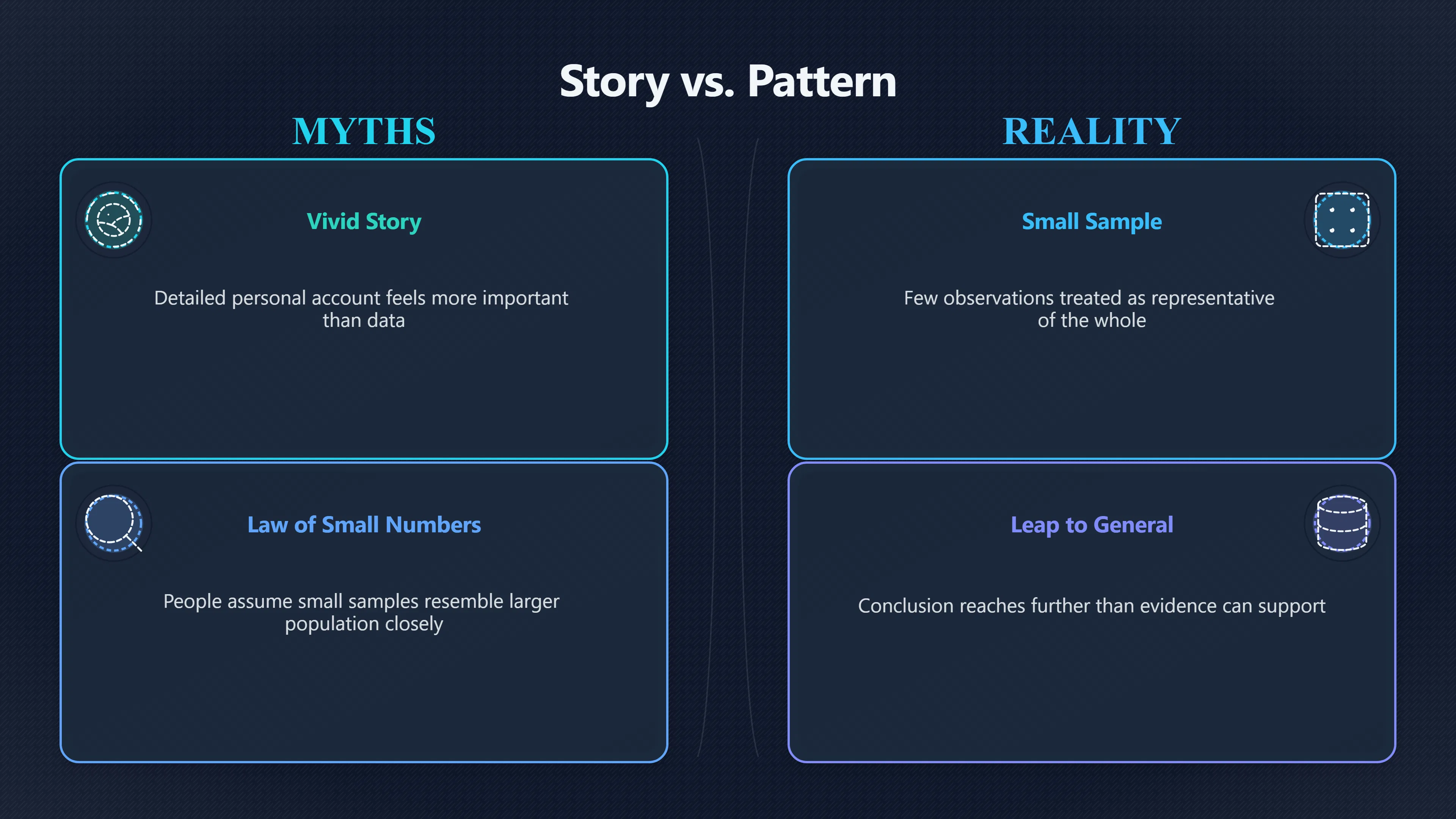
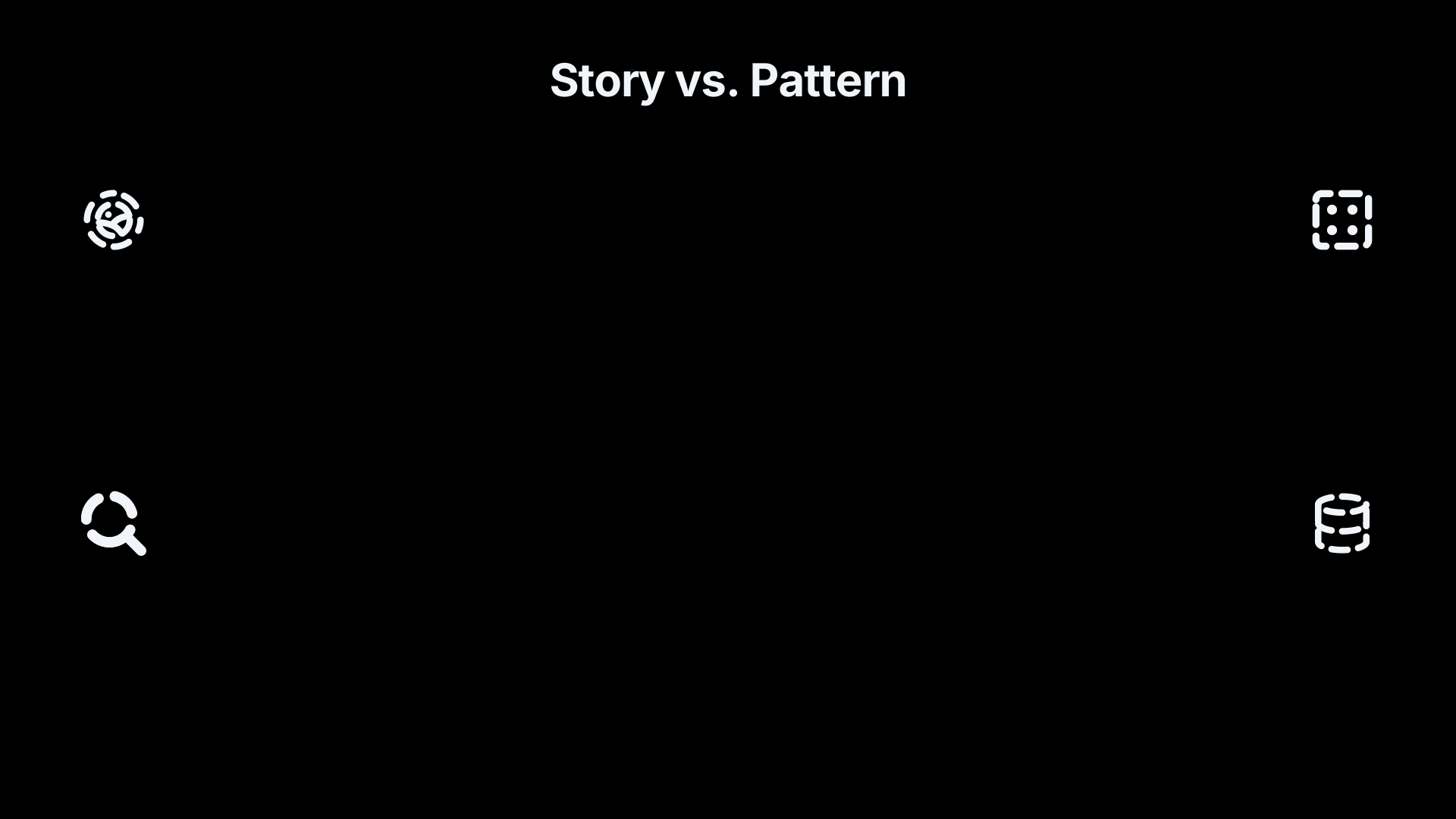
A hasty generalisation occurs when someone takes a small amount of evidence—often a personal story, a few examples, or a tiny sample—and treats it as proof of a much broader claim. Within everyday informal arguments, this is one of the most common reasoning errors because the evidence often feels persuasive. The experience may be real, vivid and emotionally memorable. The problem is not that the anecdote is false; it is that the conclusion reaches further than the evidence can support. A single bad customer-service experience does not show that a company is always incompetent. Knowing one successful school dropout does not prove that education is unimportant. The mistake lies in moving too quickly from “this happened” to “this is generally true”.[Wikipedia]WikipediaFaulty generalizationFaulty generalization
Why anecdotes feel more decisive than they are
People naturally pay attention to stories. A detailed personal account is easier to imagine and remember than a table of statistics. Research on the availability heuristic shows that information that comes to mind quickly often feels more important or more common than it really is. As a result, one striking example can outweigh a large body of less vivid evidence in people’s judgments.[The Decision Lab]thedecisionlab.comThe Decision Lab Availability HeuristicThe Decision LabAvailability Heuristic - The Decision…The availability heuristic describes our tendency to think that whatever is easi…
Consider a common conversation:
“My grandfather smoked every day and lived to ninety, so smoking cannot be that dangerous.”
The anecdote may be completely accurate. Yet it does not answer the broader question of how smoking affects populations. The story highlights an exception while leaving unknown how many similar people experienced different outcomes. The evidence is therefore too narrow to support the general conclusion.
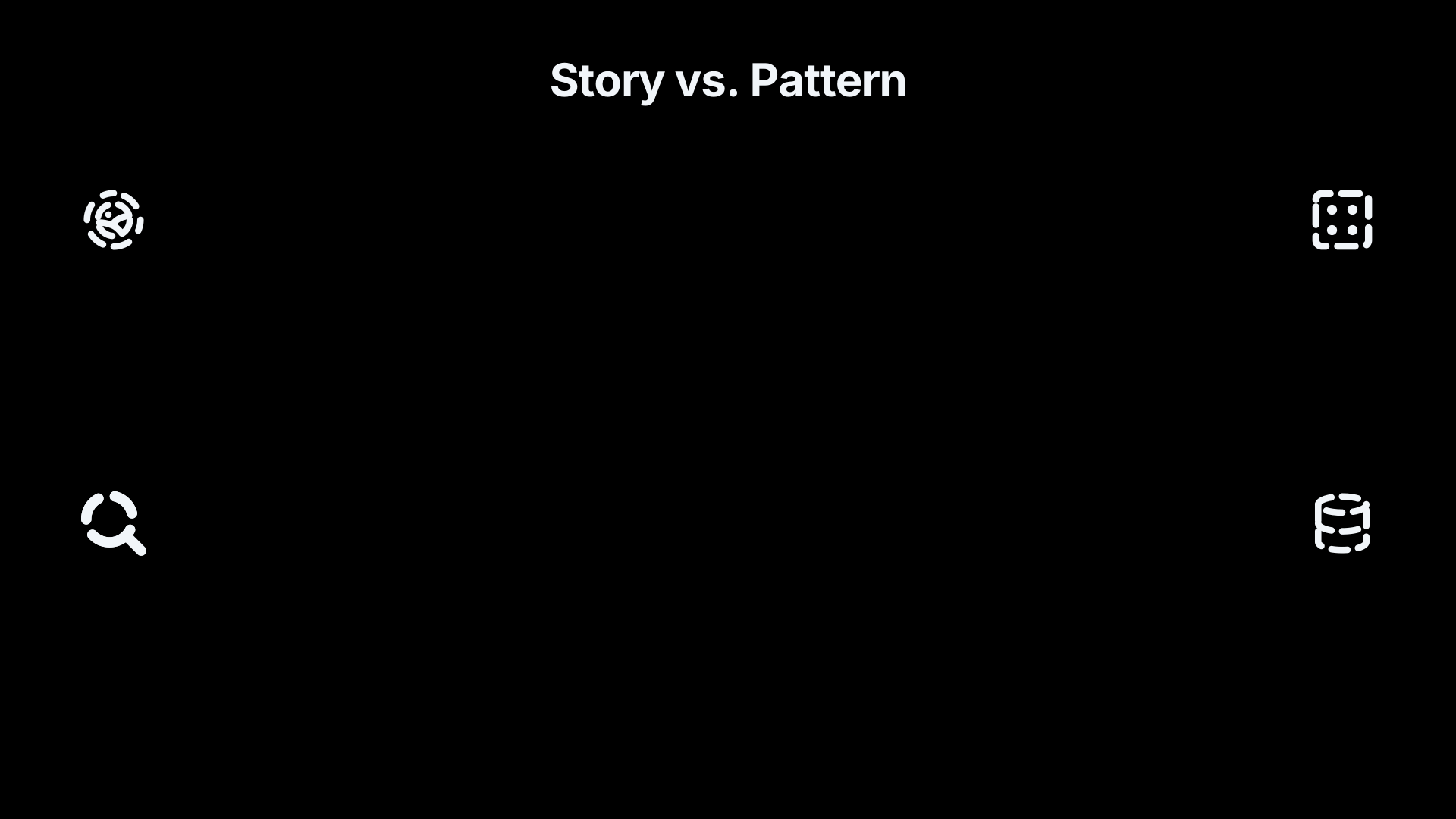
Studies of persuasion have repeatedly found that anecdotes can be surprisingly influential, even when statistical evidence is available. People often give substantial weight to personal experiences and testimonies because they feel concrete, human and trustworthy. Utrecht University[Repository UBN]repository.ubn.ru.nlRepository UBNCombining Anecdotal and Statistical Evidence in Real-Life…25 May 2017 — The persuasiveness of anecdotal evidence and sta…
This helps explain why hasty generalisations are common in debates about health, education, politics and consumer products. The speaker is often not inventing evidence; they are overextending it.
Sample size, bias and representativeness
The central question is not simply how many examples exist, but whether those examples fairly represent the wider group being discussed.
Imagine asking three friends whether a new restaurant is good. If all three enjoyed it, that tells you something. However, it does not automatically tell you what hundreds of customers think. The sample is small, and it may also be biased. Perhaps all three ordered the same dish, visited on the same night, or share similar tastes.
A hasty generalisation typically appears when one of two problems exists:
- The sample is too small. There are not enough observations to justify a broad conclusion.
- The sample is unrepresentative. The observations come from a narrow or unusual subgroup that does not reflect the wider population.[Wikipedia]WikipediaAnecdotal evidenceAnecdotal evidence
The distinction matters. A sample can be large but biased, or small yet reasonably informative. What makes the reasoning fallacious is the confidence placed in evidence that cannot adequately support the claim being made.
The “law of small numbers” problem
Psychologists Amos Tversky and Daniel Kahneman famously described a tendency they called the “belief in the law of small numbers”. People often assume that small samples will closely resemble the larger population from which they come. In reality, small samples are much more likely to produce unusual or extreme results by chance alone.[stats.org.uk]stats.org.ukBELIE F IN THE LAW OF SMALL NUMBERSIn particular, they regard a sample randomly drawn from a population as highly representative.Read more…[PMC]pmc.ncbi.nlm.nih.govPMCCan we shift belief in the 'Law of Small Numbers'?NIHby DVM Bishop · 2022 · Cited by 8 — One cognitive bias demonstrated by Tversky & Kahneman [1] is the 'belief in the law of small…
For example:
- A coin flipped ten times may produce eight heads.
- A coin flipped ten thousand times is much more likely to end up close to fifty percent heads.
Yet people often treat the first result as more meaningful than it deserves. They see a pattern where randomness may be sufficient to explain what happened. Research on sample-size neglect shows that many people underestimate how variable small samples can be.[Farnam Street]fs.blogFarnam StreetMental Model: Bias from Insensitivity to Sample SizeOur bias from insensitivity to sample size, (aka the law of small number…
This misunderstanding encourages broad conclusions from limited evidence. A few observations appear representative when they may simply be statistical noise.
Everyday examples of the fallacy
The fallacy appears in ordinary conversation because everyday life constantly supplies anecdotes.
Consumer experiences
A person buys one laptop that fails after a month and concludes that the manufacturer produces poor-quality products. Another person owns a reliable model from the same company and concludes the opposite. Both are relying on experiences that may be genuine but insufficiently broad.
Travel and places
Someone has an unpleasant interaction during a visit to a city and decides that the residents are unfriendly. The conclusion extends a handful of encounters to millions of people.
Health claims
A friend reports that a particular supplement improved their energy levels. Another says it did nothing. Neither account alone establishes whether the supplement is generally effective. Individual experiences can be influenced by coincidence, placebo effects, differing circumstances and natural variation.[Wikipedia]WikipediaInsensitivity to sample sizeAugust 13, 2025 — Insensitivity to sample size is a cognitive bias where people estimate the probability of obtaining a sample statistic…
Social stereotypes
One encounter with a member of a group becomes evidence about the group as a whole. This is among the most damaging forms of hasty generalisation because it converts isolated observations into sweeping judgments about categories of people.[Wikipedia]WikipediaBase rate fallacyBase rate fallacyThe base rate fallacy, also called base rate neglect or base rate bias, is a type of fallacy in which people tend to…
In each case, the reasoning error is the same: a narrow set of observations is treated as if it were representative of a much larger reality.
When anecdotes are useful evidence
Recognising the fallacy does not mean dismissing all anecdotes.
Personal experiences can serve important purposes:
- They can reveal problems worth investigating.
- They can illustrate how a broader pattern affects individuals.
- They can generate hypotheses for further testing.
- They can highlight outcomes that statistics alone may overlook.
The issue is proportionality. An anecdote is often excellent evidence that something happened to a particular person. It is usually much weaker evidence that the same thing happens frequently, typically or universally. Statistical evidence is generally more informative when the goal is to make claims about populations, frequencies or probabilities. Research comparing anecdotal and statistical evidence has found that statistical information is particularly valuable when the argument aims to support a generalisation about a wider group.[Utrecht University]research-portal.uu.nlwhen is statistical evidence superior to anecdotal evidence in suUtrecht UniversityWhen is Statistical Evidence Superior to Anecdotal…by H Hoeken · 2009 · Cited by 178 — Under certain conditions, sta…
A useful mental shift is to ask:
Is this story evidence of a possibility, or evidence of a pattern?
Many anecdotes establish the first but not the second.
How to shrink claims to match the evidence
One of the simplest ways to avoid hasty generalisation is to reduce the strength of the conclusion until it matches the strength of the evidence.
Compare these statements:
- “This restaurant is terrible.”
- “I had a bad experience at this restaurant.”
The second claim stays close to the evidence. The first leaps beyond it.
Similarly:
- “Online courses do not work.”
- “The online course I took did not work well for me.”
The revised version remains informative without claiming more than the evidence can support.
A practical checklist is:
- How many cases am I relying on?
- Could these cases be unusual?
- Do I know whether they represent the wider group?
- Would broader evidence change my view?
- Am I describing what happened, or generalising beyond it?
These questions encourage a more cautious relationship between evidence and conclusion.
The key lesson
Hasty generalisation from anecdotes and small samples is not a failure to observe reality; it is a failure to recognise the limits of what has been observed. Personal stories can be accurate, memorable and emotionally powerful. Small samples can contain genuine information. The fallacy appears when that limited evidence is stretched into a claim about a much larger population without adequate support. Understanding the difference between a story and a pattern helps keep conclusions proportionate to the evidence and makes everyday reasoning more reliable.[scribbr.com]scribbr.comthat they both result in conclusions drawn from insufficient evidence.Read more…[Wikipedia]WikipediaRepresentativeness heuristicRepresentativeness heuristicThe representativeness heuristic is used when making judgments about the probability of an event being rep…
eBay marketplace picks
Marketplace Samples
Example marketplace items related to this page. Use the search link to explore similar finds on eBay.
Endnotes
1.
Source: Wikipedia
Title: Faulty generalization
Link:https://en.wikipedia.org/wiki/Faulty_generalization
2.
Source: Wikipedia
Title: Anecdotal evidence
Link:https://en.wikipedia.org/wiki/Anecdotal_evidence
3.
Source: repository.ubn.ru.nl
Link:https://repository.ubn.ru.nl/bitstream/2066/190868/1/190868.pdf
Source snippet
Repository UBNCombining Anecdotal and Statistical Evidence in Real-Life...25 May 2017 — The persuasiveness of anecdotal evidence and sta...
Published: May 2017
4.
Source: stats.org.uk
Title: BELIE F IN THE LAW OF SMALL NUMBERS
Link:https://www.stats.org.uk/statistical-inference/TverskyKahneman1971.pdf
Source snippet
In particular, they regard a sample randomly drawn from a population as highly representative.Read more...
5.
Source: pmc.ncbi.nlm.nih.gov
Title: PMCCan we shift belief in the ‘Law of Small Numbers’?
Link:https://pmc.ncbi.nlm.nih.gov/articles/PMC8889191/
Source snippet
NIHby DVM Bishop · 2022 · Cited by 8 — One cognitive bias demonstrated by Tversky & Kahneman [1] is the 'belief in the law of small...
6.
Source: Wikipedia
Title: Insensitivity to sample size
Link:https://en.wikipedia.org/wiki/Insensitivity_to_sample_size
Source snippet
August 13, 2025 — Insensitivity to sample size is a cognitive bias where people estimate the probability of obtaining a sample statistic...
Published: August 13, 2025
7.
Source: pmc.ncbi.nlm.nih.gov
Title: PMCWhen and why do people act on flawed science?
Link:https://pmc.ncbi.nlm.nih.gov/articles/PMC8023527/
Source snippet
Effects of...by AL Michal · 2021 · Cited by 39 — In particular, the presence of anecdotal evidence can serve as a powerful barrier for s...
8.
Source: scribbr.com
Link:https://www.scribbr.com/frequently-asked-questions/difference-between-the-hasty-generalization-fallacy-and-anecdotal-evidence-fallacy/
Source snippet
that they both result in conclusions drawn from insufficient evidence.Read more...
9.
Source: Wikipedia
Title: Base rate fallacy
Link:https://en.wikipedia.org/wiki/Base_rate_fallacy
Source snippet
Base rate fallacyThe base rate fallacy, also called base rate neglect or base rate bias, is a type of fallacy in which people tend to...
10.
Source: Wikipedia
Title: Representativeness heuristic
Link:https://en.wikipedia.org/wiki/Representativeness_heuristic
Source snippet
Representativeness heuristicThe representativeness heuristic is used when making judgments about the probability of an event being rep...
11.
Source: scribbr.com
Link:https://www.scribbr.com/frequently-asked-questions/how-to-avoid-base-rate-fallacy/
Source snippet
her words, [post hoc]({{ 'post-hoc/' | relative_url }}) fallacy involves a leap to a...
12.
Source: scribbr.com
Title: hasty generalization fallacy
Link:https://www.scribbr.com/fallacies/hasty-generalization-fallacy/
Source snippet
Definition & Examples26 Apr 2023 — A hasty generalization fallacy occurs when people draw a conclusion from a sample that is too small or...
13.
Source: thedecisionlab.com
Title: The Decision Lab Availability Heuristic
Link:https://thedecisionlab.com/biases/availability-heuristic
Source snippet
The Decision LabAvailability Heuristic - The Decision...The availability heuristic describes our tendency to think that whatever is easi...
14.
Source: research-portal.uu.nl
Title: when is statistical evidence superior to anecdotal evidence in su
Link:https://research-portal.uu.nl/en/publications/when-is-statistical-evidence-superior-to-anecdotal-evidence-in-su/
Source snippet
Utrecht UniversityWhen is Statistical Evidence Superior to Anecdotal...by H Hoeken · 2009 · Cited by 178 — Under certain conditions, sta...
15.
Source: fs.blog
Link:https://fs.blog/mental-model-bias-from-insensitivity-to-sample-size/
Source snippet
Farnam StreetMental Model: Bias from Insensitivity to Sample SizeOur bias from insensitivity to sample size, (aka the law of small number...
16.
Source: thedecisionlab.com
Title: Base Rate Fallacy
Link:https://thedecisionlab.com/biases/base-rate-fallacy
Source snippet
The Decision...Base Rate Fallacy is our tendency to give more weight to the event-specific information than we should, and sometimes eve...
17.
Source: brainly.com
Link:https://brainly.com/question/43284718
Source snippet
Describe the mistaken belief in the "law of small numbers...23 Nov 2023 — The 'law of small numbers' leads to the mistaken belief that s...
Additional References
18.
Source: researchgate.net
Link:https://www.researchgate.net/publication/369977297_Revisiting_the_Belief_in_the_law_of_small_numbers_Conceptual_replication_and_extensions_Registered_Report_of_problems_reviewed_in_Tversky_and_Kahneman_1971
Source snippet
(PDF) Revisiting the "Belief in the law of small numbers"16 Jul 2023 — PDF | The belief in the law of small numbers is the phenomenon tha...
19.
Source: ebsco.com
Link:https://www.ebsco.com/research-starters/psychology/base-rate-fallacy
Source snippet
Base rate fallacy | Psychology | Research StartersBase rate fallacy, which is also called base rate neglect, is a social science theory a...
20.
Source: shortcogs.com
Link:https://www.shortcogs.com/bias/base-rate-neglect-fallacy
Source snippet
Base rate neglect fallacy | ShortcutsThe base rate neglect fallacy, which can be seen as a cognitive bias, is in fact a group of phenomen...
21.
Source: reddit.com
Link:https://www.reddit.com/r/changemyview/comments/n9dl9s/cmv_anecdotal_evidence_is_very_much_valid_evidence/
Source snippet
CMV: Anecdotal evidence is very much *valid* evidence.The trendy sentiment that any anecdotal evidence MUST be invalid and the only valid...
22.
Source: journals.sagepub.com
Link:https://journals.sagepub.com/doi/10.1177/17470218241255916
Source snippet
Sage JournalsRevisiting representativeness heuristic classic paradigmsKahneman and Tversky showed that when people make probability judge...
23.
Source: viva.pressbooks.pub
Link:https://viva.pressbooks.pub/comp2/chapter/a-repository-of-fallacies/
Source snippet
Another type of hasty generalization involves relying on anecdotal evidence for support. As human beings, we overestimate...Read more...
24.
Source: fallacyinlogic.medium.com
Title: anecdotal fallacy why is the use of anecdotal evidence fallacious 192eacb5db93
Link:https://fallacyinlogic.medium.com/anecdotal-fallacy-why-is-the-use-of-anecdotal-evidence-fallacious-192eacb5db93
Source snippet
Is The Use of Anecdotal Evidence Fallacious?This is a logical fallacy that arises when one draws a conclusion on the grounds of too few e...
25.
Source: youtube.com
Link:https://www.youtube.com/watch?v=HoMb4nKTZwg
Source snippet
The Law of Small NumbersWe don't get how statistics or randomness work and we treat conclusions from small samples with too much confiden...
26.
Source: youtube.com
Link:https://www.youtube.com/watch?v=LFi6PeD_PyA
Source snippet
Hasty generalization fallacy critical thinking anecdotal evidence [Logical fallacies]({{ 'logical-fallacies/' | relative_url }}), part 1. Hasty generalization + anecdotal evidence...
27.
Source: renascence.io
Title: base rate fallacy ignoring general information in favor of specifics
Link:https://www.renascence.io/journal/base-rate-fallacy-ignoring-general-information-in-favor-of-specifics
Source snippet
Base Rate Fallacy: Ignoring General Information in Favor of...2 Aug 2024 — The Base Rate Fallacy is the tendency to ignore general stati...
Topic Tree