Within Novelty
When Modern Language Does the Persuading
Calling a reform modern can make it sound progressive before anyone proves that it improves outcomes.
On this page
- How words like modern and upgraded shift attention away from evidence
- When policy language changes but burdens or risks remain
- How to ask what the reform improves, for whom, and at what cost
Page outline Jump by section
Introduction
In debates about public and workplace reform, the word modern often carries persuasive force that exceeds the evidence behind it. A proposal described as a “modernisation”, “upgrade”, “transformation”, or “future-ready framework” can sound inherently desirable before anyone has established whether it improves outcomes. This is a specific form of the appeal to novelty fallacy: language associated with progress subtly encourages acceptance of a reform because it appears contemporary rather than because it has been shown to work.
 The problem is not that modern reforms are usually bad. Many genuinely improve services, efficiency, fairness, or safety. The problem arises when labels such as modern and upgraded do the argumentative work that evidence should be doing. Once that happens, attention can shift away from measurable results, trade-offs, costs, and unintended consequences. Evidence-based policy research has repeatedly stressed that reforms should be judged by demonstrated outcomes rather than by their branding or perceived freshness.[OECD]oecd.orgfull reportFull Report: Government at a Glance 202519 Jun 2025 — The 2025 edition of Government at a Glance offers a comprehensive overview of p…[OECD]oecd.orgGovernanceIn the public sector, the OECD helps governments design and implement strategic, evidence-based and innovative policies to stre…
How Words Like “Modern” and “Upgraded” Shift Attention Away From Evidence
Policy language is rarely neutral. Describing a proposal as modern implicitly contrasts it with something presumed outdated. The comparison often occurs before any empirical comparison has been made.
A common pattern looks like this:
- Existing policy is described as old, legacy, or outdated.
- A new proposal is described as modern, innovative, agile, or transformed.
- The positive associations attached to modernity are transferred to the proposal itself.
- Questions about performance become secondary.
This rhetorical move can be powerful because many people reasonably associate technological, scientific, and social progress with improvement. Yet the fact that something is newer does not establish that it is more effective. Public-administration scholars have long noted that waves of reform frequently arrive with attractive narratives and ambitious labels, while the actual effects remain uncertain until implementation and evaluation occur.[OECD]oecd.orgModernising Government (ENModernising Government (EN)May 28, 2025 — This book identifies levers for reform to modernise the public sector, and presents an over…[OECD]oecd.orgpublic administration after new public management 9789264086449 enPublic Administration after "New Public Management"7 June 2010 — Reforms are focusing on the quality of services for citizens and busines…
The language of reform can therefore create an illusion of evidence. A policy may sound advanced because it is presented as part of a modernisation agenda, even when supporting data are limited, contested, or unavailable.
When Policy Language Changes but Burdens or Risks Remain
One reason modern-language appeals are persuasive is that they often focus on processes, structures, or branding rather than outcomes.
For example, governments may announce a “digital transformation” of a service. The reform may indeed modernise technology, but the relevant public question is whether citizens experience shorter waiting times, fewer errors, greater accessibility, or lower costs. Without those measures, the word transformation says little about success.
The same pattern appears in workplace reforms. Organisations may replace familiar procedures with “next-generation workflows”, “smart performance frameworks”, or “agile operating models”. Such changes can be beneficial, but they can also shift administrative burdens onto employees, create confusion during transitions, or generate new compliance requirements. The modern language highlights novelty while obscuring the possibility that old problems remain.
Research on public-sector reform repeatedly emphasises the importance of evaluation because reforms often produce mixed results. Some achieve intended goals; others create costs, complexities, or unintended effects that were not obvious during the launch phase.[amor.cms.hu-berlin.de]amor.cms.hu-berlin.de371 Public sector reform and evaluationApproaches and…by H Wollmann · Cited by 4 — Finally, there is evidence of a growing interest in the academic research community in con…[Open Knowledge]openknowledge.worldbank.orgOpen Knowledge RepositoryMaking Public Sector Reforms Work: Political and Economic…by S Bunse · 2012 · Cited by 72 — Supporting effec…
This is why descriptions such as “modern governance”, “reimagined service delivery”, or “institutional transformation” should be treated as starting points for inquiry rather than conclusions.
Why Modernity Is a Particularly Powerful Political Signal
Modern language does more than describe change. It signals membership in a broader story of progress.
Political leaders often present reforms as evidence that institutions are adapting to contemporary challenges. Organisations do the same when they describe restructuring efforts as modernisation programmes. The underlying message is often cultural as much as practical: modern institutions are responsible, efficient, innovative, and future-oriented.
The difficulty is that symbolic progress and practical progress are not identical.
A reform can successfully communicate dynamism while failing to improve outcomes. Conversely, a less glamorous reform may generate substantial benefits despite lacking fashionable terminology. Studies of evidence-informed policymaking repeatedly stress that policy quality depends on the strength of analysis, implementation, monitoring, and evaluation rather than on how progressive the reform sounds.[OECD]oecd.orgManaging Change in OECD Governments (EN)by OH Melchor · 2008 · Cited by 118 — The objective is to explore the different ways in which…[OECD]oecd.orgpolicy implications and the way forward 1cf96736Strengthening National Evidence-Informed Policymaking…18 Dec 2025 — This chapter outlines forward-looking policy pathways to suppo…
The appeal to novelty enters when modernity itself becomes evidence. Instead of demonstrating that a proposal works, advocates rely on the assumption that contemporary approaches must be superior to older ones.
The Warning Signs of Weakly Supported Modernisation Claims
Several recurring features suggest that a reform may be relying more on modern language than on demonstrated benefits.
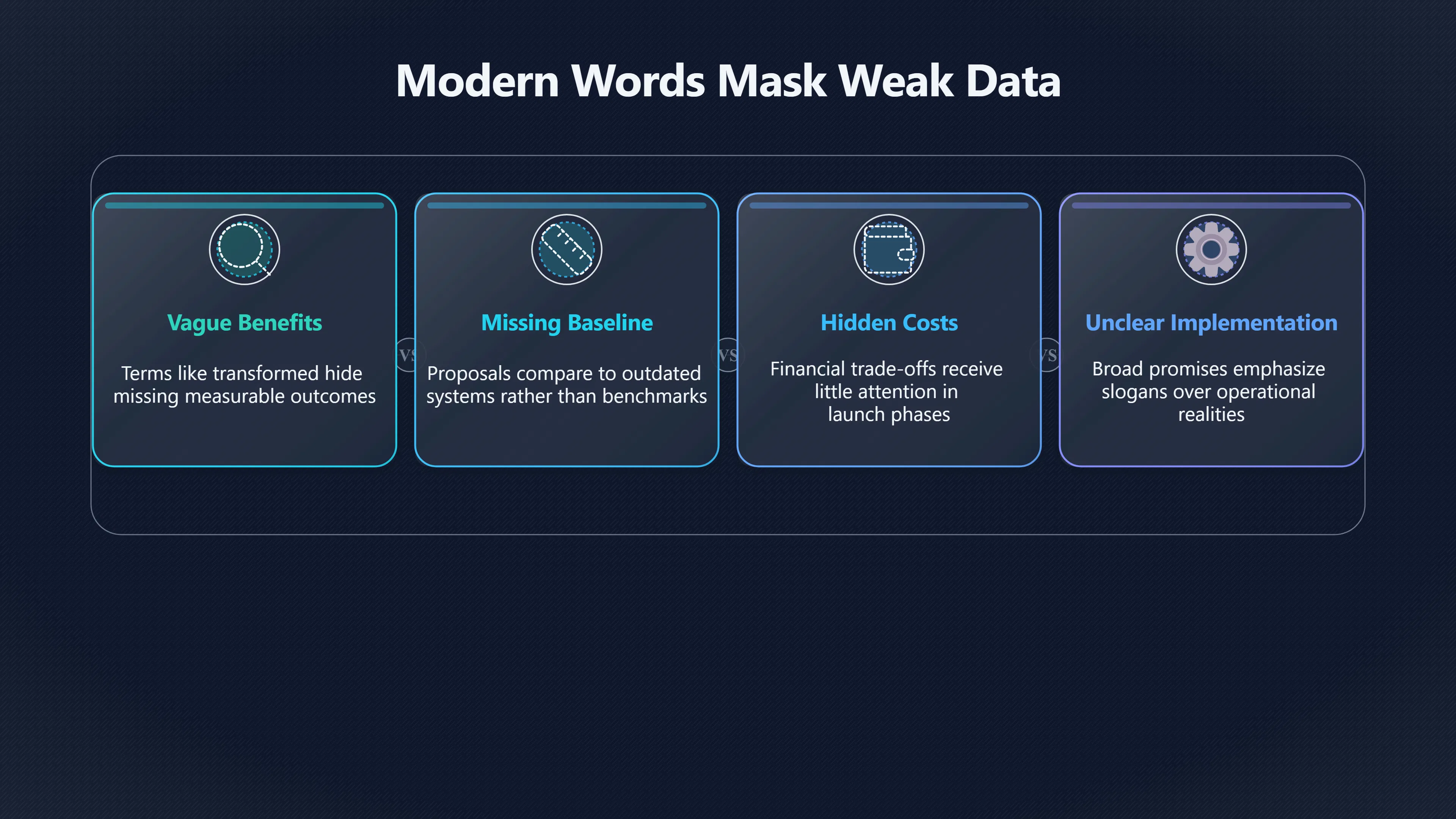
Benefits are described vaguely. Terms such as “streamlined”, “transformed”, “future-ready”, and “enhanced” appear frequently, while measurable outcomes remain unspecified.
Comparisons are missing. The proposal is compared to an allegedly outdated system rather than to clear performance benchmarks.
Evidence is replaced by aspiration. Supporters focus on what the reform is intended to achieve without presenting evidence that it actually does so.
Costs receive little attention. Financial, administrative, or social trade-offs are minimised while benefits are highlighted.
Implementation details remain unclear. Broad promises are emphasised more than operational realities.
These signs do not prove that a reform is unsound. They indicate that readers and citizens should ask for stronger evidence before accepting claims of improvement.

How to Ask What the Reform Improves, for Whom, and at What Cost
The most effective response to modern-language persuasion is not hostility towards innovation. It is disciplined questioning.
When encountering claims about modernisation, several questions help separate rhetoric from evidence:
What specific outcome improves?
A claim that a policy is modern tells us little. A claim that it reduces processing times by 30 per cent, increases service access, or lowers costs is testable.
Who benefits?
A reform may help one group while imposing burdens on another. Aggregate language can conceal uneven effects.
What is the baseline?
Improvement requires comparison. Compared with what exactly is the reform better?
What evidence supports the claim?
Pilot programmes, evaluations, audits, experiments, performance indicators, and independent reviews provide stronger grounds than slogans.
What are the costs and trade-offs?
Nearly every reform involves compromises. Understanding them is essential for informed judgement.
These questions align with broader evidence-informed policy approaches, which emphasise evaluating costs, benefits, effects, and implementation realities rather than relying on assumptions about progress.[OECD]oecd.orgStrengthening National Evidence-Informed Policymaking…18 Dec 2025 — This chapter distils findings from the EIPM project's seven countr…[OECD]oecd.orgevidence informed infrastructure decision making ac3e2c57Evidence-informed infrastructure decision making19 Jun 2025 — Such evidence-informed decision making uses existing evidence and past…
When Modernisation Language and Evidence Work Together
Not every appeal to modernity is fallacious. Sometimes the language accurately describes a reform that has been rigorously evaluated.
The distinction lies in the role that modernity plays within the argument. If modernity is merely descriptive—“this is a newer system, and here is evidence that it improves outcomes”—the argument may be sound. If modernity functions as the main reason for acceptance—“this is a newer system, therefore it is better”—the argument slips into appeal to novelty.
Evidence-informed governance increasingly emphasises measurable outcomes, transparency, evaluation, and accountability precisely because reform rhetoric alone cannot establish effectiveness. Public trust is strengthened when governments and organisations can demonstrate results rather than merely promise modernisation.[OECD]oecd.orgoecd survey on drivers of trust in public institutions 2024 results 9a20554b enOECD Survey on Drivers of Trust in Public Institutions10 Jul 2024 — The second OECD Survey on Drivers of Trust in Public Institutions…[OECD]oecd.orgGovernments should strengthen public trust by improving…19 Jun 2025 — Governments can strengthen public trust by ensuring meaningful p…
The Core Mechanism
The central mechanism behind modern language claims that hide weak policy evidence is straightforward: favourable associations attached to words such as modern, upgraded, transformed, and innovative are allowed to substitute for proof of improvement.
The reform may indeed be beneficial. The fallacy occurs when the language of progress becomes a shortcut around the harder task of demonstrating results. In debates about policy, governance, and organisational change, the crucial question is never whether a proposal sounds modern. It is whether the evidence shows that it produces better outcomes than the available alternatives.
Amazon book picks
Further Reading
Books and field guides related to When Modern Language Does the Persuading. Use these as the next step if you want deeper reading beyond the article.
Language in Thought and Action
Directly addresses how wording influences judgment and perception beyond evidence.
Thinking, Fast and Slow
Shows how framing and intuitive impressions affect decisions about supposedly modern reforms.
Manufacturing Consent
Explores how presentation and narrative shape acceptance of policies and institutions.
The Art of Thinking Clearly
Helps readers identify shortcuts and persuasive cues that substitute for evidence.
eBay marketplace picks
Marketplace Samples
Example marketplace items related to this page. Use the search link to explore similar finds on eBay.








Endnotes
1.
Source: oecd.org
Title: full report
Link:https://www.oecd.org/en/publications/government-at-a-glance-2025_0efd0bcd-en/full-report.html
Source snippet
Full Report: Government at a Glance 202519 Jun 2025 — The 2025 edition of Government at a Glance offers a comprehensive overview of p...
2.
Source: oecd.org
Link:https://www.oecd.org/en/topics/policy-areas/governance.html
Source snippet
GovernanceIn the public sector, the OECD helps governments design and implement strategic, evidence-based and innovative policies to stre...
3.
Source: oecd.org
Title: Modernising Government (EN)
Link:https://www.oecd.org/content/dam/oecd/en/publications/reports/2005/09/modernising-government_g1gh5a93/9789264010505-en.pdf
Source snippet
Modernising Government (EN)May 28, 2025 — This book identifies levers for reform to modernise the public sector, and presents an over...
Published: May 28, 2025
4.
Source: oecd.org
Title: public administration after new public management 9789264086449 en
Link:https://www.oecd.org/en/publications/public-administration-after-new-public-management_9789264086449-en.html
Source snippet
Public Administration after "New Public Management"7 June 2010 — Reforms are focusing on the quality of services for citizens and busines...
Published: June 2010
5.
Source: amor.cms.hu-berlin.de
Title: 371 Public sector reform and evaluation
Link:https://amor.cms.hu-berlin.de/~h0598bce/docs/hw2003-public-sector-reform-and-evaluation.pdf
Source snippet
Approaches and...by H Wollmann · Cited by 4 — Finally, there is evidence of a growing interest in the academic research community in con...
6.
Source: oecd.org
Link:https://www.oecd.org/content/dam/oecd/en/publications/reports/2008/12/managing-change-in-oecd-governments_g17a1c80/227141782188.pdf
Source snippet
Managing Change in OECD Governments (EN)by OH Melchor · 2008 · Cited by 118 — The objective is to explore the different ways in which...
7.
Source: oecd.org
Title: policy implications and the way forward 1cf96736
Link:https://www.oecd.org/en/publications/strengthening-national-evidence-informed-policymaking-ecosystems_855c5286-en/full-report/policy-implications-and-the-way-forward_1cf96736.html
Source snippet
Strengthening National Evidence-Informed Policymaking...18 Dec 2025 — This chapter outlines forward-looking policy pathways to suppo...
8.
Source: oecd.org
Link:https://www.oecd.org/en/publications/strengthening-national-evidence-informed-policymaking-ecosystems_855c5286-en/full-report/overview-of-lessons-learned-and-principles-for-healthy-evidence-informed-policymaking-ecosystems_f4089495.html
Source snippet
Strengthening National Evidence-Informed Policymaking...18 Dec 2025 — This chapter distils findings from the EIPM project's seven countr...
9.
Source: oecd.org
Title: evidence informed infrastructure decision making ac3e2c57
Link:https://www.oecd.org/en/publications/government-at-a-glance-2025_0efd0bcd-en/full-report/evidence-informed-infrastructure-decision-making_ac3e2c57.html
Source snippet
Evidence-informed infrastructure decision making19 Jun 2025 — Such evidence-informed decision making uses existing evidence and past...
10.
Source: oecd.org
Title: oecd survey on drivers of trust in public institutions 2024 results 9a20554b en
Link:https://www.oecd.org/en/publications/oecd-survey-on-drivers-of-trust-in-public-institutions-2024-results_9a20554b-en.html
Source snippet
OECD Survey on Drivers of Trust in Public Institutions10 Jul 2024 — The second OECD Survey on Drivers of Trust in Public Institutions...
11.
Source: oecd.org
Link:https://www.oecd.org/en/about/news/press-releases/2025/06/governments-should-strengthen-public-trust-by-improving-efficiency-citizen-engagement-and-access-to-public-services.html
Source snippet
Governments should strengthen public trust by improving...19 Jun 2025 — Governments can strengthen public trust by ensuring meaningful p...
12.
Source: oecd.org
Title: government at a glance 2025 0efd0bcd en
Link:https://www.oecd.org/en/publications/government-at-a-glance-2025_0efd0bcd-en.html
Source snippet
Government at a Glance 202519 Jun 2025 — The 2025 edition of Government at a Glance offers a comprehensive overview of public governance...
13.
Source: oecd.org
Title: component 16
Link:https://www.oecd.org/en/publications/government-at-a-glance-2025_0efd0bcd-en/full-report/component-16.html
Source snippet
Public services: Government at a Glance 202519 Jun 2025 — The 2025 edition of Government at a Glance offers a comprehensive overview of p...
14.
Source: oecd.org
Link:https://www.oecd.org/en/topics/public-governance-and-administration-modernisation.html
Source snippet
Public governance and administration modernisationGovernments are enacting new public administration reforms that increasingly seek to in...
15.
Source: oecd.org
Link:https://www.oecd.org/content/dam/oecd/en/publications/reports/2019/12/public-value-in-public-service-transformation_73c2ed5a/47c17892-en.pdf
Source snippet
Public Value in Public Service TransformationThis report was prepared by the OECD Directorate for Public Governance (GOV), under the lead...
16.
Source: oecd.org
Title: government at a glance 2025 70e14c6c
Link:https://www.oecd.org/en/publications/2025/06/government-at-a-glance-2025_70e14c6c.html
Source snippet
Government at a Glance 2025Jun 19, 2025 — The 2025 edition of Government at a Glance offers a comprehensive overview of public governance...
17.
Source: oecd.org
Title: perceptions of public sector integrity dd721ac4
Link:https://www.oecd.org/en/publications/government-at-a-glance-2025_0efd0bcd-en/full-report/perceptions-of-public-sector-integrity_dd721ac4.html
Source snippet
Perceptions of public sector integrity: Government at a...19 Jun 2025 — Overall, the findings highlight persistent concerns about integr...
18.
Source: oecd.org
Link:https://www.oecd.org/content/dam/oecd/en/publications/reports/2017/05/multi-level-governance-reforms_g1g77b03/9789264272866-en.pdf
Source snippet
untries. Multi-level governance reforms often have...Read more...
19.
Source: oecd.org
Title: drivers of trust in public institutions fe2b7742
Link:https://www.oecd.org/en/publications/government-at-a-glance-2025_0efd0bcd-en/full-report/drivers-of-trust-in-public-institutions_fe2b7742.html
Source snippet
Drivers of trust in public institutions: Government at a...19 Jun 2025 — The 2025 edition of Government at a Glance offers a comprehensi...
20.
Source: oecd.org
Title: transparency of public information 60a963c4
Link:https://www.oecd.org/en/publications/government-at-a-glance-2025_0efd0bcd-en/full-report/transparency-of-public-information_60a963c4.html
Source snippet
Transparency of public information: Government at a...19 Jun 2025 — The 2025 edition of Government at a Glance offers a comprehensive ov...
21.
Source: oecd.org
Title: governance of sector regulators 48990352
Link:https://www.oecd.org/en/publications/government-at-a-glance-2025_0efd0bcd-en/full-report/governance-of-sector-regulators_48990352.html
Source snippet
Governance of sector regulators19 Jun 2025 — The 2025 edition of Government at a Glance offers a comprehensive overview of public governa...
22.
Source: oecd.org
Link:https://www.oecd.org/content/dam/oecd/en/publications/reports/2003/09/governance-of-public-research_g1gh383a/9789264103764-en.pdf
Source snippet
ce on project funding and contract research exerts.Read more...
23.
Source: oecd.org
Link:https://www.oecd.org/en/publications/government-at-a-glance-2025_0efd0bcd-en/full-report/levels-of-trust-in-public-institutions_62a3b94e.html
Source snippet
Levels of trust in public institutions: Government at a...19 Jun 2025 — Strengthening trust in public institutions through good public g...
24.
Source: oecd.org
Title: 1c258f55 en
Link:https://www.oecd.org/content/dam/oecd/en/publications/reports/2021/07/government-at-a-glance-2021_70df9612/1c258f55-en.pdf
Source snippet
Government at a Glance 2021 (EN)New process indicators for this edition cover public sector integrity, infrastructure governance, and ope...
25.
Source: oecd.org
Title: getting the public on side 262255fd en
Link:https://www.oecd.org/en/publications/getting-the-public-on-side_262255fd-en.html
Source snippet
Getting the Public on Side26 Mar 2025 — This report looks at and assesses the available data and what they can tell policymakers about pe...
26.
Source: openknowledge.worldbank.org
Link:https://openknowledge.worldbank.org/entities/publication/65b64572-1146-51fd-b0e8-ef977eea9a19
Source snippet
Open Knowledge RepositoryMaking Public Sector Reforms Work: Political and Economic...by S Bunse · 2012 · Cited by 72 — Supporting effec...
Additional References
27.
Source: instituteforgovernment.org.uk
Link:https://www.instituteforgovernment.org.uk/sites/default/files/publications/Policy%20making%20in%20the%20real%20world.pdf
Source snippet
POLICY MAKING IN THE REAL WORLDby P MAKING — It provides both an in-depth look at attempts to reform policy making over the last fourteen...
28.
Source: ppp-online.org
Link:https://ppp-online.org/view-all-volumes/modernisation-marketisation-and-housing-reform-the-use-of-evidence-based-policy-as-a-rationality-discourse-3/
Source snippet
Modernisation, marketisation and housing reform: The use...12 Jun 2013 — The language of evidence-based policies appeals to politicians...
29.
Source: tandfonline.com
Link:https://www.tandfonline.com/doi/full/10.1080/14719037.2022.2080860
Source snippet
Public sector innovation in [context]({{ 'context/' | relative_url }}): A comparative study of...by E Cinar · 2024 · Cited by 184 — Our comparative study examines 108 inno...
30.
Source: researchgate.net
Link:https://www.researchgate.net/publication/242419804_Discussion_Paper_2_Evidence-based_policy_and_practice_moving_from_rhetoric_to_reality
Source snippet
nd practice' agenda, and explores how the UK public sector is grappling with...Read more...
31.
Source: idos-research.de
Title: Available evidence must be the backbone of policy-making
Link:https://www.idos-research.de/uploads/media/DP_8.2018.pdf
Source snippet
IDOS ResearchEvidence-Oriented Approaches in Development Cooperationby P Marschall · Cited by 2 — For supporting evidence-oriented policy...
32.
Source: cmi.no
Link:https://www.cmi.no/publications/file/3042-public-sector-reform-what-works-and-why.pdf
Source snippet
Public Sector Reform: What Works and Why?by A Copy — sumed without evidence that these changes would bring about improved public administ...
33.
Source: undp.org
Link:https://www.undp.org/sites/g/files/zskgke326/files/publications/PS-Reform_Paper.pdf
Source snippet
Several frameworks have been developed to classify and analyse...Read more...
34.
Source: brookings.edu
Link:https://www.brookings.edu/wp-content/uploads/2016/07/reformingthepublicsector_chapter.pdf
Source snippet
Introduction: Challenges of Public Sector ReformAfter almost three decades of reforms, the role of the public sector has changed signific...
35.
Source: econstor.eu
Title: This is despite large inequalities in practical, de facto, powers.Read more
Link:https://www.econstor.eu/bitstream/10419/339202/1/1950996050.pdf
Source snippet
Resisting reform in the public sector: Theory and historical...by O Brufal · 2025 — Reform in the public sector treats organisations as...
36.
Source: ahuri.edu.au
Link:https://www.ahuri.edu.au/sites/default/files/migration/documents/AHURI_Final_Report_No58_A_critical_review_of_evidence_based_policy_making.pdf
Source snippet
tuition or any other method, because policy making per se can never be...
Topic Tree