Within Remedies
Why bestsellers can still mislead
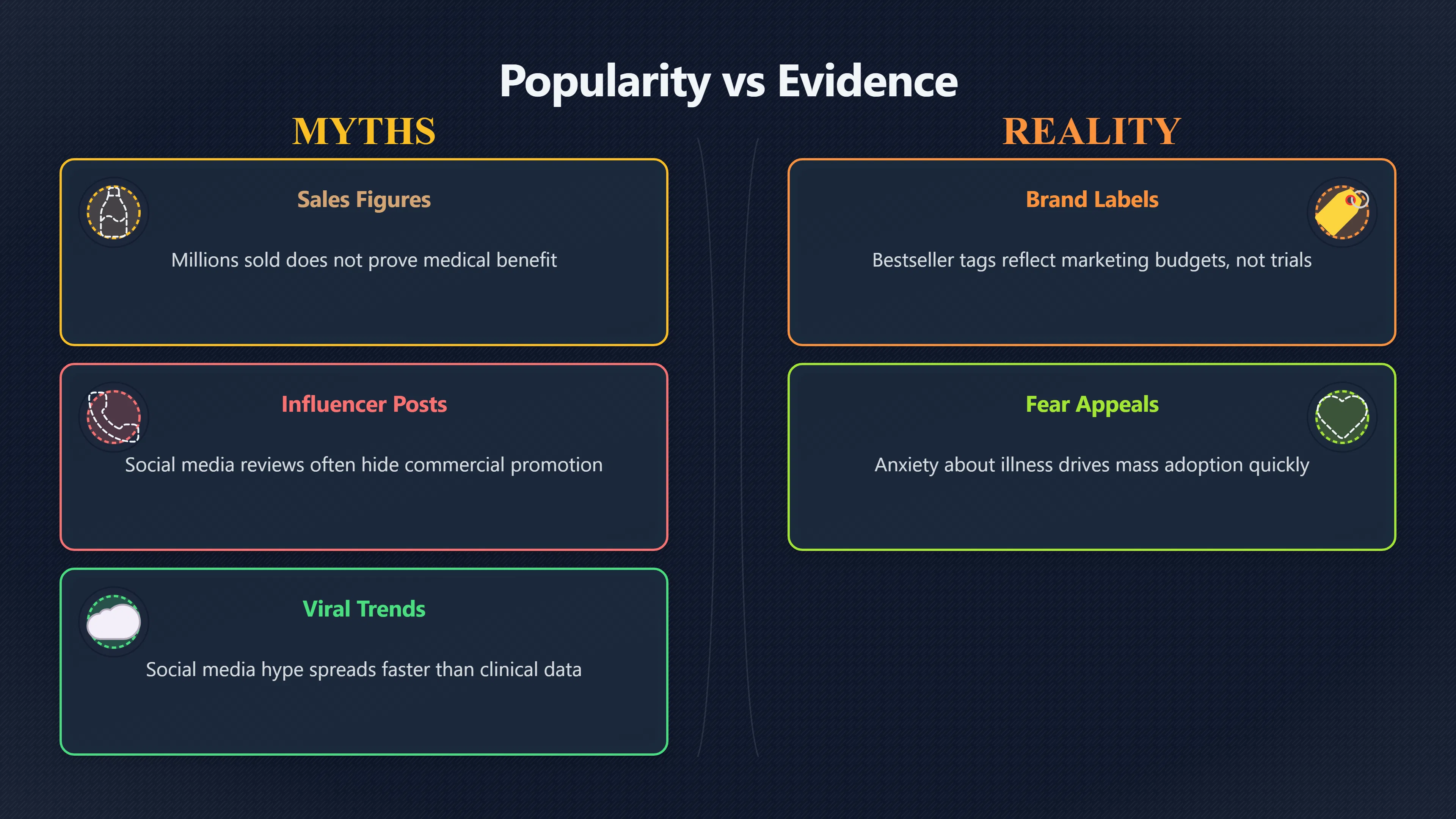
A bestseller label or millions of users can show demand, but it cannot prove that a product treats disease.
On this page
- What popularity can and cannot prove
- Influencers, branding, fear, and hope as market forces
- Questions to ask before trusting mass use
Page outline Jump by section
Introduction
Popularity is one of the most powerful tools in supplement marketing. Labels such as “best-selling”, “#1 brand”, “millions of users”, or “trusted worldwide” create the impression that a product has already been tested by the crowd and found effective. In the context of logical fallacies, this is a classic appeal to popularity: the suggestion that widespread use is evidence that a health claim is true.
 Demand can reveal many things. It can show that consumers like a product, that advertising has been effective, or that a supplement fits a popular health trend. What it cannot do is demonstrate that the supplement prevents, treats, or cures a medical condition. Regulators and health authorities consistently distinguish between market success and scientific evidence, requiring health claims to be supported by reliable research rather than sales figures, testimonials, or consumer enthusiasm. Federal Trade Commission[2cohenhealthcarelaw.com]cohenhealthcarelaw.comIt means you must have solid scientific evidence—often including expert analysis or…Read more…
What Popularity Can and Cannot Prove
A supplement that sells millions of units has clearly achieved commercial success. Consumers may perceive value in it. The manufacturer may have built strong brand recognition. Retailers may keep it on shelves because it generates revenue. None of these facts establishes that the supplement produces the health outcomes implied by its marketing.
The logical mistake occurs when popularity is treated as a substitute for evidence. The reasoning often sounds persuasive:
- Millions of people use it.
- Therefore it must work.
The conclusion does not follow. History contains many examples of widely accepted health beliefs that later proved ineffective, exaggerated, or wrong. Mass adoption can spread faster than scientific verification, especially when consumers are motivated by fear of illness, hope for improvement, or dissatisfaction with existing treatments.
Health regulators emphasise that claims about health benefits must be supported by scientific substantiation rather than consumer belief. The US Federal Trade Commission (FTC), which oversees advertising claims, states that health-related claims must be truthful, not misleading, and backed by appropriate scientific evidence.[Federal Trade Commission]ftc.govhealth products compliance guidanceFederal Trade CommissionHealth Products Compliance Guidance20 Dec 2022 — This document provides guidance from FTC staff on how to ensure…
Popularity can therefore suggest demand. It cannot establish efficacy.
Why Large Numbers Feel Like Evidence
Humans often use social information as a shortcut for decision-making. When faced with uncertainty, people naturally look at what others are doing.
In supplement marketing, this tendency is amplified by impressive numbers:
- “Over 10 million bottles sold.”
- “Used by athletes worldwide.”
- “Trusted by millions.”
- “America’s favourite supplement.”
Such statements create the feeling that the product has undergone a form of collective testing. If enough people buy it, many consumers assume that poor products would disappear from the market.
The problem is that supplement markets do not function as controlled scientific experiments. Buyers rarely use the same dosage, for the same condition, over the same period, while controlling for other variables. Many users never know whether improvements came from the supplement, lifestyle changes, natural recovery, placebo effects, or unrelated factors. As a result, popularity can grow even when evidence remains weak or disputed.[Office of Dietary Supplements]ods.od.nih.govLearn about their label information, effectiveness, safety, risk, quality,Office of Dietary SupplementsDietary Supplements: What You Need to Know - Consumer4 Jan 2023 — Important things to know about dietary sup…[Office of Dietary Supplements]ods.od.nih.govLearn about their label information, effectiveness, safety, risk, quality,Office of Dietary SupplementsDietary Supplements: What You Need to Know - Consumer4 Jan 2023 — Important things to know about dietary sup…
The appeal to popularity is especially strong in health because people often assume that large groups cannot all be mistaken. In reality, large groups can share the same advertising exposure, the same cultural beliefs, and the same misconceptions.
Influencers, Branding, Fear, and Hope as Market Forces
Popularity is rarely spontaneous. It is often manufactured through marketing systems designed to create social proof.
Influencer endorsement and perceived consensus
Social media allows supplements to spread rapidly through influencer recommendations. When consumers repeatedly encounter favourable reviews, transformation stories, and endorsement videos, a perception of consensus emerges even when the underlying evidence is limited.
Research on affiliate marketing and endorsements has shown that many consumers struggle to distinguish between genuine recommendations and commercial promotion. Disclosure practices have historically been inconsistent, increasing the persuasive power of influencer endorsements.[arXiv]arxiv.orgEndorsements on Social Media: An Empirical Study of Affiliate Marketing Disclosures on YouTube and PinterestSeptember 3, 2018…
The FTC has repeatedly stressed that advertisers cannot use testimonials or endorsements as a substitute for scientific substantiation. If a company could not legally make a health claim directly, it generally cannot rely on influencers or testimonials to make that claim indirectly.[Federal Trade Commission]ftc.govhealth products compliance guidanceFederal Trade CommissionHealth Products Compliance Guidance20 Dec 2022 — This document provides guidance from FTC staff on how to ensure…
Branding and the bestseller effect
The word “bestseller” carries psychological weight. Consumers often interpret it as a quality signal. In reality, bestseller status may reflect advertising budgets, retail placement, celebrity promotion, social media visibility, or timing within a health trend.
A memory supplement, weight-loss aid, or immunity booster may become commercially dominant without possessing unusually strong clinical evidence. Market leadership and medical effectiveness measure different things.
Fear and hope
Health products occupy a uniquely emotional market. Consumers may be worried about ageing, weight gain, memory loss, fatigue, chronic pain, or serious disease. Marketing that combines popularity with these concerns can become especially persuasive.
Messages such as “millions have already discovered the secret” appeal simultaneously to fear of missing out and hope for improvement. The popularity claim functions less as evidence and more as reassurance: if so many others are using it, perhaps it is worth trying.
This emotional mechanism helps explain why products can become cultural phenomena before strong evidence emerges.
When Popularity Outruns Evidence
Several supplement categories illustrate the gap between consumer enthusiasm and scientific support.
Fish oil supplements became enormously popular because of early observational research and widespread belief that they promoted heart health. Yet reviews of later evidence have often produced more limited conclusions than many consumers expected, and researchers have noted that numerous products make health-oriented claims that exceed the strength of available evidence.[Health]health.comStudy: Majority of Fish Oil Supplements Make Unfounded Health Claimsmake health claims not supported by scientific evidence, particularly regarding heart health. Conducted by researchers from UT Southweste…
More recently, supplements promoted on social media as alternatives to prescription weight-loss medications have gained attention through viral popularity. Their rapid adoption has often been driven by influencer discussion, affordability, and accessibility rather than a large body of high-quality clinical evidence.[Teen Vogue]teenvogue.comHowever, experts warn it is not equivalent to these prescription drugs and lacks proven efficacy. Ozempic and Wegovy, designed for diabet…
These examples do not prove that every popular supplement is ineffective. Some supplements do have evidence-supported uses. The point is that popularity alone cannot distinguish effective products from ineffective ones. Scientific testing is required for that task.
Questions to Ask Before Trusting Mass Use
When a supplement advertisement emphasises popularity, several questions can help separate market success from medical evidence.
What exactly is being claimed?
A statement that a product is popular is different from a statement that it improves health outcomes.
Is there evidence beyond testimonials?
Consumer stories can be sincere while still failing to establish causation. Regulators expect health claims to be supported by reliable scientific evidence.[Federal Trade Commission]ftc.govhealth products compliance guidanceFederal Trade CommissionHealth Products Compliance Guidance20 Dec 2022 — This document provides guidance from FTC staff on how to ensure…
Could marketing explain the popularity?
Advertising campaigns, influencer partnerships, celebrity endorsements, and retail visibility can all increase sales without changing effectiveness.
Does the claim rely on vague language?
Phrases such as “supports”, “promotes”, or “helps maintain” may sound stronger than the evidence behind them. Health authorities distinguish among different types of claims and regulate them differently.[U.S. Food and Drug Administration]fda.govlabel claims conventional foods and dietary supplementsFood and Drug AdministrationLabel Claims for Conventional Foods and Dietary…28 Mar 2024 — Among the claims that can be used on food an…
Who evaluates the evidence?
Independent scientific reviews, clinical trials, and evidence summaries from health organisations provide stronger grounds for judgment than sales rankings or online ratings. Resources from the NIH Office of Dietary Supplements are designed specifically to help consumers assess evidence rather than popularity.[Office of Dietary Supplements]ods.od.nih.govLearn about their label information, effectiveness, safety, risk, quality,Office of Dietary SupplementsDietary Supplements: What You Need to Know - Consumer4 Jan 2023 — Important things to know about dietary sup…

The Logical Fallacy Behind the Bestseller Label
The central error in popularity-based supplement marketing is not that popularity is irrelevant. Demand can convey useful information about consumer behaviour. The error occurs when popularity is presented as proof of a health claim.
A bestseller label may indicate successful marketing. Millions of users may indicate broad interest. A viral trend may reveal cultural enthusiasm. None of these facts demonstrates that a supplement produces the advertised medical benefit.
Scientific evidence and popularity answer different questions. Popularity asks, “How many people believe in or buy this product?” Evidence asks, “Does it actually work?” Confusing those questions is the essence of the appeal-to-popularity fallacy in supplement marketing.
Amazon book picks
Further Reading
Books and field guides related to Why bestsellers can still mislead. Use these as the next step if you want deeper reading beyond the article.
Calling Bullshit
Helps readers evaluate claims that rely on popularity and weak evidence.
Trick or Treatment?
Welcome to the world of alternative medicine. Prince Charles is a staunch defender and millions of people swear by it; most UK doctors co...
Trick or Treatment? Alternative Medicine on Trial
Illustrates why widespread use does not prove a treatment works.
eBay marketplace picks
Marketplace Samples
Example marketplace items related to this page. Use the search link to explore similar finds on eBay.



Endnotes
1.
Source: ftc.gov
Title: health products compliance guidance
Link:https://www.ftc.gov/business-guidance/resources/health-products-compliance-guidance
Source snippet
Federal Trade CommissionHealth Products Compliance Guidance20 Dec 2022 — This document provides guidance from FTC staff on how to ensure...
2.
Source: cohenhealthcarelaw.com
Link:https://cohenhealthcarelaw.com/fda-ftc-law/advertising-and-marketing-claims/
Source snippet
It means you must have solid scientific evidence—often including expert analysis or...Read more...
3.
Source: ods.od.nih.gov
Title: Learn about their label information, effectiveness, safety, risk, quality,
Link:https://ods.od.nih.gov/factsheets/WYNTK-Consumer/
Source snippet
Office of Dietary SupplementsDietary Supplements: What You Need to Know - Consumer4 Jan 2023 — Important things to know about dietary sup...
4.
Source: ods.od.nih.gov
Link:https://ods.od.nih.gov/HealthInformation/healthinformation.aspx
Source snippet
Office of Dietary SupplementsHealth InformationEvidence-based summaries for health professionals and consumers on specific vitamins, mine...
5.
Source: arxiv.org
Link:https://arxiv.org/abs/1809.00620
Source snippet
Endorsements on Social Media: An Empirical Study of Affiliate Marketing Disclosures on YouTube and PinterestSeptember 3, 2018...
Published: September 3, 2018
6.
Source: health.com
Title: Study: Majority of Fish Oil Supplements Make Unfounded Health Claims
Link:https://www.health.com/fish-oil-supplements-for-heart-health-7852475
Source snippet
make health claims not supported by scientific evidence, particularly regarding heart health. Conducted by researchers from UT Southweste...
7.
Source: fda.gov
Title: label claims conventional foods and dietary supplements
Link:https://www.fda.gov/food/nutrition-food-labeling-and-critical-foods/label-claims-conventional-foods-and-dietary-supplements
Source snippet
Food and Drug AdministrationLabel Claims for Conventional Foods and Dietary...28 Mar 2024 — Among the claims that can be used on food an...
8.
Source: ods.od.nih.gov
Title: Office of Dietary Supplements Background Information: Dietary Supplements
Link:https://ods.od.nih.gov/factsheets/DietarySupplements-Consumer/
Source snippet
Office of Dietary SupplementsBackground Information: Dietary Supplements - Consumer11 Mar 2020 — Health claims describe a relationship be...
9.
Source: ods.od.nih.gov
Link:https://ods.od.nih.gov/
Source snippet
of Dietary Supplements (ODS) - NIHThe ODS Probiotics Fact Sheet for Consumers has been updated. It provides essential information on the...
10.
Source: pmc.ncbi.nlm.nih.gov
Link:https://pmc.ncbi.nlm.nih.gov/articles/PMC6513729/
Source snippet
regulatory guidelines and resources to support...by RL Bailey · 2018 · Cited by 196 — This review will highlight the existing American r...
11.
Source: pmc.ncbi.nlm.nih.gov
Link:https://pmc.ncbi.nlm.nih.gov/articles/PMC11082796/
Source snippet
by C Muela-Molina · 2021 · Cited by 36 — The aim of this research is to analyse the presence of false and misleading claims in food su...
12.
Source: pmc.ncbi.nlm.nih.gov
Link:https://pmc.ncbi.nlm.nih.gov/articles/PMC12265102/
Source snippet
by J Antonio · 2025 · Cited by 4 — It should be noted that supplements are not required to have FDA approval prior to marketing unless...
13.
Source: pmc.ncbi.nlm.nih.gov
Link:https://pmc.ncbi.nlm.nih.gov/articles/PMC4330859/
Source snippet
by RR Starr · 2015 · Cited by 259 — However, supplements need not be evaluated for efficacy, and only limited data on safety are requi...
14.
Source: ncbi.nlm.nih.gov
Link:https://www.ncbi.nlm.nih.gov/books/NBK220865/
Source snippet
Framework for Evaluating the Safety of Dietary...A framework for the evaluation of safety of dietary supplement ingredients must be carr...
15.
Source: ods.od.nih.gov
Title: list all
Link:https://ods.od.nih.gov/factsheets/list-all/
Source snippet
Supplement Fact SheetsProvides information about dietary supplements and their ingredients. These include vitamins, minerals, herbs and b...
16.
Source: pmc.ncbi.nlm.nih.gov
Link:https://pmc.ncbi.nlm.nih.gov/articles/PMC12455376/
Source snippet
Statements and Perceived Health Benefits of Dietary...by JN Assadourian · 2025 · Cited by 5 — To evaluate how commonly used structure/fu...
17.
Source: ftc.gov
Link:https://www.ftc.gov/business-guidance/advertising-marketing/health-claims
Source snippet
Health Claims | Federal Trade CommissionHealth Products Compliance Guidance. Companies must support their advertising claims with solid p...
18.
Source: youtube.com
Title: CRITICAL THINKING
Link:https://www.youtube.com/watch?v=aF6EHTtyYqw
Source snippet
SUPPLEMENT INDUSTRY MARKETING..."Somebody's got to tell the truth!!!" - Rich Piana...
19.
Source: youtube.com
Link:https://www.youtube.com/watch?v=pwUYSi3c2Oo
Source snippet
Argumentum ad populum...
20.
Source: youtube.com
Title: Argumentum ad populum
Link:https://www.youtube.com/watch?v=myspZ3Ap4jQ
Source snippet
Dr. Oz Exposes Supplement Scams: What You Need to Know! | Dr. Oz | S6 | Ep 161 | Full Episode...
21.
Source: youtube.com
Link:https://www.youtube.com/watch?v=Y5Y2aY06ums
Source snippet
The Logic of the Herbalist Tricking Sick People...
22.
Source: youtube.com
Title: The Logic of the Herbalist Tricking Sick People
Link:https://www.youtube.com/watch?v=tPAUPY2vhH0
23.
Source: teenvogue.com
Link:https://www.teenvogue.com/story/berberine-isnt-natures-ozempic
Source snippet
However, experts warn it is not equivalent to these prescription drugs and lacks proven efficacy. Ozempic and Wegovy, designed for diabet...
24.
Source: fda.gov
Title: dietary supplements
Link:https://www.fda.gov/food/dietary-supplements
Source snippet
Oct 1, 2024 — FDA regulates dietary supplements under a different set of regulations than those covering conventional foods and drug prod...
25.
Source: youtube.com
Link:https://www.youtube.com/watch?v=IEZ0lQ1JOnY
Source snippet
Public Meeting Exploring the Scope of Dietary Supplement...FDA's Office of Dietary Supplement Programs (ODSP) invites stakeholders to pa...
26.
Source: youtube.com
Link:https://www.youtube.com/watch?v=7CmI5zjFFAE
Source snippet
nal Institutes of Health (NIH) Office of Dietary Supplements (ODS)...
27.
Source: youtube.com
Link:https://www.youtube.com/watch?v=Y8WsTQ2G-HY
Source snippet
activities related to ensuring that supplement advertising... Claims...
28.
Source: npanational.org
Link:https://www.npanational.org/regulatory/federal-trade-commission-ftc/
Source snippet
ypically applied a substantiation standard of...
Additional References
29.
Source: nutrition.gov
Link:https://www.nutrition.gov/topics/dietary-supplements
Source snippet
Dietary SupplementsFind evidence-based information about dietary supplements. This collection of fact sheets presents information about d...
30.
Source: nutrition.gov
Link:https://www.nutrition.gov/nutrition-misinformation-and-fraud
Source snippet
Nutrition Misinformation and FraudFind resources to help identify nutrition misinformation and fraudulent health claims, which provide fa...
31.
Source: fda.gov
Link:https://www.fda.gov/regulatory-information/search-fda-guidance-documents/guidance-industry-substantiation-dietary-supplement-claims-made-under-section-403r-6-federal-food
Source snippet
Substantiation for Dietary Supplement Claims Made Under...20 Sept 2018 — The FTC has typically applied a substantiation standard of "com...
32.
Source: federalregister.gov
Title: guides concerning the use of endorsements and testimonials in advertising
Link:https://www.federalregister.gov/documents/2023/07/26/2023-14795/guides-concerning-the-use-of-endorsements-and-testimonials-in-advertising
Source snippet
Guides Concerning the Use of Endorsements and...26 Jul 2023 — The Federal Trade Commission (FTC or Commission) is adopting revised Guide...
33.
Source: ftcdefenselawyer.com
Link:https://ftcdefenselawyer.com/advertising-claim-substantiation/
Source snippet
FTC Advertising Claim Substantiation Compliance AttorneyClaim Substantiation and “Competent and Reliable Scientific Evidence;”; Endorseme...
34.
Source: ftcdefenselawyer.com
Link:https://ftcdefenselawyer.com/advertising-claim-substantiation-copy/
Source snippet
FTC Health Products Compliance Guidance | HinchNewman...As a general rule, advertisers should not make claims through consumer testimoni...
35.
Source: cirs-group.com
Link:https://www.cirs-group.com/en/food/faqs-american-dietary-supplements-2-do-dietary-supplements-require-fda-approval-before-marketing
Source snippet
Do Dietary Supplements Require FDA Approval Before...Dec 26, 2024 — Since dietary supplements do not require pre-market approval from th...
36.
Source: cov.com
Link:https://www.cov.com/en/news-and-insights/insights/2023/01/ftc-issues-new-guidance-on-health-related-claims-to-replace-the-dietary-supplements-advertising-guide
Source snippet
FTC Issues New Guidance on Health-Related Claims to...5 Jan 2023 — The new guidance broadly applies to all health-related claims, as opp...
37.
Source: kelleydrye.com
Link:https://www.kelleydrye.com/viewpoints/blogs/ad-law-access/misguided-the-ftc-attempts-to-redefine-the-law-with-its-health-products-compliance-guidance
Source snippet
Misguided: The FTC Attempts to Redefine the Law with its...21 Dec 2022 — Yesterday, the FTC's Bureau of Consumer Protection released its...
38.
Source: linkedin.com
Link:https://www.linkedin.com/posts/nih-office-of-dietary-supplements-ods_ods-offers-reliable-evidence-based-information-activity-7278409351554293761-_B9h
Source snippet
NIH Office of Dietary Supplements (ODS)27 Dec 2024 — ODS offers reliable, evidence-based information about dietary supplements. Students...
Topic Tree