Within Tone
When is a personal criticism relevant?
Personal criticism can be relevant when it bears directly on testimony, trust, or a role-specific duty rather than replacing the argument.
On this page
- Why credibility matters in testimonial claims
- The difference between character evidence and character attacks
- Examples from witnesses, officials, and expert claims
Page outline Jump by section
Introduction
Not every personal criticism of a witness is an ad hominem fallacy. When a claim depends heavily on testimony—what someone says they saw, heard, remembered, measured, or concluded—the witness’s credibility becomes part of the evidence itself. In those circumstances, criticism that targets honesty, bias, competence, conflicts of interest, or reliability may be directly relevant rather than fallacious. The key question is whether the criticism helps assess the trustworthiness of the testimony or merely distracts from the issue with insults and character smears. This distinction is especially important within discussions of logical fallacies because witness credibility sits at one of the main boundaries between a genuine ad hominem attack and a legitimate challenge to evidence.[PhilPapers]philpapers.orgAudrey Yap, Ad Hominem Fallacies, Bias, and TestimonyAn ad hominem fallacy is committed when an individual employs an irrelevan…[ScienceDirect]sciencedirect.comFormalization of the ad hominem argumentation schemeby D Walton · 2010 · Cited by 22 — Thus an ad hominem argument is most e…

Why credibility matters in testimonial claims
Many arguments do not rest solely on physical evidence or formal proof. They rely on testimony. A witness may report events, an official may describe government actions, or an expert may interpret specialised data. In such cases, the audience must decide not only whether the statement sounds plausible but also whether the source is trustworthy.
Legal systems recognise this reality explicitly. Rules governing witness testimony allow credibility to be examined because the reliability of a witness can affect how much weight their statements deserve. Courts routinely permit questioning about bias, motives to misrepresent facts, prior inconsistent statements, and character for truthfulness when these matters bear on whether testimony should be believed.[Legal Information Institute]law.cornell.eduLegal Information Instituteimpeachment of a witness | Wexof a witness refers to the process of discrediting or undermining the credibility of a witness during a trial.Read more…[Legal Information Institute]law.cornell.eduLegal Information Instituteimpeachment of a witness | Wexof a witness refers to the process of discrediting or undermining the credibility of a witness during a trial.Read more…
This is why a criticism such as “the witness has repeatedly lied under oath” differs from “the witness is a terrible person”. The first criticism bears directly on whether the witness is likely to tell the truth in the present case. The second may simply be an attempt to generate hostility without providing relevant information about the testimony.[Legal Information Institute]law.cornell.eduLegal Information Instituteimpeachment of a witness | Wexof a witness refers to the process of discrediting or undermining the credibility of a witness during a trial.Read more…
Argumentation scholars have long noted that testimony creates special relevance conditions. When the acceptance of a claim depends on a speaker’s credibility, information about that speaker’s reliability can become evidentially significant rather than merely personal.[PhilPapers]philpapers.orgAudrey Yap, Ad Hominem Fallacies, Bias, and TestimonyAn ad hominem fallacy is committed when an individual employs an irrelevan…[ScienceDirect]sciencedirect.comFormalization of the ad hominem argumentation schemeby D Walton · 2010 · Cited by 22 — Thus an ad hominem argument is most e…
The difference between character evidence and character attacks
The easiest way to distinguish a rude but relevant criticism from a fallacious ad hominem is to ask whether the criticism changes the probability that the testimony is accurate.
Consider the following contrasts:
Relevant criticism
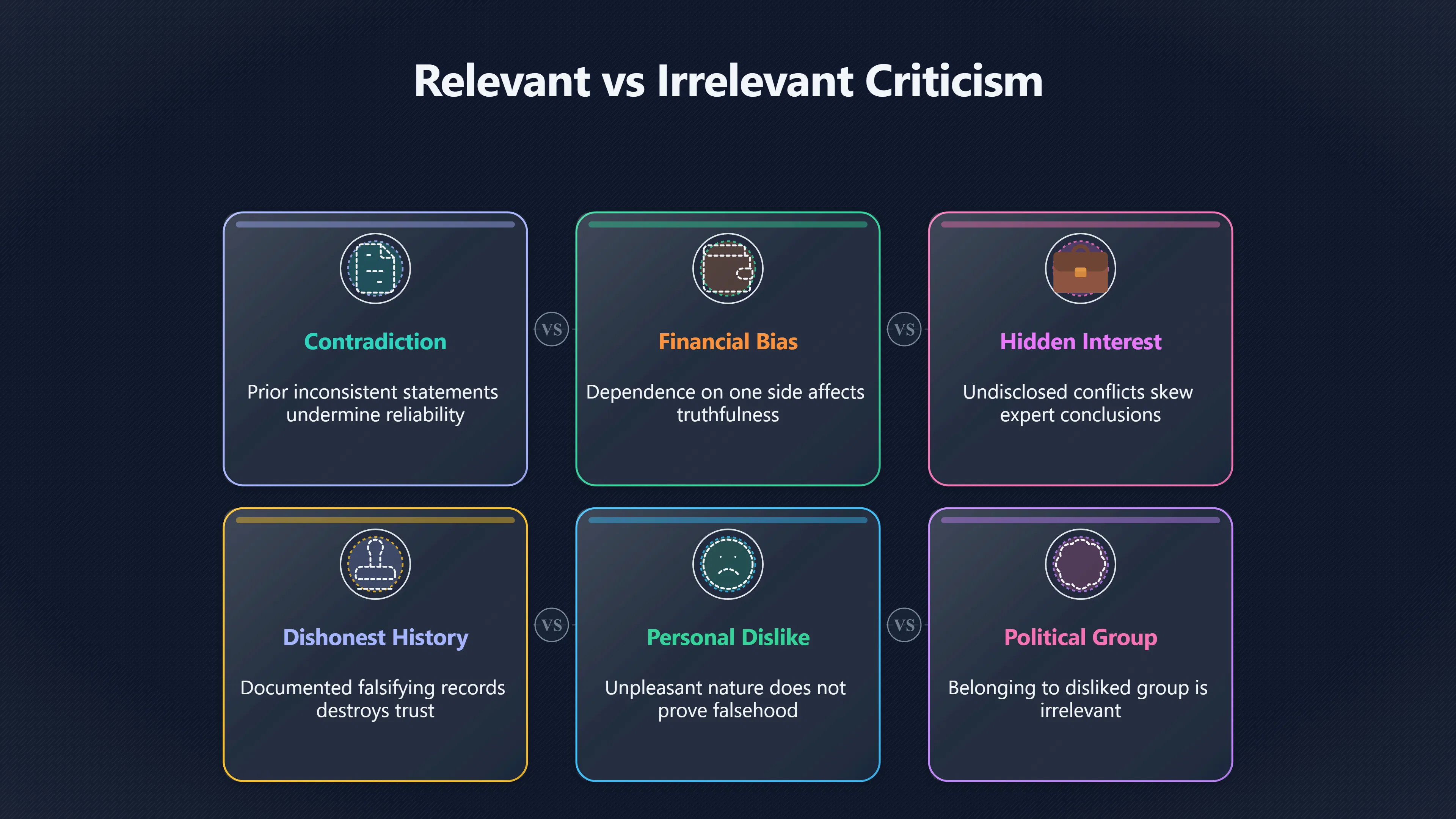
- “This witness previously gave three contradictory accounts of the same event.”
- “The witness is financially dependent on one side of the dispute.”
- “The expert failed to disclose a significant conflict of interest.”
- “The witness has a documented history of falsifying records.”
These statements may sound harsh, but they address factors that could reasonably affect reliability or truthfulness. PMC[Legal Information Institute]law.cornell.eduLegal Information Instituteimpeachment of a witness | Wexof a witness refers to the process of discrediting or undermining the credibility of a witness during a trial.Read more…[UC Law]repository.uclawsf.eduThe existence of bias does not necessarily imply conscious falsehood.Read more…
Irrelevant character attacks
- “The witness is unpleasant.”
- “The witness had a messy divorce.”
- “The witness belongs to a disliked political group.”
- “The witness dresses strangely.”
These remarks may encourage prejudice, but they do not provide evidence that the testimony itself is false or unreliable. They therefore fit the classic pattern of an ad hominem attack.[Wikipedia]WikipediaAd hominemAd hominem
The distinction mirrors evidence law. Many legal systems limit the use of character evidence because general claims about a person’s character are often poor indicators of what happened in a specific incident. Yet evidence related to truthfulness, bias, or motive may still be admitted because it bears directly on credibility.[Legal Information Institute]law.cornell.eduLegal Information Instituteimpeachment of a witness | Wexof a witness refers to the process of discrediting or undermining the credibility of a witness during a trial.Read more…[Legal Information Institute]law.cornell.eduLegal Information Instituteimpeachment of a witness | Wexof a witness refers to the process of discrediting or undermining the credibility of a witness during a trial.Read more…
Why rudeness does not decide the issue
A criticism can be both rude and relevant.
An advocate might say, “This witness has lied repeatedly and cannot be trusted.” The wording is hostile. However, if the accusation is supported by evidence showing repeated dishonesty, the criticism contributes to evaluating testimony rather than replacing that evaluation. The problem would arise only if the speaker relied on the insult alone without supporting evidence.[ScienceDirect]sciencedirect.comFormalization of the ad hominem argumentation schemeby D Walton · 2010 · Cited by 22 — Thus an ad hominem argument is most e…[Legal Information Institute]law.cornell.eduLegal Information Instituteimpeachment of a witness | Wexof a witness refers to the process of discrediting or undermining the credibility of a witness during a trial.Read more…
The logical question is not whether the criticism sounds offensive. The question is whether it provides information relevant to assessing the witness’s credibility.
Examples from witnesses, officials, and expert claims
Eyewitness testimony
Suppose a witness claims to have seen a collision at night from across a busy road.
A relevant challenge might focus on visibility, memory, intoxication, inconsistent descriptions, or demonstrated dishonesty. These factors bear directly on whether the witness accurately perceived and reported the event. Courts frequently allow attacks on credibility through contradiction, inconsistency, or evidence of bias because such matters help fact-finders assess reliability.[armfor.uscourts.gov]armfor.uscourts.govCore Criminal Law Subjects: Evidence: ImpeachmentImpeachment by contradiction is a line of attack that involves showing the tribunal the…[Legal Information Institute]law.cornell.eduLegal Information Instituteimpeachment of a witness | Wexof a witness refers to the process of discrediting or undermining the credibility of a witness during a trial.Read more…
An irrelevant attack would be to dismiss the testimony because the witness is unpopular in the community or has unrelated personal failings.

Public officials
Public officials often make factual claims that depend partly on public trust.
If a journalist notes that an official previously concealed information, altered records, or misled investigators, the criticism may be relevant because the current claim requires confidence in the official’s honesty. If the criticism instead centres on unrelated lifestyle choices or personal dislike, it becomes much closer to a fallacious personal attack.[PhilPapers]philpapers.orgAudrey Yap, Ad Hominem Fallacies, Bias, and TestimonyAn ad hominem fallacy is committed when an individual employs an irrelevan…
The distinction matters because testimony from officials is frequently accepted on the basis of institutional credibility. Evidence that weakens that credibility can therefore be relevant to evaluating the testimony itself.
Expert witnesses and specialists
Expert testimony provides one of the clearest examples of relevant personal criticism.
An expert’s qualifications, methods, independence, and conflicts of interest all affect how much confidence should be placed in the expert’s conclusions. Research on testimony and source credibility has found that knowledge of conflicts of interest can significantly influence how audiences evaluate scientific and expert claims.[PMC]pmc.ncbi.nlm.nih.govThe effect of ad hominem attacks on the evaluation of claims…by RM Barnes · 2018 · Cited by 55 — The current finding that knowledge…
For example, pointing out that a scientific expert is being paid by a company whose product is under review is not necessarily an ad hominem. The information may reveal a potential source of bias. Likewise, concerns about adversarial allegiance, unconscious bias, or undisclosed interests can be relevant when assessing expert evidence.[PMC]pmc.ncbi.nlm.nih.govThe analysis of competing hypotheses and expert witness…by J Otzipka · 2026 — Cognitive biases, such as adversarial allegiance, can…
However, attacking an expert’s appearance, age, accent, or unrelated political views would not normally provide evidence about the quality of the expert analysis.
A practical test for spotting the difference
When evaluating a personal criticism aimed at a witness, three questions help separate relevance from fallacy:
- Does the claim depend on testimony?
If the argument relies heavily on what a person reports or concludes, credibility becomes more relevant.
- Does the criticism bear directly on truthfulness, competence, bias, perception, or reliability?
If so, it may legitimately affect how much weight the testimony deserves.[Legal Information Institute]law.cornell.eduLegal Information Instituteimpeachment of a witness | Wexof a witness refers to the process of discrediting or undermining the credibility of a witness during a trial.Read more…[2sccourts.org]sccourts.orgNote:.Read moreRule 608 - South Carolina Judicial BranchBias, prejudice or any motive to misrepresent may be shown to impeach the witness either by exam…
- Would the criticism still matter if the witness were otherwise liked and respected?
If the answer is yes because it reveals a concrete credibility issue, the criticism is probably relevant. If the criticism works only by generating dislike, it is more likely an ad hominem fallacy.

The central lesson
Within the broader distinction between fallacies and rude but relevant arguments, witness credibility is one of the strongest examples of why personal criticism is not automatically fallacious. Testimonial claims require judgments about trust. Information concerning honesty, bias, conflicts of interest, competence, and reliability can therefore be relevant evidence even when expressed harshly. The fallacy arises not from mentioning the person, but from treating irrelevant personal traits as if they settled the truth of the claim. When credibility is genuinely at issue, criticism of the witness may be part of the evidence rather than a diversion from it.[ScienceDirect]sciencedirect.comFormalization of the ad hominem argumentation schemeby D Walton · 2010 · Cited by 22 — Thus an ad hominem argument is most e…[PhilPapers]philpapers.orgAudrey Yap, Ad Hominem Fallacies, Bias, and TestimonyAn ad hominem fallacy is committed when an individual employs an irrelevan…
Amazon book picks
Further Reading
Books and field guides related to When is a personal criticism relevant?. Use these as the next step if you want deeper reading beyond the article.
Mistakes Were Made (but Not by Me)
Explores credibility, self-justification, and trustworthiness.
Critical Thinking
Helps distinguish relevant credibility evidence from fallacious attacks.
Thinking, Fast and Slow
Explains judgment under uncertainty and credibility assessment.
eBay marketplace picks
Marketplace Samples
Example marketplace items related to this page. Use the search link to explore similar finds on eBay.

Endnotes
1.
Source: philpapers.org
Link:https://philpapers.org/rec/YAPAHF
Source snippet
Audrey Yap, Ad Hominem Fallacies, Bias, and TestimonyAn ad hominem fallacy is committed when an individual employs an irrelevan...
2.
Source: sciencedirect.com
Link:https://www.sciencedirect.com/science/article/pii/S1570868308000384
Source snippet
Formalization of the ad hominem argumentation schemeby D Walton · 2010 · Cited by 22 — Thus an ad hominem argument is most e...
3.
Source: sccourts.org
Title: Note:.Read more
Link:https://www.sccourts.org/resources/judicial-community/court-rules/evidence/rule-608/
Source snippet
Rule 608 - South Carolina Judicial BranchBias, prejudice or any motive to misrepresent may be shown to impeach the witness either by exam...
4.
Source: pmc.ncbi.nlm.nih.gov
Link:https://pmc.ncbi.nlm.nih.gov/articles/PMC5790247/
Source snippet
The effect of ad hominem attacks on the evaluation of claims...by RM Barnes · 2018 · Cited by 55 — The current finding that knowledge...
5.
Source: Wikipedia
Title: Ad hominem
Link:https://en.wikipedia.org/wiki/Ad_hominem
6.
Source: armfor.uscourts.gov
Link:https://www.armfor.uscourts.gov/digest/IIIC11.htm
7.
Source: pmc.ncbi.nlm.nih.gov
Link:https://pmc.ncbi.nlm.nih.gov/articles/PMC13094959/
Source snippet
The analysis of competing hypotheses and expert witness...by J Otzipka · 2026 — Cognitive biases, such as adversarial allegiance, can...
8.
Source: Wikipedia
Title: Argumentation scheme
Link:https://en.wikipedia.org/wiki/Argumentation_scheme
Source snippet
Argumentation schemeIn argumentation theory, an argumentation scheme or argument scheme is a template that represents a common type of...
9.
Source: ilms.academy
Link:https://www.ilms.academy/blog/ad-hominem-explained-a-common-logical-fallacy-in-law-and-[debate
Source snippet
Ad Hominem Explained: A Common Logical Fallacy in Law...3 Nov 2025 — Ad hominem arguments that attack a witness's character without subs...
10.
Source: scholarlycommons.law.case.edu
Link:https://scholarlycommons.law.case.edu/cgi/viewcontent.cgi?article=1398&[context
Source snippet
In some trials, it is the only issue; once the jury has...Read...
11.
Source: law.cornell.edu
Title: Legal Information Instituteimpeachment of a witness | Wex
Link:https://www.law.cornell.edu/wex/impeachment_of_a_witness
Source snippet
of a witness refers to the process of discrediting or undermining the credibility of a witness during a trial.Read more...
12.
Source: law.cornell.edu
Title: Legal Information Institute Rule 608
Link:https://www.law.cornell.edu/rules/fre/rule_608
Source snippet
A Witness's Character for Truthfulness or...A witness's credibility may be attacked or supported by testimony about the witness's reputa...
13.
Source: repository.uclawsf.edu
Link:https://repository.uclawsf.edu/cgi/viewcontent.cgi?article=1315&context=hastings_law_journal
Source snippet
The existence of bias does not necessarily imply conscious falsehood.Read more...
14.
Source: law.cornell.edu
Title: Legal Information Institute Rule 404
Link:https://www.law.cornell.edu/rules/fre/rule_404
Source snippet
Character Evidence; Other Crimes, Wrongs, or ActsEvidence of a person's character or character trait is not admissible to prove that on a...
15.
Source: legal-resources.uslegalforms.com
Title: ad hominem
Link:https://legal-resources.uslegalforms.com/a/ad-hominem
Source snippet
Hominem: A Deep Dive into Its Legal Meaning and UsageThis tactic is often employed when someone lacks a strong case and seeks to undermin...
16.
Source: britannica.com
Link:https://www.britannica.com/topic/ad-hominem
Source snippet
feelings or irrelevantly impugns another person's character instead of addressing the facts...Read more...
Additional References
17.
Source: goldsteinhilley.com
Link:https://www.goldsteinhilley.com/our-passion/legal-resources/trial-evidence/evidence-of-character-and-conduct-of-witness/
Source snippet
EVIDENCE OF CHARACTER AND CONDUCT OF WITNESSEvidence of truthful character is admissible only after the character of the witness for trut...
18.
Source: opencasebook.org
Link:https://opencasebook.org/casebooks/230-federal-rules-of-evidence/as-printable-html/3/
Source snippet
Federal Rules of Evidence: Impeachment and WitnessesThe second sentence of Rule 608(b) as submitted by the Court permitted specific insta...
19.
Source: gambonelaw.com
Link:https://gambonelaw.com/library/the-8-ways-to-attack-a-witness-at-a-criminal-trial/
Source snippet
Criminal Trial Witnesses & Evidence: The 8 Areas of Attack!The rules of evidence allow the prosecution and the defense to impeach the cre...
20.
Source: okcca.net
Link:https://okcca.net/ouji-cr/9-21/
Source snippet
Impeachment by Prior Bad ActsThis evidence is called impeachment evidence, and it is offered to show that the defendant's/witness's testi...
21.
Source: ecampusontario.pressbooks.pub
Link:https://ecampusontario.pressbooks.pub/wsia062018/chapter/13/
Source snippet
Social Epistemology of ArgumentIn a fallacious ad hominem argument in which the arguer is attacked, there is an unsuccessful and poorly f...
22.
Source: wklaw.com
Link:https://www.wklaw.com/if-you-want-to-win-your-case-your-lawyer-needs-to-know-how-to-get-the-best-evidence-before-the-jury-or-judge-2/
Source snippet
Wallin & KlarichEnsure Your Lawyer Presents the Best Evidence in Court21 Nov 2024 — Improper impeachment occurs when a party attempts to...
23.
Source: evidenceattrial.com
Link:https://www.evidenceattrial.com/blog/the-admissibility-of-character-evidence-demystifying-the-rules-and-their-application
Source snippet
The Admissibility of Character Evidence: Demystifying...1 Apr 2018 — Character evidence is similar to hearsay in that there is a general...
24.
Source: philosophy.lander.edu
Link:https://philosophy.lander.edu/logic/person.html
Source snippet
Philosophy Home PageAd HominemThe ad hominem fallacy occurs whenever the character or circumstances of an individual who is advancing an...
25.
Source: faculty.fiu.edu
Link:https://faculty.fiu.edu/~harrisk/Notes/Critical%20Thinking/CT%20Lecture%2015%20Fallacies%20of%20Relevance%20-%20Red%20Herrings.htm
Source snippet
Lecture 15 Fallacies of Relevance: (Red Herrings)Ad Hominem ([tu quoque]({{ 'tu-quoque/' | relative_url }}), abusive, circumstantial) There are three main types of ad homine...
26.
Source: youtube.com
Link:https://www.youtube.com/watch?v=abrZeMSnwpk
Source snippet
tory witness evidence · Demeanour · Corroboration · Inherent probability · Consistency...
Topic Tree