Within Tradition
What Has Time Really Tested?
Calling a practice time-tested is useful only after asking what outcomes, conditions and alternatives were really tested.
On this page
- Why endurance is not the same as evidence
- How to identify the outcome being claimed
- When long survival points to usefulness and when it does not
Page outline Jump by section
Introduction
When people defend a custom by calling it “time-tested”, they often assume that long survival is evidence of quality. Sometimes it is. A practice that has persisted across generations may contain accumulated experience, practical knowledge, or solutions to recurring problems. The logical mistake occurs when longevity itself is treated as proof. In discussions about the appeal to tradition, the crucial question is not whether something has lasted, but what exactly its survival has tested.
 Time can reveal certain kinds of information. It can show whether a practice is compatible with a community, whether it is easy to transmit, or whether it can endure changing circumstances. What time cannot automatically tell us is whether the practice is the best available option, whether it remains justified under current conditions, or whether alternatives would perform better. Understanding that distinction helps separate genuine evidence from the fallacious claim that “old therefore means good”.[Wikipedia]WikipediaAppeal to traditionAppeal to tradition
Why Endurance Is Not the Same as Evidence
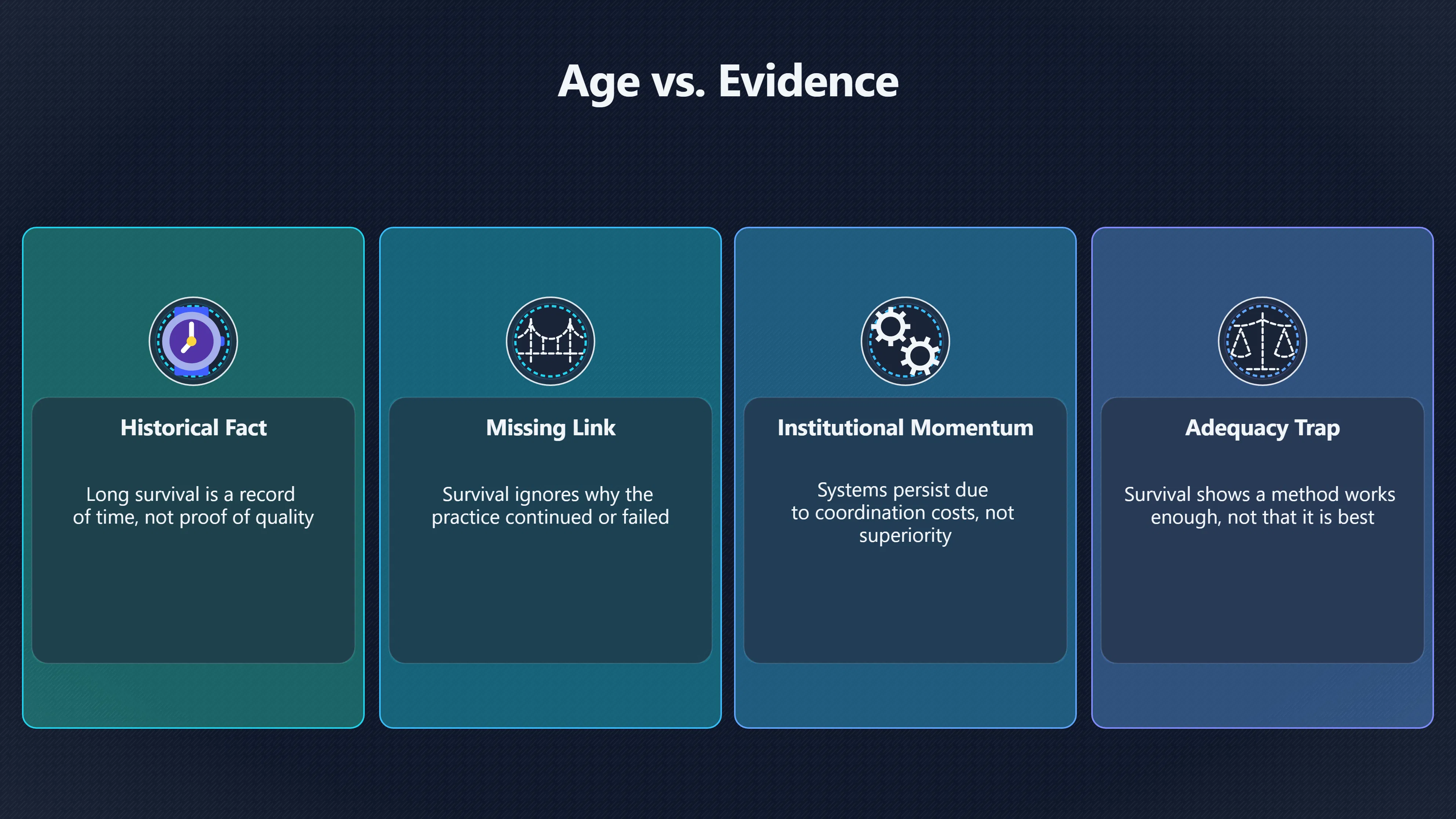
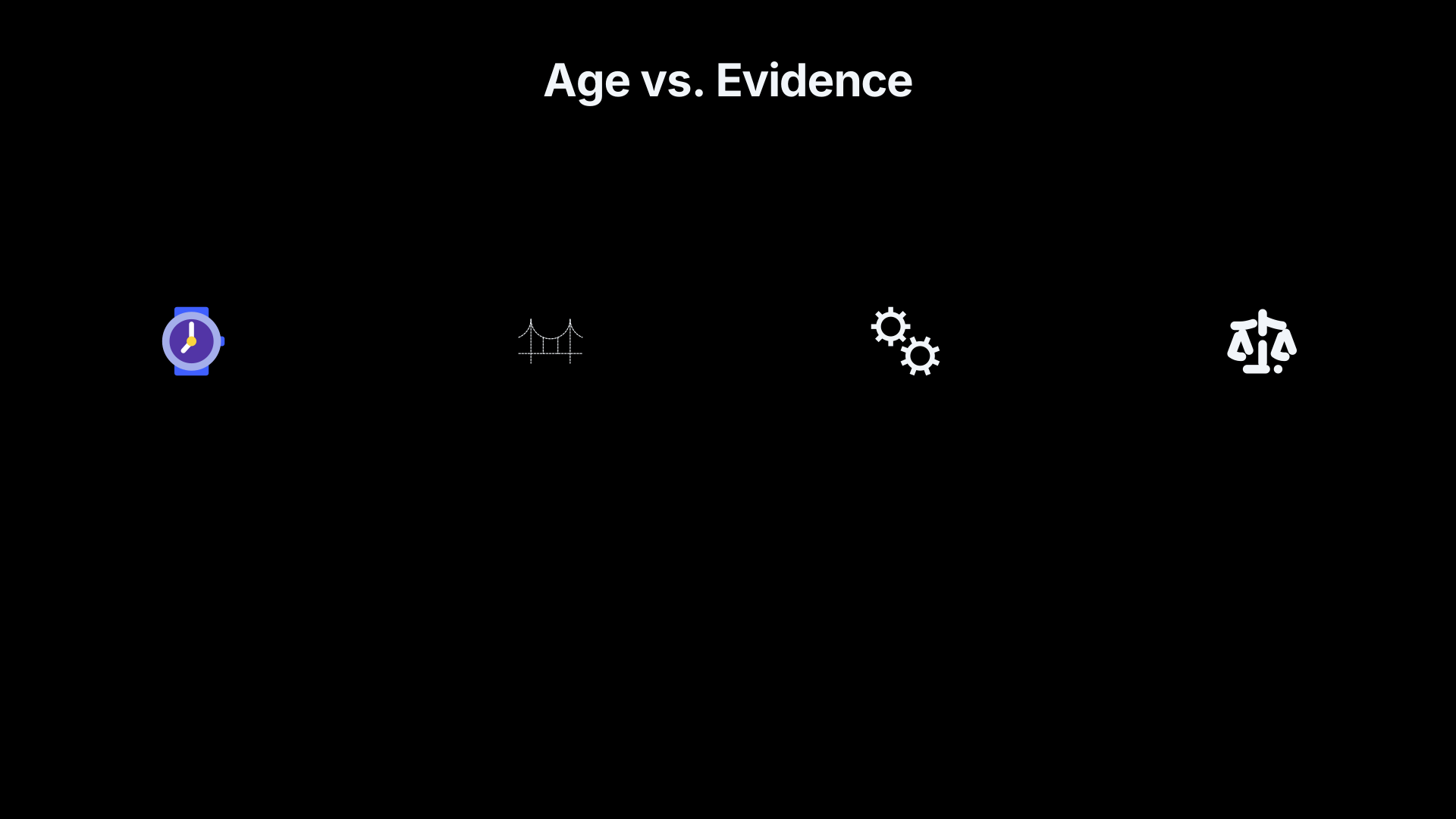
A tradition’s age is a historical fact. Its value is a separate question.
The appeal to tradition often skips over the missing link between those two ideas. A custom may survive for reasons unrelated to its effectiveness. It may continue because changing it is expensive, because institutions reward conformity, because people are familiar with it, or because alternatives never received a fair trial. Long survival alone does not identify which of these explanations is responsible.[Wikipedia]WikipediaAppeal to traditionAppeal to tradition
A useful comparison is the concept of path dependence. Economists and historians use this term to describe situations where earlier decisions shape later possibilities. Once a system becomes established, switching to another system may be difficult even if superior alternatives exist. In such cases, persistence reflects historical momentum rather than demonstrated superiority.[Oxford University Research Archive]ora.ox.ac.ukford University Research ArchivePath Dependence, its critics, and the quest for 'historical…by P David · 2000 · Cited by 1605 — The…
The familiar QWERTY keyboard is frequently discussed in debates about path dependence. Whether or not every claim made about QWERTY is correct, the broader lesson remains important: a system can become entrenched because of coordination, compatibility, training costs, and historical sequence rather than because it is objectively optimal. Persistence alone does not settle the question.[Oxford University Research Archive]ora.ox.ac.ukford University Research ArchivePath Dependence, its critics, and the quest for 'historical…by P David · 2000 · Cited by 1605 — The…
What Has Actually Been Tested?
When someone says a practice is “time-tested”, the first task is to identify the outcome being claimed.
Different outcomes require different evidence:
- If the claim is reliability, long survival may provide relevant evidence. A method used successfully for centuries may have demonstrated robustness.
- If the claim is moral correctness, survival proves very little. Many long-standing institutions have later been judged unjust.
- If the claim is effectiveness compared with alternatives, we need evidence about the alternatives, not merely evidence that one option survived.
- If the claim is suitability today, we must ask whether present conditions resemble the conditions under which the tradition developed.
The phrase “time-tested” often hides this ambiguity. Time may have tested durability, but not fairness. It may have tested social acceptance, but not efficiency. It may have tested compatibility with older technologies, but not performance in modern circumstances.
The central logical error occurs when evidence for one outcome is silently converted into evidence for another.
The Missing Comparison Problem
A practice can survive for centuries without ever facing a meaningful comparison.
Imagine a society using one agricultural method for generations. The method’s survival shows that it can produce crops well enough to sustain the community. It does not automatically show that alternative methods would not have produced more food, required less labour, or reduced environmental damage.
This is a common weakness in traditional arguments. They often focus on the history of the surviving practice while ignoring the absence of controlled comparisons.
Scientific testing attempts to overcome this problem by comparing outcomes under different conditions. Tradition, by contrast, often provides only a single historical pathway. Without comparison, it is difficult to know whether survival reflects excellence or merely adequacy.
For that reason, the strongest arguments based on historical experience do not merely point to longevity. They identify specific outcomes and show that competing approaches repeatedly performed worse under comparable conditions.
Survivorship Bias and the Illusion of Success
Another reason to be cautious about “time-tested” claims is survivorship bias.
Survivorship bias occurs when attention focuses on what remains visible while overlooking what disappeared. Researchers have documented how concentrating only on survivors can create misleading conclusions about performance and success.[ResearchGate]researchgate.netPath Dependence and the Quest for Historical EconomicsThe term path dependence (PD) here refers to a dynamic property of allocative proce…
Applied to traditions, the problem is straightforward. We see the customs that survived. We usually do not see the abandoned customs, failed institutions, forgotten techniques, or discarded beliefs that existed alongside them.
A surviving practice can therefore appear uniquely wise simply because competing practices left fewer traces.
Historical examples illustrate the point. Practices such as bloodletting survived for many centuries within respected medical traditions. Their longevity reflected widespread acceptance and institutional continuity, not reliable evidence of therapeutic effectiveness. Likewise, many societies maintained systems of slavery over long periods. Their persistence demonstrated social and political endurance, not moral legitimacy. The mere fact that something lasted did not prove that it was beneficial or justified.[Wikipedia]WikipediaAppeal to traditionAppeal to tradition
The lesson is not that traditions are worthless. The lesson is that survival alone cannot tell us why something survived.
When Long Survival Does Point to Genuine Usefulness
Rejecting the appeal to tradition does not require ignoring historical experience.[Wikipedia]WikipediaAppeal to traditionAppeal to tradition
Sometimes endurance genuinely is informative. Long survival can provide evidence when the mechanism being claimed is closely related to the thing that has been tested.
For example:
- A building technique that has remained effective across centuries of use may provide evidence of durability.
- A social convention that repeatedly helps people coordinate behaviour may demonstrate practical utility.
- A farming method that continues to function under recurring environmental conditions may reveal resilience.
In these cases, survival supplies evidence because the outcome of interest has actually been tested over time.
The key difference is that the argument does not stop at “it is old”. Instead, it identifies a specific benefit and explains how repeated historical experience supports that benefit.
This transforms a fallacious appeal to tradition into an empirical argument from accumulated evidence.
When Survival Tells Us Little
Long survival becomes weak evidence when the conditions surrounding a practice have changed substantially.
A custom may have evolved to solve a problem that no longer exists. A regulation may have worked under older economic conditions. A social norm may have reflected assumptions that later evidence undermined.
In these situations, history tells us that the practice once fit its environment. It does not automatically tell us that it fits the present one.
The more conditions change, the less confidence we can place in simple appeals to longevity. The relevant question shifts from “How long has this existed?” to “Are the reasons it existed still valid?”
That question focuses attention on evidence rather than age.
A Practical Test for Time-Tested Claims
Whenever a tradition is defended because it is “time-tested”, three questions help reveal what has actually been established:
- What outcome is being claimed?
Is the argument about effectiveness, morality, safety, stability, fairness, or something else?
- What conditions were tested?
Did the practice survive under circumstances similar to those that exist now?
- What alternatives were compared?
Do we know that competing options performed worse, or do we only know that one option persisted?
These questions do not dismiss tradition. They examine it more carefully. A tradition may emerge stronger after that scrutiny because its benefits become clearer. Alternatively, the examination may reveal that its reputation rests more on age and familiarity than on demonstrated results.
In either case, the focus shifts from a logical fallacy to a genuine evaluation of evidence. A practice’s history can be relevant, but only when we understand what history has actually tested.
Amazon book picks
Further Reading
Books and field guides related to What Has Time Really Tested?. Use these as the next step if you want deeper reading beyond the article.
The Demon-Haunted World
Teaches evidence-based evaluation rather than accepting claims because they persist.
eBay marketplace picks
Marketplace Samples
Example marketplace items related to this page. Use the search link to explore similar finds on eBay.






Endnotes
1.
Source: Wikipedia
Title: Appeal to tradition
Link:https://en.wikipedia.org/wiki/Appeal_to_tradition
2.
Source: researchgate.net
Link:https://www.researchgate.net/publication/5201279_Path_Dependence_and_the_Quest_for_Historical_Economics_One_More_chorus_of_Ballad_of_QWERTY
Source snippet
Path Dependence and the Quest for Historical EconomicsThe term path dependence (PD) here refers to a dynamic property of allocative proce...
3.
Source: researchgate.net
Title: Research Gate(PDF) Survivorship bias and attrition effects in performance
Link:https://www.researchgate.net/publication/222506221_Survivorship_bias_and_attrition_effects_in_performance_persistence
Source snippet
ResearchGate(PDF) Survivorship bias and attrition effects in performance...February 1, 1999 — 5 May 2026 — When survival depends on perf...
Published: February 1, 1999
4.
Source: researchgate.net
Link:https://www.researchgate.net/publication/380183206_Survivorship_Care_for_People_Affected_by_Advanced_or_Metastatic_Cancer_MASCC-ASCO_Standards_and_Practice_Recommendations
Source snippet
MASCC-ASCO Standards and Practice RecommendationsThe recently published MASCC-ASCO Standards and Practice Recommendations set out standar...
5.
Source: youtube.com
Title: Appeal to Tradition | [Logical Fallacies]({{ ‘logical-fallacies/’ | relative_url }})
Link:https://www.youtube.com/watch?v=5jiTWnyliQY
Source snippet
What is Path Dependency | Explained in 2 min...
6.
Source: ora.ox.ac.uk
Link:https://ora.ox.ac.uk/objects/uuid%3Ada8832b0-b5b1-48a9-9d41-c25de88980e1/files/m4a38baa88776a396ad4d21e9746b59f1
Source snippet
ford University Research ArchivePath Dependence, its critics, and the quest for 'historical...by P David · 2000 · Cited by 1605 — The...
Additional References
7.
Source: facebook.com
Link:https://www.facebook.com/ThinkingPowers/posts/fallacy-appeal-to-traditiondefinition-and-explanation-the-appeal-to-tradition-fa/599753345482700/
Source snippet
The appeal to tradition fallacy asserts that something is...FALLACY: APPEAL TO TRADITION DEFINITION AND EXPLANATION: The appeal to tradi...
8.
Source: esgs.free.fr
Link:https://esgs.free.fr/uk/log12.htm
9.
Source: logicallyfallacious.com
Link:https://www.logicallyfallacious.com/logicalfallacies/Survivorship-Fallacy
10.
Source: thedecisionlab.com
Link:https://thedecisionlab.com/biases/survivorship-bias
Source snippet
Survivorship biasSurvivorship bias is a cognitive shortcut that occurs when a visible successful subgroup is mistaken as an entire group...
11.
Source: mdanderson.org
Link:https://www.mdanderson.org/cancerwise/remission–cancer-free–no-evidence-of-disease–what-is-the-difference-when-talking-about-cancer-treatment-effectiveness-and-results.h00-159460845.html
Source snippet
Remission, cancer-free, no evidence of disease: What's the...12 May 2021 — What does the term “remission” actually mean?...
Published: May 2021
12.
Source: jons-online.com
Link:https://www.jons-online.com/articles/survivorship-care-plans-initial-evidence-of-impact-on-distress-and-self-efficacy-among-high-risk-cancer-survivors
Source snippet
es that survivorship care plans (SCPs) may not yield improvements in cancer survivors' patient-reported...Read more...
13.
Source: youtube.com
Link:https://www.youtube.com/watch?v=7QZcLkbSW_8
Source snippet
Appeal to Tradition FallacyCritical Thinking: The Fallacy of Appeal to Pity. Critical Thinking, Logic, and Argumentation (ReasonIO) &midd...
14.
Source: ppesydney.net
Link:https://www.ppesydney.net/
15.
Source: naepcjournal.org
Link:https://www.naepcjournal.org/issue/47/survivorship-presumptions-and-estates/
Source snippet
shed, by clear and convincing evidence, that they survived the other by...Read more...
16.
Source: paecon.net
Link:https://www.paecon.net/PAEReview/issue53/whole53.pdf
Source snippet
ch in-built motor of development and so suffered repeatedly...Read more...
Topic Tree