Within Social Media
Why Screenshots Are Not Always Evidence
A real screenshot, quote or personal story can still support a bad conclusion when context and scale are missing.
On this page
- What screenshots leave out
- How anecdotes become hasty generalisations
- A quick context checklist for viral proof
Page outline Jump by section
Introduction
A screenshot can be genuine and still support a false conclusion. A personal story can be completely true and still fail to prove a broader claim. This is one of the most common reasoning errors in social media debates: people mistake a fragment of evidence for the whole picture.
 Within the wider world of social media fallacies and viral claims, screenshots and anecdotes are especially persuasive because they feel concrete. A cropped image appears to show exactly what happened. A first-person account sounds authentic because it comes from a real individual. Yet logical errors often arise not from fabricated evidence but from missing context, missing scale, and unwarranted generalisation. Research on misinformation repeatedly shows that real photos, real posts, and real experiences can be repurposed or overinterpreted in ways that mislead audiences.[PBS]pbs.orgout of context photos are a powerful low tech form of misinformationOut-of-context photos are a powerful low-tech form…18 Feb 2020 — Psychological research demonstrates that these out-of-context phot…
What Screenshots Leave Out
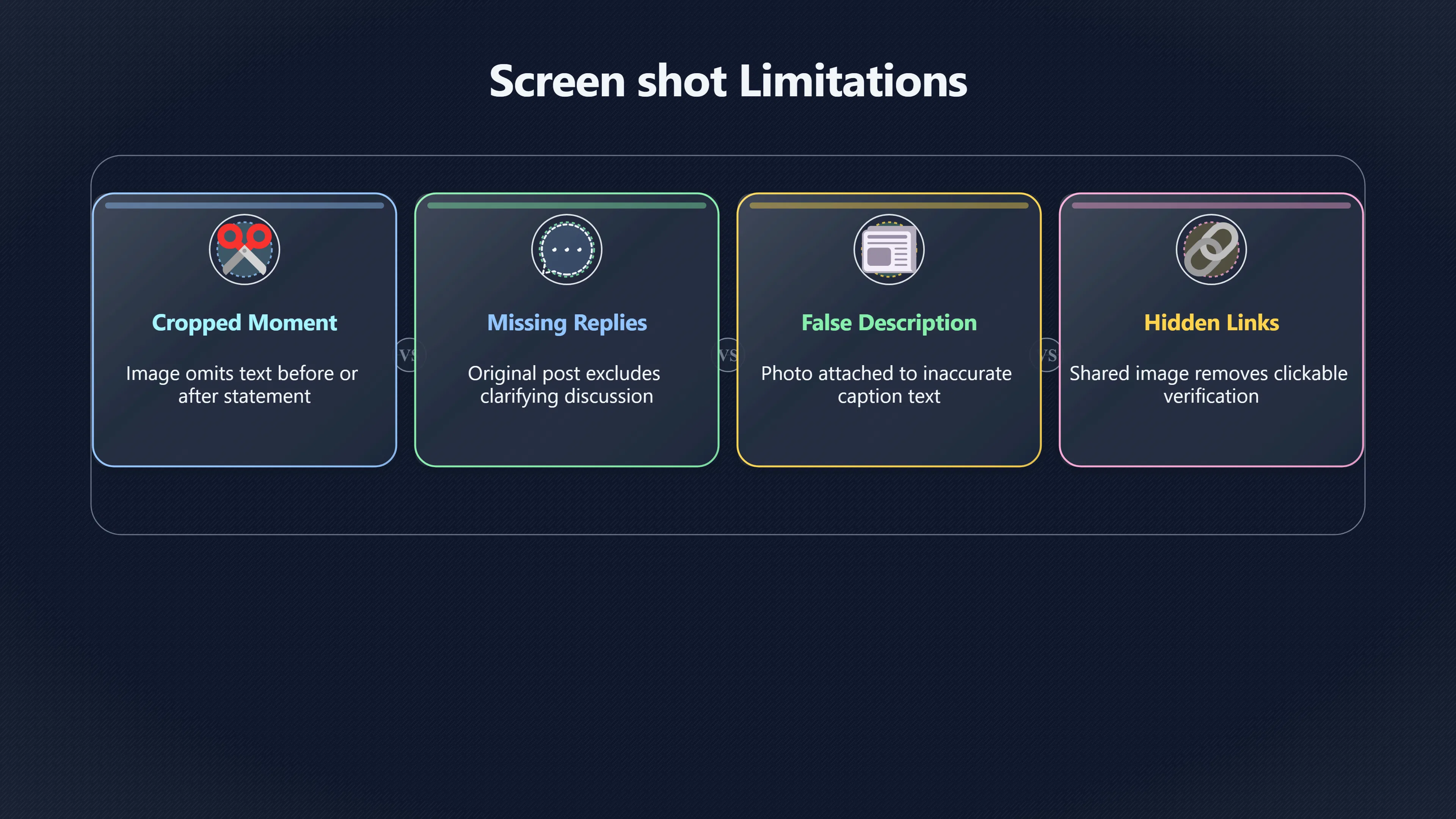
A screenshot has one major advantage in online arguments: it looks like proof. Unlike a rumour or unsupported assertion, it appears to provide direct visual evidence. The problem is that screenshots capture only a selected moment.
A cropped image may omit what came before or after a statement. A screenshot of a social media post may exclude replies that clarify the meaning. A photograph may be authentic but attached to a false description. Researchers studying misinformation have identified “out-of-context” content as one of the most effective forms of online deception because it uses genuine material while changing its interpretation.[PBS]pbs.orgout of context photos are a powerful low tech form of misinformationOut-of-context photos are a powerful low-tech form…18 Feb 2020 — Psychological research demonstrates that these out-of-context phot…
Consider a common viral pattern:
- A screenshot shows a politician making a controversial statement.
- The original post is real.
- Missing text outside the crop changes the meaning.
- Viewers conclude something that the full conversation does not support.
The screenshot itself may be authentic. The conclusion may still be wrong.
Fact-checking organisations repeatedly encounter cases where real images, videos, or screenshots are relabelled, misdated, or detached from their original setting. Reuters Fact Check regularly documents examples in which genuine visuals are presented with inaccurate descriptions, leading audiences to infer events that never occurred.[Reuters]reuters.comReuters Fact CheckReuters Fact Check addresses online misinformation with coverage that maintains accuracy, integrity and impartia…
Another limitation is that screenshots conceal verification clues. A shared image often removes links, timestamps, account histories, edits, and surrounding discussion. Once information becomes an image rather than a clickable post, independent checking becomes more difficult. Researchers examining misinformation spread through screenshots note that users frequently share screenshot content without verifying whether the original post was genuine or manipulated.[Poynter]poynter.orgwhy people still fall for fake screenshotsWhy people still fall for fake screenshots13 Feb 2020 — The surge of misinformation accompanying the coronavirus outbreak has incl…
Why “Digital Receipts” Feel More Convincing Than They Are
People often describe screenshots as “receipts”, implying that they settle a dispute. In reality, they usually answer only a narrow question: did this image exist at a particular moment?
They do not automatically answer:
- Was the content edited?
- What happened before the screenshot was taken?
- What happened afterwards?
- Is the account authentic?
- Does the image represent a typical case?
- Does it support the conclusion being claimed?
The logical mistake occurs when readers move from “this screenshot is real” to “therefore the broader claim is true”. The first proposition may be correct while the second remains unsupported.[PBS]pbs.orgout of context photos are a powerful low tech form of misinformationOut-of-context photos are a powerful low-tech form…18 Feb 2020 — Psychological research demonstrates that these out-of-context phot…
How Anecdotes Become Hasty Generalisations
The anecdote problem follows a similar pattern. An anecdote is a personal story, observation, or individual experience. Such accounts can be valuable because they describe real events and human consequences. The error appears when a small number of experiences is treated as proof of a general rule.
Suppose someone writes:
“This happened to me, so it must happen to everyone.”
That leap from one case to a broad conclusion is the classic hasty generalisation fallacy. Philosophers and critical-thinking scholars define anecdotal reasoning as problematic when it substitutes a limited sample for systematic evidence.[Internet Encyclopedia of Philosophy]iep.utm.eduInternet Encyclopedia of PhilosophyFallaciesAnecdotal Evidence. This is fallacious generalizing on the basis of some story that provides…
Online platforms amplify this tendency because stories are memorable. Research on scientific reasoning and misinformation suggests that anecdotal evidence can exert a powerful influence on judgement, even when stronger statistical evidence points elsewhere.[PubMed Central]pmc.ncbi.nlm.nih.govPub Med Central When and why do people act on flawed science?Effects of…by AL Michal · 2021 · Cited by 39 — In particular, the presence of anecdotal evidence can serve as a powerful barrier for s…
A viral post might say:
- “My friend had a side effect, therefore the treatment is dangerous.”
- “I was refused service once, therefore the company always behaves this way.”
- “I know someone who became wealthy using this method, therefore it works for everyone.”
Each story may be truthful. The problem is representativeness. One person’s experience cannot automatically reveal what happens across thousands or millions of cases.
This distinction matters because unusual experiences attract attention. Social media algorithms and human psychology both favour dramatic stories over ordinary outcomes. As a result, audiences may encounter the most extreme examples rather than the most typical ones. Researchers have long noted that memorable cases can distort perceptions when people use them as substitutes for broader evidence.[Wikipedia]WikipediaAnecdotal evidenceAnecdotal evidence

True Stories Can Still Mislead
A common misconception is that exposing the weakness of an anecdote requires proving the story is false. That is not necessary.
Anecdotes can be:
- Accurate but unrepresentative.
- Honest but incomplete.
- Important but insufficient.
For example, a single customer complaint may reveal a genuine problem. It does not automatically establish how common the problem is. Likewise, one success story may demonstrate that an outcome is possible without showing that it is likely.
The logical question is not merely “Did this happen?” but “What does this example allow us to conclude?”[Scribbr]scribbr.comThe hasty generalization fallacy and the anecdotal…The hasty generalization fallacy and the anecdotal evidence fallacy are simi…
Why Context and Scale Matter More Than Viral Proof
Screenshots and anecdotes become especially misleading when combined.
A viral post may contain:
- A screenshot of one event.
- A personal testimony.
- A sweeping conclusion.
Because the evidence feels concrete, readers often skip the crucial step of asking whether the example is representative.
Imagine a screenshot showing a single incident at a school, workplace, or public event. Even if the image accurately depicts what happened, it may not justify claims such as:
- “This is happening everywhere.”
- “This proves the system is broken.”
- “This is what all members of this group believe.”
The jump from example to general rule is where the logical error occurs.
Researchers studying misinformation have repeatedly found that manipulated narratives often rely not on entirely fabricated material but on selective presentation. Real facts, real images, and real experiences are arranged to support conclusions that the underlying evidence cannot sustain.[reutersinstitute.politics.ox.ac.uk]reutersinstitute.politics.ox.ac.uktypes sources and claims covid 19 misinformationTypes, sources, and claims of COVID-19 misinformation7 Apr 2020 — In this factsheet we identify some of the main types, sources, and clai…

A Quick Context Checklist for Viral Proof
Before accepting a screenshot or anecdote as evidence for a broader claim, ask a few simple questions.
For screenshots:
- What happened before and after the captured moment?
- Is the image cropped or selectively framed?
- Can the original source be located?
- Has the image, quote, or post been independently verified?
- Could the same screenshot support multiple interpretations?
For anecdotes:
- Is this a typical case or an unusual one?
- How many examples support the claim?
- Is there broader evidence beyond personal testimony?
- Are contradictory examples being ignored?
- Does the story prove a trend, or merely illustrate a possibility?
If the answer to several of these questions is unclear, the evidence may still be useful, but it should not carry the weight of a general conclusion.
The Key Lesson
The most misleading online evidence is often not fabricated evidence. It is evidence that is real but incomplete.
A genuine screenshot can hide the context needed to understand an event. A truthful anecdote can hide the scale needed to judge a broader claim. In both cases, the fallacy emerges when readers treat a fragment as the whole picture.
Recognising this distinction helps separate two different questions that social media often merges together: whether a piece of evidence is authentic, and whether it actually proves the conclusion being claimed. Those questions are not the same, and confusing them is one of the easiest ways for viral misinformation to acquire the appearance of proof.[PBS]pbs.orgout of context photos are a powerful low tech form of misinformationOut-of-context photos are a powerful low-tech form…18 Feb 2020 — Psychological research demonstrates that these out-of-context phot…[PubMed Central]pmc.ncbi.nlm.nih.govPub Med Central When and why do people act on flawed science?Effects of…by AL Michal · 2021 · Cited by 39 — In particular, the presence of anecdotal evidence can serve as a powerful barrier for s…
Amazon book picks
Further Reading
Books and field guides related to Why Screenshots Are Not Always Evidence. Use these as the next step if you want deeper reading beyond the article.
Calling Bullshit
Teaches readers how to evaluate evidence, context, and misleading presentations.
The Skeptics' Guide to the Universe
Explains anecdotal evidence, confirmation bias, and misinformation tactics.
An Illustrated Book of Bad Arguments
Covers hasty generalisations and other common reasoning mistakes.
eBay marketplace picks
Marketplace Samples
Example marketplace items related to this page. Use the search link to explore similar finds on eBay.

Endnotes
1.
Source: pbs.org
Title: out of context photos are a powerful low tech form of misinformation
Link:https://www.pbs.org/newshour/science/out-of-context-photos-are-a-powerful-low-tech-form-of-misinformation
Source snippet
Out-of-context photos are a powerful low-tech form...18 Feb 2020 — Psychological research demonstrates that these out-of-context phot...
2.
Source: reuters.com
Link:https://www.reuters.com/fact-check/
Source snippet
Reuters Fact CheckReuters Fact Check addresses online misinformation with coverage that maintains accuracy, integrity and impartia...
3.
Source: poynter.org
Title: why people still fall for fake screenshots
Link:https://www.poynter.org/fact-checking/2020/why-people-still-fall-for-fake-screenshots/
Source snippet
Why people still fall for fake screenshots13 Feb 2020 — The surge of misinformation accompanying the coronavirus outbreak has incl...
4.
Source: scribbr.com
Link:https://www.scribbr.com/frequently-asked-questions/difference-between-the-hasty-generalization-fallacy-and-anecdotal-evidence-fallacy/
Source snippet
The hasty generalization fallacy and the anecdotal...The hasty generalization fallacy and the anecdotal evidence fallacy are simi...
5.
Source: Wikipedia
Title: Anecdotal evidence
Link:https://en.wikipedia.org/wiki/Anecdotal_evidence
6.
Source: reutersinstitute.[politics]({{ ‘politics/’ | relative_url }}). ox.ac.uk
Title: types sources and claims covid 19 misinformation
Link:https://reutersinstitute.politics.ox.ac.uk/types-sources-and-claims-covid-19-misinformation
Source snippet
Types, sources, and claims of COVID-19 misinformation7 Apr 2020 — In this factsheet we identify some of the main types, sources, and clai...
7.
Source: Wikipedia
Link:https://en.wikipedia.org/wiki/Wikipedia%3AAIB
Source snippet
Requests for comment/AI imagesIllustrating a living person with an AI-generated image might misinform as to how that person...
8.
Source: iep.utm.edu
Link:https://iep.utm.edu/fallacy/
Source snippet
Internet Encyclopedia of PhilosophyFallaciesAnecdotal Evidence. This is fallacious generalizing on the basis of some story that provides...
9.
Source: pmc.ncbi.nlm.nih.gov
Title: Pub Med Central When and why do people act on flawed science?
Link:https://pmc.ncbi.nlm.nih.gov/articles/PMC8023527/
Source snippet
Effects of...by AL Michal · 2021 · Cited by 39 — In particular, the presence of anecdotal evidence can serve as a powerful barrier for s...
Additional References
10.
Source: facebook.com
Link:https://www.facebook.com/groups/124043941594409/posts/761926247806172/
Source snippet
Anecdotes vs Data in Decision MakingThe problem with using anecdotes to make decisions is that the effects of an intervention can only be...
11.
Source: reddit.com
Link:https://www.reddit.com/r/changemyview/comments/n9dl9s/cmv_anecdotal_evidence_is_very_much_valid_evidence/
Source snippet
CMV: Anecdotal evidence is very much *valid* evidence.The trendy sentiment that any anecdotal evidence MUST be invalid and the only valid...
12.
Source: medium.com
Link:https://medium.com/%40drmozellemartin/the-screenshot-fallacy-why-digital-receipts-often-mislead-5f15b72e66ad
Source snippet
The Screenshot Fallacy: Why Digital “Receipts” Often MisleadScreenshots feel like evidence, but without context, timing, and motive, they...
13.
Source: youtube.com
Link:https://www.youtube.com/watch?v=jjISO-juArY
Source snippet
Anecdotal Fallacy: A Data Point of One Is Not EvidenceWhy does one vivid customer story outweigh months of research? This week on the Cog...
14.
Source: cris.maastrichtuniversity.nl
Title: Proceedings Dialnet SmartEthicsInTheDigitalWorld 969458
Link:https://cris.maastrichtuniversity.nl/files/187261304/Proceedings_Dialnet-SmartEthicsInTheDigitalWorld-969458.pdf
Source snippet
maastrichtuniversity.nl(Ref)using AI1 Jan 2024 — As the research has progressed, the context has shifted to online graduate students in c...
15.
Source: researchgate.net
Link:https://www.researchgate.net/figure/Sample-screenshots-of-the-top-of-an-article-about-a-true-left-and-false-right-claim_fig3_371348003
Source snippet
Retrieval practice is one way to increase memory, thus multiple-choice...Read more...
16.
Source: facebook.com
Link:https://www.facebook.com/factcheckPH.assortedge/posts/manipulated-content-uses-real-factsbut-bends-them-just-enough-to-mislead-its-not/1108237698010220/
Source snippet
ctive visuals, or framing things to push a certain narrative.Read more...
17.
Source: newsinitiative.withgoogle.com
Link:https://newsinitiative.withgoogle.com/resources/trainings/fact-check-explorer/
Source snippet
Fact check images on Fact Check ExplorerFact Check Explorer gives journalists and fact checkers a deeper way to learn about an image or t...
18.
Source: interaliaproject.com
Title: Social (Media) Inclusion
Link:https://interaliaproject.com/wp-content/uploads/2021/03/SMI-Toolkit.pdf
Source snippet
Inter AliaThis project rotates around the concept and perception of good and bad use of “social media” and the impact that this has on a...
19.
Source: aclanthology.org
Title: 2026.eacl long.316
Link:https://aclanthology.org/2026.eacl-long.316.pdf
Source snippet
AI-driven Emotional Framing Impairs Human Fallacy...by Y Chen · 2026 · Cited by 1 — [Logical fallacies]({{ 'logical-fallacies/' | relative_url }}) are common in public commu- nicati...
Topic Tree