Within Essays
When Because Does Not Prove the Point
A weak because clause can make a paragraph sound persuasive while leaving the real proof missing.
On this page
- What a because gap looks like in student paragraphs
- How to test whether a reason actually supports the claim
- Revision examples that narrow or strengthen the argument
Page outline Jump by section
Introduction
A “because gap” occurs when a writer makes a claim and adds a reason after the word because, but the reason does not actually prove the conclusion. The sentence sounds argumentative because it contains a claim and an explanation, yet the logical connection is weak, incomplete, or missing. In academic writing, this is one of the most common ways that logical fallacies appear inside otherwise fluent paragraphs.
 The problem is not necessarily a lack of evidence. More often, the writer has supplied a fact, example, observation, or opinion but has failed to show why that information justifies the claim being made. Writing specialists frequently describe argument as a claim supported by evidence, while argumentation models such as Toulmin’s emphasise the need for a warrant—the reasoning that links evidence to a conclusion. When that link is absent, a because gap appears.[The Writing Center]writingcenter.unc.eduThe Writing CenterArgument – The Writing CenterAn argument is usually a main idea, often called a “claim” or “thesis statement,” backed u…[Purdue OWL]owl.purdue.eduOWLToulmin ArgumentPurdue OWLToulmin Argument - Purdue OWLThe Toulmin method is a style of argumentation that breaks arguments down into six component parts…
What a because gap looks like in student paragraphs
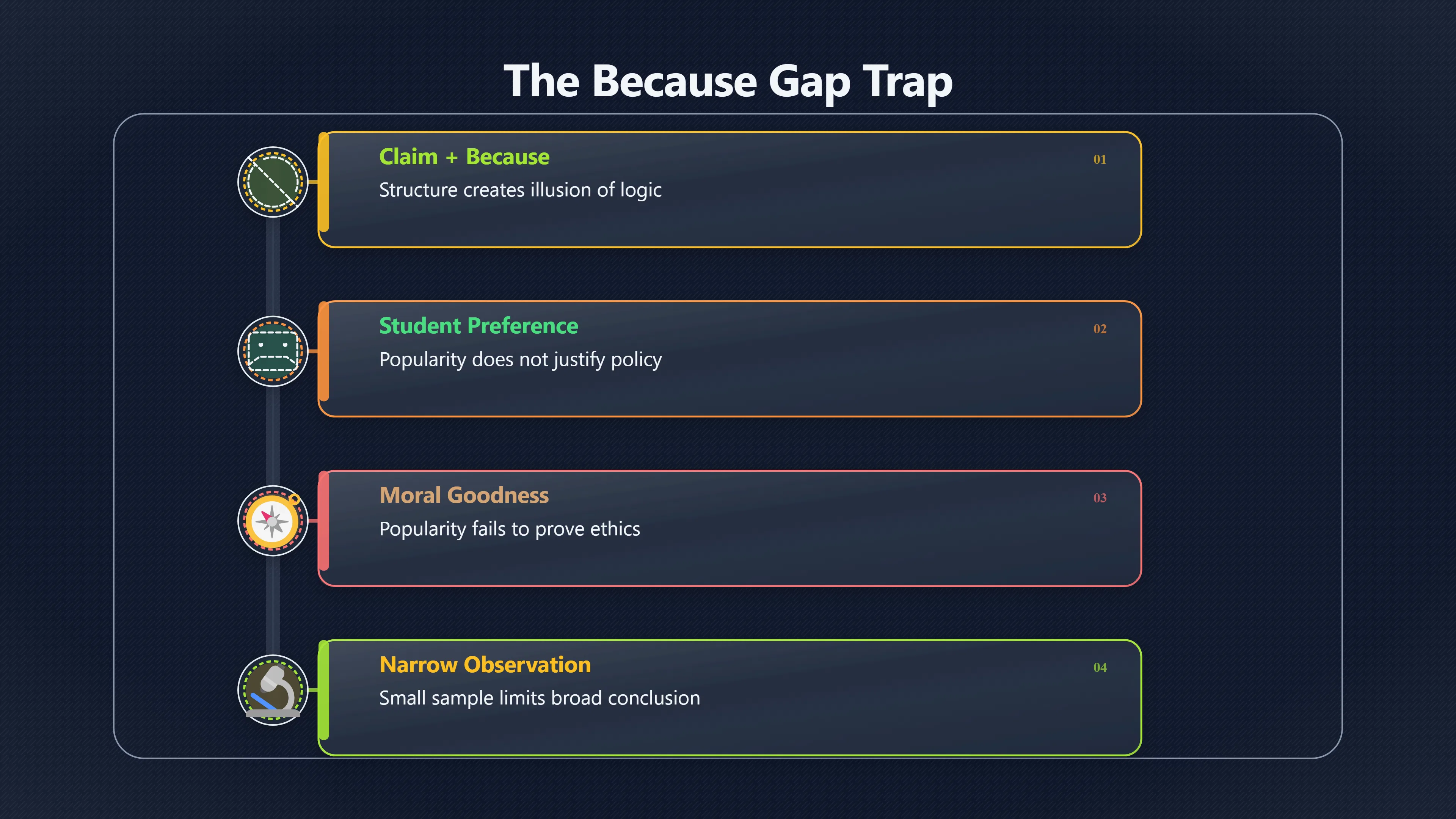
Because gaps often hide inside sentences that seem persuasive at first glance. The structure creates an illusion of logic:
Claim + because + reason
The weakness becomes visible only when the reader asks whether the reason truly supports the claim.
Consider this example:
University lectures should be recorded because students like having access to recordings.
The reason explains a preference, but the claim concerns what universities should do. Student preference alone does not necessarily justify policy. The paragraph would need additional reasoning showing why student preference is a relevant basis for institutional decisions.
A similar problem appears here:
The novel’s protagonist is morally good because she is popular with other characters.
Popularity does not automatically establish moral goodness. The reason and conclusion belong to different categories. The writer has moved from social approval to ethical judgement without explaining the connection.
Another common pattern involves broad conclusions supported by narrow observations:
Social media damages attention spans because several students in my seminar check their phones during class.
Even if the observation is accurate, it does not establish the broader claim. The evidence is too limited and the reasoning leap is too large.
In each case, the paragraph contains information, but the information does not carry the argumentative weight placed upon it. The reader is expected to accept a conclusion without being shown the logical bridge connecting reason and claim. Purdue OWL[Excelsior OWL]owl.excelsior.eduOWLToulmin ArgumentExcelsior OWLToulmin Argument - Excelsior OWLWarrant. The warrant is what links the grounds to the claim. This is what makes the audience…
Why the gap happens
A because gap is usually a reasoning problem rather than an evidence problem.
Argumentation scholars often describe arguments as consisting of a claim, supporting grounds, and a warrant. The warrant is the assumption or explanation that allows the conclusion to follow from the evidence. When writers leave that warrant unstated, readers must supply it themselves. If the implied warrant is weak, the argument fails. Purdue OWL[academics]academics.umw.eduAcademics Toulmin Argument ModelWarrant: The reasoning that authorizes the inferential leap from the grounds to the claim. Backing:…Read more… Several habits create because gaps:
Replacing proof with explanation.[uscb.edu]uscb.eduUnderstanding ArgumentsSee this explanation at the Purdue OWL: “An argumentative paper makes a claim about a topic and justifies this cla…
A reason may explain why something happened without proving that a larger claim is true.
Confusing correlation with support.[ncl.ac.uk]ncl.ac.ukUsing Evidence to Support your ArgumentTo check if you're supporting your own points with evidence, imagine that the reader is asking you…
A fact related to the topic may be treated as proof even though it does not directly justify the conclusion.
Using emotionally appealing reasons.
Readers may sympathise with the reason, but sympathy is not the same as logical support.
Making the claim broader than the reason.
The conclusion may concern an entire population, policy, text, or historical period while the supporting reason addresses only a small part of it.
Because gaps therefore sit at the point where reasoning should connect evidence and conclusion but fails to do so. Writing centres often stress that evidence never speaks for itself; writers must explain how the evidence supports the point they are trying to make.[The Writing Center]writingcenter.unc.eduThe Writing CenterArgument – The Writing CenterAn argument is usually a main idea, often called a “claim” or “thesis statement,” backed u…[The Writing Center]writingcenter.unc.eduThe Writing CenterArgument – The Writing CenterAn argument is usually a main idea, often called a “claim” or “thesis statement,” backed u…
How to test whether a reason actually supports the claim
A useful diagnostic technique is to separate the claim from the reason and examine the relationship between them.
Ask three questions.
Does the reason make the claim more likely to be true?
If removing the claim leaves a fact that could easily coexist with the opposite conclusion, the support is weak.
Example:
School uniforms should be mandatory because many schools use them.
The reason shows that uniforms are common, not that they are beneficial or should be required.
Is a hidden assumption doing all the work?
Many because gaps rely on an unstated belief.
Example:
The policy should be adopted because it is popular.
Hidden assumption:
Whatever is popular should be adopted.
Once the assumption is stated explicitly, its weakness becomes easier to evaluate.
This approach mirrors the Toulmin concept of the warrant, which identifies the reasoning that authorises movement from evidence to conclusion.[Academics]academics.umw.eduAcademics Toulmin Argument ModelWarrant: The reasoning that authorizes the inferential leap from the grounds to the claim. Backing:…Read more…[2open.baypath.edu]open.baypath.eduThis is what makes the audience understand how the grounds are connected to supporting the claim.Read more…

Could the same reason support opposing claims?
If the reason can plausibly support multiple conclusions, it may not strongly support any particular one.
Example:
Remote work should become permanent because employees value flexibility.
That reason might support permanent remote work, hybrid work, or expanded flexible scheduling. Additional reasoning is needed to establish the specific conclusion.
Does the claim require a different type of evidence?
Policy claims usually require evidence about outcomes or consequences.
Literary claims usually require textual analysis.
Historical claims usually require documentary or contextual evidence.
If the reason belongs to the wrong category, the argument often contains a because gap.
Revision examples that narrow or strengthen the argument
The best revisions either strengthen the reason or narrow the claim so that the two fit together.
Example 1: Overly broad claim
Weak version:
Social media harms teenagers because many teenagers use social media every day.
Daily use does not demonstrate harm.
Stronger version:
Heavy social media use may contribute to sleep disruption among teenagers because studies have found associations between late-night platform use and reduced sleep duration.
The revised sentence introduces evidence relevant to the specific claim rather than merely describing usage.
Example 2: Unsupported policy recommendation
Weak version:
Attendance should be optional because students prefer flexibility.
Preference alone does not justify the policy recommendation.
Stronger version:
Attendance requirements could be reduced in some lecture-based courses because recorded lectures allow students to review material without losing access to course content.
The revision supplies a mechanism explaining why flexibility might support the proposed change.
Example 3: Literary analysis
Weak version:
The narrator is unreliable because she tells an interesting story.
An interesting story does not imply unreliability.
Stronger version:
The narrator appears unreliable because her account of key events repeatedly contradicts information provided elsewhere in the text.
The reason now directly relates to the claim being made.
Example 4: Historical argument
Weak version:
The reform was successful because it was widely discussed.
Discussion does not prove success.
Stronger version:
The reform was successful because it achieved its stated objective of increasing voter participation, with turnout rising substantially in subsequent elections.
The revised version matches the type of evidence to the claim.
A quick check before submitting an essay
Many because gaps can be found with a simple editing exercise. After drafting a paragraph, highlight every occurrence of because, since, therefore, thus, shows that, or proves that. Then ask:
- What exactly is the claim?
- What exactly is the reason?
- Why should the reader believe the claim on the basis of that reason?
- Is the connecting logic explicitly stated or merely assumed?
- Would a sceptical reader see the same connection?
If answering these questions feels difficult, the paragraph probably needs additional reasoning.
Academic arguments become stronger not when writers add more facts, but when they clearly explain how those facts justify their conclusions. The because gap is therefore less about missing information than about missing logic. A paragraph succeeds when the reader can see not only what the evidence is, but why the evidence genuinely supports the point being made.[ncl.ac.uk]ncl.ac.ukUsing Evidence to Support your ArgumentTo check if you're supporting your own points with evidence, imagine that the reader is asking you…[Purdue OWL]owl.purdue.eduOWLOrganizing Your ArgumentPurdue OWLOrganizing Your Argument - Purdue OWLWarrant (Bridge): In this section, you explain why or how your data supports the claim. As…
eBay marketplace picks
Marketplace Samples
Example marketplace items related to this page. Use the search link to explore similar finds on eBay.




Endnotes
1.
Source: owl.purdue.edu
Title: OWLToulmin Argument
Link:https://owl.purdue.edu/owl/general_writing/academic_writing/historical_perspectives_on_argumentation/toulmin_argument.html
Source snippet
Purdue OWLToulmin Argument - Purdue OWLThe Toulmin method is a style of argumentation that breaks arguments down into six component parts...
2.
Source: owl.purdue.edu
Title: OWLOrganizing Your Argument
Link:https://owl.purdue.edu/owl/general_writing/academic_writing/establishing_arguments/organizing_your_argument.html
Source snippet
Purdue OWLOrganizing Your Argument - Purdue OWLWarrant (Bridge): In this section, you explain why or how your data supports the claim. As...
3.
Source: owl.excelsior.edu
Title: OWLToulmin Argument
Link:https://owl.excelsior.edu/argument-and-critical-thinking/organizing-your-argument/organizing-your-argument-toulmin/
Source snippet
Excelsior OWLToulmin Argument - Excelsior OWLWarrant. The warrant is what links the grounds to the claim. This is what makes the audience...
4.
Source: open.baypath.edu
Link:https://open.baypath.edu/eng124/chapter/unknown-2/
Source snippet
This is what makes the audience understand how the grounds are connected to supporting the claim.Read more...
5.
Source: ncl.ac.uk
Link:https://www.ncl.ac.uk/academic-skills-kit/study-skills/critical-thinking/using-evidence-to-support-your-argument/
Source snippet
Using Evidence to Support your ArgumentTo check if you're supporting your own points with evidence, imagine that the reader is asking you...
6.
Source: owl.purdue.edu
Title: strong> In a work of persuasive writing, the writer presents
Link:https://owl.purdue.edu/owl/general_writing/academic_writing/establishing_arguments/organizing_your_argument.%20In%20this%20case%2C%20your%20paper%20will%20be%20completed%20by%20a%20standard%20author.%20It%20does%20not%20mean%20that%20your%20paper%20will%20be%20of%20poor%20quality.The%20%3Cstrong%3EToulmin%3C/strong%3E%20model%20can%20be%20used%20as%20a%20framework%20to%20test%20an%20argument%27s%20validity%20by%20identifying%20the%20%3Cstrong%3Eclaim%3C/strong%3E%2C%20evidence%2C%20%3Cstrong%3Ewarrants%3C/strong%3E%2C%20backing%2C%20counterarguments%2C%20and%20qualifiers.%20In%20an%20academic%20%3Cstrong%3Eessay%3C/strong%3E%2C%20the%20%3Cstrong%3Ewarrant%3C/strong%3E%20and%20backing%20would%20be%20allotted%20the%20most%20in-depth%20discussion%20because%20these%20aspects%20are%20normally%20unstated%20and%20taken%20for%20granted%20in%20causal%20arguments.%203.%20Each%20is%20explained%20below.%20%3Cstrong%3EClaims%3C/strong%3E%20In%20a%20work%20of%20persuasive%20writing%2C%20the%20writer%20presents
Source snippet
ChoicesThe <strong>Toulmin</strong> model can be used as a framework to test an argument's validity by identifying the <strong>claim</str...
7.
Source: acikders.ankara.edu.tr
Link:https://acikders.ankara.edu.tr/mod/resource/view.php?id=135922
Source snippet
AND ANALYTICAL THINKINGIn academic writing, an argument is usually a main idea, often called a "claim" or "thesis statement," backed up w...
8.
Source: writingcenter.unc.edu
Link:https://writingcenter.unc.edu/tips-and-tools/argument/
Source snippet
The Writing CenterArgument – The Writing CenterAn argument is usually a main idea, often called a “claim” or “thesis statement,” backed u...
9.
Source: writingcenter.unc.edu
Link:https://writingcenter.unc.edu/wp-content/uploads/sites/346/2012/09/Evidence-The-Writing-Center.pdf
Source snippet
The Writing CenterEvidenceWhat turns a fact or piece of information into evidence is the connection it has with a larger claim or argumen...
10.
Source: academics.umw.edu
Title: Academics Toulmin Argument Model
Link:https://academics.umw.edu/speaking/resources/handouts/toulmin-argument-model/
Source snippet
Warrant: The reasoning that authorizes the inferential leap from the grounds to the claim. Backing:...Read more...
11.
Source: writingcenter.unc.edu
Link:https://writingcenter.unc.edu/tips-and-tools/evidence/
Source snippet
The Writing CenterEvidence – The Writing CenterDoes evidence speak for itself? Absolutely not. After you introduce evidence into your wri...
12.
Source: cliffsnotes.com
Link:https://www.cliffsnotes.com/study-notes/19661738
Source snippet
explain why you need one in most of your academic [essays]({{ 'essays/' | relative_url }}). Read more...
13.
Source: courses.lumenlearning.com
Title: text applying evidence
Link:https://courses.lumenlearning.com/suny-eng-101-college-writing-i/chapter/text-applying-evidence/
Source snippet
Evidence | ENG 101 College Writing IThe “Evidence” handout from The Writing Center at UNC-Chapel Hill continues, offering guidance for ho...
14.
Source: upresearch.lonestar.edu
Link:https://upresearch.lonestar.edu/rhetoric/toulmin
Source snippet
Argument: Toulmin Argument21 Jan 2026 — The parts of a Toulmin argument are: the claim, the grounds, warrant, backing, qualifier, and reb...
15.
Source: studocu.com
Title: the writing center at unc fallacies
Link:https://www.studocu.com/en-us/document/lone-star-college-system/classical-philosophy/the-writing-center-at-unc-fallacies/21835008
Source snippet
Understanding Fallacies in Academic Writing: A Guide from UNCMost academic writing tasks require you to make an argument—that is, to pres...
Additional References
16.
Source: statisticssolutions.com
Link:https://www.statisticssolutions.com/expanding-on-the-basic-toulmin-model-when-writing-a-literature-review/
Source snippet
Expanding on the Basic Toulmin ModelThe Toulmin model of argumentation contains six elements: Claim, Grounds, Warrant, Qualifier, Backing...
17.
Source: ucc.ie
Link:https://www.ucc.ie/en/media/support/skillscentre/pdfx27sampbookmarks/HowToBuildAnAcademicArgument.pdf
Source snippet
HOW TO BUILD AN ACADEMIC ARGUMENTWhat is an Argument? An argument involves establishing a claim and proving it with logical reasoning, ex...
18.
Source: unemployedprofessors.com
Link:https://unemployedprofessors.com/How-To-Write-A-Toulmin-Essay
Source snippet
How To Write A Toulmin EssayMake sure that you have explicitly included a claim, grounds, a warrant, backing, the rebuttal, and the quali...
19.
Source: blinn.edu
Link:https://www.blinn.edu/writing-centers/wide/toulmin-argument.html
Source snippet
Toulmin ArgumentIdentify each argument's claims, data, and [warrants]({{ 'warrants/' | relative_url }}). Look for qualifiers, rebuttals, and backing for the warrants. Compar...
20.
Source: sjsu.edu
Link:https://www.sjsu.edu/writingcenter/docs/handouts/Toulmin%20Model%20of%20Argumentative%20Writing.pdf
Source snippet
Toulmin's Model of Argumentative WritingIt consists of six parts: three fundamental elements are the claim, grounds, and warrant; then, t...
21.
Source: ciris.info
Link:https://www.ciris.info/learningcenter/toulmins-model/
Source snippet
Toulmin's model of ArgumentationThe Toulmin model shows how reasoning moves from evidence (grounds) to a conclusion (claim), supported by...
22.
Source: uscb.edu
Link:https://www.uscb.edu/campus-life/student-development/academic-support/tutoring-and-writing-center/pdfs/Understanding_Arguments.pdf
Source snippet
Understanding ArgumentsSee this explanation at the Purdue OWL: “An argumentative paper makes a claim about a topic and justifies this cla...
23.
Source: publications.coventry.ac.uk
Link:https://publications.coventry.ac.uk/index.php/joaw/article/download/1154/1126/7568
Source snippet
Students How to Tame the Warrant with...This teaching practice paper deals with some practical ideas of teaching the concept of 'warrant...
24.
Source: studypedia.au.dk
Link:https://studypedia.au.dk/en/academic-standards/argumentation
Source snippet
argument is a claim that is justified. Toulmin's model of argumentation is often used to understand and explain how arguments are connect...
25.
Source: utsa.pressbooks.pub
Link:https://utsa.pressbooks.pub/fromcollegetocareer/chapter/core-101-academic-argument-essay/
Source snippet
pressbooks.pubClaims, Support, and Structure – From College to Careerby C Frasier — Evidence for an academic argument can be based on pri...
Topic Tree