Within Remedies
When recovery stories are not evidence
Personal recovery stories can be sincere and still fail to show whether a remedy caused the improvement.
On this page
- Why anecdotes feel more convincing than data
- False cause, regression to the mean, and selective visibility
- How to use testimonials without overtrusting them
Page outline Jump by section
Introduction
Personal recovery stories are among the most persuasive forms of health marketing. A neighbour says a supplement ended years of joint pain. An online reviewer claims a detox programme transformed their energy levels. A video testimonial shows someone who appears healthier after using a remedy. These accounts may be completely sincere, yet sincerity is not the same as evidence.
 The logical fallacy at work is often called the anecdotal fallacy or, in consumer health, the anecdote trap: treating individual experiences as proof that a remedy works. The problem is not dishonesty. The problem is that a single story cannot reliably distinguish between the effect of the remedy and the many other reasons people may improve. Health researchers therefore treat testimonials as clues that may generate hypotheses, not as proof that a treatment causes recovery.[NCBI]ncbi.nlm.nih.govNCBIBad evidenceAnecdotal evidence can be unreliable. You cannot infer a general rule from a…Read more…
Why anecdotes feel more convincing than data
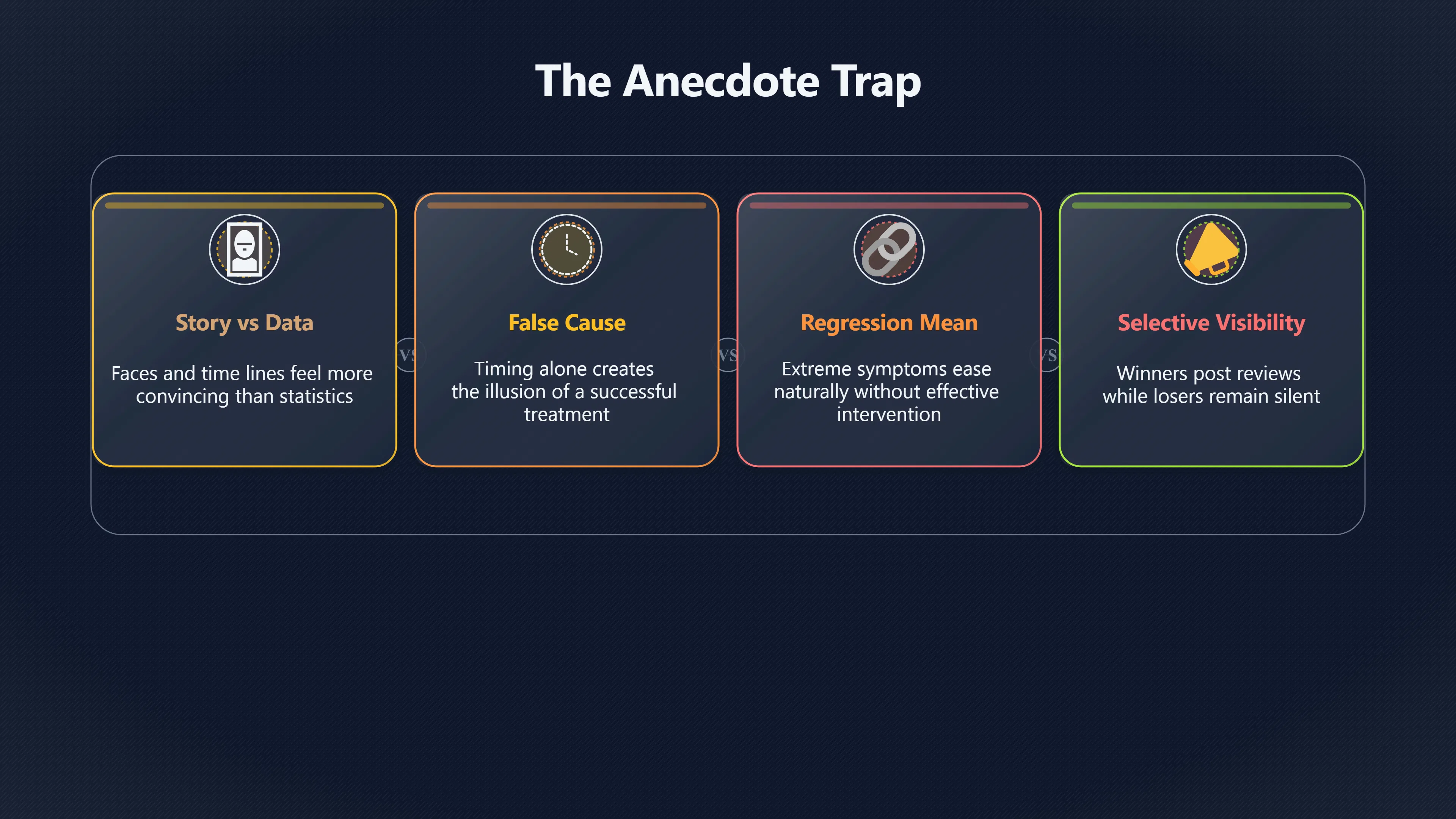
Human beings naturally understand stories better than statistics. A testimonial provides a face, a timeline, emotions, and a clear before-and-after narrative. By contrast, a controlled clinical trial may involve hundreds of participants, confidence intervals, and competing explanations that are harder to visualise.
This creates a mismatch between psychological impact and evidential value. A vivid story of one person’s recovery often feels more compelling than a large study showing little or no benefit. Yet from an evidence perspective, the study is usually more reliable because it is designed to separate genuine treatment effects from coincidence, expectation, and natural variation.[NCBI]ncbi.nlm.nih.govNCBIBad evidenceAnecdotal evidence can be unreliable. You cannot infer a general rule from a…Read more…
Testimonials also exploit a common intuition: if someone improved after taking a remedy, the remedy must have caused the improvement. In everyday life, this type of reasoning often works reasonably well. In medicine, however, symptoms frequently change for reasons unrelated to the treatment being tried.
False cause, regression to the mean, and selective visibility
The anecdote trap is powered by several overlapping mechanisms that can make ineffective remedies appear successful.
Improvement after treatment is not necessarily improvement because of treatment
The most common error is the false-cause fallacy: assuming that because event B followed event A, event A caused event B.
Many people begin a remedy when symptoms are at their worst. Headaches, back pain, fatigue, allergies, digestive problems, anxiety, and many other conditions naturally fluctuate. When symptoms later ease, the timing alone can create the illusion of a successful treatment.[PMC]pmc.ncbi.nlm.nih.govKnowledge of regression to the mean can help with everything from interpreting test results to improving your career prospects…
A testimonial often captures only two moments:
- Symptoms were severe.
- The person took the remedy and later felt better.
What is missing is the crucial comparison: what would have happened if the person had not taken the remedy?
Regression to the mean creates convincing success stories
One of the most important but least understood explanations is regression to the mean. When people seek treatment during an unusually bad period, statistical tendency alone predicts that later measurements will often be closer to their normal level. In other words, extreme symptoms frequently become less extreme even without an effective intervention.[PMC]pmc.ncbi.nlm.nih.govPMCRegression to the Mean: Implications for Clinical Trialsby JL Cummings · 2004 · Cited by 22 — Analysis of the trial outcomes demonstrated that the reduction observed in the placebo group was…[PMC]pmc.ncbi.nlm.nih.govPMCOpen label placebo: can honestly prescribedNIHby TJ Kaptchuk · 2018 · Cited by 167 — Importantly, clinical research has shown that placebo effects are more than spontaneous i…
Imagine someone whose chronic back pain fluctuates between mild and severe. They buy a supplement during a particularly painful week. A month later, the pain has returned to its usual level. The improvement feels real because it is real. The mistaken step is attributing that improvement to the supplement without ruling out the possibility that the symptoms would have eased anyway.
Researchers have repeatedly warned that regression to the mean can make ineffective interventions appear beneficial unless proper controls are used. PMC[BMJ Evidence-Based Medicine]ebm.bmj.comHowever, some interventions take…Read more…
Expectations can influence symptoms
People’s expectations can affect how they experience symptoms. The placebo effect refers to beneficial changes that arise from anticipation, context, and the treatment experience rather than from a specific therapeutic ingredient. The effect is particularly relevant for subjective outcomes such as pain, discomfort, or perceived wellbeing.[NCCIH]nccih.nih.govNCCIHKnow the Science of Complementary Health Approachesthe Science of Complementary Health Approaches - nccihAs you know, there is a lot of inaccurate or misleading information circulating abo…
This means a person can honestly report feeling better after taking a remedy even if the remedy itself has no active effect on the underlying condition. Their experience is genuine, but their explanation for the experience may be incorrect.
Researchers also emphasise that placebo responses do not account for all improvement. Natural recovery, symptom fluctuation, regression to the mean, and other factors can operate at the same time.[PMC]pmc.ncbi.nlm.nih.govPatients in the placebo arms of randomized controlled trials (RCT) often experience positive changes from baseline.Read more…

The public sees winners more often than losers
Testimonials are affected by selective visibility.
People who experience improvement are more likely to:
- Post reviews.
- Tell friends.
- Join user communities.
- Agree to appear in advertisements.
- Share before-and-after photographs.
People who see no benefit often remain silent, abandon the product, or move on to another remedy.
As a result, consumers are exposed to a filtered collection of experiences. The visible population is not necessarily representative of everyone who tried the product. This is closely related to survivorship bias: observing only the apparent successes while the failures disappear from view.[NCBI]ncbi.nlm.nih.govNCBIBad evidenceAnecdotal evidence can be unreliable. You cannot infer a general rule from a…Read more…
Why marketers rely on testimonials
Health-product advertising frequently features testimonials because they are persuasive, memorable, and relatively inexpensive compared with producing strong scientific evidence.
Regulators have repeatedly stressed that testimonials do not replace the need for scientific substantiation. In the United States, the Federal Trade Commission (FTC) requires health-related claims to be supported by competent and reliable scientific evidence rather than by endorsements alone.[Federal Trade Commission]ftc.govhealth products compliance guidanceFederal Trade CommissionHealth Products Compliance Guidance20 Dec 2022 — This document provides guidance from FTC staff on how to ensure…[Federal Trade Commission]ftc.govhealth products compliance guidanceFederal Trade CommissionHealth Products Compliance Guidance20 Dec 2022 — This document provides guidance from FTC staff on how to ensure…
The FTC has also studied how testimonial-based promotions influence consumers. Research conducted for the agency found that readers exposed to collections of consumer testimonials could draw strong efficacy impressions from those stories.[Federal Trade Commission]ftc.govhealth products compliance guidanceFederal Trade CommissionHealth Products Compliance Guidance20 Dec 2022 — This document provides guidance from FTC staff on how to ensure…
This does not mean every testimonial is deceptive. It means that a compelling story can communicate a much stronger message than the underlying evidence actually supports.
How to use testimonials without overtrusting them
Testimonials are not useless. They simply answer a different question from the one many consumers think they answer.
A testimonial can sometimes help reveal:
- What users hope to achieve.
- How a treatment feels in practice.
- Common complaints or side effects.
- Questions worth investigating scientifically.
What it cannot reliably establish is whether the remedy caused the reported improvement.
When evaluating a health claim, it helps to ask:
- Would some people have improved anyway?
- Is the condition known to fluctuate naturally?
- Are unsuccessful users visible as well as successful ones?
- Has the remedy been tested in controlled studies?
- Do systematic reviews and clinical trials agree with the testimonial claims?
If the answer relies mainly on personal stories, caution is warranted. Anecdotes can suggest possibilities, but they are poor tools for measuring effectiveness. Controlled research exists precisely because human beings are so good at finding patterns, causes, and success stories even when those patterns are misleading.[NCBI]ncbi.nlm.nih.govNCBIBad evidenceAnecdotal evidence can be unreliable. You cannot infer a general rule from a…Read more…[NCCIH]nccih.nih.govnih.govEvidence-Based Medicine: Literature Reviews | NCCIHThe resources on this page will help inform you about what the science says (li…
The key lesson of the anecdote trap
The most important insight is that a testimonial can be truthful and still fail as evidence. A person may genuinely recover after using a remedy, genuinely believe the remedy caused the recovery, and genuinely want to help others by sharing the story. None of those facts establishes causation.
The anecdote trap occurs when a recovery story is treated as the test rather than as a starting point for testing. In consumer health claims, the distinction matters because the same story can be explained by an effective treatment, natural recovery, regression to the mean, placebo responses, behavioural changes, or simple coincidence. Only controlled evidence can reliably tell those explanations apart.[Federal Trade Commission]ftc.govhealth products compliance guidanceFederal Trade CommissionHealth Products Compliance Guidance20 Dec 2022 — This document provides guidance from FTC staff on how to ensure… [3PMC 3PMC]
Amazon book picks
Further Reading
Books and field guides related to When recovery stories are not evidence. Use these as the next step if you want deeper reading beyond the article.
Bad Science
Directly addresses anecdotes, evidence quality, and misleading health claims.
The Demon-Haunted World
Teaches evidence-based thinking and resistance to persuasive stories.
Thinking, Fast and Slow
Explains why vivid anecdotes often outweigh statistics in judgment.
How to Lie with Statistics
Helps readers compare stories against population-level evidence.
eBay marketplace picks
Marketplace Samples
Example marketplace items related to this page. Use the search link to explore similar finds on eBay.






Endnotes
1.
Source: ncbi.nlm.nih.gov
Title: NCBIBad evidence
Link:https://www.ncbi.nlm.nih.gov/books/NBK63649/
Source snippet
Anecdotal evidence can be unreliable. You cannot infer a general rule from a...Read more...
2.
Source: nccih.nih.gov
Title: NCCIHKnow the Science of Complementary Health Approaches
Link:https://www.nccih.nih.gov/health/providers/digest/know-the-science-of-complementary-health-approaches
Source snippet
the Science of Complementary Health Approaches - nccihAs you know, there is a lot of inaccurate or misleading information circulating abo...
3.
Source: nccih.nih.gov
Link:https://www.nccih.nih.gov/health/providers/litreviews
Source snippet
nih.govEvidence-Based Medicine: Literature Reviews | NCCIHThe resources on this page will help inform you about what the science says (li...
4.
Source: pmc.ncbi.nlm.nih.gov
Link:https://pmc.ncbi.nlm.nih.gov/articles/PMC1125994/
Source snippet
Knowledge of regression to the mean can help with everything from interpreting test results to improving your career prospects...
5.
Source: pmc.ncbi.nlm.nih.gov
Title: PMCRegression to the Mean: Implications for Clinical Trials
Link:https://pmc.ncbi.nlm.nih.gov/articles/PMC4371726/
Source snippet
by JL Cummings · 2004 · Cited by 22 — Analysis of the trial outcomes demonstrated that the reduction observed in the placebo group was...
6.
Source: ebm.bmj.com
Link:https://ebm.bmj.com/content/27/3/153
Source snippet
However, some interventions take...Read more...
7.
Source: nccih.nih.gov
Title: NCCIHPlacebo Effect | NCCIH
Link:https://www.nccih.nih.gov/health/placebo-effect
Source snippet
The placebo effect is a beneficial health outcome resulting from a person's anticipation that an intervention will help. How a health...
8.
Source: pmc.ncbi.nlm.nih.gov
Title: PMCOpen label placebo: can honestly prescribed
Link:https://pmc.ncbi.nlm.nih.gov/articles/PMC6889847/
Source snippet
NIHby TJ Kaptchuk · 2018 · Cited by 167 — Importantly, clinical research has shown that placebo effects are more than spontaneous i...
9.
Source: ftc.gov
Title: health products compliance guidance
Link:https://www.ftc.gov/business-guidance/resources/health-products-compliance-guidance
Source snippet
Federal Trade CommissionHealth Products Compliance Guidance20 Dec 2022 — This document provides guidance from FTC staff on how to ensure...
10.
Source: ftc.gov
Link:https://www.ftc.gov/business-guidance/advertising-marketing/health-claims
Source snippet
Health Claims | Federal Trade CommissionCompanies must support their advertising claims with solid proof. This is especially true for bus...
11.
Source: ftc.gov
Link:https://www.ftc.gov/reports/effect-consumer-testimonials-disclosures-ad-communication-dietary-supplement-endorsement-booklet
Source snippet
Federal Trade CommissionThe Effect of Consumer Testimonials and Disclosures of Ad...The booklet consisted entirely of three pages of con...
12.
Source: mentalhealth.bmj.com
Link:https://mentalhealth.bmj.com/content/26/1/e300701
Source snippet
To compare the models' performance, we calculated the mean absolute...
13.
Source: bmjpaedsopen.bmj.com
Link:https://bmjpaedsopen.bmj.com/content/9/1/e003594
Source snippet
and diagnostic pursuit. Although there is a lack of an universally agreed definition to operationalise developmental regression, when...
14.
Source: bmj.com
Title: bmj 2021 067606
Link:https://www.bmj.com/content/378/bmj-2021-067606
Source snippet
Response to acute monotherapy for major depressive...by MB Stone · 2022 · Cited by 172 — The trimodal response distributions suggests th...
15.
Source: bmj.com
Link:https://www.bmj.com/content/374/bmj.n1585
Source snippet
cluster randomised controlled trialby MR Blum · 2021 · Cited by 249 — Conclusions Inappropriate prescribing was common in older adults wi...
16.
Source: bmj.com
Link:https://www.bmj.com/content/308/6942/1499/related
Source snippet
Statistic Notes: Regression towards the meanA reassessment of regression to the mean and spontaneous remission. Abstract... Articles by...
17.
Source: pmc.ncbi.nlm.nih.gov
Link:https://pmc.ncbi.nlm.nih.gov/articles/PMC2716443/
Source snippet
Patients in the placebo arms of randomized controlled trials (RCT) often experience positive changes from baseline.Read more...
18.
Source: nccih.nih.gov
Title: research results
Link:https://www.nccih.nih.gov/research/research-results
Source snippet
NCCIH - NIHThis page provides plain language summaries of a few of the studies that NCCIH has supported or conducted...
19.
Source: nccih.nih.gov
Title: research results
Link:https://www.nccih.nih.gov/research/research-results/2024
Source snippet
NCCIH - NIHAccording to a new study, not only does mindfulness meditation reduce pain more than a placebo, but it also uses different n...
20.
Source: pmc.ncbi.nlm.nih.gov
Link:https://pmc.ncbi.nlm.nih.gov/articles/PMC9361274/
Source snippet
Our aims were to provide updated information on placebo/nocebo effect and the potential use of placebo in clinical practice.Read more...
21.
Source: pmc.ncbi.nlm.nih.gov
Link:https://pmc.ncbi.nlm.nih.gov/articles/PMC12826090/
Source snippet
by YT Chen · 2025 · Cited by 3 — The present article provides an overview of regression to the mean and contextual effects, emphasizin...
Additional References
22.
Source: healthcaresuccess.com
Link:https://healthcaresuccess.com/blog/medical-marketing-advertising/revised-ftc-guidelines-apply-to-healthcare-medical-practice-testimonials.html
Source snippet
FTC Guidelines Apply to Healthcare & Medical TestimonialsThe Federal Trade Commission (FTC) updated its guidelines regarding the use of e...
23.
Source: ftcdefenselawyer.com
Link:https://ftcdefenselawyer.com/advertising-claim-substantiation-copy/
Source snippet
FTC Health Products Compliance Guidance | HinchNewman...The new and updated guidance prohibits false and deceptive advertising represent...
24.
Source: jonesday.com
Link:https://www.jonesday.com/en/insights/2023/05/ftc-signals-intent-to-combat-deceptive-health-claims-advertising
Source snippet
FTC Targets Deceptive Health Claims AdvertisingFTC warns companies advertising health- and wellness-related products against making unsub...
25.
Source: kslaw.com
Link:https://www.kslaw.com/attachments/000/010/346/original/It%27s_Not_Just_for_Dietary_Supplements_Anymore_-_FTC_Revises_and_Expands_Guidance_for_Health_Claims.pdf?1675367806=
Source snippet
FTC Revises and Expands Guidance for Health Claims2 Feb 2023 — According to the Guidance, surveys of individual experiences “are never su...
26.
Source: researchgate.net
Link:https://www.researchgate.net/publication/10757420_Effect_of_regression_to_the_mean_on_decision_making_in_health_care
Source snippet
Effect of regression to the mean on decision making in...Regression to the mean may occur due to greater severity patients having more r...
27.
Source: researchgate.net
Link:https://www.researchgate.net/publication/8070017_Regression_to_the_mean_Treatment_effect_without_the_intervention
Source snippet
Regression to the mean: Treatment effect without...The regression to the mean (RTM) effect is a group phenomenon in clinical studies, ap...
28.
Source: kelleydrye.com
Link:https://www.kelleydrye.com/viewpoints/blogs/ad-law-access/misguided-the-ftc-attempts-to-redefine-the-law-with-its-health-products-compliance-guidance
Source snippet
Misguided: The FTC Attempts to Redefine…21 Dec 2022 — First, review claim substantiation and disclosure practices with an understanding t...
29.
Source: fdli.org
Link:https://www.fdli.org/2023/02/ftc-and-nad-remind-industry-of-their-authority-over-all-health-product-advertising-including-rx/
30.
Source: dcscience.net
Link:https://www.dcscience.net/2015/12/11/placebo-effects-are-weak-regression-to-the-mean-is-the-main-reason-ineffective-treatments-appear-to-work/
Source snippet
Placebo effects are weak: regression to the mean is...Dec 11, 2015 — Statistical regression to the mean predicts that patients selected...
31.
Source: nutraceuticalsworld.com
Link:https://www.nutraceuticalsworld.com/reviewing-claims-substantiation-for-supplements-and-the-roles-of-federal-and-state-regulatory-bodies/
Source snippet
Reviewing Claims Substantiation for Supplements and the...10 Jan 2024 — This regulatory primer discusses the responsibilities and roles...
Topic Tree