Within Relevance
When Character Attacks Are Actually Relevant
Personal criticism matters only when the conclusion depends on trustworthiness, testimony or conflicts of interest.
On this page
- Evidence claims versus credibility claims
- Conflicts of interest and testimony
- How to recover the argument after a personal attack
Page outline Jump by section
Introduction
Not every criticism of a person is an ad hominem fallacy. In disputes about credibility, testimony, expertise, or conflicts of interest, information about a speaker can sometimes be directly relevant. The key relevance test is simple: does the conclusion depend on whether the speaker is trustworthy, unbiased, or reliable? If it does, then questions about character, incentives, honesty, or competence may legitimately affect the strength of the argument. If it does not, then personal attacks merely distract from the evidence. Philosophers of argumentation have long noted that the central issue is not whether a remark concerns a person, but whether that personal information bears on the claim being evaluated.[stanford]plato.stanford.eduStanford Encyclopedia of PhilosophyFallacies - Stanford Encyclopedia of Philosophyby H Hansen · 2015 · Cited by 426 — The ad hominem fall… Encyclopedia of Philosophy[Internet Encyclopedia of Philosophy]iep.utm.eduInternet Encyclopedia of PhilosophyFallaciesThe major difficulty with labeling a piece of reasoning an Ad Hominem Fallacy is deciding whe…
 This distinction matters because many real-world arguments rely partly on testimony. People routinely accept information from witnesses, experts, journalists, scientists, and public officials without independently verifying every detail. In those situations, credibility becomes part of the evidence. The challenge is determining when criticism of a source genuinely helps assess reliability and when it merely substitutes insult for reasoning.[stanford]plato.stanford.eduStanford Encyclopedia of PhilosophyFallacies - Stanford Encyclopedia of Philosophyby H Hansen · 2015 · Cited by 426 — The ad hominem fall… Encyclopedia of Philosophy[PhilPapers]philpapers.orgAudrey Yap, Ad Hominem Fallacies, Bias, and TestimonyAn ad hominem fallacy is committed when an individual employs an irrelevan…
Evidence Claims Versus Credibility Claims
A useful relevance test begins by identifying the type of claim under discussion.
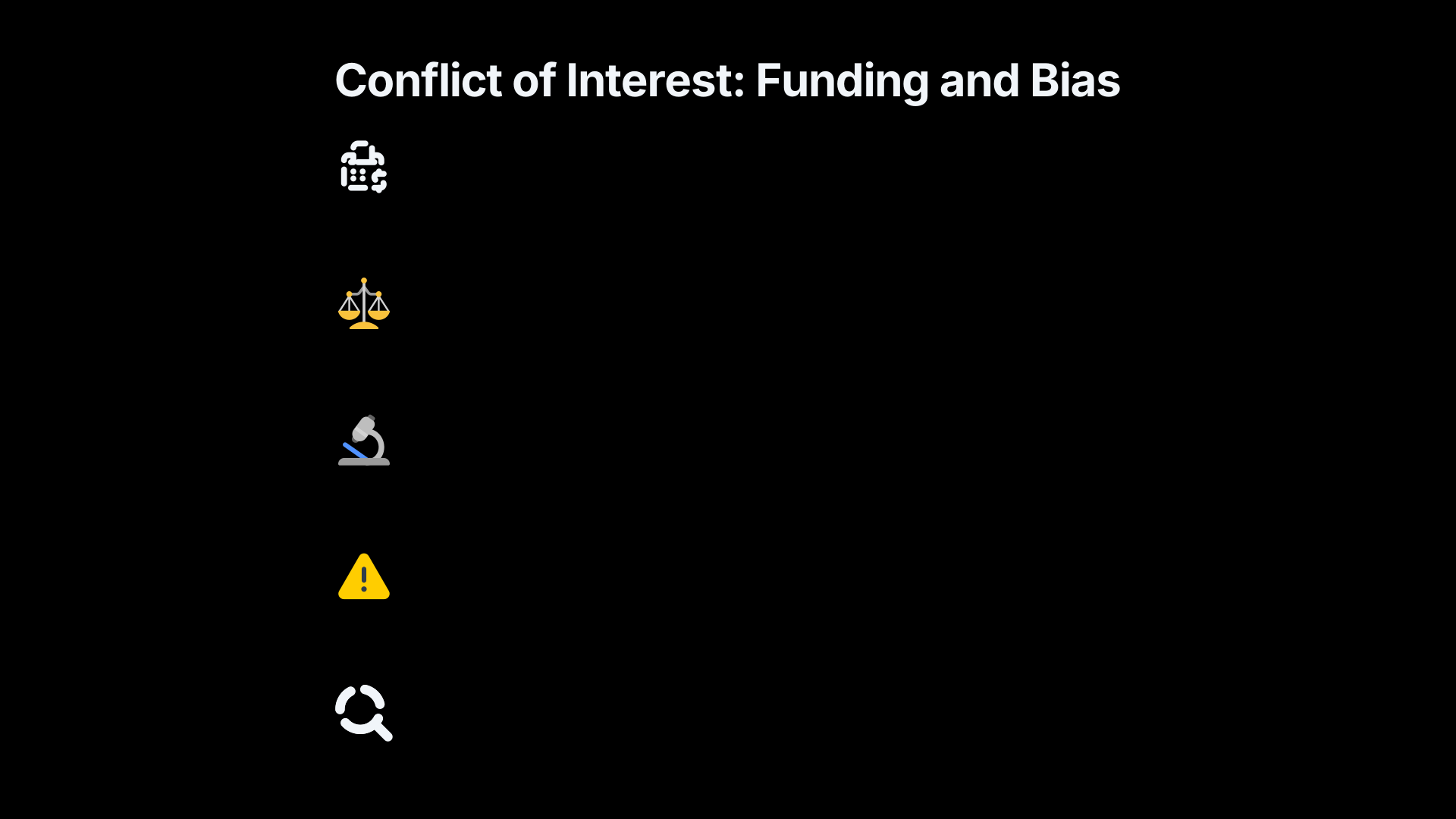
When a claim can be assessed directly through evidence, attacking the speaker is usually irrelevant. Suppose someone argues that a bridge design is unsafe and provides engineering calculations. Whether the speaker is arrogant, unpopular, or politically controversial has no bearing on the calculations themselves. The evidence stands or falls on its own merits. This is the classic setting in which ad hominem attacks become fallacious because they attempt to undermine a conclusion without addressing the supporting reasons.[stanford]plato.stanford.eduStanford Encyclopedia of PhilosophyFallacies - Stanford Encyclopedia of Philosophyby H Hansen · 2015 · Cited by 426 — The ad hominem fall… Encyclopedia of Philosophy[Encyclopedia Britannica]britannica.comEncyclopedia BritannicaAd hominem | Definition, Fallacy, Bias, Examples, & Facts5 days ago — Ad hominem, type of argument or attack that…
By contrast, credibility becomes relevant when the claim depends substantially on testimony. If a witness reports seeing an event, if an expert offers a judgment that cannot be immediately checked by non-specialists, or if a source asserts facts unavailable elsewhere, then reliability matters. Questions about honesty, competence, bias, memory, or conflicts of interest may legitimately affect how much weight the testimony deserves. Philosophical discussions of testimony emphasise that trust in speakers is often part of the justification for believing what they say.[stanford]plato.stanford.eduStanford Encyclopedia of PhilosophyFallacies - Stanford Encyclopedia of Philosophyby H Hansen · 2015 · Cited by 426 — The ad hominem fall… Encyclopedia of Philosophy PhilPapers The difference can be expressed as a practical rule:[philpapers.org]philpapers.orgAudrey Yap, Ad Hominem Fallacies, Bias, and TestimonyAn ad hominem fallacy is committed when an individual employs an irrelevan…
- Evidence-centred claim: evaluate the evidence first; personal attacks are usually irrelevant.
- Testimony-centred claim: evaluate both the testimony and the credibility of the source.
- Mixed claim: credibility may matter, but it cannot replace examination of the evidence.
This explains why the statement “the witness has repeatedly lied under oath” may be relevant in a trial, while “the witness is an unpleasant person” generally is not. Only the former bears directly on reliability.[fallacyfiles.org]fallacyfiles.orgArgumentum ad Hominem - Logical FallacyA lawyer attacking the credibility of a witness in a trial would be engaging in an "ad hominem att…[MN Revisor's Office]revisor.mn.govRevisor's Office Rule 608Evidence of Character and Conduct of WitnessRule 608. Evidence of Character and Conduct of Witness. (a) Opinion and reputation evidence…
When Character Information Becomes Relevant
The common textbook slogan “attack the argument, not the person” is useful but incomplete. Some conclusions are themselves about the trustworthiness of a source. In those cases, information about the person becomes part of the evidence.
Several kinds of personal information may be relevant:
Past honesty. Evidence that a source has previously fabricated information, falsified records, or deliberately deceived others can affect confidence in current testimony. The relevance comes from the connection between past and present reliability, not from moral condemnation.[MN Revisor's Office]revisor.mn.govRevisor's Office Rule 608Evidence of Character and Conduct of WitnessRule 608. Evidence of Character and Conduct of Witness. (a) Opinion and reputation evidence…
Competence and expertise. If a claim depends on specialised knowledge, evidence that a speaker lacks the necessary qualifications or repeatedly makes serious errors may be relevant to assessing credibility. This does not automatically refute the claim, but it affects how much trust the testimony deserves.[stanford]plato.stanford.eduStanford Encyclopedia of PhilosophyFallacies - Stanford Encyclopedia of Philosophyby H Hansen · 2015 · Cited by 426 — The ad hominem fall… Encyclopedia of Philosophy
Bias and incentives. Financial interests, political commitments, personal relationships, or institutional pressures can sometimes create reasons to doubt neutrality. Such considerations do not prove a claim false, but they may justify increased scrutiny.[PhilPapers]philpapers.orgAudrey Yap, Ad Hominem Fallacies, Bias, and TestimonyAn ad hominem fallacy is committed when an individual employs an irrelevan… ScienceDirect The crucial point is that these considerations affect confidence in the source rather than directly disproving the proposition. Confusing tho[sciencedirect.com]sciencedirect.comFormalization of the ad hominem argumentation schemeby D Walton · 2010 · Cited by 22 — The circumstantial ad hominem argument combines th… se two functions is one of the most common reasoning errors in credibility disputes.
Conflicts of Interest and Testimony
Conflicts of interest provide one of the clearest examples of relevant personal criticism.
Imagine a researcher publicly endorsing a medical product while receiving substantial funding from the company that manufactures it. Mentioning the financial relationship is not necessarily a fallacious ad hominem attack. The relationship may be relevant because it creates a potential incentive that readers should consider when evaluating the testimony.[PhilPapers]philpapers.orgAudrey Yap, Ad Hominem Fallacies, Bias, and TestimonyAn ad hominem fallacy is committed when an individual employs an irrelevan…[Law Explores]lawexplores.comLaw Explores Ad Hominem Fallacies and Epistemic CredibilityAd Hominem Fallacies and Epistemic Credibility | - Law Explorer26 Oct 2015 — An ad hominem fallacy is an error in logical reasoning in wh…
However, identifying a conflict of interest does not automatically defeat the underlying claim. This is where reasoning often goes wrong. The existence of a financial incentive may justify caution, requests for independent verification, or closer examination of the evidence. It does not logically establish that the conclusion is false.
A relevance test can help distinguish legitimate concern from fallacious reasoning:
- Relevant: “The expert receives funding from the company, so we should examine the evidence carefully and seek independent confirmation.”
- Fallacious: “The expert receives funding from the company, therefore the conclusion must be false.”
The first treats the conflict as evidence about credibility. The second treats it as proof against the claim itself. Philosophers discussing circumstantial ad hominem arguments have repeatedly highlighted this distinction. Circumstances may reveal possible bias without determining the truth or falsity of the conclusion.[ScienceDirect]sciencedirect.comFormalization of the ad hominem argumentation schemeby D Walton · 2010 · Cited by 22 — The circumstantial ad hominem argument combines th…
Historical Shifts in Understanding Ad Hominem
Older treatments of logic often classified ad hominem arguments as straightforward fallacies. More recent work in informal logic and argumentation theory has drawn a more nuanced picture. Scholars increasingly distinguish between personal attacks that are irrelevant and those that legitimately challenge the credibility of a source whose testimony is central to the dispute.[stanford]plato.stanford.eduStanford Encyclopedia of PhilosophyFallacies - Stanford Encyclopedia of Philosophyby H Hansen · 2015 · Cited by 426 — The ad hominem fall… Encyclopedia of Philosophy[Stanford Encyclopedia of Philosophy]plato.stanford.eduStanford Encyclopedia of PhilosophyFallacies - Stanford Encyclopedia of Philosophyby H Hansen · 2015 · Cited by 426 — The ad hominem fall…
This shift emerged partly because many real arguments involve testimony rather than purely deductive proof. Courts evaluate witnesses. Journalists evaluate sources. Scientists assess potential conflicts of interest. Voters assess the trustworthiness of political leaders. In all these settings, credibility judgments are unavoidable.
The modern view does not abandon the concept of ad hominem fallacy. Instead, it narrows the category. The mistake is not mentioning personal characteristics. The mistake is treating irrelevant personal characteristics as if they settled the issue.[PhilPapers]philpapers.orgAudrey Yap, Ad Hominem Fallacies, Bias, and TestimonyAn ad hominem fallacy is committed when an individual employs an irrelevan…[Law Explores]lawexplores.comLaw Explores Ad Hominem Fallacies and Epistemic CredibilityAd Hominem Fallacies and Epistemic Credibility | - Law Explorer26 Oct 2015 — An ad hominem fallacy is an error in logical reasoning in wh…
How to Recover the Argument After a Personal Attack
Once a discussion turns personal, it is often possible to restore focus by asking what role the criticism is supposed to play.
A few questions are especially useful:
- Does this criticism affect the evidence or only the speaker?
- Is the claim being evaluated through testimony, or can it be independently checked?
- Does the personal information bear directly on honesty, expertise, memory, or bias?
- Even if the criticism is relevant, does it merely reduce confidence or actually refute the claim?
These questions separate legitimate credibility challenges from attempts to avoid the substance of an argument. They also prevent the opposite error of dismissing all source-based criticism as fallacious. A witness’s history of dishonesty, an expert’s undisclosed financial interest, or a source’s demonstrated lack of competence may be relevant considerations. The mistake lies in allowing those considerations to replace examination of the actual evidence. PMC[3fallacyfiles.org]fallacyfiles.orgArgumentum ad Hominem - Logical FallacyA lawyer attacking the credibility of a witness in a trial would be engaging in an "ad hominem att…[MN Revisor's Office]revisor.mn.govRevisor's Office Rule 608Evidence of Character and Conduct of WitnessRule 608. Evidence of Character and Conduct of Witness. (a) Opinion and reputation evidence…
The Core Relevance Test
In credibility disputes, personal criticism becomes relevant only when the conclusion depends partly on trustworthiness, testimony, expertise, or potential bias. When the issue is the quality of evidence itself, personal attacks usually miss the target. The strongest reasoning therefore asks two separate questions: “Can this source be trusted?” and “What does the evidence show?” Keeping those questions distinct prevents both naïve trust and unfair dismissal. It also explains why some ad hominem arguments are legitimate challenges to credibility while others remain classic logical fallacies. [Stanford Encyclopedia of Philosophy+3Stanford Encyclopedia of Philosophy+3Stanford Encyclopedia of Philosophy]
Amazon book picks
Further Reading
Books and field guides related to When Character Attacks Are Actually Relevant. Use these as the next step if you want deeper reading beyond the article.
A Rulebook for Arguments
Directly explains relevance, evidence, credibility, and common argument errors including ad hominem issues.
Being Logical
Covers how to evaluate claims, sources, and reasoning without relying on personal attacks.
Attacking Faulty Reasoning
Addresses relevance standards and distinguishes legitimate credibility concerns from fallacious attacks.
eBay marketplace picks
Marketplace Samples
Example marketplace items related to this page. Use the search link to explore similar finds on eBay.




Endnotes
1.
Source: plato.stanford.edu
Link:https://plato.stanford.edu/entries/fallacies/
Source snippet
Stanford Encyclopedia of PhilosophyFallacies - Stanford Encyclopedia of Philosophyby H Hansen · 2015 · Cited by 426 — The ad hominem fall...
2.
Source: plato.stanford.edu
Link:https://plato.stanford.edu/entries/logic-informal/
Source snippet
Stanford Encyclopedia of PhilosophyInformal Logic - Stanford Encyclopedia of Philosophyby L Groarke · 1996 · Cited by 97 — Treated in thi...
3.
Source: plato.stanford.edu
Title: testimony episprob
Link:https://plato.stanford.edu/entries/testimony-episprob/
Source snippet
However, there is disagreement about where exactly...Read more...
4.
Source: philpapers.org
Link:https://philpapers.org/rec/YAPAHF
Source snippet
Audrey Yap, Ad Hominem Fallacies, Bias, and TestimonyAn ad hominem fallacy is committed when an individual employs an irrelevan...
5.
Source: britannica.com
Link:https://www.britannica.com/topic/ad-hominem
6.
Source: fallacyfiles.org
Link:https://www.fallacyfiles.org/adhomine.html
Source snippet
Argumentum ad Hominem - Logical FallacyA lawyer attacking the credibility of a witness in a trial would be engaging in an "ad hominem att...
7.
Source: sciencedirect.com
Link:https://www.sciencedirect.com/science/article/pii/S1570868308000384
Source snippet
Formalization of the ad hominem argumentation schemeby D Walton · 2010 · Cited by 22 — The circumstantial ad hominem argument combines th...
8.
Source: Wikipedia
Title: Ad hominem
Link:https://en.wikipedia.org/wiki/Ad_hominem
9.
Source: pmc.ncbi.nlm.nih.gov
Link:https://pmc.ncbi.nlm.nih.gov/articles/PMC5790247/
Source snippet
In regards to the first point, ad hominem attacks have been described...Read more...
10.
Source: plato.stanford.edu
Link:https://plato.stanford.edu/entries/argument/
Source snippet
and Argumentationby C Dutilh Novaes · 2021 · Cited by 105 — Argumentation can be defined as the communicative activity of producing and e...
11.
Source: ilms.academy
Link:https://www.ilms.academy/blog/ad-hominem-explained-a-common-logical-fallacy-in-law-and-[debate
Source snippet
Ad Hominem Explained: A Common Logical Fallacy in Law...3 Nov 2025 — Ad hominem arguments that attack a witness's character without subs...
12.
Source: Wikipedia
Title: [Tu quoque]({{ ‘tu-quoque/’ | relative_url }})
Link:https://en.wikipedia.org/wiki/Tu_quoque
Source snippet
Tu quoqueTu quoque, [a] literally "you, too", is a rhetorical technique that intends to discredit the opponent's argument being incon...
13.
Source: philosophy.institute
Link:https://philosophy.institute/logic/understanding-fallacies-reasoning-errors/
Source snippet
Understanding Fallacies: Errors in Reasoning9 Dec 2025 — The fallacy arises when personal characteristics are used as a substitute for en...
14.
Source: iep.utm.edu
Link:https://iep.utm.edu/fallacy/
Source snippet
Internet Encyclopedia of PhilosophyFallaciesThe major difficulty with labeling a piece of reasoning an Ad Hominem Fallacy is deciding whe...
15.
Source: lawexplores.com
Title: Law Explores Ad Hominem Fallacies and Epistemic Credibility
Link:https://lawexplores.com/ad-hominem-fallacies-and-epistemic-credibility/
Source snippet
Ad Hominem Fallacies and Epistemic Credibility | - Law Explorer26 Oct 2015 — An ad hominem fallacy is an error in logical reasoning in wh...
16.
Source: revisor.mn.gov
Title: Revisor’s Office Rule 608
Link:https://www.revisor.mn.gov/court_rules/rule/ev-608/pdf/
Source snippet
Evidence of Character and Conduct of WitnessRule 608. Evidence of Character and Conduct of Witness. (a) Opinion and reputation evidence...
17.
Source: seop.illc.uva.nl
Title: evidence legal
Link:https://seop.illc.uva.nl/entries/evidence-legal/
Source snippet
Stanford Encyclopedia of PhilosophyThe Legal Concept of Evidenceby HL Ho · 2015 · Cited by 102 — This entry focuses on the modern concept...
18.
Source: scribbr.com
Title: ad hominem fallacy
Link:https://www.scribbr.com/fallacies/ad-hominem-fallacy/
Source snippet
Definition & Examples21 Apr 2023 — Ad hominem fallacy is a group of argumentation strategies that focus on the person making an argument...
19.
Source: ebsco.com
Link:https://www.ebsco.com/research-starters/religion-and-philosophy/ad-hominem
20.
Source: legal-resources.uslegalforms.com
Title: ad hominem
Link:https://legal-resources.uslegalforms.com/a/ad-hominem
Source snippet
Hominem: A Deep Dive into Its Legal Meaning and UsageThis tactic is often employed when someone lacks a strong case and seeks to undermin...
Additional References
21.
Source: researchgate.net
Link:https://www.researchgate.net/post/Is-it-ever-OK-to-include-ad-hominem-information-about-an-author-whose-work-you-are-critiquing
Source snippet
Is it ever OK to include "ad hominem" information about an...28 Dec 2013 — -- i.e., so long as you're not resting your argument on the a...
22.
Source: journals.ku.edu
Link:https://journals.ku.edu/auslegung/article/download/13176/12472/25807
Source snippet
Rejection of Testimony and the...If not by name but by content, Cudmore clearly recognizes the ad hominem specter raised by previous con...
23.
Source: philosophy.hku.hk
Link:https://philosophy.hku.hk/think/fallacy/list.php
Source snippet
hku.hk[F06] List of fallaciesHere are some examples of common fallacies: ad hominem. A theory is discarded not because of any evidence ag...
24.
Source: evidenceattrial.com
Link:https://www.evidenceattrial.com/blog/the-admissibility-of-character-evidence-demystifying-the-rules-and-their-application
Source snippet
The Admissibility of Character Evidence: Demystifying...1 Apr 2018 — Character evidence is similar to hearsay in that there is a general...
25.
Source: elilyons.medium.com
Title: the cases when ad hominem arguments are not a fallacy c49e49316710
Link:https://elilyons.medium.com/the-cases-when-ad-hominem-arguments-are-not-a-fallacy-c49e49316710
Source snippet
Cases When Ad Hominem Arguments are Not a FallacyAd hominem arguments work when they represent a collection of events so complex, that al...
26.
Source: philosophy.lander.edu
Link:https://philosophy.lander.edu/logic/person.html
Source snippet
Philosophy Home PageAd HominemThe ad hominem fallacy occurs whenever the character or circumstances of an individual who is advancing an...
27.
Source: faculty.fiu.edu
Link:https://faculty.fiu.edu/~harrisk/Notes/Critical%20Thinking/CT%20Lecture%2015%20Fallacies%20of%20Relevance%20-%20Red%20Herrings.htm
Source snippet
Lecture 15 Fallacies of Relevance: (Red Herrings)Ad Hominem (tu quoque, abusive, circumstantial) There are three main types of ad homine...
28.
Source: facebook.com
Link:https://www.facebook.com/groups/968580683281312/posts/1076238102515569/
Source snippet
the basis of an irrelevant premise. But ad hominem...Read more...
29.
Source: jstor.org
Title: Better Account of the Ad Hominem
Link:https://www.jstor.org/stable/23014772
Source snippet
A Reply to...by G JASON · 2011 · Cited by 7 — the witness biased? Is the witness's testimony consistent? Is there cor roborating evidenc...
30.
Source: cambridge.org
Link:https://www.cambridge.org/core/journals/journal-of-the-american-philosophical-[association
Source snippet
Cambridge University Press & AssessmentThree Puzzles with Ad Hominem Argumentsby S AIKIN · 2025 · Cited by 2 — The ad hominem appears to...
Topic Tree