Within Loaded Words
Are the Labels Doing More Than the Evidence?
Words such as 'corrupt', 'humane' or 'reckless' can push a conclusion before the supporting facts are established.
On this page
- Condemnation before proof
- Praise before proof
- Testing claims with neutral wording
Page outline Jump by section
Introduction
Emotionally charged labels become a problem when they do argumentative work before the evidence has done its job. Words such as “corrupt”, “humane”, “reckless”, “extremist”, “heroic”, or “dangerous” do more than describe. They carry approval, condemnation, fear, admiration, or suspicion. In debates, news coverage, politics, workplace disputes, and everyday disagreements, these labels can quietly encourage a conclusion before the underlying facts have been established.
 This does not mean strong language is always wrong. Sometimes the evidence genuinely supports strong descriptions. The fallacy risk arises when the label arrives first and the proof arrives later—or never arrives at all. In that situation, the audience may be persuaded by the emotional force of the wording rather than by a demonstrated case. Research on persuasion and framing shows that emotionally loaded language can significantly influence judgement, while studies of framing demonstrate that the way information is presented can shape how people think, feel, and act.[Sage Journals]journals.sagepub.comSage JournalsThe Psychology of Framing: How Everyday Language…by SJ Flusberg · 2024 · Cited by 91 — Framing a discussion one way or an…[PubMed]pubmed.ncbi.nlm.nih.govPersuasion, Emotion, and Language: The Intent to…by MD Rocklage · 2018 · Cited by 175 — This work revealed that the intent to pe…[Association for Psychological Science]psychologicalscience.orgAssociation for Psychological SciencePersuasion, Emotion, and Language: The Intent to…This research examined the possibility that peop…
Are the Labels Doing More Than the Evidence?
A useful question for critical thinking is simple: if the emotionally charged label were replaced with neutral wording, would the argument still be convincing?
Consider these pairs:
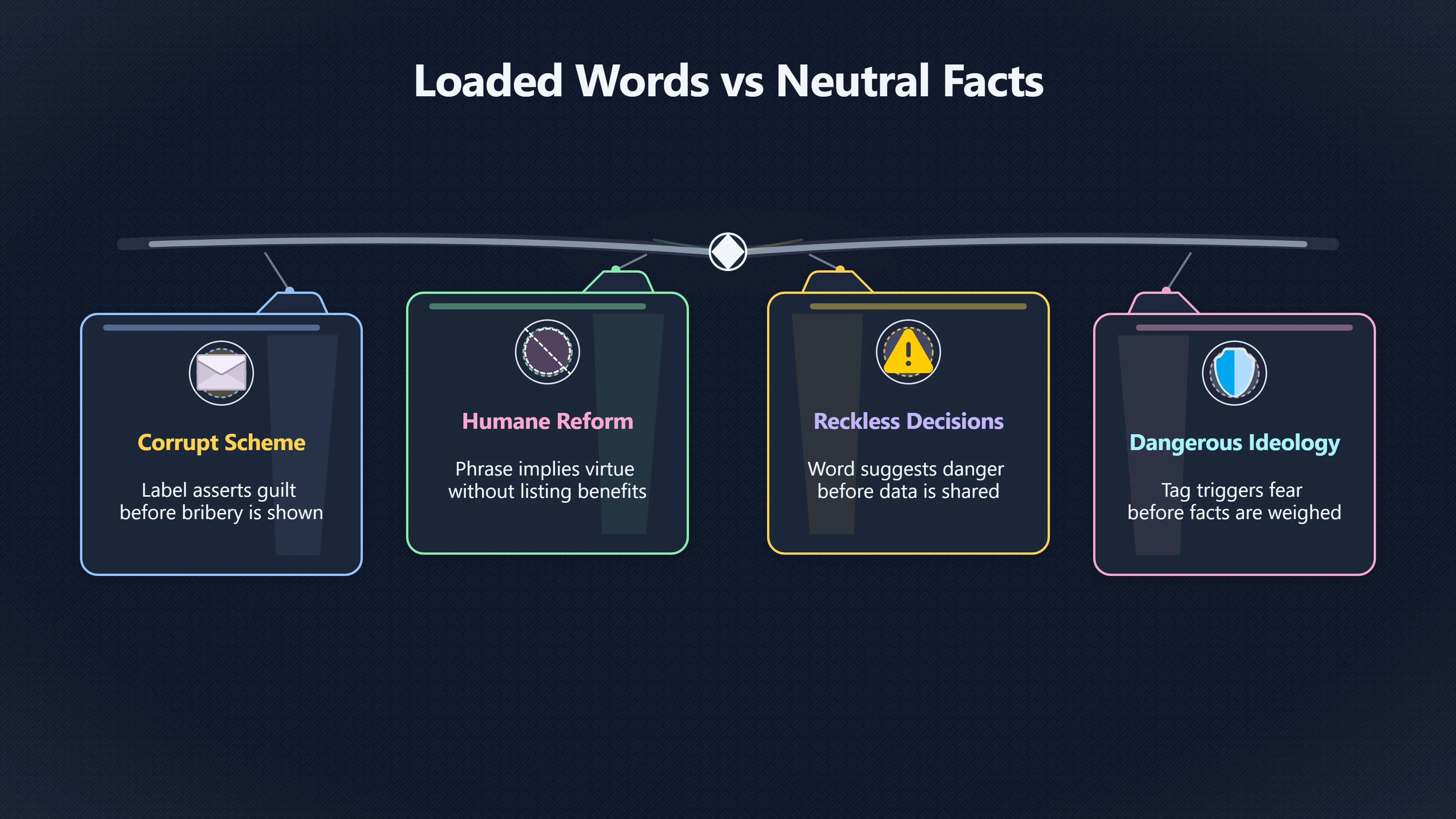
- “This corrupt scheme must be stopped” versus “This programme should be examined.”
- “This humane reform deserves support” versus “This reform has been proposed.”
- “These reckless decisions caused the problem” versus “These decisions contributed to the problem.”
In each case, the first version contains an evaluative judgement embedded in the description. The audience is encouraged to accept that judgement before being shown why it is warranted.
The mechanism is subtle because labels often appear to be factual descriptions. Yet many labels are actually conclusions. Calling an action “corrupt” is not merely reporting an event; it is asserting that improper conduct occurred. Calling a policy “humane” is not merely identifying its existence; it is asserting a moral evaluation. The label therefore smuggles part of the argument into the premise.
Research on persuasion suggests that people naturally increase the emotional content of their language when trying to convince others. Experiments have found that the intention to persuade tends to make communicators use more emotionally charged words, even in situations where emotional appeals may not be the most effective strategy.[PubMed]pubmed.ncbi.nlm.nih.govPersuasion, Emotion, and Language: The Intent to…by MD Rocklage · 2018 · Cited by 175 — This work revealed that the intent to pe…
Condemnation Before Proof
The most obvious form of this fallacy uses negative labels.
A speaker may refer to:
- a “corrupt administration”
- a “fraudulent project”
- a “dangerous ideology”
- a “reckless manager”
- a “dishonest witness”
Such descriptions may eventually prove accurate. The problem is not the possibility that they are true. The problem is treating them as established before presenting supporting evidence.
Imagine a discussion about a public contract. If a commentator repeatedly calls the contract “corrupt” before demonstrating bribery, conflicts of interest, or unlawful conduct, listeners may begin evaluating every subsequent fact through the lens of assumed guilt. The label creates a psychological starting point. Evidence is no longer assessed from a neutral position; it is interpreted in light of the condemnation already supplied.
This can be especially powerful because negative labels trigger moral reactions. Once a person or policy has been categorised as corrupt, reckless, or dangerous, many audiences feel less need to examine details. The emotional judgement appears settled.
A practical warning sign is that the label appears easier to defend than the underlying claim. When asked why something is “corrupt”, the speaker may offer only suspicion, association, or dissatisfaction rather than evidence that actually establishes corruption.
Praise Before Proof
Positive labels can distort reasoning just as easily.
People often notice hostile rhetoric more readily than flattering rhetoric, yet favourable descriptions can also bypass critical evaluation.
Examples include:
- “a compassionate policy”
- “a courageous decision”
- “a humane reform”
- “a visionary leader”
- “a common-sense solution”
Each phrase encourages approval before the supporting case has been made.
Calling a proposal “humane” suggests moral virtue. Calling a leader “visionary” implies unusual insight. Calling a policy “common-sense” implies that disagreement is unreasonable. The audience receives a recommendation disguised as a description.
This matters because positive labels can discourage scrutiny. If a programme is repeatedly introduced as compassionate, critics may feel pressure to defend themselves against the implication that they oppose compassion rather than simply questioning effectiveness. The emotional framing changes the burden of discussion.
The persuasive power of such framing is consistent with broader psychological research showing that linguistic framing affects judgement across domains including politics, health communication, journalism, business, and law. How a proposal is described can influence reactions independently of the underlying facts.[PubMed]pubmed.ncbi.nlm.nih.govPersuasion, Emotion, and Language: The Intent to…by MD Rocklage · 2018 · Cited by 175 — This work revealed that the intent to pe…[Reed College]reed.eduReed CollegeHow Everyday Language Shapes the Way We Think, Feel…by SJ Flusberg · 2024 · Cited by 91 — Throughout the article, we emph…
Why Labels Feel Like Evidence
Emotionally charged labels are effective because they compress a large conclusion into a single word.
Instead of arguing:
- Certain actions occurred.
- Those actions violated established standards.
- Therefore the conduct was corrupt.
A speaker can simply say:
“The corrupt conduct must stop.”
The reasoning becomes hidden inside the label.
This shortcut reduces the audience’s need to analyse intermediate steps. Rather than evaluating evidence, people react to the emotional and moral associations attached to the word itself.
Studies of framing emphasise that communicators must choose what to say and how to say it. These framing choices influence interpretation by highlighting some aspects of a situation while downplaying others. A charged label can therefore shape judgement before formal argument begins. PubMed[Sage Journals]journals.sagepub.comSage JournalsThe Psychology of Framing: How Everyday Language…by SJ Flusberg · 2024 · Cited by 91 — Framing a discussion one way or an…
The effect is not limited to politics. It appears in workplace evaluations, legal disputes, consumer advertising, social media discussions, and personal conflicts. Any context involving persuasion creates incentives to choose language that nudges judgement.
When Strong Labels Are Justified
Avoiding this fallacy does not require avoiding strong language.
Some conduct is genuinely corrupt. Some decisions are genuinely reckless. Some policies may reasonably be described as humane or cruel.
The key distinction is timing and support.
A strong label is justified when:
- the relevant evidence has been presented;
- the criteria for the label are clear;
- the evidence actually satisfies those criteria;
- alternative interpretations have been considered.
In those circumstances, the label functions as a conclusion drawn from evidence rather than a substitute for evidence.
For example, after documenting bribery, hidden payments, and abuse of public office, describing conduct as corruption may be entirely appropriate. The word summarises demonstrated facts rather than replacing them.

Testing Claims with Neutral Wording
One of the most reliable ways to detect emotionally charged labels is to perform a neutrality test.
Replace the evaluative term with a descriptive one and examine what remains.
Examples:
Charged wordingNeutral wordingcorrupt schemeproposed schemereckless cutsbudget cutshumane reformpolicy reformextremist proposalproposalcourageous decisiondecision
After the substitution, ask:
- What evidence supports the original label?
- Is the label a proven conclusion or merely an assertion?
- Would a reasonable opponent accept the description?
- Does the argument still work without the emotional wording?
If the argument collapses once the label is removed, the label was probably carrying more persuasive weight than the evidence.
This method resembles the broader critical-thinking practice of separating claims from framing. In discussions of loaded questions and presuppositions, philosophers often recommend identifying the hidden assumption before addressing the claim itself. The same principle applies here: identify the judgement embedded in the label, then ask whether it has been independently established. [Philosophy Home Page+3Internet Encyclopedia of Philosophy+3Internet Encyclopedia of Philosophy]
The Real Risk
The danger of emotionally charged labels is not emotion itself. Human communication inevitably contains emotion, values, and moral judgement. The risk is that a label can make a conclusion feel settled before the supporting case has been examined.
When readers or listeners encounter words such as “corrupt”, “heroic”, “reckless”, “humane”, or “dangerous”, the most useful response is not immediate agreement or disagreement. It is a question:
What evidence has earned that label?
If the evidence clearly supports it, the label may be accurate. If the label arrives before the proof, the wording may be steering judgement rather than helping establish the truth.
eBay marketplace picks
Marketplace Samples
Example marketplace items related to this page. Use the search link to explore similar finds on eBay.





Endnotes
1.
Source: reed.edu
Link:https://www.reed.edu/psychology/thought-lab/assets/publications/Flusberg%2C-Holmes%2C-Thibodeau%2C-Nabi%2C-Matlock-2024—Psychological-Science-in-the-Public-Interest.pdf
Source snippet
Reed CollegeHow Everyday Language Shapes the Way We Think, Feel...by SJ Flusberg · 2024 · Cited by 91 — Throughout the article, we emph...
2.
Source: encyclopedia.com
Link:https://www.encyclopedia.com/humanities/encyclopedias-almanacs-transcripts-and-maps/presupposition
Source snippet
PresuppositionAccording to the presupposition thesis, both (2) and (3) presuppose (4). Hence, if (4) is false, then (2) and (3) must lack...
3.
Source: pubmed.ncbi.nlm.nih.gov
Link:https://pubmed.ncbi.nlm.nih.gov/29543563/
Source snippet
Persuasion, Emotion, and Language: The Intent to...by MD Rocklage · 2018 · Cited by 175 — This work revealed that the intent to pe...
4.
Source: psychologicalscience.org
Link:https://www.psychologicalscience.org/journals/psychological-science/0956797617744797/
Source snippet
Association for Psychological SciencePersuasion, Emotion, and Language: The Intent to...This research examined the possibility that peop...
5.
Source: pubmed.ncbi.nlm.nih.gov
Title: That is, we must decide how to frame the message
Link:https://pubmed.ncbi.nlm.nih.gov/39704149/
Source snippet
How Everyday Language Shapes the Way We Think, Feel...by SJ Flusberg · 2024 · Cited by 91 — When we use language to communicate, w...
6.
Source: journals.sagepub.com
Link:https://journals.sagepub.com/doi/abs/10.1177/15291006241246966
Source snippet
Sage JournalsThe Psychology of Framing: How Everyday Language...by SJ Flusberg · 2024 · Cited by 91 — Framing a discussion one way or an...
7.
Source: journals.sagepub.com
Title: Sage Journals Psychological Science in the Public Interest
Link:https://journals.sagepub.com/toc/psia/25/3
Source snippet
When we use language to communicate, we must choose what to say, what not to say, and how to say it. That is, we must decide how...Read...
8.
Source: journals.sagepub.com
Link:https://journals.sagepub.com/doi/10.1177/15291006241246966
Source snippet
Sage JournalsThe Psychology of Framing: How Everyday Language...20 Dec 2024 — Throughout the article, we emphasize the [relevance]({{ 'relevance/' | relative_url }}) of fram...
9.
Source: britannica.com
Link:https://www.britannica.com/topic/fallacy
Source snippet
Logic, Definition & Examples13 Feb 2026 — An argument may be fallacious in three ways: in its material content, through a misstatement of...
Additional References
10.
Source: logicallyfallacious.com
Link:https://www.logicallyfallacious.com/logicalfallacies/Complex-Question-Fallacy
Source snippet
Complex Question FallacyDescription: A question that has a presupposition built in, which implies something but protects the one asking t...
11.
Source: rep.routledge.com
Link:https://www.rep.routledge.com/articles/thematic/questions/v-1
Source snippet
Routledge Encyclopedia of PhilosophyQuestionsMost hold that each question has an assertive core or presupposition that is implied by each...
12.
Source: iep.utm.edu
Link:https://iep.utm.edu/page/3/?cat=-
Source snippet
Internet Encyclopedia of PhilosophyFallaciesThe Fallacy of Complex Question is a form of Begging the Question. Composition. The Compositi...
13.
Source: iep.utm.edu
Link:https://iep.utm.edu/fallacy/
Source snippet
Internet Encyclopedia of PhilosophyFallaciesYou use this fallacy when you frame a question so that some controversial presupposition is m...
14.
Source: researchgate.net
Link:https://www.researchgate.net/publication/387275543_The_Psychology_of_Framing_How_Everyday_Language_Shapes_the_Way_We_Think_Feel_and_Act
Source snippet
(2024) have crafted a comprehensive review examining the effects of linguistic framing on health, social, political, and interpersonal be...
15.
Source: answers-in-reason.com
Title: Category Errors and Meaningless Propositions: Why Bricks Can’t Be
Link:https://www.answers-in-reason.com/philosophy/epistemology/logic/fallacies/category-error/category-errors-and-meaningless-propositions-why-bricks-cant-be-happy/
Source snippet
October 11, 2024 — The intent behind loaded questions is typically to throw the respondent off guard, potentially making them reveal a se...
Published: October 11, 2024
16.
Source: kellogg.northwestern.edu
Title: persuasion emotion and language the intent to persuade transforms
Link:https://www.kellogg.northwestern.edu/academics-research/research/detail/2018/persuasion-emotion-and-language-the-intent-to-persuade-transforms/
Source snippet
2018. Persuasion, Emotion, and Language: The Intent to Persuade Transforms Language via Emotionality. Psychological Science. (5)749-760.R...
17.
Source: philosophy.lander.edu
Link:https://philosophy.lander.edu/logic/complex.html
Source snippet
Philosophy Home PageFallacy of Complex QuestionThe complex question fallacy is usually resolved by challenging the false or dubious presu...
18.
Source: psychologicalscience.org
Title: 25, No. 3) PDF & HTML (Available to the Public).Read more
Link:https://www.psychologicalscience.org/publications/pspi/pspi-archive
Source snippet
Psychological Science in the Public Interest ArchiveThe Psychology of Framing: How Everyday Language Shapes the Way We Think, Feel, and A...
19.
Source: researchgate.net
Title: 283236860 Effects of emotional expressions on persuasion
Link:https://www.researchgate.net/publication/283236860_Effects_of_emotional_expressions_on_persuasion
Source snippet
(PDF) Effects of emotional expressions on persuasion29 Oct 2015 — Emotionally charged messages can distort truth perception, and recent r...
Topic Tree