Within Novelty
How to Compare Old and New Fairly
The fair test is not whether an option is old or new, but what each one improves, preserves, risks, and costs.
On this page
- How appeal to novelty and appeal to tradition make matching mistakes
- What to measure before replacing an existing system
- How baselines, transition costs, and failure criteria prevent hype driven decisions
Page outline Jump by section
Introduction
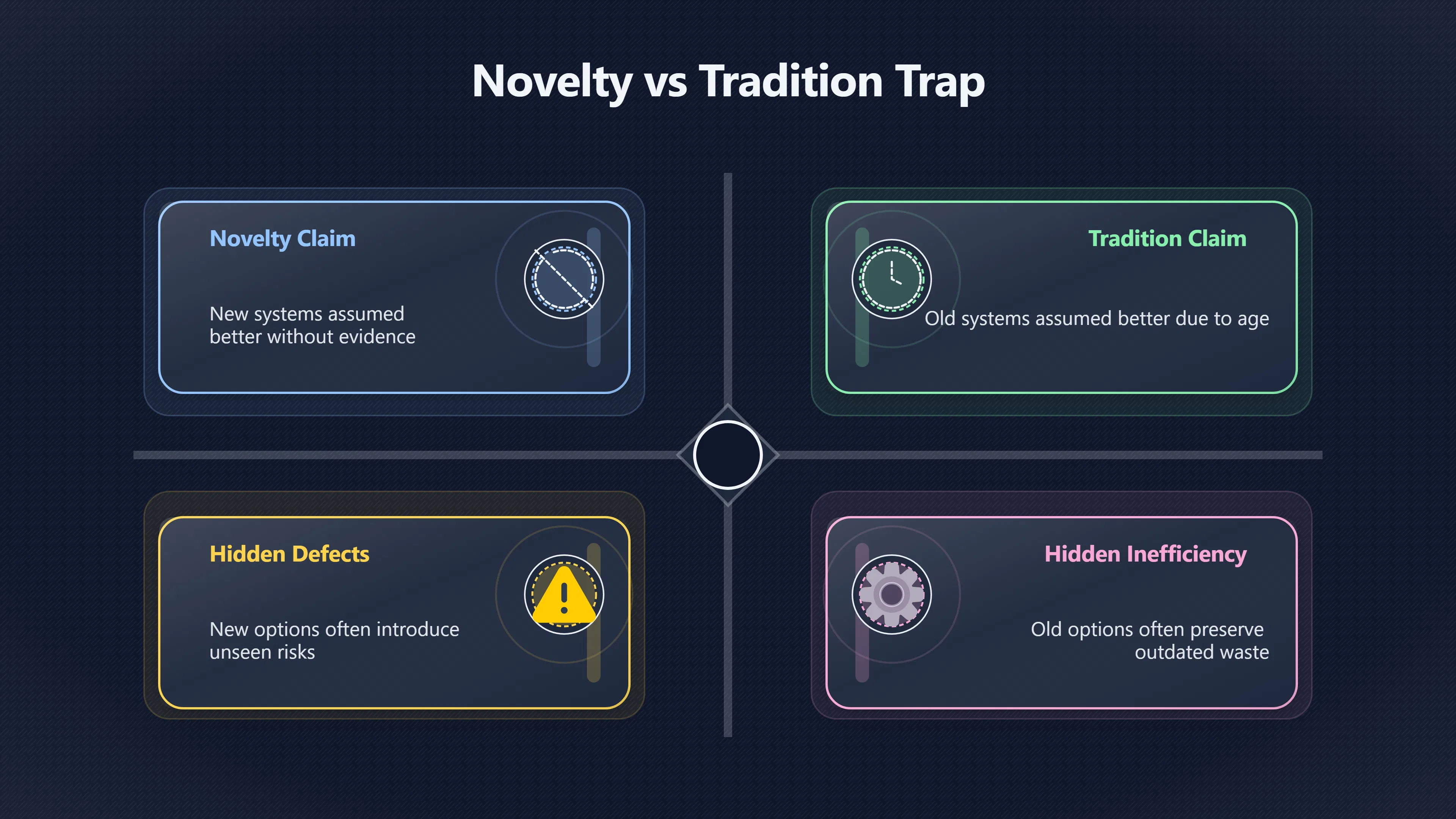
When people debate whether to keep an existing system or adopt a new one, they often fall into a symmetrical pair of errors. The appeal to novelty assumes that the new option is better because it is new. The appeal to tradition assumes that the existing option is better because it has been around longer. Both mistakes substitute age for evidence. A fair comparison asks a different question: what does each option improve, preserve, risk, and cost?
 In practice, better decisions come from comparing outcomes against a clear baseline, identifying transition costs, and defining success and failure before implementation begins. Whether the subject is public policy, digital government, healthcare processes, education reform, or organisational technology, the strongest arguments are grounded in measurable effects rather than assumptions about modernity or tradition.[Wikipedia]WikipediaAppeal to noveltyAppeal to novelty[2effectiviology.com]effectiviology.commed to be either good or better than something else, simply because it's perceived…Read more…
How Appeal to Novelty and Appeal to Tradition Make Matching Mistakes
The appeal to novelty and the appeal to tradition appear to be opposites, but they share the same logical flaw. Both treat a historical fact as proof of quality.
The appeal to novelty follows a pattern such as: “This policy is new, therefore it is better.” The appeal to tradition follows the mirror image: “This policy has worked for years, therefore it is better.” Neither conclusion follows from the premise. New systems can introduce hidden defects, while long-established systems can preserve inefficiency. Age alone does not establish effectiveness.[Wikipedia]WikipediaAppeal to noveltyAppeal to novelty[2effectiviology.com]effectiviology.commed to be either good or better than something else, simply because it's perceived…Read more…
A useful way to expose the error is to remove references to age entirely. If a proposal cannot explain its advantages without words such as “modern”, “innovative”, “next-generation”, “traditional”, or “time-tested”, the argument may be relying more on symbolism than evidence.
The challenge is that both biases appeal to genuine human tendencies. People are often attracted to innovation because it promises improvement, while others prefer existing arrangements because familiar systems feel less risky. Research on status quo bias shows that individuals frequently favour existing options even when alternatives may offer benefits. At the same time, novelty bias can lead people to overestimate the value of change before results are demonstrated.[Springer]link.springer.comHow to measure the status quo bias?A review of current…by ME Godefroid · 2023 · Cited by 143 — The Status Quo Bias (SQB) describes an individual's preference to avoid ch…[The Decision Lab]thedecisionlab.comStatus Quo BiasThe status quo bias describes our preference for the current state of affairs, resulting in resistance to change.Read more…
A fair comparison therefore requires resisting both impulses simultaneously.
What to Measure Before Replacing an Existing System
The central implementation question is not whether a replacement looks promising. It is whether it performs better than the current baseline.
Before replacing an existing policy, process, or technology, decision-makers should identify measurable criteria in advance:
- Effectiveness: Does the new option produce better outcomes?
- Reliability: Does it fail less often or recover more quickly?
- Cost: What are the acquisition, maintenance, and operating costs?
- Accessibility: Does it improve access for intended users?
- Safety and risk: Does it reduce harm or introduce new vulnerabilities?
- Scalability: Can it perform adequately under real-world demand?
- User impact: Does it make work easier or create additional burdens?
The baseline matters because improvements are often selective. A new system may improve one metric while worsening another. A digital platform might increase speed but reduce transparency. A policy reform might lower administrative costs while creating new compliance burdens. Judging only the advertised benefit creates an unfair comparison because it ignores trade-offs.[Wikipedia]WikipediaAppeal to noveltyAppeal to novelty
Large-scale digital transformation programmes illustrate this point. International organisations such as the OECD emphasise measurement frameworks precisely because modernisation efforts must be evaluated against defined objectives rather than assumed to succeed simply because they involve newer technologies. What matters is not the presence of digital tools but whether they improve outcomes that can actually be measured.[OECD]oecd.orgcomponent 3The OECD Going Digital Measurement Roadmap 202613 Mar 2026 — The OECD Going Digital Measurement Roadmap (the Roadmap) aims to support…[OECD]oecd.orgMeasuring the Digital TransformationA Roadmap for the Future provides new insights into the state of the digital transformation by mappin…
Looking Beyond Headline Benefits
Many replacement proposals focus attention on their strongest feature.
For example:
- A new information system may promise faster processing.
- A new public service platform may promise convenience.
- A new organisational workflow may promise automation.
- A new policy framework may promise innovation.
These claims may be true, but implementation decisions require a broader assessment. Faster processing may come with training costs. Greater automation may create new points of failure. Increased convenience for one group may impose complexity on another.
A fair comparison asks whether the overall package produces better results than the existing alternative, not whether it excels in one carefully selected dimension.
Why Transition Costs Matter
One of the most common mistakes in novelty-driven decision-making is comparing a fully functioning existing system with an idealised future version of the replacement.
Real transitions are rarely frictionless.
Replacing an established system often requires:
- Staff training
- Data migration
- Temporary productivity losses
- New governance procedures
- Technical integration work
- Communication and stakeholder management
- Risk mitigation and contingency planning
These costs are easy to overlook because they occur during implementation rather than after the new system is fully operational.
Research on digital transformation repeatedly finds that successful adoption depends not only on technology itself but also on complementary investments in organisational change, skills, and implementation capacity. A technically superior system can still underperform if transition requirements are underestimated. MDPI[ITU]itu.intA ROADMAP TOWARD A COMMON FRAMEWORK FOR…5 Mar 2020 — in the long term, low-skilled workers are most likely to bear the cost of digital…
This does not mean transition costs should prevent change. It means they should be included in the comparison. Ignoring them creates an unfair advantage for the proposed replacement.

The Cost of Keeping the Current System
Fairness also requires measuring the costs of inaction.
Existing systems may appear inexpensive because their transition costs were paid long ago. However, they may impose ongoing expenses through inefficiency, maintenance requirements, security weaknesses, or declining performance.
Status quo bias can obscure these hidden costs by making the current arrangement seem normal or inevitable. Studies of organisational decision-making show that people frequently prefer existing options simply because they are familiar, even when objective improvements are available.[Springer]link.springer.comHow to measure the status quo bias?A review of current…by ME Godefroid · 2023 · Cited by 143 — The Status Quo Bias (SQB) describes an individual's preference to avoid ch… MDPI A balanced assessment therefore compares:[mdpi.com]mdpi.comAre Nations Ready for Digital Transformation?R Chinoracky · 2025 · Cited by 9 — The OECD and World Bank have documented that digital adoption boosts productivity and growth…
- The costs of changing.
- The costs of not changing.
Either side alone provides an incomplete picture.
How Baselines Prevent Hype-Driven Decisions
A baseline is a clear description of current performance before any intervention occurs.
Without a baseline, almost any change can be presented as a success.
Suppose a public agency adopts a new digital service platform. If officials only report that the platform is “modern” or “innovative”, the claim provides little information. A meaningful evaluation compares measurable outcomes before and after implementation, such as processing times, error rates, user satisfaction, operating costs, or service accessibility.
The same principle applies to organisational reforms, educational initiatives, healthcare systems, and regulatory changes. Improvement is meaningful only relative to a known starting point. Measurement frameworks developed for digital transformation and public-sector modernisation place heavy emphasis on establishing indicators precisely because outcomes must be compared against existing performance rather than marketing claims.[OECD]oecd.orgdigital government index 1edec44eDigital government index: Government at a Glance 202519 Jun 2025 — The 2025 edition of Government at a Glance offers a comprehensive over…[OECD]oecd.orgDigital transformationEncompassing the integration of technology into financial services, digital finance is revolutionising how people m…
Baselines also reduce selective reporting. If success criteria are agreed beforehand, advocates cannot simply switch to whichever metric looks best after implementation.
Why Failure Criteria Matter Before Adoption
Another safeguard against appeal-to-novelty reasoning is defining failure in advance.[Wikipedia]WikipediaAppeal to noveltyAppeal to novelty
Organisations often establish success metrics but neglect failure thresholds. As a result, projects can continue long after evidence suggests they are underperforming.
Before implementation begins, decision-makers should specify questions such as:
- What outcomes must improve?
- By how much?
- Over what time period?
- What risks are unacceptable?
- Under what conditions will the project be revised, paused, or reversed?
Predefined failure criteria create accountability. They force advocates of change to demonstrate actual improvement rather than relying on the attractiveness of innovation itself.
They also encourage learning. A replacement that fails against established criteria may still provide useful evidence for future reforms. What matters is that decisions are evaluated against agreed standards rather than defended solely because they represent progress, modernisation, or reform.

A Practical Test for Fair Comparison
When confronted with a claim that an existing system should be replaced, a simple test helps separate evidence from bias.
Ask five questions:
- What specific problem does the current system have?
- What measurable improvement is expected?
- What trade-offs accompany the improvement?
- What are the transition costs and risks?
- What evidence would prove the replacement unsuccessful?
If clear answers exist, the argument is probably based on comparative evidence. If the argument relies mainly on the fact that the proposal is newer, more modern, or more innovative, it risks becoming an appeal to novelty.
Fair comparison does not favour old systems or new ones. It favours systems that perform better when measured against relevant goals, realistic costs, and observable outcomes. That principle provides a more reliable guide to decision-making than either enthusiasm for novelty or attachment to tradition.
Amazon book picks
Further Reading
Books and field guides related to How to Compare Old and New Fairly. Use these as the next step if you want deeper reading beyond the article.
Thinking, Fast and Slow
Explains cognitive biases that lead people to overvalue novelty or cling to tradition instead of evaluating evidence.
Think Again
Focuses on updating beliefs when evidence changes rather than defending old or new positions automatically.
The Art of Thinking Clearly
Covers common reasoning errors involved in judging options and making comparisons.
The Demon-Haunted World
Promotes evidence-based evaluation rather than assumptions rooted in fashion or tradition.
eBay marketplace picks
Marketplace Samples
Example marketplace items related to this page. Use the search link to explore similar finds on eBay.







Endnotes
1.
Source: Wikipedia
Title: Appeal to novelty
Link:https://en.wikipedia.org/wiki/Appeal_to_novelty
2.
Source: effectiviology.com
Link:https://effectiviology.com/appeal-to-novelty-fallacy/
Source snippet
med to be either good or better than something else, simply because it's perceived...Read more...
3.
Source: link.springer.com
Title: How to measure the status quo bias?
Link:https://link.springer.com/article/10.1007/s11301-022-00283-8
Source snippet
A review of current...by ME Godefroid · 2023 · Cited by 143 — The Status Quo Bias (SQB) describes an individual's preference to avoid ch...
4.
Source: oecd.org
Title: component 3
Link:https://www.oecd.org/en/publications/the-oecd-going-digital-measurement-roadmap-2026_b455e132-en/full-report/component-3.html
Source snippet
The OECD Going Digital Measurement Roadmap 202613 Mar 2026 — The OECD Going Digital Measurement Roadmap (the Roadmap) aims to support...
5.
Source: oecd.org
Link:https://www.oecd.org/en/publications/2019/03/measuring-the-digital-transformation_g1g9f08f.html
Source snippet
Measuring the Digital TransformationA Roadmap for the Future provides new insights into the state of the digital transformation by mappin...
6.
Source: oecd.org
Title: digital government index 1edec44e
Link:https://www.oecd.org/en/publications/2025/06/government-at-a-glance-2025_70e14c6c/full-report/digital-government-index_1edec44e.html
Source snippet
Digital government index: Government at a Glance 202519 Jun 2025 — The 2025 edition of Government at a Glance offers a comprehensive over...
7.
Source: mdpi.com
Title: Are Nations Ready for Digital Transformation?
Link:https://www.mdpi.com/2227-7099/13/6/152
Source snippet
R Chinoracky · 2025 · Cited by 9 — The OECD and World Bank have documented that digital adoption boosts productivity and growth...
8.
Source: itu.int
Link:https://www.itu.int/en/ITU-D/Statistics/Documents/publications/OECDRoadmapDigitalEconomy2020.pdf
Source snippet
A ROADMAP TOWARD A COMMON FRAMEWORK FOR...5 Mar 2020 — in the long term, low-skilled workers are most likely to bear the cost of digital...
9.
Source: mdpi.com
Link:https://www.mdpi.com/2071-1050/14/13/8188
Source snippet
Keeping Things as They Are: How Status Quo Biases and...by B Hofman · 2022 · Cited by 32 — Status quo bias, the tendency to remain i...
10.
Source: oecd.org
Link:https://www.oecd.org/en/topics/digital-transformation.html
Source snippet
Digital transformationEncompassing the integration of technology into financial services, digital finance is revolutionising how people m...
11.
Source: legalinstruments.oecd.org
Title: OECD LEGAL 0380
Link:https://legalinstruments.oecd.org/en/instruments/OECD-LEGAL-0380
Source snippet
of the Council on Digital Technologies...4 Jun 2025 — RECOGNISING the interlinkages between the digital and green transitions and their...
12.
Source: youtube.com
Title: Avoiding the Appeal to Novelty: When New Isn’t Always Better
Link:https://www.youtube.com/watch?v=SJWvTZ3h18E
Source snippet
Appeal to Tradition | [Logical Fallacies]({{ 'logical-fallacies/' | relative_url }})...
13.
Source: youtube.com
Title: Appeal to Tradition | Logical Fallacies
Link:https://www.youtube.com/watch?v=5jiTWnyliQY
Source snippet
Appeal to Tradition Fallacy...
14.
Source: thedecisionlab.com
Link:https://thedecisionlab.com/biases/status-quo-bias
Source snippet
Status Quo BiasThe status quo bias describes our preference for the current state of affairs, resulting in resistance to change.Read more...
Additional References
15.
Source: learn.academy4sc.org
Link:https://learn.academy4sc.org/video/appeal-to-novelty-a-cutting-edge-fallacy/
Source snippet
Appeal to Novelty: A Cutting Edge FallacyAn appeal to novelty is a logical fallacy in which a proposal is claimed to be better because it...
16.
Source: beyonduxdesign.com
Link:https://www.beyonduxdesign.com/cognition-catalog/appeal-to-novelty/
Source snippet
Appeal to NoveltyAppeal to Novelty does not have a single point of origin. Research in organizational psychology has explored how busines...
17.
Source: nesslabs.com
Link:https://nesslabs.com/novelty-fallacy
Source snippet
Novelty fallacy: why new isn't always betterThe novelty bias is a form of informal logical fallacy, where we consider that something is b...
18.
Source: logicallyfallacious.com
Link:https://www.logicallyfallacious.com/logicalfallacies/Appeal-to-Novelty
Source snippet
Appeal to NoveltyClaiming that something that is new or modern is superior to the status quo, based exclusively on its newness...
19.
Source: fallacyinlogic.medium.com
Title: what is the appeal to novelty fallacy definition and examples 5f227432acc5
Link:https://fallacyinlogic.medium.com/what-is-the-appeal-to-novelty-fallacy-definition-and-examples-5f227432acc5?source=user_profile———9—————————-
Source snippet
Definition and ExamplesAppeal to novelty is a logical fallacy, or an error in reasoning, that is based on the assumption that novel (new)...
20.
Source: davidpublisher.com
Link:https://www.davidpublisher.com/Public/uploads/Contribute/65f00058c7536.pdf
Source snippet
ias in these different circumstances and the mechanism about how Status Quo Bias...Read more...
21.
Source: profrjstarr.com
Link:https://profrjstarr.com/cognitive-biases/status-quo-bias-why-we-prefer-the-familiar-even-when-it-doesnt-work
Source snippet
Status Quo Bias: Why We Prefer the Familiar—Even When...Status quo bias makes us favor familiar situations, systems, and routines—even w...
22.
Source: innovationmanagement.se
Title: how status quo bias can kill innovation
Link:https://innovationmanagement.se/2013/03/26/how-status-quo-bias-can-kill-innovation/
Source snippet
26 Mar 2013 — Status quo bias may also explain why some companies innovate constantly, while others struggle to maintain a process of con...
23.
Source: theccc.org.uk
Title: the seventh carbon budget
Link:https://www.theccc.org.uk/publication/the-seventh-carbon-budget/
Source snippet
26 Feb 2025 — Compared to the baseline, both transitions provide a net increase in private and social benefits, equivalent to £700/hectar...
24.
Source: researchgate.net
Link:https://www.researchgate.net/publication/370701091_A_Study_of_Psychological_Mechanisms_and_Relevant_Application_Research_of_Status_Quo_Bias
Source snippet
We call it status quo...Read more...
Topic Tree