Within Circularity
When Authority Arguments Turn in Circles
Religious authority arguments can become circular when a source is treated as true because the claim already assumes its truth.
On this page
- How the authority loop is built
- Why the premise is not independent
- How to test the argument fairly
Page outline Jump by section
Introduction
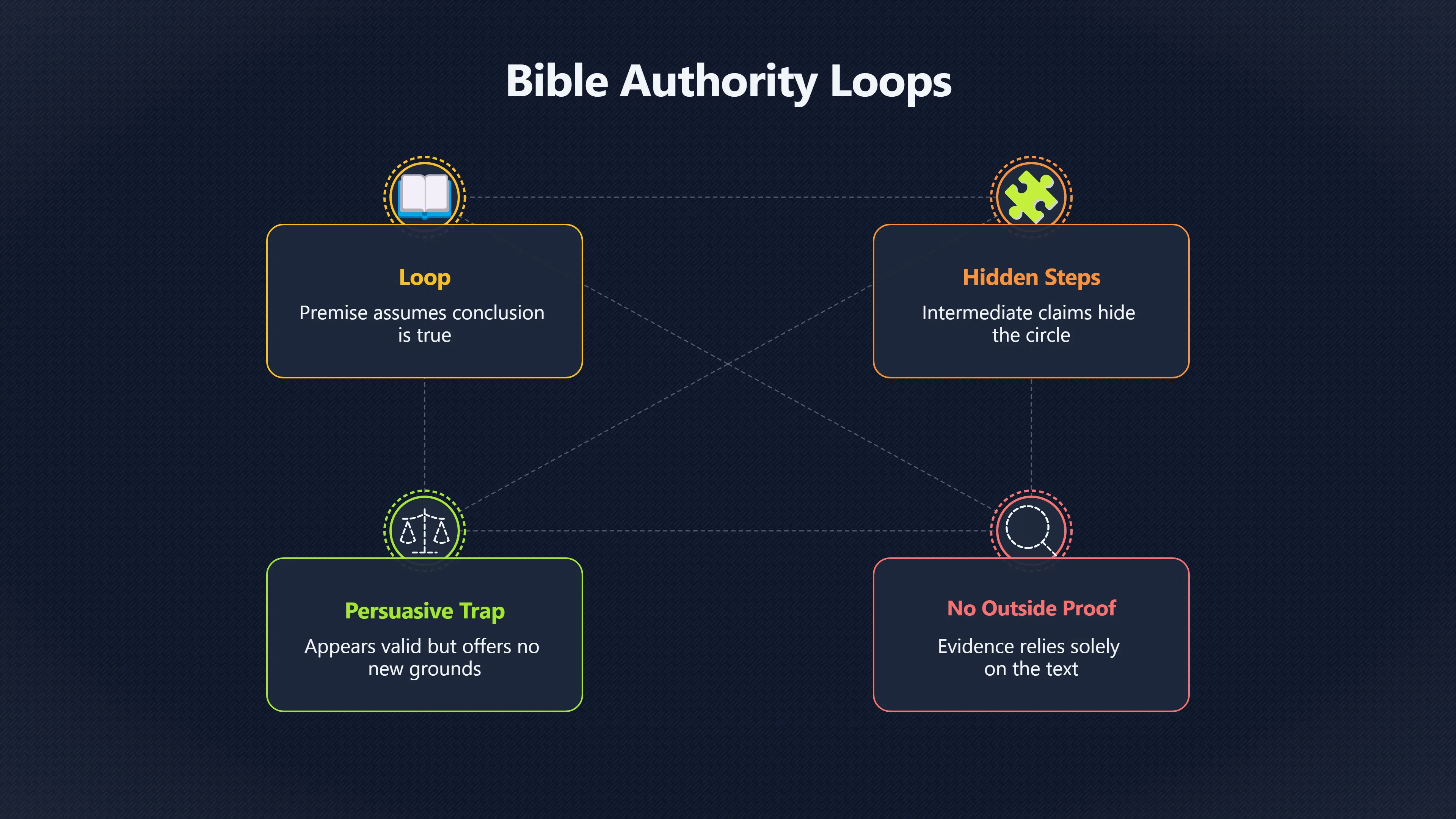
Bible authority arguments are often used as examples of begging the question, a form of circular reasoning in which a claim is supported by premises that already assume the claim is true. The issue is not whether the Bible is true or false. Rather, the logical question is whether an argument provides independent support for its conclusion. When someone argues that the Bible is true because it is God’s word, and then argues that it is God’s word because the Bible says so, the reasoning forms a loop rather than an evidential chain. Philosophers and logicians classify this pattern as a version of petitio principii—assuming what one is trying to prove.[Internet Encyclopedia of Philosophy]iep.utm.eduInternet Encyclopedia of PhilosophyFallaciesThe most well known examples of circular reasoning are cases of the Fallacy of Begging the Qu…[Philosophy Home Page]philosophy.lander.eduPhilosophy Home PagePetitio Principii (Begging the Question or Circular Argument)Petitio principii is sometimes defined as a simple or im…
 This makes Bible authority loops a useful case study within the broader topic of circular reasoning and unsupported conclusions. They show how an argument can appear persuasive while failing to offer evidence that a sceptical listener could accept independently of the conclusion.[Encyclopedia Britannica]britannica.comcircular argumentEncyclopedia BritannicaCircular argument | Definition, History, Examples, & Facts13 Feb 2026 — A circular argument's premise explicitly o…
How the Authority Loop Is Built
The simplest version of the Bible authority loop follows a short chain:
- The Bible is true because it is the word of God.
- We know it is the word of God because the Bible says it is.
- Therefore, the Bible is true.
At first glance, the argument seems to contain two different reasons. On closer inspection, however, both reasons depend on accepting the Bible’s authority in advance. The conclusion and the supporting premise rely on the same underlying assumption. Logicians identify this as begging the question because the conclusion is effectively embedded within the premises.[Texas State University]txst.eduTexas State UniversityBegging the Question: Department of PhilosophyThe fallacy of begging the question occurs when an argument's premis… Wikipedia A slightly more elaborate version hides the circularity:[Wikipedia]WikipediaBegging the questionBegging the question
- The Bible is trustworthy because it was inspired by God.
- God would not inspire an erroneous book.
- We know the Bible was inspired by God because the Bible teaches divine inspiration.
Although the reasoning has more steps, the loop remains. The final premise depends on the authority of the very text whose authority is under examination. Philosophers describe this kind of structure as circular reasoning that may be immediate or may extend through several linked propositions before returning to its starting point.[Philosophy Home Page]philosophy.lander.eduPhilosophy Home PagePetitio Principii (Begging the Question or Circular Argument)Petitio principii is sometimes defined as a simple or im…
The same pattern appears in many discussions of religious authority, which is why introductory logic courses frequently use such examples to illustrate question-begging arguments. The logical concern is structural rather than theological. An argument can be circular regardless of whether its conclusion eventually turns out to be true.[Philosophy Stack Exchange]philosophy.stackexchange.comis the reiteration rule in formal logic begging the questionPhilosophy Stack ExchangeIs the reiteration rule in formal logic begging the question?12 Aug 2018 — The informal fallacy of begging the q…[Philosophy Stack Exchange]philosophy.stackexchange.comis the reiteration rule in formal logic begging the questionPhilosophy Stack ExchangeIs the reiteration rule in formal logic begging the question?12 Aug 2018 — The informal fallacy of begging the q…
Why the Premise Is Not Independent
The defining weakness of a question-begging argument is the absence of an independent premise. A premise is independent when a person could reasonably accept it without already accepting the conclusion.
Consider two different claims:
- “The Bible is true because the Bible says it is true.”
- “The Bible is historically reliable because certain manuscripts, archaeological findings, and external historical sources support specific claims.”
The first statement relies on the Bible’s authority to establish the Bible’s authority. The second appeals to evidence that exists outside the claim being examined. Whether the external evidence succeeds is a separate question, but it is at least independent of the conclusion.[iCriticalThinking]icriticalthinking.orgbegging the questionNone. How can you avoid Begging the Question? Use independent premises. Assume the conclusion.Read more…[Encyclopedia Britannica]britannica.comcircular argumentEncyclopedia BritannicaCircular argument | Definition, History, Examples, & Facts13 Feb 2026 — A circular argument's premise explicitly o…
This independence requirement explains why circular arguments are generally unpersuasive to those who do not already share the conclusion. If someone doubts the Bible’s authority, citing the Bible’s own declarations of authority gives that person no new reason to change their view. The argument simply returns them to the starting point. As philosophers of logic often note, circular arguments can be formally valid while remaining evidentially ineffective because they provide no new grounds for belief.[Stanford Encyclopedia of Philosophy]plato.stanford.eduEncyclopedia of Philosophy FallaciesOne of them is nicely illustrated with Whately's…Read more…
A useful way to see the problem is to substitute another authority source:
“This book is completely reliable because the book itself says it is completely reliable.”
Most people immediately recognise that such a statement proves very little. The concern is not unique to religion; the same reasoning would be defective if applied to a political manifesto, a scientific pamphlet, a company’s advertising material, or a news source evaluating itself.[Encyclopedia Britannica]britannica.comcircular argumentEncyclopedia BritannicaCircular argument | Definition, History, Examples, & Facts13 Feb 2026 — A circular argument's premise explicitly o…[Wikipedia]WikipediaBegging the questionBegging the question
When the Circularity Is Less Obvious
Bible authority loops are not always stated openly. Sometimes the circularity is concealed behind intermediate claims.
For example:
- The Bible is infallible because it comes from God.
- The doctrine that the Bible comes from God is correct because Scripture teaches it.
- Scripture is trustworthy because it is infallible.
Each statement appears to support the next, yet the chain eventually circles back to its beginning. This is what makes circular reasoning difficult to spot in practice. The conclusion may be separated from the key assumption by several steps, creating the impression that evidence has been supplied when the reasoning never actually leaves the loop.[Philosophy Home Page]philosophy.lander.eduPhilosophy Home PagePetitio Principii (Begging the Question or Circular Argument)Petitio principii is sometimes defined as a simple or im… Wikipedia Philosophers have long observed that question-begging arguments often rely on rewording[Wikipedia]WikipediaBegging the questionBegging the question, abstraction, or hidden assumptions rather than simple repetition. The conclusion may not be repeated verbatim, but it is still presupposed in a different form.[Stanford Encyclopedia of Philosophy]plato.stanford.eduEncyclopedia of Philosophy FallaciesOne of them is nicely illustrated with Whately's…Read more…
How to Test the Argument Fairly
A fair test for any authority claim is to ask whether the supporting evidence can stand without assuming the conclusion.
Several practical questions help reveal a Bible authority loop:
- Would the premise be accepted by someone who doubts the conclusion?
- Does the argument appeal to evidence outside the text whose authority is being debated?
- If the conclusion were removed, would the premise still have support?
- Could the same reasoning be used to prove the authority of any other sacred text?
If the answer to these questions repeatedly leads back to the Bible’s own authority claims, the argument is likely circular. If the argument instead relies on historical, textual, philosophical, or other external evidence, then it may succeed or fail on its merits, but it is no longer begging the question.[iCriticalThinking]icriticalthinking.orgbegging the questionNone. How can you avoid Begging the Question? Use independent premises. Assume the conclusion.Read more…[Texas State University]txst.eduTexas State UniversityBegging the Question: Department of PhilosophyThe fallacy of begging the question occurs when an argument's premis…
This distinction is important because identifying a logical fallacy does not settle the truth of the underlying religious claim. It only evaluates the quality of the reasoning offered in support of that claim. A conclusion may be true for reasons not presented in a particular argument. The fallacy lies in the argument’s structure, not necessarily in the conclusion itself.[Philosophy Stack Exchange]philosophy.stackexchange.comis the reiteration rule in formal logic begging the questionPhilosophy Stack ExchangeIs the reiteration rule in formal logic begging the question?12 Aug 2018 — The informal fallacy of begging the q…[Philosophy Stack Exchange]philosophy.stackexchange.comis the reiteration rule in formal logic begging the questionPhilosophy Stack ExchangeIs the reiteration rule in formal logic begging the question?12 Aug 2018 — The informal fallacy of begging the q…

What This Example Reveals About Circular Reasoning
Bible authority loops illustrate one of the central lessons of logical fallacies: a claim cannot serve as its own evidence. An argument becomes question-begging when its premises depend on the truth of the very conclusion they are supposed to establish. In the Bible authority case, the loop emerges when scriptural authority is justified solely by scriptural self-attestation.
The key diagnostic question is therefore simple: what evidence remains if the disputed authority claim is temporarily set aside? If no independent support remains, the reasoning has turned in a circle rather than providing a genuine evidential foundation. That is precisely why Bible authority loops remain a classic example of begging the question within discussions of circular reasoning and unsupported conclusions. [Encyclopedia Britannica+3Internet Encyclopedia of Philosophy+3Philosophy Home Page]
eBay marketplace picks
Marketplace Samples
Example marketplace items related to this page. Use the search link to explore similar finds on eBay.




Endnotes
1.
Source: Wikipedia
Title: Begging the question
Link:https://en.wikipedia.org/wiki/Begging_the_question
2.
Source: britannica.com
Title: circular argument
Link:https://www.britannica.com/topic/circular-argument
Source snippet
Encyclopedia BritannicaCircular argument | Definition, History, Examples, & Facts13 Feb 2026 — A circular argument's premise explicitly o...
3.
Source: Wikipedia
Title: Circular reasoning
Link:https://en.wikipedia.org/wiki/Circular_reasoning
Source snippet
Circular reasoningCircular reasoning is a logical fallacy in which the reasoner begins with what they are trying to end with. Circular...
4.
Source: icriticalthinking.org
Title: begging the question
Link:https://icriticalthinking.org/library/begging-the-question/
Source snippet
None. How can you avoid Begging the Question? Use independent premises. Assume the conclusion.Read more...
5.
Source: plato.stanford.edu
Title: Encyclopedia of Philosophy Fallacies
Link:https://plato.stanford.edu/entries/fallacies/
Source snippet
One of them is nicely illustrated with Whately's...Read more...
6.
Source: plato.stanford.edu
Title: Encyclopedia of Philosophy Fallacies
Link:https://plato.stanford.edu/archives/fall2020/entries/fallacies/
Source snippet
Stanford Encyclopedia of PhilosophyFallacies - Stanford Encyclopedia of PhilosophyMay 29, 2015 — Begging the question is explained as ask...
Published: May 29, 2015
7.
Source: philosophy.institute
Title: understanding fallacies reasoning errors
Link:https://philosophy.institute/logic/understanding-fallacies-reasoning-errors/
Source snippet
Understanding Fallacies: Errors in Reasoning9 Dec 2025 — Petitio principii, more commonly known as “begging the question” or circular rea...
8.
Source: iep.utm.edu
Link:https://iep.utm.edu/fallacy/
Source snippet
Internet Encyclopedia of PhilosophyFallaciesThe most well known examples of circular reasoning are cases of the Fallacy of Begging the Qu...
9.
Source: philosophy.lander.edu
Link:https://philosophy.lander.edu/logic/circular.html
Source snippet
Philosophy Home PagePetitio Principii (Begging the Question or Circular Argument)Petitio principii is sometimes defined as a simple or im...
10.
Source: txst.edu
Link:https://www.txst.edu/philosophy/student-resources/informal-fallacies/begging-the-question.html
Source snippet
Texas State UniversityBegging the Question: Department of PhilosophyThe fallacy of begging the question occurs when an argument's premis...
11.
Source: philosophy.stackexchange.com
Title: is the reiteration rule in [formal logic]({{ ‘formal-logic/’ | relative_url }}) begging the question
Link:https://philosophy.stackexchange.com/questions/54550/is-the-reiteration-rule-in-formal-logic-begging-the-question
Source snippet
Philosophy Stack ExchangeIs the reiteration rule in formal logic begging the question?12 Aug 2018 — The informal fallacy of begging the q...
12.
Source: philosophy.stackexchange.com
Title: begging the question is a type of circular reasoning
Link:https://philosophy.stackexchange.com/questions/102321/begging-the-question-is-a-type-of-circular-reasoning
Source snippet
the question is a type of circular reasoning?30 Aug 2023 — Begging the question is a type of circular reasoning, and often occurs in an i...
13.
Source: philosophy.stackexchange.com
Title: Typically it is a matter of having a premise that is very similar
Link:https://philosophy.stackexchange.com/questions/8351/how-do-i-understand-begging-the-question-in-philosophical-[context
Source snippet
do I understand "Begging the question" in philosophical context?October 8, 2013 — "Begging the question" in a philosophical context means...
Published: October 8, 2013
14.
Source: youtube.com
Link:https://www.youtube.com/watch?v=IJ2dWrI-PTA
Source snippet
circular reasoning...
Additional References
15.
Source: finmasters.com
Link:https://finmasters.com/circular-reasoning/
Source snippet
Circular Reasoning: Definition and ExamplesCircular reasoning, or circular argument, is a logical fallacy in which a person attempts to p...
16.
Source: philosophicalsociety.com
Link:https://www.philosophicalsociety.com/HTML/LogicalFallacies.html
Source snippet
Logical FallaciesThere may be reasons for temporary silence other than [ignorance]({{ 'ignorance/' | relative_url }}). begging the question -- Circular reasoning in which a c...
17.
Source: fallacyfiles.org
Link:https://www.fallacyfiles.org/begquest.html
Source snippet
Logical Fallacy: Begging the QuestionBegging the question is a fallacious form of argument. Therefore, to beg the question is to argue fa...
18.
Source: reddit.com
Link:https://www.reddit.com/r/DebateReligion/comments/x0wktg/nearly_all_the_reasoning_for_christianity_is/
Source snippet
Nearly all the reasoning for Christianity is circularWe are in a situation where the Bible is used as proof of itself, which of course, i...
19.
Source: reddit.com
Link:https://www.reddit.com/r/DebateReligion/comments/tyt4n/to_all_stop_begging_the_question/
Source snippet
To All: Stop begging the question: r/DebateReligionBegging the question is a kind of circular reasoning where the premise is held as pro...
20.
Source: facebook.com
Title: the circular reasoning fallacy also known as begging the question petitio princi
Link:https://www.facebook.com/Religiontg/photos/the-circular-reasoning-fallacy-also-known-as-begging-the-question-petitio-princi/122233834934193629/
Source snippet
The circular reasoning fallacy, also known as...31 Mar 2025 — The circular reasoning fallacy, also known as begging the question (petiti...
21.
Source: youtube.com
Link:https://www.youtube.com/watch?v=cwb0Ye3o0zo&vl=en
Source snippet
Why This Argument Is NOT CircularIn this video, AMOT gives a short lesson in deductive logic to the glory of God with the power of the Sc...
22.
Source: facebook.com
Link:https://www.facebook.com/groups/31425129128/posts/10166685576959129/
Source snippet
on it to get me where I need to go." Or "God exists because the...Read more...
23.
Source: facebook.com
Link:https://www.facebook.com/100064331543876/posts/to-beg-the-question-is-to-presuppose-an-answer-based-in-logic-from-latin-assumin/887084443445932/
Source snippet
ular reasoning. This is an informal fallacy where the...Read more...
24.
Source: cerebralfaith.net
Link:https://cerebralfaith.net/logical-fallacy-series-part-10-begging/
Source snippet
Logical Fallacy Series — Part 10: Begging The QuestionThis argument for The Bible being true is logically fallacious because the Christia...
Topic Tree