Within Deadlines
When Does One Extension Become Unfair?
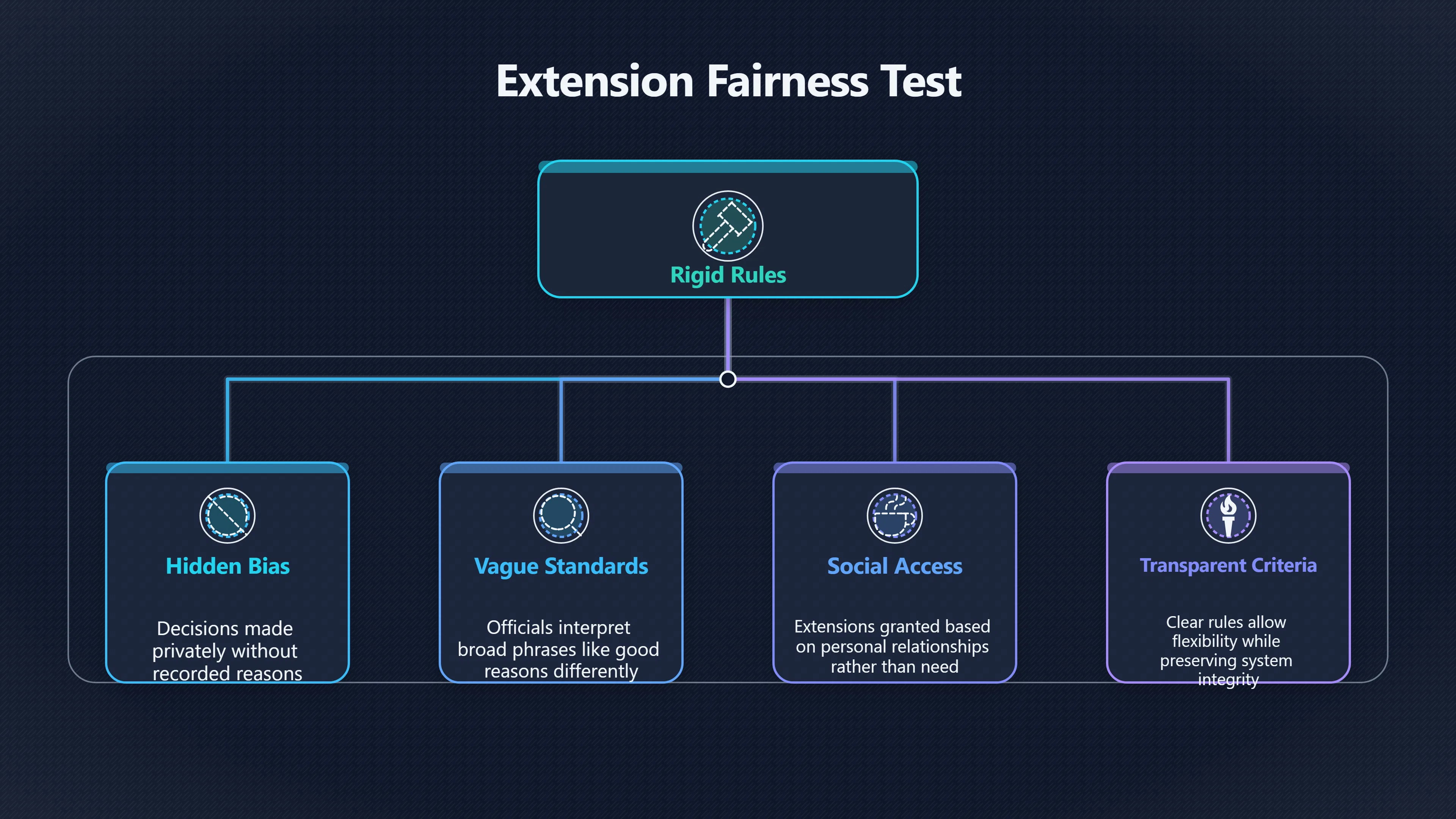
A deadline extension is a real fairness risk when vague discretion, hidden decisions, or unequal access make similar cases come out differently.
On this page
- Fairness concerns that are not fallacies
- Warning signs in discretionary decisions
- How consistent criteria protect both sides
Page outline Jump by section
Introduction
A request for a deadline extension does not become unfair simply because it is granted. In debates about slippery slope arguments, people often assume that any exception will undermine equal treatment. That claim is frequently fallacious because it skips over the crucial question: what mechanism would actually make the system unfair? A genuine fairness problem arises not from flexibility itself, but from the way flexibility is exercised. When similar cases receive different treatment because decisions are hidden, inconsistent, biased, or based on vague standards, an extension can create real inequality rather than merely imagined risk. The key distinction is between controlled discretion and arbitrary discretion. Institutions can accommodate legitimate needs while preserving fairness, but only if they apply transparent and consistent criteria.[alrc.gov.au]alrc.gov.auProcedural fairness: the duty and its content12 Jan 2016 — 'Procedural fairness' means acting fairly in administrative decision making…
When Does One Extension Become Unfair?
The strongest fairness concerns do not centre on the fact that one person received more time. They centre on whether others in materially similar circumstances would receive the same opportunity.
Consider two students who experience comparable medical emergencies. If one receives an extension because they know the right administrator or are more confident in asking, while the other is denied because a different decision-maker applies a different standard, the issue is not the extension itself. The issue is unequal treatment.
This distinction matters because deadline disputes often become trapped in a false choice:
- Either enforce every deadline rigidly.
- Or allow extensions and destroy fairness.
In practice, many institutions operate successfully between those extremes. Universities, courts, professional bodies, and public agencies routinely allow extensions, special consideration, or reasonable adjustments while maintaining formal rules about eligibility, evidence, and review. The existence of an exception does not automatically create unfairness; inconsistent access to exceptions does.[oiahe.org.uk]oiahe.org.ukDisability and requests for additional consideration - OIAHEExtensions to coursework submission deadlines;; Alternative methods of assess…[Queen Mary]qmul.ac.ukExtenuating Circumstances Policy12 Jun 2025 — a) Provide an extension to a written coursework deadline. Extensions would normally be a maximum 7 calendar days. Exception… University of London
The slippery slope concern becomes reasonable only when someone can identify a credible pathway from one exception to unequal treatment. Merely asserting that “everyone will want one” is not enough. Evidence is needed that decision-makers cannot or will not distinguish between cases. UCLA School of Law[SCC Decisions]decisions.scc-csc.caSCC Decisions R. v. J.JSCC DecisionsR. v. J.J. - SCC Cases30 Jun 2022 — It is no answer simply to impugn a concern as a “slippery slope” argument. After all, so…
Fairness Concerns That Are Not Fallacies
Some objections to extensions are grounded in real risks rather than speculative chains of events.
Unequal Access to Decision-Makers
A common problem arises when extension requests depend heavily on personal relationships. Individuals with supportive supervisors, sympathetic lecturers, or greater confidence in navigating bureaucracy may receive accommodations that others never discover are available.
In such situations, fairness is threatened because access to flexibility depends on social position rather than relevant circumstances. Transparency research consistently identifies visibility of procedures and access to decision-makers as important safeguards against unequal outcomes.[OECD]oecd.orgProcedural Fairness and Transparency: Key Findings (EN)Consistency, predictability, and fairness in decision-making processes, can be…
Vague Standards
A policy that says extensions may be granted for “good reasons” provides broad discretion but little guidance. Different officials may interpret the phrase differently.
One administrator might regard caring responsibilities as sufficient justification. Another might not. One might require documentary evidence. Another might rely on personal judgement. The broader and less defined the standard, the greater the risk that similar cases will receive different outcomes. Procedural fairness literature repeatedly emphasises that fairness depends on procedures appropriate to the circumstances rather than unconstrained discretion.[alrc.gov.au]alrc.gov.auProcedural fairness: the duty and its content12 Jan 2016 — 'Procedural fairness' means acting fairly in administrative decision making…
Hidden Decisions
Fairness problems multiply when extension decisions are not recorded or explained.
If applicants cannot see how decisions are made, they cannot determine whether the process is being applied consistently. Hidden exceptions also make it difficult for organisations to detect patterns of favouritism, bias, or unequal treatment. Transparency contributes to consistency and predictability precisely because it allows decisions to be compared against established standards.[OECD]oecd.orgProcedural Fairness and Transparency: Key Findings (EN)Consistency, predictability, and fairness in decision-making processes, can be…
Warning Signs in Discretionary Decisions
A single extension request may signal a broader fairness problem when several warning signs appear together.
Different outcomes for similar facts. If people facing comparable circumstances routinely receive different decisions, discretion may be operating arbitrarily rather than fairly.
No documented reasons. When decision-makers cannot explain why one request succeeded and another failed, consistency becomes difficult to evaluate.
Informal channels dominate. Systems that rely on private conversations, personal appeals, or unofficial arrangements often create unequal access.
Policies exist but are rarely followed. Written criteria lose their value if actual decisions depend on unwritten practices.
Appeals are unavailable or ineffective. Fair procedures normally include some mechanism for reviewing disputed decisions. Without review, inconsistent decisions can persist unchecked.[alrc.gov.au]alrc.gov.auProcedural fairness: the duty and its content12 Jan 2016 — 'Procedural fairness' means acting fairly in administrative decision making…[Clayton Utz]claytonutz.compublic law essentials procedural fairnessPublic Law Essentials: Procedural fairness2 Dec 2024 — Procedural fairness in administrative decision-making relates to the fairness of t…
These warning signs identify concrete mechanisms by which an extension system can become unfair. They are stronger arguments than abstract predictions that “the deadline will soon mean nothing.”
Why Equality Sometimes Requires Extensions
A common misunderstanding is that treating everyone identically is always the fairest approach. In many settings, equal treatment may require different treatment.
For example, disability accommodations often include extensions, additional consideration, or other adjustments designed to ensure that assessment measures the intended skill rather than the effects of a disability. The purpose is not to provide an advantage but to create a more level playing field. Refusing all extensions in the name of uniformity can itself create unequal outcomes.[oiahe.org.uk]oiahe.org.ukDisability and requests for additional consideration - OIAHEExtensions to coursework submission deadlines;; Alternative methods of assess…
This is why fairness debates should focus on relevant differences rather than identical treatment. If two cases differ in ways that matter to the purpose of the rule, different outcomes may be justified. What threatens fairness is not recognising relevant differences but applying them inconsistently.
How Consistent Criteria Protect Both Sides
The best protection against both unfairness and slippery-slope fears is a system of clear criteria.
Effective systems typically answer several questions in advance:
- What circumstances justify an extension?
- What evidence is required?
- Who decides?
- How long can extensions last?
- How are decisions recorded?
- How can a refusal be reviewed?
When these questions are answered publicly, decision-makers retain flexibility while reducing arbitrariness. Consistent criteria also protect those who oppose an extension. They can be confident that the decision was made according to known rules rather than favouritism.
Research and policy guidance across administrative and educational settings repeatedly link fairness to transparency, predictability, consistency, and documented procedures. These safeguards make it possible to grant justified extensions without undermining confidence in the system.[OECD]oecd.orgProcedural Fairness and Transparency: Key Findings (EN)Consistency, predictability, and fairness in decision-making processes, can be…[LSHTM]lshtm.ac.ukademic manual chapter 07ademic Manual 2025-26 - Chapter 7This procedure is intended to be fair, consistent and transparent, whilst forming part of a fram…

The Real Fairness Test
The most important question is not whether one person received extra time. It is whether another person in the same situation would have received the same consideration.
A slippery slope argument claims that an exception will inevitably produce unfairness. A fairness analysis asks whether the decision-making process already contains mechanisms that prevent unequal treatment. When criteria are transparent, reasons are documented, and similar cases are handled similarly, an extension may strengthen fairness rather than weaken it. When discretion is opaque, inconsistent, or selectively available, the fairness risk is genuine.
The difference lies not in the exception itself, but in the quality of the process governing it.[alrc.gov.au]alrc.gov.auProcedural fairness: the duty and its content12 Jan 2016 — 'Procedural fairness' means acting fairly in administrative decision making…[OECD]oecd.orgProcedural Fairness and Transparency: Key Findings (EN)Consistency, predictability, and fairness in decision-making processes, can be…
eBay marketplace picks
Marketplace Samples
Example marketplace items related to this page. Use the search link to explore similar finds on eBay.



Endnotes
1.
Source: alrc.gov.au
Link:https://www.alrc.gov.au/publication/traditional-rights-and-freedoms-encroachments-by-commonwealth-laws-alrc-report-129/14-procedural-fairness-2/procedural-fairness-the-duty-and-its-content/
Source snippet
Procedural fairness: the duty and its content12 Jan 2016 — 'Procedural fairness' means acting fairly in administrative decision making...
2.
Source: oecd.org
Link:https://www.oecd.org/content/dam/oecd/en/publications/reports/2012/11/procedural-fairness-and-transparency-key-findings_ee42a955/17f27597-en.pdf
Source snippet
Procedural Fairness and Transparency: Key Findings (EN)Consistency, predictability, and fairness in decision-making processes, can be...
3.
Source: oiahe.org.uk
Link:https://www.oiahe.org.uk/resources-and-publications/good-practice-framework/requests-for-additional-consideration/disability-and-requests-for-additional-consideration/
Source snippet
Disability and requests for additional consideration - OIAHEExtensions to coursework submission [deadlines]({{ 'deadlines/' | relative_url }});; Alternative methods of assess...
4.
Source: www2.law.ucla.edu
Title: School of Law The Mechanisms of the Slippery Slope
Link:https://www2.law.ucla.edu/Volokh/slippery.pdf
Source snippet
Slippery slope risks might also be hidden - especially from aver- age voters - by information...
5.
Source: qmul.ac.uk
Title: Extenuating Circumstances Policy
Link:https://www.qmul.ac.uk/governance-and-legal-services/media/dgls-media/policy/current-policies/Extenuating-Circumstances-Policy.pdf
Source snippet
12 Jun 2025 — a) Provide an extension to a written coursework deadline. Extensions would normally be a maximum 7 calendar days. Exception...
6.
Source: decisions.scc-csc.ca
Title: SCC Decisions R. v. J.J
Link:https://decisions.scc-csc.ca/scc-csc/scc-csc/en/item/19428/index.do
Source snippet
SCC DecisionsR. v. J.J. - SCC Cases30 Jun 2022 — It is no answer simply to impugn a concern as a “slippery slope” argument. After all, so...
7.
Source: claytonutz.com
Title: public law essentials procedural fairness
Link:https://www.claytonutz.com/insights/2024/december/public-law-essentials-procedural-fairness
Source snippet
Public Law Essentials: Procedural fairness2 Dec 2024 — Procedural fairness in administrative decision-making relates to the fairness of t...
8.
Source: lshtm.ac.uk
Title: ademic manual chapter 07
Link:https://www.lshtm.ac.uk/sites/default/files/academic-manual-chapter-07.pdf
Source snippet
ademic Manual 2025-26 - Chapter 7This procedure is intended to be fair, consistent and transparent, whilst forming part of a fram...
9.
Source: diokami.wordpress.com
Title: fairness slippery slope
Link:https://diokami.wordpress.com/2015/03/10/fairness-slippery-slope/
Source snippet
Slippery Slope - Titivillus - WordPress.com10 Mar 2015 — A fairness slippery slope argument is one that exploits the vagueness of a categ...
Additional References
10.
Source: reddit.com
Link:https://www.reddit.com/r/AskAcademiaUK/comments/1ih1dwu/derby_uni_have_removed_reasonable_adjustments_is/
Source snippet
Derby Uni have removed reasonable adjustmentsWhile I agree that offering automatic extensions to every deadline may not be a reasonable a...
11.
Source: Wikipedia
Link:https://en.wikipedia.org/wiki/Slippery_slope
Source snippet
Slippery slopeThe core of the slippery slope argument is that a specific decision under [debate]({{ 'debate/' | relative_url }}) is likely to result in unintended conse...
12.
Source: realaw.blog
Link:https://realaw.blog/2025/01/17/triggering-access-to-justice-the-relation-between-the-duty-to-give-reasons-and-time-limits-in-administrative-litigation-in-italy-germany-and-france-by-flaminia-aperio-bella/
Source snippet
Triggering access to justice: the relation between the duty...17 Jan 2025 — This blog post focuses on time limits in administrative liti...
13.
Source: bryanschwartzlaw.com
Link:https://www.bryanschwartzlaw.com/a-win-for-fairness-in-the-u-s-supreme-court-administrative-filing-deadlines-are-not-generally-jurisdictional-requirements/
Source snippet
Supreme Court: Administrative Filing Deadlines are Not Generally Jurisdictional Requirements. The United States...Read more...
14.
Source: canlii.org
Link:https://www.canlii.org/en/commentary/doc/2024CanLIIDocs31
15.
Source: scope.org.uk
Title: reasonable adjustments college university
Link:https://www.scope.org.uk/advice-and-support/reasonable-adjustments-college-university
Source snippet
Reasonable adjustments in college and university26 Aug 2025 — Under the Equality Act, disabled students have rights to reasonable adjustm...
16.
Source: hallandwilcox.com.au
Link:https://hallandwilcox.com.au/news/regulating-the-discretion-to-extend-time-applying-statutory-extension-of-time-provisions/
Source snippet
ringe upon the general right of access to the courts.Read more...
17.
Source: yalelawandpolicy.org
Title: 6 mooney deadlines in civil litigation
Link:https://yalelawandpolicy.org/sites/default/files/YLPR/6_mooney_deadlines_in_civil_litigation.pdf
Source snippet
Deadlines in Civil Litigationby J Mooney · 2019 · Cited by 4 — But the new weighing principles would provide a more equitable normative b...
18.
Source: edwebcontent.ed.ac.uk
Title: exceptional circumstances policy final
Link:https://edwebcontent.ed.ac.uk/sites/default/files/atoms/files/exceptional_circumstances_policy_-_final.pdf
Source snippet
Web ContentExceptional Circumstances Policy16 Sept 2024 — 1.1 The purpose of this policy is to ensure a fair and consistent response to...
19.
Source: europeanpapers.eu
Title: A Journal on Law and Integration, Vol
Link:https://www.europeanpapers.eu/sites/default/files/EP_eJ_2021_2.pdf
Source snippet
6, 2021, No 2... precedent for the K 3/21 ruling. This [tu quoque]({{ 'tu-quoque/' | relative_url }}) argument is unfounded, as the two rulings reveal a number of dis- simila...
Topic Tree