Within Relevance
Does Popular Belief Make a Claim True?
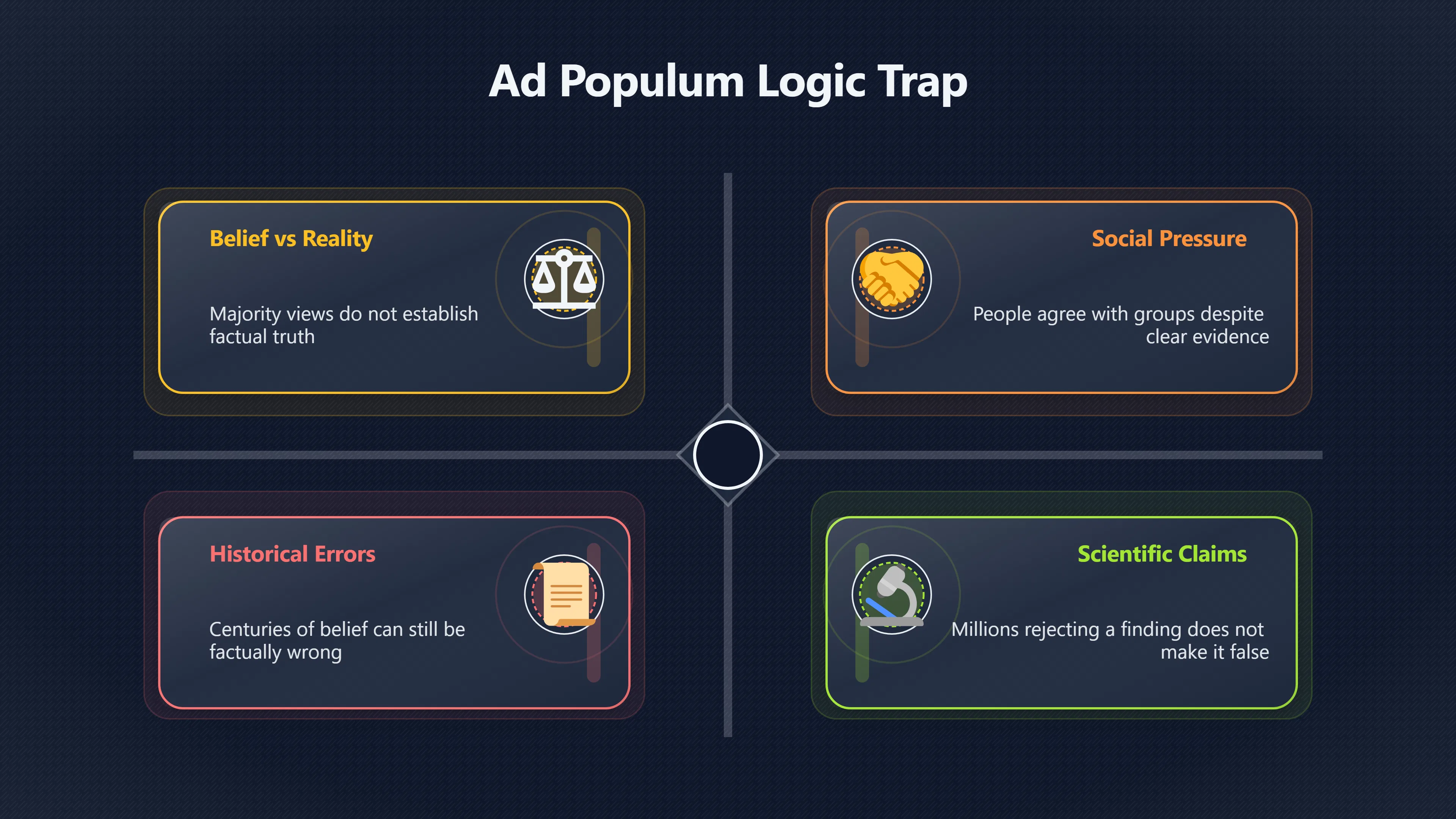
Majority belief can show what people think, but it rarely proves that a factual, moral or historical claim is true.
On this page
- Where popularity evidence is relevant
- Where ad populum reasoning fails
- Questions that separate opinion from proof
Page outline Jump by section
Introduction
Does popular belief make a claim true? In most cases, no. A large majority can reveal what people think, prefer, fear or support, but it does not by itself establish that a factual, scientific, historical or moral claim is correct. This distinction is central to relevance testing in logic. When an argument moves from “many people believe this” to “therefore it is true”, it substitutes evidence about opinion for evidence about the claim itself. Logicians traditionally classify this mistake as an appeal to popularity, or ad populum reasoning. Encyclopedia Britannica[scribbr]scribbr.comad populum fallacyWhat Is Ad Populum Fallacy? | Definition & ExamplesJun 20, 2023 — Ad populum fallacy is arguing that a claim is true simply because that'… The mistake matters because popularity often feels persuasive. Human beings are social creatures, and majority views can provide useful information. Yet a belief can be widely accepted and still be false, just as a minority view can be correct. The key relevance question is not how many people agree, but whether the popularity of the belief bears directly on the truth of the conclusion.

Where Popularity Evidence Is Relevant
Popularity is not always irrelevant. The crucial issue is what question is being asked.
In governance, public opinion is often directly relevant to decisions about elections, political legitimacy, policy preferences and social acceptance. If a government wants to know whether voters support a tax proposal, polling data are relevant because the question concerns public attitudes. Similarly, market researchers can use popularity data to identify consumer preferences. In such cases, popularity is evidence about what people want or believe.[Springer]link.springer.comArguments from Popularity: Their Merits and Defects in…by JA van Laar · 2023 · Cited by 2 — I define the concept of an argumen…
There are also limited cases where widespread agreement provides indirect evidence. If many independent observers report the same event, their agreement may increase confidence that something happened. However, the evidential force comes from the independence and reliability of the observations, not from the sheer number of believers. A crowd of witnesses can be informative because each witness contributes evidence, not because majority opinion magically creates truth.
Some matters are partly defined by social agreement. Language is a familiar example. The meaning of a word often depends on how speakers collectively use it. In such cases, consensus helps determine the answer because the subject itself concerns social conventions.[Wikipedia]WikipediaArgumentum ad populumArgumentum ad populum
These examples show that popularity can be relevant when the conclusion is about preferences, conventions or collective choices. The problem arises when popularity is treated as proof of factual correctness.
Where Ad Populum Reasoning Fails
The appeal to popularity becomes fallacious when the argument follows this pattern:
- Many people believe claim X.[scribbr.com]scribbr.comad populum fallacyWhat Is Ad Populum Fallacy? | Definition & ExamplesJun 20, 2023 — Ad populum fallacy is arguing that a claim is true simply because that'…
- Therefore claim X is true.
The weakness lies in the missing connection between belief and reality. Whether people believe something and whether it is true are separate questions. A belief can be sincere, widespread and mistaken. Logical reference works consistently identify this move as a fallacy because it replaces reasons and evidence with popularity.[Encyclopedia Britannica]britannica.comargumentum ad populumEncyclopedia BritannicaArgumentum ad populum | logicFeb 13, 2026 — Argument ad populum (an appeal “to the people”), which, instead of off…[Encyclopedia Britannica]britannica.comargumentum ad populumEncyclopedia BritannicaArgumentum ad populum | logicFeb 13, 2026 — Argument ad populum (an appeal “to the people”), which, instead of off…
Consider several common forms:
- Historical claims: “People believed for centuries that a certain event happened exactly this way, so it must be true.”
- Scientific claims: “Millions of people reject a scientific finding, therefore the finding is false.”
- Moral claims: “Most people approve of this practice, therefore it is morally right.”
- Commercial claims: “This is the best product because it is the most popular.”
In each case, popularity may describe social reality, but it does not settle the substantive question. Evidence about historical records, scientific testing, ethical principles or product performance is still required.[fallacyfiles.org]fallacyfiles.orgThe Bandwagon FallacyThe Bandwagon Fallacy is committed whenever one argues for an idea based upon an irrelevant appeal to its popularity…
A useful relevance test asks: if the number of believers suddenly changed, would the facts change as well? For many factual claims, the answer is clearly no. A disease does not become harmless because most people think it is harmless. A historical event does not become real because a majority believes it occurred.
Why Majorities Can Be Wrong
One reason the fallacy persists is that people often assume large groups are unlikely to make the same mistake. Yet history contains many examples of widely accepted beliefs later shown to be false.
The underlying mechanisms are well studied. People learn from one another, imitate respected peers and respond to social pressure. A belief can spread because it is repeated, rewarded or culturally embedded rather than because it has been independently verified.
The classic conformity experiments conducted by psychologist Solomon Asch demonstrated that individuals sometimes agree with a majority even when the majority’s answer is obviously wrong. Participants frequently altered their responses to align with a group consensus despite clear visual evidence to the contrary. Later replications and extensions found that social influence remains powerful across different contexts.[Simply Psychology]simplypsychology.orgasch conformitySimply PsychologyAsch Conformity Line Experiment15 May 2025 — Solomon Asch experimented with investigating the extent to which social pre…[PMC]pmc.ncbi.nlm.nih.govpower of social influence: A replication and extension of…by A Franzen · 2023 · Cited by 61 — In this paper, we pursue four goals: Fir…
These findings do not prove that majorities are usually wrong. They show something more important for reasoning: popularity and truth can diverge. The fact that many people endorse a claim may reflect social influence rather than evidential strength.[Verywell Mind]verywellmind.comVerywell Mind The Asch Conformity ExperimentsVerywell MindThe Asch Conformity ExperimentsFebruary 9, 2009 — 26 Oct 2025 — After combining the trials, the results indicated that parti…

Popularity, Governance and Public Decision-Making
Governance creates a special challenge because democratic systems depend on counting opinions while also requiring accurate information.
A majority vote can legitimately determine who wins an election or whether a proposal receives political support. In those situations, popularity is part of the decision rule. Yet even overwhelming electoral support does not transform a factual claim into a true one. A government may enjoy broad public backing while still making incorrect assessments about economics, health, security or history.
This distinction helps separate democratic legitimacy from epistemic validity. A policy may be democratically authorised because many citizens support it. Whether the policy’s factual assumptions are correct requires additional evidence. Confusing these two questions often leads to poor public reasoning.
In practical terms:
- Polls can reveal preferences.
- Elections can reveal collective choices.
- Surveys can reveal attitudes.
- None of these automatically reveal objective truth.
The relevance test asks which of these questions is actually under discussion.
Questions That Separate Opinion from Proof
When encountering a popularity-based argument, several questions help determine whether the popularity evidence is relevant.
What Exactly Does the Majority Agree About?
Sometimes agreement concerns preferences rather than facts. If most residents prefer a particular transport policy, that tells us something important about public priorities. It does not necessarily tell us whether the policy will achieve its stated goals.
What Independent Evidence Supports the Claim?
If popularity disappeared, what evidence would remain? Reliable arguments should still have supporting reasons after the crowd is removed from the picture.
Could the Majority Be Influenced by the Same Source?
A million people repeating the same unsupported claim may represent one piece of information repeated many times rather than a million independent confirmations.

Is the Issue About Convention or About Reality?
Questions about language, customs or collective rules often depend on social agreement. Questions about scientific facts, historical events or physical processes generally require evidence that exists independently of public opinion.[Wikipedia]WikipediaAsch conformity experimentsAsch conformity experimentsIn psychology, the Asch conformity experiments were a series of studies testing the Asch paradigm, directed…
Would Expert Agreement Matter for a Different Reason?
A broad expert consensus may carry evidential weight because it reflects specialised investigation, testing and review. The relevant factor is not merely the number of people agreeing but the quality of the underlying evidence and expertise.
A Practical Relevance Test
Popularity claims become stronger reasoning only when they are connected to the specific issue being debated. If the issue is what people prefer, support or accept, popularity may be highly relevant. If the issue is whether a factual claim is true, popularity alone is usually beside the point.
A simple test is to replace the statement “many people believe this” with “many people believe this, but they might all be mistaken”. If the argument collapses, it was relying on popularity rather than proof. That is the hallmark of an appeal to popularity: treating widespread belief as if it were evidence of truth rather than evidence of what people happen to think. Encyclopedia Britannica[Scribbr]scribbr.comad populum fallacyWhat Is Ad Populum Fallacy? | Definition & ExamplesJun 20, 2023 — Ad populum fallacy is arguing that a claim is true simply because that'…
Amazon book picks
Further Reading
Books and field guides related to Does Popular Belief Make a Claim True?. Use these as the next step if you want deeper reading beyond the article.
The Demon-Haunted World
Rating: 4.5/5 from 43 Google Books ratings
Directly addresses why popularity and belief are not reliable tests of truth.
A Rulebook for Arguments
Covers relevance and common reasoning mistakes including appeals to popularity.
The Skeptics' Guide to the Universe
Examines how beliefs spread and how evidence should be evaluated independently of popularity.
eBay marketplace picks
Marketplace Samples
Example marketplace items related to this page. Use the search link to explore similar finds on eBay.







Endnotes
1.
Source: britannica.com
Title: argumentum ad populum
Link:https://www.britannica.com/topic/argumentum-ad-populum
Source snippet
Encyclopedia BritannicaArgumentum ad populum | logicFeb 13, 2026 — Argument ad populum (an appeal “to the people”), which, instead of off...
2.
Source: scribbr.com
Title: ad populum fallacy
Link:https://www.scribbr.com/fallacies/ad-populum-fallacy/
Source snippet
What Is Ad Populum Fallacy? | Definition & ExamplesJun 20, 2023 — Ad populum fallacy is arguing that a claim is true simply because that'...
3.
Source: link.springer.com
Link:https://link.springer.com/article/10.1007/s11245-022-09872-4
Source snippet
Arguments from Popularity: Their Merits and Defects in...by JA van Laar · 2023 · Cited by 2 — I define the concept of an argumen...
4.
Source: Wikipedia
Title: Argumentum ad populum
Link:https://en.wikipedia.org/wiki/Argumentum_ad_populum
5.
Source: britannica.com
Link:https://www.britannica.com/topic/fallacy
Source snippet
Encyclopedia BritannicaFallacy | Logic, Definition & ExamplesFeb 13, 2026 — ad populum (an appeal “to the people”), which, instead of off...
6.
Source: fallacyfiles.org
Link:https://www.fallacyfiles.org/bandwagn.html
Source snippet
The [Bandwagon]({{ 'bandwagon/' | relative_url }}) FallacyThe Bandwagon Fallacy is committed whenever one argues for an idea based upon an irrelevant appeal to its popularity...
7.
Source: pmc.ncbi.nlm.nih.gov
Link:https://pmc.ncbi.nlm.nih.gov/articles/PMC10686423/
Source snippet
power of social influence: A replication and extension of...by A Franzen · 2023 · Cited by 61 — In this paper, we pursue four goals: Fir...
8.
Source: Wikipedia
Title: Asch conformity experiments
Link:https://en.wikipedia.org/wiki/Asch_conformity_experiments
Source snippet
Asch conformity experimentsIn psychology, [the Asch conformity experiments]({{ 'the-asch-conformity-experiments/' | relative_url }}) were a series of studies testing the Asch paradigm, directed...
9.
Source: britannica.com
Title: argument logic
Link:https://www.britannica.com/topic/argument-logic
Source snippet
Argument | logicFeb 13, 2026 —... argument ad populum (an appeal “to the people”), which, instead of offering logical reasons, appeals t...
10.
Source: britannica.com
Title: circular argument
Link:https://www.britannica.com/topic/circular-argument
Source snippet
argument ad populum (an appeal “to the people”), which, instead of offering logical reasons, appeals to such popular attitudes as the...
11.
Source: britannica.com
Title: Applied logic | Fallacies, Varieties, & Facts
Link:https://www.britannica.com/topic/applied-logic
Source snippet
appeals to pity (traditionally called the fallacy of ad misericordiam), to authority (ad verecundiam), or to popular opinion (ad populum)...
12.
Source: britannica.com
Link:https://www.britannica.com/topic/validity
Source snippet
Reasoning, Argument, EvidenceFeb 13, 2026 — ad populum (an appeal “to the people”), which, instead of offering logical reasons, appeals t...
13.
Source: britannica.com
Title: What Is the Either-Or Fallacy?
Link:https://www.britannica.com/topic/What-Is-the-Either-Or-Fallacy
Source snippet
[False Dilemma]({{ 'false-dilemma/' | relative_url }}), Dichotomy...Feb 13, 2026 — The either-or fallacy, also called a false dilemma, is a logical error that happens when som...
14.
Source: britannica.com
Title: Applied logic
Link:https://www.britannica.com/topic/applied-logic/Nonverbal-fallacies
Source snippet
Nonverbal Fallacies... appeals to pity (traditionally called the fallacy of ad misericordiam), to authority (ad verecundiam), or to popul...
15.
Source: britannica.com
Link:https://www.britannica.com/topic/argumentum-ad-baculum
Source snippet
Argumentum ad baculum | logicArgument ad baculum (an appeal “to force”), which rests on a threatened or implied use of force to induce ac...
16.
Source: Wikipedia
Link:https://en.wikipedia.org/wiki/Appeal
Source snippet
AppealIn law, an appeal is the process in which cases or decisions are reviewed by a higher authority, where parties request a formal...
17.
Source: psychology.town
Title: reevaluating aschs experiments critical perspective
Link:https://psychology.town/social/reevaluating-aschs-experiments-critical-perspective/
Source snippet
Reevaluating Asch's Experiments: A Critical PerspectiveNov 19, 2025 — Participants who were more confident in their own perceptions were...
18.
Source: psychology.town
Title: asch conformity line length experiments
Link:https://psychology.town/social/asch-conformity-line-length-experiments/
Source snippet
Inside Asch's Line and Length Experiments14 Nov 2025 — Explore Solomon Asch's conformity experiments: social influence, group pressure, a...
19.
Source: plato.stanford.edu
Link:https://plato.stanford.edu/entries/argument/
Source snippet
Stanford Encyclopedia of PhilosophyArgument and Argumentationby C Dutilh Novaes · 2021 · Cited by 101 — Argumentation can be defined as t...
20.
Source: simplypsychology.org
Title: asch conformity
Link:https://www.simplypsychology.org/asch-conformity.html
Source snippet
Simply PsychologyAsch Conformity Line Experiment15 May 2025 — Solomon Asch experimented with investigating the extent to which social pre...
Published: May 2025
21.
Source: verywellmind.com
Title: Verywell Mind The Asch Conformity Experiments
Link:https://www.verywellmind.com/the-asch-conformity-experiments-2794996
Source snippet
Verywell MindThe Asch Conformity ExperimentsFebruary 9, 2009 — 26 Oct 2025 — After combining the trials, the results indicated that parti...
Published: February 9, 2009
22.
Source: dictionary.cambridge.org
Link:https://dictionary.cambridge.org/dictionary/english/appeal
Source snippet
to request formally that a decision, esp. a legal or official one, be changed: [ T ] The verdict was appealed to a higher...Read more...
23.
Source: philosophy.lander.edu
Link:https://philosophy.lander.edu/scireas/popular.html
Source snippet
to the PeopleThe argument based upon what most or all people think or believe is characterized and shown to be sometimes persuasive but n...
24.
Source: tutor2u.net
Link:https://www.tutor2u.net/psychology/reference/conformity-asch-1951?srsltid=AfmBOooOOF9RzrtKCnWsw7vwa2i1GHp1bzd5U6Yb-lLQwzC38SbXFm-r
Source snippet
Conformity - Asch (1951) | Reference Library | Psychology3 Dec 2025 — Asch wanted to see if the real participant would conform to the maj...
25.
Source: plato.stanford.edu
Title: logic informal
Link:https://plato.stanford.edu/entries/logic-informal/
Source snippet
Logic - Stanford Encyclopedia of Philosophyby L Groarke · 1996 · Cited by 96 — [Informal logic]({{ 'informal-logic/' | relative_url }}) (“IL”) is the study of reasoning and infere...
26.
Source: en.wikisource.org
Link:https://en.wikisource.org/wiki/1911_Encyclop%C3%A6dia_Britannica/Fallacy
Source snippet
wikisource.org1911 Encyclopædia Britannica/Fallacy - Wikisource22 Jun 2022 — Under this head come the so-called argumentum (a) ad hominem...
27.
Source: ebsco.com
Title: asch conformity experiments
Link:https://www.ebsco.com/research-starters/history/asch-conformity-experiments
Source snippet
History | Research StartersThe Asch conformity experiments, conducted by Solomon Asch in the 1950s, explored the impact of social pressur...
Additional References
28.
Source: merriam-webster.com
Link:https://www.merriam-webster.com/dictionary/appeal
Source snippet
APPEAL Definition & MeaningThe meaning of APPEAL is a legal proceeding by which a case is brought before a higher court for review of the...
29.
Source: psychstory.co.uk
Link:https://www.psychstory.co.uk/social-influence/asch-variables-affecting-conformity
Source snippet
ASCH: VARIABLES AFFECTING CONFORMITYHis findings suggested that conformity rates might be lower when individuals are not under direct gro...
30.
Source: logicallyfallacious.com
Link:https://www.logicallyfallacious.com/logicalfallacies/Appeal-to-Popularity
Source snippet
Appeal to PopularityAppeal to Popularity... Description: Using the popularity of a premise or proposition as evidence for its truthfulne...
31.
Source: madeofmillions.com
Link:https://www.madeofmillions.com/articles/the-asch-conformity-study
Source snippet
The Asch Conformity StudyThe Asch Conformity Study shows how a group majority can influence decisions. However, the results aren't someth...
32.
Source: open.edu
Link:https://www.open.edu/openlearn/health-sports-psychology/psychology/starting-psychology/content-section-5.3
Source snippet
The Open UniversityStarting with psychology: 5.3 Groups and conformityOut of fifty participants in Asch's original study, 75 per cent con...
33.
Source: wordwebonline.com
Link:https://www.wordwebonline.com/en/APPEAL
34.
Source: learn.academy4sc.org
Title: the asch conformity experiments the line between independence and conformity
Link:https://learn.academy4sc.org/video/the-asch-conformity-experiments-the-line-between-independence-and-conformity/
Source snippet
Asch Conformity Experiments: The Line Between...Despite the fact that only a minority of the total responses were wrong, a majority of s...
35.
Source: law.cornell.edu
Link:https://www.law.cornell.edu/wex/appeal
Source snippet
An appeal is directed towards a legal power higher than the power making the challenged...Read more...
36.
Source: philosophy.lander.edu
Link:https://philosophy.lander.edu/logic/popular.html
Source snippet
Philosophy Home PageAd Populum: Appeal to PopularityThe ad populum argument claims a conclusion is true because most, all, or even an eli...
37.
Source: choicepointpsychology.au
Link:https://choicepointpsychology.au/blog/everyone-else-was-doing-it-what-aschs-conformity-study-teaches-us-about-peer-pressure
Source snippet
Or how a work meeting can go strangely silent until the boss speaks and...Read more...
Topic Tree