Within Fallacy Lab
Did One Thing Really Cause Another?
Post hoc reasoning mistakes sequence for causation when other explanations may fit the same events.
On this page
- Timing versus causation
- Alternative explanations
- Causal evidence checks
Page outline Jump by section
Introduction
Post hoc reasoning is the mistake of treating sequence as proof of causation: one thing happened, then another thing happened, so the first thing must have caused the second. In logical fallacies, this sits under the wider family of false cause claims, where an argument identifies the wrong cause, an unproved cause, or a cause that is only one of several possibilities. The problem is not that timing is irrelevant. Causes normally come before effects, so timing is often a useful clue. The fallacy begins when timing does more work than it can support.
This matters because false cause claims are persuasive in everyday life. A person changes diet and then feels better. A new policy is introduced and unemployment falls. A vaccine is given and an illness is noticed later. In each case, the timing may deserve investigation, but it is not enough by itself. Good causal reasoning asks what else changed, what would probably have happened otherwise, and whether stronger evidence supports the proposed link.[The Writing Center]writingcenter.unc.eduThe Writing Center FallaciesThe Writing CenterFallacies - The Writing CenterPost hoc (also called false cause). This fallacy gets its name from the Latin phrase “pos…[Stanford Encyclopedia of Philosophy]plato.stanford.eduEncyclopedia of Philosophy FallaciesThere are a number of fallacies associated with causation, the most frequently discussed is post hoc ergo propter hoc, (after this, there…
Why “after” is not the same as “because”
The classic name for the fallacy is post hoc ergo propter hoc, usually translated as “after this, therefore because of this”. The Stanford Encyclopedia of Philosophy describes it as ascribing a causal relationship between two states or events on the basis of temporal succession. The Internet Encyclopedia of Philosophy treats it as one of the principal forms of false cause, alongside related errors such as mistaking correlation for causation or reversing cause and effect.[stanford]plato.stanford.eduEncyclopedia of Philosophy FallaciesThere are a number of fallacies associated with causation, the most frequently discussed is post hoc ergo propter hoc, (after this, there… Encyclopedia of Philosophy
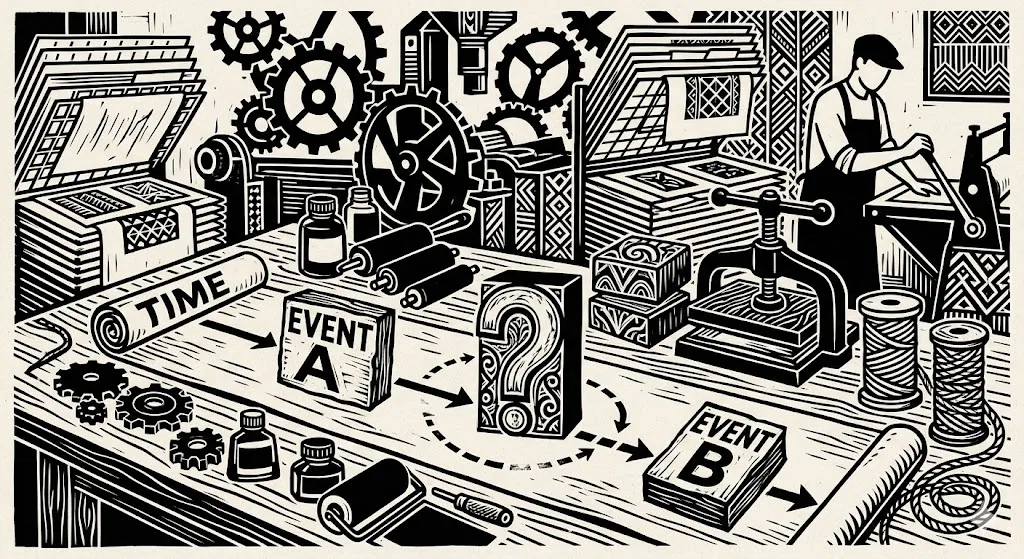
The basic pattern is simple:
- Event A happened.
- Event B happened afterwards.
- Therefore, A caused B.
That pattern is not always wrong. If someone presses a working light switch and the light immediately comes on, the sequence is good initial evidence. But it becomes weak when the argument ignores other plausible causes: a timer, another switch, a motion sensor, or a coincidence. The point is not that sequence proves nothing; it is that sequence alone rarely proves enough.
A useful way to see the gap is to ask a counterfactual question: if A had not happened, would B still have happened? Counterfactual theories of causation are built around this kind of test, asking whether the effect would have occurred without the supposed cause. In ordinary argument, this does not require formal philosophy. It means asking whether the same result was likely anyway, whether a background trend was already under way, or whether a different event better explains the outcome.[stanford]plato.stanford.eduEncyclopedia of Philosophy FallaciesThere are a number of fallacies associated with causation, the most frequently discussed is post hoc ergo propter hoc, (after this, there… Encyclopedia of Philosophy

Timing is a clue, not a verdict
Timing matters because a cause must usually come before its effect. If a claimed cause happened after the alleged effect, the claim is normally in serious trouble. Epidemiological reasoning has long treated temporality as one of the important viewpoints for assessing causation, but not as a complete test on its own. Modern discussions of the Bradford Hill viewpoints stress that causation is assessed through a pattern of evidence, including strength, consistency, dose-response relationships, plausibility, coherence and experimental support where available.[PMC]pmc.ncbi.nlm.nih.govOpen source on nih.gov.
That distinction helps separate a reasonable suspicion from a fallacy. Suppose a factory changes a chemical process in March and a nearby river shows pollution in April. The sequence is relevant. It gives investigators a reason to look at the factory. But a strong claim needs more: measurements before and after the change, evidence of the same substance in the discharge and the river, exclusion of other sources, and perhaps a pattern showing that pollution rises when the discharge rises.
The post hoc fallacy often appears when this middle stage is skipped. The argument jumps from “this happened before that” to “this explains that”, without showing the mechanism, ruling out alternatives, or checking whether the pattern repeats.
Alternative explanations are the heart of the problem
The most important question in post hoc reasoning is not “Could A have caused B?” but “What else could explain B just as well, or better?” False cause claims are tempting because real life rarely presents one clean event followed by one clean outcome. Several changes usually overlap.
Common alternative explanations include:[juliankingnz.substack.com]juliankingnz.substack.comSource details in endnotes.
- Coincidence: B followed A, but the two events were unrelated.
- Background trends: B was already becoming more likely before A happened.
- Common cause: A and B were both caused by a third factor.
- Reverse causation: B, or an early sign of B, caused A rather than the other way round.
- Regression to the mean: an unusually bad or good result was likely to move closer to normal anyway.
- Selection effects: people notice memorable sequences and forget all the times the same “cause” was followed by no effect.
This is why before-and-after stories are often weaker than they feel. A company may introduce a new training course and then see productivity rise. The course might have helped. But productivity may also have risen because demand changed, poor-performing equipment was replaced, a new manager arrived, seasonal workload shifted, or employees were already adapting. A post hoc claim chooses the most visible preceding event and treats it as decisive.
The weakness is not merely technical. It changes what people do next. If a business credits the wrong intervention, it may repeat an expensive ritual. If a patient credits the wrong remedy, they may abandon an effective treatment. If voters credit or blame the wrong policy, public debate moves away from the actual drivers of change.
Why the fallacy feels so convincing
Post hoc reasoning works on ordinary human habits of attention. People naturally look for causes, especially after surprising, costly or emotionally charged events. Psychological research on illusions of causality shows that people can perceive causal links between unrelated events, particularly when the events occur close together or when the outcome is important to them. In one review, Helena Matute and colleagues describe illusions of causality as beliefs that two events are causally connected when they are actually unrelated.[PMC]pmc.ncbi.nlm.nih.govOpen source on nih.gov.
Superstition shows the mechanism in a familiar form. A football fan wears a particular shirt and the team wins. The next time, the shirt feels lucky. The evidence is thin, but the sequence is vivid, personal and easy to remember. Research on illusory control similarly suggests that people may overestimate their influence over outcomes governed by chance; one study found that people who endorsed more superstitious beliefs showed stronger illusory control in a task where pressing a button had no objective effect on whether a light appeared.[Oxford University Research Archive]ora.ox.ac.ukSource details in endnotes.
Temporal closeness also matters. Work on human causal learning finds that people use timing as a cue in judging cause and effect. That is sensible: many real causes have regular delays. But the same cue can mislead when the mind treats closeness or predictability as stronger evidence than it really is.[euresis.org]euresis.orgEJv7id1 BuehnerEJv7id1 Buehner[PubMed]pubmed.ncbi.nlm.nih.govSource details in endnotes.
A public-health example: reports after vaccination
Vaccine safety reporting is a useful concrete example because it shows both sides of the issue. If a medical problem happens after vaccination, the timing should not be dismissed automatically. Safety systems are designed to notice possible signals. But the timing also does not prove the vaccine caused the problem.
The United States Vaccine Adverse Event Reporting System, known as VAERS, explicitly warns that a report generally does not prove causation. It confirms that an event was reported after vaccination; it does not require proof that the vaccine caused the event. The CDC similarly states that a VAERS report alone does not indicate whether a vaccine caused or contributed to an adverse event, and that such determinations require investigation by scientists and public health professionals.[vaers.hhs.gov]vaers.hhs.govGuide to Interpreting VAERS DataHHS.gov8 May 2025 — A report to VAERS generally does not prove that the identified vaccine(s) caused the adverse event described. It only…
This is not a minor caveat. Passive reporting systems are designed to be sensitive: they collect possible warning signs early, including reports that may later turn out to be unrelated. That design is useful for detecting patterns, but it also makes the raw reports easy to misuse. A false cause argument can take the form: “The event happened after the vaccine, so the vaccine caused it.” A responsible causal argument asks a different set of questions: Is the event more common among vaccinated people than comparable unvaccinated people? Is there a plausible biological mechanism? Does the risk appear in multiple data sources? Does it cluster within a credible time window? Does the pattern remain after accounting for age, health status and background rates?
The same reasoning applies beyond vaccines. Adverse-event reports, customer complaints, accident timelines and workplace incident logs can all be important starting points. They become fallacious only when a temporal report is treated as a finished causal conclusion.

What stronger causal evidence looks like
A good causal claim does not need absolute certainty, but it should show more than a sequence. Different fields use different methods, yet the broad checks are similar.
A credible time order: The proposed cause should occur before the effect in a time window that makes sense. If a medicine is alleged to cause an immediate allergic reaction, minutes or hours may be relevant. If an exposure is alleged to increase cancer risk, years may be relevant. Timing must fit the proposed mechanism, not merely appear in the right order.
A comparison group: The strongest question is not “Did B happen after A?” but “Did B happen more often with A than without A?” Randomised trials are valuable because randomisation helps balance known and unknown confounders between groups, reducing the risk that some other factor explains the difference. Cochrane guidance also notes that non-randomised studies can be necessary, but their results need cautious interpretation because potential biases are often greater.[Cochrane]cochrane.orgOpen source on cochrane.org.
A plausible mechanism: A cause is more credible when there is a realistic account of how it produces the effect. Mechanism alone is not proof, and lack of a known mechanism does not always rule out causation, but it helps distinguish a serious hypothesis from a coincidence dressed up as an explanation.
Consistency across cases: A single before-and-after story is weak. A repeated pattern across different settings, data sources or methods is stronger, especially when alternative explanations differ across those settings.
Dose-response or exposure pattern: When greater exposure is associated with greater effect, the causal claim often becomes more plausible. The Bradford Hill tradition treats such gradients as supportive, while modern discussions also caution that not every real cause has a simple linear dose-response pattern.[PMC]pmc.ncbi.nlm.nih.govOpen source on nih.gov.
Ruling out rival explanations: The most persuasive causal evidence actively tests competing explanations rather than ignoring them. This may involve controlling for confounders, using natural experiments, checking pre-existing trends, or testing whether the effect disappears when the cause is removed.
How false cause claims appear in everyday arguments
Post hoc reasoning is common because it fits the shape of a story: something changed, then something happened. It is especially tempting when people already like or dislike the supposed cause.
In politics, a government may take credit for an improving economy after a policy change, while opponents blame the same policy for later problems. Either claim may be right, partly right or wrong. The fallacy lies in treating the calendar as proof, rather than examining prior trends, external shocks, global conditions, delayed effects and comparable places where the policy did not occur.
In health and lifestyle claims, a person may begin a supplement, stop eating a food, change sleep habits and reduce stress in the same month. If symptoms improve, one change may receive all the credit. The better question is whether the improvement reliably follows that change across similar cases, whether symptoms naturally fluctuate, and whether a controlled comparison supports the link.
In workplaces, a new manager may arrive just before team performance rises. That can become a convenient story: the manager fixed the team. But performance may reflect market demand, staff changes, delayed results from earlier work, or measurement choices. The sequence is worth noting, but it is not a verdict.
In personal relationships, post hoc reasoning can become unfair blame: “Everything went wrong after you joined,” or “We started arguing after that trip, so the trip caused the problem.” The timing may mark a turning point, but it may also hide slower causes that were already present.
When a post hoc argument is not automatically fallacious
It would be too crude to say that before-and-after reasoning is always bad. Much practical reasoning begins with temporal clues. A doctor asks what changed before symptoms appeared. An engineer asks what was altered before a system failed. A historian asks what events preceded a revolution. The difference is that good inquiry treats sequence as a lead, not a conclusion.
Some sources on fallacies warn that labelling every temporal inference as “post hoc” can itself be careless. A before-and-after comparison may be reasonable when one relevant change stands out, when the effect follows in a plausible time frame, and when alternative explanations have been considered. The fallacy is not the use of timing; it is the overuse of timing.[Encyclopedia.com]encyclopedia.comSource details in endnotes.
A fair test is to ask whether the argument would survive if the words “after that” were removed. If the only support left is the order of events, the claim is weak. If there is also a mechanism, comparison, repeated pattern and serious engagement with alternatives, then the argument may be a legitimate causal inference rather than a fallacy.
A practical check before accepting a false cause claim
When a claim says one event caused another, a quick evidence check can prevent the most common mistakes:
- What exactly is the alleged cause and effect? Vague claims are harder to test.
- Did the cause clearly come first? If not, the claim may involve reverse causation or confusion over timing.
- Is the time gap plausible? Too short or too long a gap may weaken the explanation unless a mechanism explains it.
- What else changed at the same time? Look for confounders, background trends and common causes.
- What would probably have happened without the alleged cause? This counterfactual question is often the centre of causal reasoning.
- Is there a comparison group or baseline rate? A raw “after” count is rarely enough.
- Does the pattern repeat? One striking example may be coincidence; repeated evidence is harder to dismiss.
- Has the claim ruled out rival explanations, or merely ignored them? The latter is the signature of a false cause argument.
These questions do not demand perfection. Everyday decisions often have to be made with incomplete evidence. But they change the standard from “Can I tell a story where A caused B?” to “Is A the best-supported explanation among the realistic alternatives?”
The core takeaway
Post hoc reasoning is powerful because it begins with something real: causes do come before effects, and timelines often matter. Its failure is stopping there. A false cause claim turns a clue into a conclusion before the evidence has earned it.
The safest habit is to treat sequence as an invitation to investigate. Ask what else could explain the result, what would have happened otherwise, and what evidence would distinguish the proposed cause from coincidence, background trends or a third factor. That habit does not make causal judgement effortless, but it prevents one of the most common ways weak arguments become persuasive.
eBay marketplace picks
Marketplace Samples
Example marketplace items related to this page. Use the search link to explore similar finds on eBay.




Endnotes
1.
Source: plato.stanford.edu
Title: Encyclopedia of Philosophy Fallacies
Link:https://plato.stanford.edu/entries/fallacies/
Source snippet
There are a number of fallacies associated with causation, the most frequently discussed is post hoc ergo propter hoc, (after this, there...
2.
Source: vaers.hhs.gov
Title: Guide to Interpreting VAERS Data
Link:https://vaers.hhs.gov/data/dataguide.html
Source snippet
HHS.gov8 May 2025 — A report to VAERS generally does not prove that the identified vaccine(s) caused the adverse event described. It only...
Published: May 2025
3.
Source: plato.stanford.edu
Title: causation counterfactual
Link:https://plato.stanford.edu/entries/causation-counterfactual/
Source snippet
Stanford Encyclopedia of PhilosophyCounterfactual Theories of Causationby P Menzies · 2001 · Cited by 611 — The basic idea of counterfact...
4.
Source: plato.stanford.edu
Title: Encyclopedia of Philosophy [Counterfactuals]({{ ‘counterfactuals/’ | relative_url }})
Link:https://plato.stanford.edu/entries/counterfactuals/
5.
Source: pmc.ncbi.nlm.nih.gov
Link:https://pmc.ncbi.nlm.nih.gov/articles/PMC8206235/
6.
Source: pmc.ncbi.nlm.nih.gov
Link:https://pmc.ncbi.nlm.nih.gov/articles/PMC4488611/
7.
Source: euresis.org
Title: EJv7id1 Buehner
Link:https://euresis.org/wp-content/uploads/2019/06/EJv7id1_Buehner.pdf
8.
Source: cdc.gov
Link:https://www.cdc.gov/vaccine-safety-systems/vaers/index.html
9.
Source: cochrane.org
Link:https://www.cochrane.org/authors/handbooks-and-manuals/handbook/current/chapter-08
10.
Source: cochrane.org
Link:https://www.cochrane.org/authors/handbooks-and-manuals/handbook/current/chapter-24
11.
Source: encyclopedia.com
Link:https://www.encyclopedia.com/humanities/encyclopedias-almanacs-transcripts-and-maps/fallacies
12.
Source: cdc.gov
Link:https://www.cdc.gov/mmwr/preview/mmwrhtml/ss5201a1.htm
13.
Source: plato.stanford.edu
Title: causation metaphysics
Link:https://plato.stanford.edu/entries/causation-metaphysics/
14.
Source: methods.cochrane.org
Link:https://methods.cochrane.org/defining-and-determining-which-quantitative-study-designs-include-your-systematic-review-effects
15.
Source: cochrane.org
Link:https://www.cochrane.org/authors/handbooks-and-manuals/handbook/current/chapter-23
16.
Source: archive.org
Link:https://archive.org/download/ThinkingFallacies/ThinkingFallacies-Part1.pdf
17.
Source: vaers.hhs.gov
Link:https://vaers.hhs.gov/data.html
18.
Source: writingcenter.unc.edu
Title: The Writing Center Fallacies
Link:https://writingcenter.unc.edu/tips-and-tools/fallacies/
Source snippet
The Writing CenterFallacies - The Writing CenterPost hoc (also called false cause). This fallacy gets its name from the Latin phrase “pos...
19.
Source: ora.ox.ac.uk
Link:https://ora.ox.ac.uk/objects/uuid%3A460038d5-1e53-47c2-941b-52dce3ef8a03/files/m23402a193143a1e3912d3d6b10934f9c
20.
Source: pubmed.ncbi.nlm.nih.gov
Link:https://pubmed.ncbi.nlm.nih.gov/12850993/
21.
Source: Wikipedia
Title: Post hoc ergo propter hoc
Link:https://en.wikipedia.org/wiki/Post_hoc_ergo_propter_hoc
22.
Source: Wikipedia
Link:https://en.wikipedia.org/wiki/Fallacy
23.
Source: dictionary.cambridge.org
Link:https://dictionary.cambridge.org/dictionary/english/false
24.
Source: tureng.com
Link:https://tureng.com/en/turkish-english/false
25.
Source: quillbot.com
Title: post hoc fallacy
Link:https://quillbot.com/blog/reasoning/post-hoc-fallacy/
26.
Source: scribbr.co.uk
Title: Post Hoc Fallacy | Definition & Examples
Link:https://www.scribbr.co.uk/fallacy/the-post-hoc-fallacy/
27.
Source: legal-resources.uslegalforms.com
Title: post hoc ergo propter hoc
Link:https://legal-resources.uslegalforms.com/p/post-hoc-ergo-propter-hoc
28.
Source: explorable.com
Title: Post Hoc Reasoning
Link:https://explorable.com/post-hoc-reasoning
29.
Source: philpapers.org
Title: Counterfactual theories of causation
Link:https://philpapers.org/rec/MENCTO
30.
Source: study.com
Title: Post Hoc Fallacy | Definition & Examples
Link:https://study.com/learn/lesson/video/post-hoc-fallacy-overview-examples.html
31.
Source: study.com
Title: Post Hoc Fallacy | Definition & Examples
Link:https://study.com/learn/lesson/post-hoc-fallacy-overview-examples.html
32.
Source: utminers.utep.edu
Link:https://utminers.utep.edu/omwilliamson/engl1311/fallacies.htm
33.
Source: afterall.net
Title: post hoc
Link:https://afterall.net/illogic/causal/post-hoc/
Additional References
34.
Source: iep.utm.edu
Link:https://iep.utm.edu/fallacy/
Source snippet
Internet Encyclopedia of PhilosophyFallaciesIts four principal kinds are the Post Hoc Fallacy, the Fallacy of Cum Hoc... This label is L...
35.
Source: youtube.com
Title: Can you outsmart the fallacy that fooled a generation of doctors?
Link:https://www.youtube.com/watch?v=8HLtFv_KqoE
Source snippet
What is The Post Hoc Fallacy? | Critical Thinking Basics...
36.
Source: researchgate.net
Link:https://www.researchgate.net/publication/327223124_Superstition_predicts_perception_of_illusory_control
37.
Source: researchgate.net
Link:https://www.researchgate.net/publication/47642331_Temporal_Predictability_Facilitates_Causal_Learning
38.
Source: helpfulprofessor.com
Link:https://helpfulprofessor.com/false-cause-fallacy-examples/
39.
Source: juliankingnz.substack.com
Link:https://juliankingnz.substack.com/p/applying-bradford-hill-criteria-to
40.
Source: usablebuildings.co.uk
Link:https://www.usablebuildings.co.uk/UsableBuildings/Unprotected/BradfordHillCriteria.pdf
41.
Source: 1000wordphilosophy.com
Link:https://1000wordphilosophy.com/2025/12/20/causation/
42.
Source: alisongopnik.com
Link:https://alisongopnik.com/Papers_Alison/Kushnir%20DevPsych.pdf
43.
Source: reddit.com
Link:https://www.reddit.com/r/askphilosophy/comments/rzyky4/difference_between_non_causa_pro_causa_post_hoc/
Topic Tree