Within Rumours
When sharing looks like evidence
Many reposts can look like many witnesses, even when they all trace back to the same unverified source.
On this page
- Why repetition feels like corroboration
- How visible engagement signals shape trust
- How to trace one rumour back to its source
Page outline Jump by section
Introduction
One of the most persuasive mistakes in online rumours is treating widespread sharing as if it were independent confirmation. A claim appears on social media, is reposted thousands of times, discussed in comments, copied into screenshots, and repeated across multiple platforms. By the time many people encounter it, the rumour seems to have been verified by sheer volume. In reality, all those apparent confirmations may trace back to a single unverified source.
 This fallacy matters because people often use repetition as a shortcut for credibility. If dozens of accounts appear to be reporting the same thing, it can feel as though dozens of people have independently checked it. Yet viral circulation and independent evidence are different things. A rumour can spread extremely widely without gaining a single new piece of supporting evidence. Research on online misinformation repeatedly shows that false claims can spread rapidly and broadly, creating a powerful illusion of corroboration.[Science]science.orgused a data set of rumor cascades on Twitter from 2006 to 2017. About 126,000 rumors were…Read more…[MIT News]news.mit.edustudy twitter false news travels faster true stories 0308MIT NewsStudy: On Twitter, false news travels faster than true stories8 Mar 2018 — A new study by three MIT scholars has found that false…
Why Repetition Feels Like Corroboration
The core mechanism is simple: people naturally infer that repeated information has been checked by others. In everyday life, hearing the same account from several genuinely independent witnesses often does increase confidence. The problem arises when that intuition is applied to networked communication, where many messages may originate from the same source.
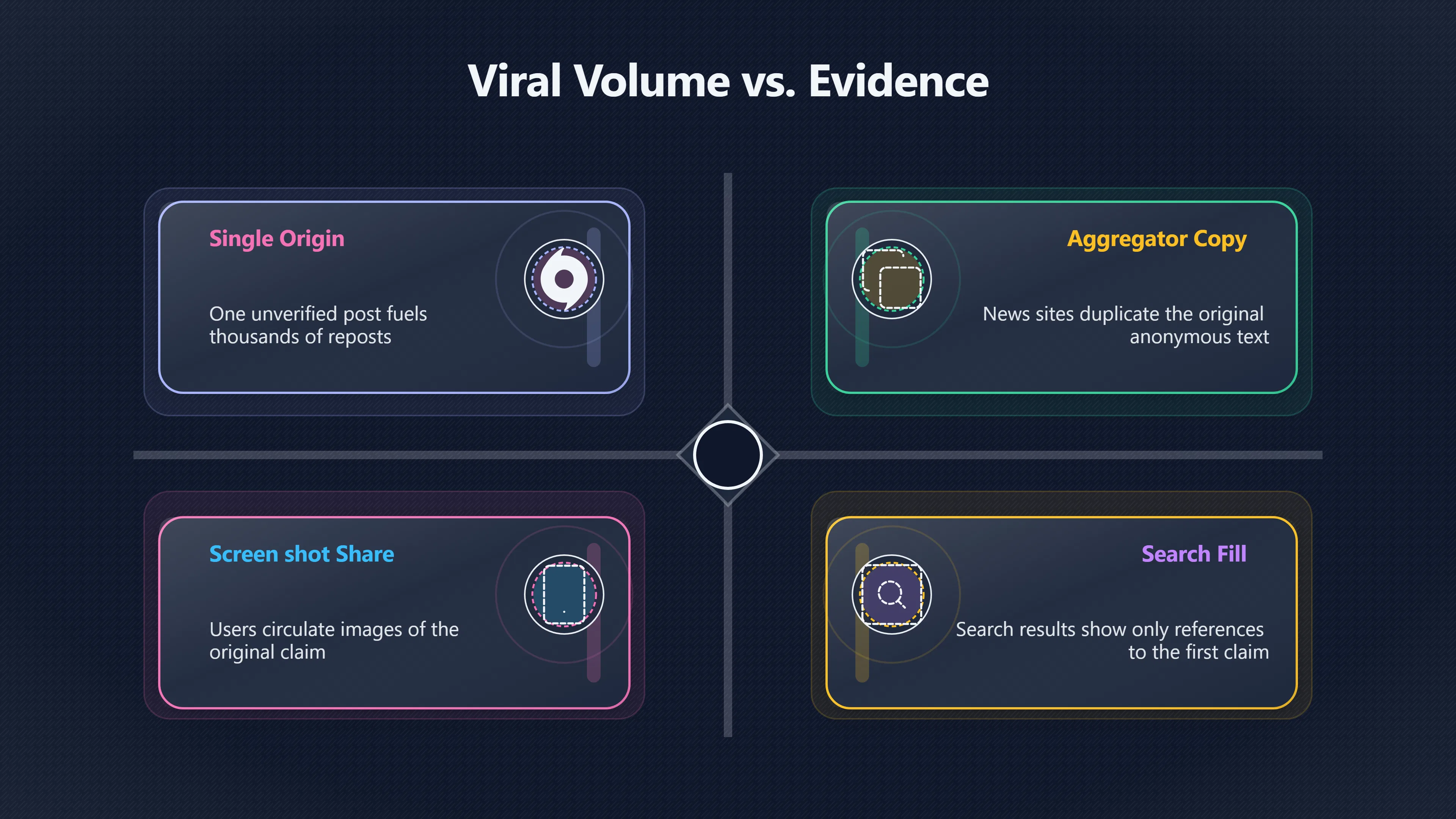
A rumour might begin with one anonymous post. News aggregators copy it. Influencers share screenshots. Users repost excerpts. Commenters repeat summaries. Search results fill with references to the claim. To a casual observer, the information appears to have multiple sources when it actually has only one.
The logical error occurs when the number of repetitions is mistaken for the number of independent observations. Ten thousand reposts of one claim do not automatically provide more evidence than the original post. They merely show that the claim travelled.
This distinction is especially important online because platforms make duplication highly visible while often hiding source relationships. A user may see hundreds of accounts discussing a rumour without realising they are all referring to the same initial statement.
How Visible Engagement Signals Shape Trust
Social media platforms display engagement cues such as likes, shares, repost counts, views, reactions, and comments. These signals were not designed as evidence, but people frequently interpret them as indicators of credibility.
Studies show that social engagement metrics influence how users interact with content. Seeing that many others have engaged with a post can increase attention and willingness to share it. Researchers have also found that exposure to engagement metrics can increase vulnerability to misinformation under some conditions.[arXiv]arxiv.orgHow many others have shared this? Experimentally investigating the effects of social cues on engagement, misinformation, and unpredi…
The psychological effect is understandable. Large numbers imply collective judgement. A post with 100,000 shares appears socially validated, even when those shares reveal nothing about whether the claim is true.
Several factors amplify this tendency:
- Perceived popularity: People often assume widely shared claims have already been checked.
- Perceived consensus: Repetition creates the impression that many people independently agree.
- Reduced scrutiny: Social proof can lower the motivation to investigate further.
- Attention effects: High-engagement content receives more visibility, creating additional opportunities for repetition.
Research on misinformation and platform design suggests that engagement-based systems can create feedback loops in which visibility generates more engagement, which in turn generates more visibility. PMC[ScienceDirect]sciencedirect.comRanking for engagement: How social media algorithms fuel…by F Germano · 2026 · Cited by 16 — Boosting sharing-based engag…
When Many Sources Are Really One Source
A useful question when assessing a rumour is not “How many places mention this?” but “How many independent sources support it?”
Consider a typical online chain:
- An anonymous account makes a claim.
- Several users repost it.
- A blog writes an article based on the reposts.
- Other sites cite the blog.
- Social media users share screenshots of those articles.[pirg.org]pirg.orgmisinformation on social mediaHow misinformation on social media has changed news30 Jul 2025 — Misinformation that seems real - but isn't - rapidly circulates through…
At first glance, the rumour appears to be supported by numerous accounts, websites, and discussions. Yet every link in the chain depends on the same original assertion.
This phenomenon is sometimes called source laundering or source circularity. Information gains an appearance of legitimacy because it is repeated through multiple channels, not because new evidence has emerged. The rumour becomes surrounded by references to itself.
The result is a misleading form of apparent consensus. What looks like corroboration is often merely distribution.

The Illusion of Truth Through Repetition
Another reason viral rumours feel convincing is that repeated exposure can increase perceived truthfulness. Psychologists refer to this tendency as the illusory truth effect: information often feels more believable simply because it has been encountered before. Taylor & Francis Online[ResearchGate Importantly]researchgate.netThe illusory truth effect leads to the spread of misinformation23 Apr 2026 — By rewarding engagement over accuracy, social me…, familiarity is not the same as verification.
A person may encounter a claim:
- in a social media post,[pirg.org]pirg.orgmisinformation on social mediaHow misinformation on social media has changed news30 Jul 2025 — Misinformation that seems real - but isn't - rapidly circulates through…
- in a reposted screenshot,
- in a comment thread,
- in a discussion forum,
- and in a messaging app.
Even when all versions ultimately derive from the same source, the repeated encounters can create a feeling that the information is established fact. Familiarity is experienced as confidence.
This helps explain why some rumours continue circulating after they have been questioned or debunked. Repetition leaves a cognitive trace even when supporting evidence remains weak.
Why Viral Rumours Spread So Easily
The appearance of confirmation is strengthened by the kinds of stories that tend to go viral. Research examining large-scale rumour diffusion on social networks found that false news spread farther, faster, deeper, and more broadly than truthful information in the studied dataset.[Science]science.orgused a data set of rumor cascades on Twitter from 2006 to 2017. About 126,000 rumors were…Read more… PubMed A viral rumour often succeeds because it is:[journals.sagepub.com]journals.sagepub.comSage JournalsHow trust feedback reduces misinformation on social mediaBy rewarding engagement over accuracy, social media platforms foste…
- surprising,
- emotionally engaging,
- alarming,
- identity-affirming,
- or highly shareable.
These qualities affect transmission, not accuracy.
In practice, users frequently share content for reasons unrelated to belief. Some share to discuss it, joke about it, criticise it, or signal group identity. Research suggests that sharing behaviour and accuracy judgements can diverge; people do not always treat truthfulness as the primary factor when deciding what to circulate.[Nature]nature.comShifting attention to accuracy can reduce misinformation…by G Pennycook · 2021 · Cited by 1596 — First, we find that the veracit…
As a result, a large volume of sharing can reflect attention rather than confirmation.
How to Trace One Rumour Back to Its Source
The most effective response to the viral-proof fallacy is to examine origins rather than volume.
Digital literacy researchers often recommend forms of lateral reading and source tracing that focus on finding the earliest evidence behind a claim rather than relying on how often it appears.[UChicago Library Guides]guides.lib.uchicago.eduLibrary Guides The SIFT MethodUChicago Library GuidesThe SIFT Method - Evaluating Resources and Misinformation30 Jun 2025 — The SIFT method is an evaluation strategy d…[2libguides.mnsu.edu]libguides.mnsu.eduSource Evaluation: Using Lateral Reading & SIFT26 Mar 2026 — Lateral reading provides a more complete picture of the credibility of a sou…
A practical approach is:
- Stop before accepting popularity as evidence.
- Identify the earliest version you can find.
- Ask who originally made the claim.
- Look for independent reporting or documentation.
- Check whether later articles are citing one another rather than new evidence.
- Distinguish primary evidence from commentary and reposts.
A rumour’s credibility changes dramatically when traced back to its source. What looked like hundreds of confirmations may collapse into a single unverified statement.
The Key Distinction: Reach Is Not Evidence
The central lesson is straightforward. Viral sharing measures reach, not truth. A rumour can accumulate millions of views, thousands of comments, and widespread discussion without gaining any additional evidential support.
Independent confirmation requires separate sources that arrive at the same conclusion through their own observations, records, investigations, or testimony. Repetition alone does not meet that standard.
In the context of rumours and unverified claims, the fallacy arises when social visibility is treated as proof. The number of times a claim is shared may tell us how effectively it travelled through a network. It does not, by itself, tell us whether the claim is true.[Sage Journals]journals.sagepub.comSage JournalsHow trust feedback reduces misinformation on social mediaBy rewarding engagement over accuracy, social media platforms foste…[Science]science.orgused a data set of rumor cascades on Twitter from 2006 to 2017. About 126,000 rumors were…Read more…[MIT News]news.mit.edustudy twitter false news travels faster true stories 0308MIT NewsStudy: On Twitter, false news travels faster than true stories8 Mar 2018 — A new study by three MIT scholars has found that false…
eBay marketplace picks
Marketplace Samples
Example marketplace items related to this page. Use the search link to explore similar finds on eBay.







Endnotes
1.
Source: news.mit.edu
Title: study twitter false news travels faster true stories 0308
Link:https://news.mit.edu/2018/study-twitter-false-news-travels-faster-true-stories-0308
Source snippet
MIT NewsStudy: On Twitter, false news travels faster than true stories8 Mar 2018 — A new study by three MIT scholars has found that false...
2.
Source: arxiv.org
Link:https://arxiv.org/abs/2207.07562
Source snippet
How many others have shared this? Experimentally investigating the effects of social cues on engagement, misinformation, and unpredi...
3.
Source: arxiv.org
Link:https://arxiv.org/abs/2005.04682
4.
Source: pmc.ncbi.nlm.nih.gov
Link:https://pmc.ncbi.nlm.nih.gov/articles/PMC11373151/
Source snippet
Social Drivers and Algorithmic [Mechanisms]({{ 'mechanisms/' | relative_url }}) on Digital Mediaby H Metzler · 2023 · Cited by 304 — Algorithmic mechanisms on digital media...
5.
Source: sciencedirect.com
Link:https://www.sciencedirect.com/science/article/pii/S0047272726000253
Source snippet
Ranking for engagement: How social media algorithms fuel...by F Germano · 2026 · Cited by 16 — Boosting sharing-based engag...
6.
Source: researchgate.net
Link:https://www.researchgate.net/publication/369031522_The_illusory_truth_effect_leads_to_the_spread_of_misinformation
Source snippet
The illusory truth effect leads to the spread of misinformation23 Apr 2026 — By rewarding engagement over accuracy, social me...
7.
Source: nature.com
Link:https://www.nature.com/articles/s41586-021-03344-2
Source snippet
Shifting attention to accuracy can reduce misinformation...by G Pennycook · 2021 · Cited by 1596 — First, we find that the veracit...
8.
Source: guides.lib.uchicago.edu
Title: Library Guides The SIFT Method
Link:https://guides.lib.uchicago.edu/c.php?g=1241077&p=9082322
Source snippet
UChicago Library GuidesThe SIFT Method - Evaluating Resources and Misinformation30 Jun 2025 — The SIFT method is an evaluation strategy d...
9.
Source: libguides.mnsu.edu
Link:https://libguides.mnsu.edu/sourcecredibility/lateralreading
Source snippet
Source Evaluation: Using Lateral Reading & SIFT26 Mar 2026 — Lateral reading provides a more complete picture of the credibility of a sou...
10.
Source: ide.mit.edu
Title: 2017 IDE Research Brief False News
Link:https://ide.mit.edu/wp-content/uploads/2018/12/2017-IDE-Research-Brief-False-News.pdf
Source snippet
SPREAD OF TRUE AND FALSE NEWS ONLINEby S Vosoughi — With this research in hand, we can consider the implications of false news on hotly d...
11.
Source: wittenberg.libguides.com
Link:https://wittenberg.libguides.com/c.php?g=1484462&p=11070234
Source snippet
Reading / SIFT Method - Communication & Digital...When evaluating web sources, "lateral reading" ("lateral" meaning "side-to-side") refe...
12.
Source: youtube.com
Title: How false news can spread
Link:https://www.youtube.com/watch?v=cSKGa_7XJkg
Source snippet
Illusory Truth Effect...
13.
Source: youtube.com
Title: Illusory Truth Effect
Link:https://www.youtube.com/watch?v=cXFxRkjZNiw
Source snippet
How does misleading and emotionally charged content spread faster than facts?...
14.
Source: science.org
Link:https://www.science.org/doi/10.1126/science.aap9559
Source snippet
used a data set of rumor [cascades]({{ 'cascades/' | relative_url }}) on Twitter from 2006 to 2017. About 126,000 rumors were...Read more...
15.
Source: journals.sagepub.com
Link:https://journals.sagepub.com/doi/10.1177/23794607261423714
Source snippet
Sage JournalsHow trust feedback reduces misinformation on social mediaBy rewarding engagement over accuracy, social media platforms foste...
16.
Source: pubmed.ncbi.nlm.nih.gov
Link:https://pubmed.ncbi.nlm.nih.gov/29590045/
Source snippet
spread of true and false news onlineby S Vosoughi · 2018 · Cited by 14070 — We investigated the differential diffusion of all of the veri...
17.
Source: libguides.clackamas.edu
Link:https://libguides.clackamas.edu/research-help/sift
Source snippet
Research help18 May 2026 — SIFT is a set of four fact-checking strategies that guide you through quickly making a decision about whether...
Published: May 2026
18.
Source: library.nwacc.edu
Link:https://library.nwacc.edu/lateralreading/sift
Source snippet
nwacc.eduLibGuides: Lateral Reading: SIFT It8 Apr 2026 — Lateral Reading: SIFT It. An introduction to lateral reading skills and techniqu...
Additional References
19.
Source: saskoer.ca
Link:https://www.saskoer.ca/disinformation/chapter/5-6-lateral-reading/
Source snippet
5.6 Lateral Reading – DisinformationLateral reading is a popular method for verifying information. It works like this: when someone searc...
20.
Source: facebook.com
Link:https://www.facebook.com/AmericanPsychologicalAssociation/posts/you-keep-seeing-the-same-claim-made-over-and-over-onlineso-it-must-be-true-right/1290086699819665/
21.
Source: pbs.org
Title: false news travels 6 times faster on twitter than truthful news
Link:https://www.pbs.org/newshour/science/false-news-travels-6-times-faster-on-twitter-than-truthful-news
Source snippet
9 Mar 2018 — False news -- inaccurate information presented as truth or opinion presented as fact -- is 70 percent more likely to be retw...
22.
Source: guides.lib.byu.edu
Link:https://guides.lib.byu.edu/c.php?g=216428&p=10146879
Source snippet
Management: Source Evaluation (SIFT)6 May 2026 — The SIFT method helps analyze information, especially news or other online media...
Published: May 2026
23.
Source: youtube.com
Title: The Illusion of Truth: Why Your Brain Believes Familiar Lies
Link:https://www.youtube.com/watch?v=AbsgLRfqsiA
Source snippet
This curated selection of videos directly addresses the concept of viral sharing mistaken for independent confirmation by exploring the p...
24.
Source: insights.som.yale.edu
Title: how social media rewards misinformation
Link:https://insights.som.yale.edu/insights/how-social-media-rewards-misinformation
Source snippet
Yale InsightsHow Social Media Rewards Misinformation | Yale Insights31 Mar 2023 — A majority of false stories are spread by a small numbe...
25.
Source: pirg.org
Title: misinformation on social media
Link:https://pirg.org/edfund/articles/misinformation-on-social-media/
Source snippet
How misinformation on social media has changed news30 Jul 2025 — Misinformation that seems real - but isn't - rapidly circulates through...
26.
Source: libguides.calstatela.edu
Link:https://libguides.calstatela.edu/c.php?g=1450827&p=10783864
Source snippet
Reading and Fact-Checking - LibGuides - Cal State LA14 Oct 2025 — Lateral reading is: a powerful digital literacy strategy used by fact-c...
27.
Source: misinforeview.hks.harvard.edu
Title: pausing reduce false news
Link:https://misinforeview.hks.harvard.edu/article/pausing-reduce-false-news/
Source snippet
to consider why a headline is true or false can...by L Fazio · 2020 · Cited by 281 — In an online experiment, participants who paused to...
28.
Source: mediahelpingmedia.org
Title: sift for fact checking
Link:https://mediahelpingmedia.org/basics/sift-for-fact-checking/
Source snippet
SIFT for fact-checking30 Mar 2025 — SIFT teaches students how to critically evaluate information online through four steps: Stop, Investi...
Topic Tree