Within Tradition
Why Familiar Choices Feel Safer
Familiar options can feel less risky even when nobody has compared them fairly with available alternatives.
On this page
- How the current option gains an unfair advantage
- Everyday decisions where the old way escapes scrutiny
- How to compare old and new options fairly
Page outline Jump by section
Introduction
Status quo bias is the tendency to prefer the current state of affairs simply because it is the current state. Within discussions of appeal to tradition and familiar practices, it helps explain why existing methods often seem safer, more sensible or less risky than proposed alternatives, even when nobody has compared the options carefully. Researchers have repeatedly found that people disproportionately stick with default choices and established arrangements, not necessarily because those options are better, but because change feels uncertain and psychologically costly.[Springer]link.springer.comStatus quo bias in decision makingStatus quo bias in decision making - Springer Natureby W Samuelson · 1988 · Cited by 9272 — A series of decision-making experimen…[ResearchGate]researchgate.netResearchGate(PDF) Status Quo Bias in Decision-MakingA series of decision-making experiments shows that individuals disproportionately sti…
 This bias matters because it can make familiar practices appear self-justifying. When people argue that a procedure, rule or habit should continue because it is already in place, they may be relying less on evidence and more on a cognitive preference for what feels normal. Status quo bias therefore provides one of the psychological mechanisms that can make appeal-to-tradition arguments persuasive.
How the Current Option Gains an Unfair Advantage
The key feature of status quo bias is that the existing option is not judged by the same standard as alternatives. A proposed change must prove itself, while the current arrangement often escapes equivalent scrutiny.
In classic experiments by William Samuelson and Richard Zeckhauser, participants were more likely to select an option when it was presented as the existing choice than when the same option was presented without any special status. Simply labelling an alternative as the status quo increased its attractiveness.[Springer]link.springer.comA review of current…by ME Godefroid · 2023 · Cited by 135 — Samuelson and Zeckhauser (1988) identified the cognitive misperception of…
Several psychological processes help create this advantage:
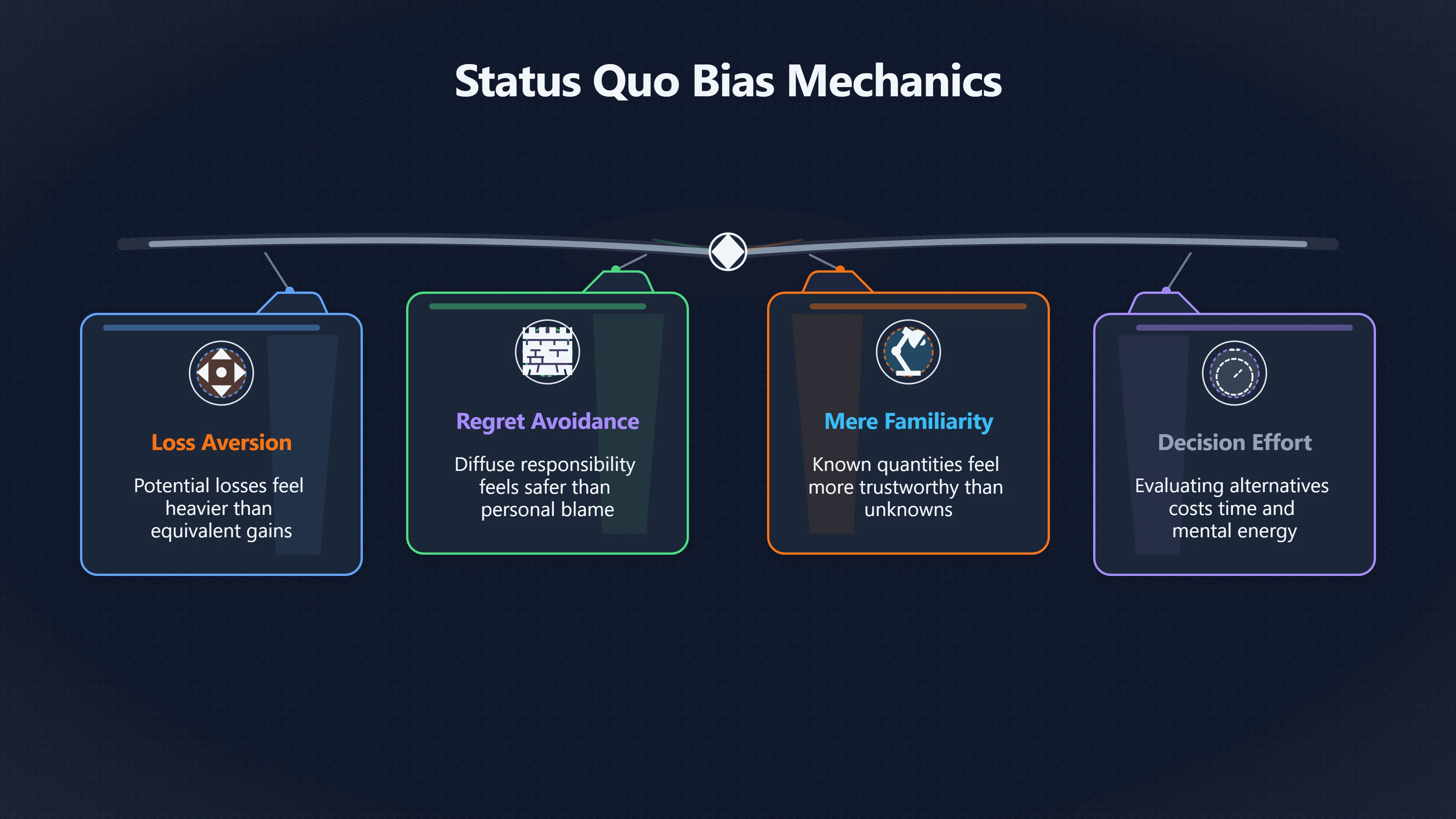
- Loss aversion: People tend to experience potential losses more intensely than equivalent gains. Any change is easily framed as giving something up, while the benefits remain uncertain.[Wikipedia]WikipediaStatus quo biasStatus quo bias
- Regret avoidance: If a person keeps the current system and problems occur, responsibility feels diffuse. If they actively choose a new option and problems occur, they may feel personally responsible.[Wikipedia]WikipediaStatus quo biasStatus quo bias
- Mere familiarity: Repeated exposure often increases comfort and perceived trustworthiness. Existing practices have the advantage of being known quantities.[Wikipedia]WikipediaStatus quo biasStatus quo bias
- Decision effort: Evaluating alternatives requires time, information and mental energy. Leaving things unchanged often feels easier.[Wharton Executive Education]executiveeducation.wharton.upenn.eduSource details in endnotes.
Together, these mechanisms make familiarity feel like evidence, even when no evidence has actually been examined.
Why Familiar Often Feels Safer Than Unknown
Status quo bias is especially strong when uncertainty is present. People may know that a current practice has flaws, yet still prefer it because its risks are familiar.
This does not mean people believe the existing arrangement is perfect. Rather, they often know more about its weaknesses than about the weaknesses of alternatives. The known defects of the current system can feel less threatening than the unknown defects of a proposed replacement.
Behavioural researchers have shown that people frequently treat departures from the current state as potential losses relative to a mental reference point. The existing arrangement becomes the baseline against which everything else is measured. Because losses loom larger than gains, change starts at a psychological disadvantage.[Wikipedia]WikipediaStatus quo biasStatus quo bias
This is one reason appeals to tradition can sound convincing. A speaker does not always need to demonstrate that an old practice works better. It may be enough to highlight uncertainty about change. Once the current arrangement is mentally framed as the safe baseline, alternatives can appear risky by comparison.
Everyday Decisions Where the Old Way Escapes Scrutiny
Status quo bias appears in many ordinary decisions, often in situations where no strong evidence supports the preference for the existing option.
Default Choices
One of the most striking examples involves default settings. Research on organ-donation systems has found large differences between countries that require people to opt in and those that automatically enrol people unless they opt out. Many individuals stay with the default rather than actively changing it, even though the decision is important.[The Decision Lab]thedecisionlab.comStatus Quo BiasFirst, we prefer the norm because of two other cognitive biases: loss aversion and regret avoidance. Second, we prefer the…[PMC]pmc.ncbi.nlm.nih.govto donate organs: do what you like or like what we do?by S Beraldo · 2021 · Cited by 39 — An effective method to increase the number of p…
The lesson is not merely about organ donation. It demonstrates how powerfully people gravitate toward what is already designated as the current choice.
Workplace Practices
Organisations frequently continue using established procedures long after circumstances have changed. Employees may defend familiar reporting systems, meeting structures or technologies because replacing them introduces uncertainty and learning costs. Resistance often stems from attachment to the current arrangement rather than a demonstrated superiority of the existing process.[SUE Behavioural Design]suebehaviouraldesign.comstatus quo bias at workEvery alternative is unconsciously measured against the current situation as the…Read more…
Personal Financial Decisions
Studies cited in the original status quo bias research found substantial inertia in decisions involving health plans and retirement programmes. Individuals often remained with existing selections even when alternatives were available and potentially beneficial.[ResearchGate]researchgate.netResearchGate(PDF) Status Quo Bias in Decision-MakingA series of decision-making experiments shows that individuals disproportionately sti…
In each case, the existing option benefits from a hidden advantage: it does not have to earn trust from scratch.
Status Quo Bias Versus Reasonable Caution
Not every preference for existing arrangements is irrational. Sometimes the current option genuinely is better.
A long-established procedure may embody valuable experience. Changing systems can involve real costs, hidden dependencies and unintended consequences. In some situations, caution toward reform is entirely justified.
The critical question is whether the current arrangement is being defended because of evidence or because it is familiar.
A reasonable argument might say:
The existing process has been tested repeatedly, performs well on these measures, and proposed alternatives have not yet demonstrated comparable results.
Status quo bias(#endnote-3 “Endnote 3”) as argument is closer to:[Wikipedia]WikipediaStatus quo biasStatus quo bias
The existing process is already in place, so changing it is probably a mistake.
The first compares evidence. The second gives the current option special treatment.
Recognising this distinction helps separate prudent conservatism from an unexamined preference for familiarity.
How to Compare Old and New Options Fairly
Because status quo bias gives existing practices an automatic advantage, fair comparison requires deliberate effort.
One useful approach is to imagine that neither option currently exists. If both the old and new arrangements were presented for the first time today, which would be chosen?
Another method is to evaluate alternatives using the same criteria:
- What benefits does the current practice provide?
- What costs does it impose?
- What benefits would the alternative provide?
- What costs would it impose?
- Which risks are known, and which are merely more familiar?
Researchers have also proposed thought experiments such as the “reversal test”, which asks whether people would oppose changes in both directions. If increasing a feature seems bad and decreasing it also seems bad, the current level may be receiving special protection simply because it is the current level.[Wikipedia]WikipediaStatus quo biasStatus quo bias
The goal is not to favour change. It is to remove the hidden bonus that familiarity gives to existing arrangements.

Why Status Quo Bias Matters for Appeal to Tradition
Status quo bias helps explain why appeals to tradition feel persuasive even when they provide little evidence. Familiar practices often appear safer, more legitimate and less risky than alternatives because people evaluate them from a privileged psychological position.
The bias does not prove that traditions are wrong. Many traditions survive because they are useful. What it does show is that survival and familiarity are not enough on their own. An old practice deserves the same scrutiny as a new proposal. When both are evaluated by the same standards, familiarity stops functioning as evidence and becomes merely one fact among many.
Amazon book picks
Further Reading
Books and field guides related to Why Familiar Choices Feel Safer. Use these as the next step if you want deeper reading beyond the article.
Thinking, Fast and Slow
Explains status quo bias, loss aversion and why familiar options feel safer.
The Art of Thinking Clearly
Covers common biases that favour existing choices over alternatives.
eBay marketplace picks
Marketplace Samples
Example marketplace items related to this page. Use the search link to explore similar finds on eBay.







Endnotes
1.
Source: link.springer.com
Title: Status quo bias in decision making
Link:https://link.springer.com/article/10.1007/BF00055564
Source snippet
Status quo bias in decision making - Springer Natureby W Samuelson · 1988 · Cited by 9272 — A series of decision-making experimen...
2.
Source: researchgate.net
Link:https://www.researchgate.net/publication/5152072_Status_Quo_Bias_in_Decision-Making
Source snippet
ResearchGate(PDF) Status Quo Bias in Decision-MakingA series of decision-making experiments shows that individuals disproportionately sti...
3.
Source: Wikipedia
Title: Status quo bias
Link:https://en.wikipedia.org/wiki/Status_quo_bias
4.
Source: pmc.ncbi.nlm.nih.gov
Link:https://pmc.ncbi.nlm.nih.gov/articles/PMC12413501/
Source snippet
Donation Decisions: When Deviating from the Status...by M Motsenok · 2025 — Our research contributes to the decision-making literature o...
5.
Source: researchgate.net
Link:https://www.researchgate.net/publication/273914178_Putting_Public_Policy_Defaults_to_the_Test_The_Case_of_Organ_Donor_Registration
Source snippet
The Case of Organ Donor Registration | Request PDFGovernments using behavioural insights in public policy increasingly change defaults in...
6.
Source: researchgate.net
Link:https://www.researchgate.net/publication/375551554_An_Analysis_of_Status_Quo_Bias_and_Its_Applications_in_Behavioral_Economics
Source snippet
(PDF) An Analysis of Status Quo Bias and Its Applications...2 May 2026 — Status quo bias is a common psychological bias in decision-maki...
Published: May 2026
7.
Source: researchgate.net
Link:https://www.researchgate.net/publication/328137078_Omission_and_commission_in_judgment_and_decision_making_Understanding_and_linking_action-inaction_effects_using_the_concept_of_normality
Source snippet
Status-quo bias and default bias seem to represent a different phenomenon than the. action-effect and omission bias (Schweitzer...Read...
8.
Source: researchgate.net
Link:https://www.researchgate.net/publication/389092488I%27ll_have_what_I_had_before_but_with_a_cherry_on_top_leveraging_status_quo_bias_when_introducing_organizational_change
Source snippet
leveraging status quo bias when introducing organizational...add a small feature that provides a “reason to change”, and employee suppor...
9.
Source: link.springer.com
Link:https://link.springer.com/article/10.1007/s11301-022-00283-8
Source snippet
A review of current...by ME Godefroid · 2023 · Cited by 135 — Samuelson and Zeckhauser (1988) identified the cognitive misperception of...
10.
Source: youtube.com
Title: Status Quo Bias: Why We Resist Change (3-Minute Explainer)
Link:https://www.youtube.com/watch?v=pGn0K6SrMa0
Source snippet
Every Critical Thinking Trap Explained in 8 Minutes...
11.
Source: youtube.com
Title: Every Critical Thinking Trap Explained in 8 Minutes
Link:https://www.youtube.com/watch?v=pCxu_NJBbX8
Source snippet
Status Quo Bias - Cognitive Bias Mini Series (13/20) - Mental Models...
12.
Source: youtube.com
Title: Status Quo Bias
Link:https://www.youtube.com/watch?v=AYUH3MF12uM
Source snippet
The Brainy Business podcast ep 376...
13.
Source: youtube.com
Title: Status Quo Bias | The Brainy Business podcast ep 376
Link:https://www.youtube.com/watch?v=Ox2w3EhtLB4
Source snippet
Learning Behavioral Finance Biases: Status Quo Bias Example...
14.
Source: executiveeducation.wharton.upenn.edu
Link:https://executiveeducation.wharton.upenn.edu/thought-leadership/wharton-online-insights/status-quo-bias/
15.
Source: rzeckhauser.scholars.harvard.edu
Title: Status Quo Bias in Decision Making
Link:https://rzeckhauser.scholars.harvard.edu/publications/status-quo-bias-decision-making
Source snippet
Quo Bias in Decision Making - Richard ZeckhauserWilliam Samuelson and Richard Zeckhauser. 1988. “Status Quo Bias in Decision Making”. Jou...
16.
Source: learningloop.io
Link:https://learningloop.io/plays/psychology/status-quo-bias
Source snippet
Status Quo Bias: Overcome hesitation to drive changeUse status quo bias to prompt users to change behavior when they need to - step-by-st...
17.
Source: thedecisionlab.com
Link:https://thedecisionlab.com/biases/status-quo-bias
Source snippet
Status Quo BiasFirst, we prefer the norm because of two other cognitive biases: loss aversion and regret avoidance. Second, we prefer the...
18.
Source: thedecisionlab.com
Link:https://thedecisionlab.com/intervention/bias-in-organ-donation
Source snippet
The Decision LabBias in organ donationResults showed that in the countries using the opt-out structure, organ donation rates were close t...
19.
Source: suebehaviouraldesign.com
Title: status quo bias at work
Link:https://www.suebehaviouraldesign.com/en/blog/status-quo-bias-at-work/
Source snippet
Every alternative is unconsciously measured against the current situation as the...Read more...
20.
Source: sciencedirect.com
Title: To change or not to change?
Link:https://www.sciencedirect.com/science/article/abs/pii/S016726812400235X
Source snippet
Status quo bias and...by G Barokas · 2024 · Cited by 8 — In this study, we explore the relationship between SQB and subjective well-be...
21.
Source: jstor.org
Link:https://www.jstor.org/stable/pdf/41760530.pdf
Source snippet
Status Quo Bias in Decision Makingby W SAMUELSON · 1988 · Cited by 9272 — Most real decisions, unlike those of economics texts, have a st...
22.
Source: researchprospect.com
Link:https://www.researchprospect.com/what-is-the-status-quo-bias/
Source snippet
Status Quo Bias: Meaning & Examples17 Jul 2023 — 2: Endowment Effect, Loss Aversion, and Status Quo Bias; 3: Causes; 4: How to Overcome...
23.
Source: communicationcache.com
Link:https://www.communicationcache.com/uploads/1/0/8/8/10887248/status_quo_bias_in_decision_making.pdf
Source snippet
Status Quo Bias in Decision MakingA series of decision-making experiments shows that individuals disproportionately stick with the status...
24.
Source: verywellmind.com
Title: status quo bias psychological definition 4065385
Link:https://www.verywellmind.com/status-quo-bias-psychological-definition-4065385
Source snippet
How the Status Quo Bias Affects Our DecisionsDec 15, 2025 — The status quo bias is a type of cognitive bias that involves the preference...
25.
Source: behavioraleconomics.com
Title: Status quo bias
Link:https://www.behavioraleconomics.com/resources/mini-encyclopedia-of-be/status-quo-bias/
Source snippet
The BE HubDec 4, 2024 — Status quo bias is evident when people prefer things to stay the same by doing nothing (see also inertia) or by...
26.
Source: economicshelp.org
Title: status quo bias
Link:https://www.economicshelp.org/blog/glossary/status-quo-bias/
Source snippet
Interestingly Samuelson, W., & Zeckhauser (1988) found a preference for the status quo was greater with more choices. This suggests that...
27.
Source: technologyadoptionbarriers.org
Title: bibliography 1 5 status quo bias samuelson zeckhauser 1988
Link:https://technologyadoptionbarriers.org/bibliography-1-5-status-quo-bias-samuelson-zeckhauser-1988/
Source snippet
Status Quo Bias – Samuelson & Zeckhauser (1988) | TABSFor system design in organizational and consumer contexts, understanding status quo...
28.
Source: scite.ai
Link:https://scite.ai/reports/status-quo-bias-in-decision-bWYj58
Source snippet
Status quo bias in decision makingData on the selections of health plans and retirement programs by faculty members reveal that the statu...
29.
Source: insidebe.com
Link:https://insidebe.com/articles/status-quo-bias/
Source snippet
Status Quo Bias: Everything You Need to KnowStatus quo bias is a subconscious, cognitive bias that causes us to stick with the way things...
30.
Source: stafforini.com
Link:https://stafforini.com/works/samuelson-1988-status-quo-bias/
Source snippet
Status quo bias in decision makingA series of decision-making experiments shows that individuals disproportionately stick with the status...
Additional References
31.
Source: andrewclark.co.uk
Link:https://andrewclark.co.uk/all-media/status-quo-bias-in-decision-making
Source snippet
Product Management Book SummariesStatus Quo Bias in Decision MakingData on the selections of health plans and retirement programs by facu...
32.
Source: ifo.de
Link:https://www.ifo.de/DocDL/dice-report-2016-4-li-nikolka-december.pdf
Source snippet
le gravitate toward the status quo because the losses weigh more heavily psychologically than the...Read more...
33.
Source: jbsfm.org
Link:https://jbsfm.org/vol3no1/biases-in-managerial-decision-making–overconfidence–status-quo–anchoring–hindsight–availability/
Source snippet
Games and Economic Behavior, 69(2), 411–...
4
2
- DOI: https://doi.org/10.1016/j.geb…Read more
34.
Source: emerald.com
Title: Remind me that I matter how self worth bias can
Link:https://www.emerald.com/jocm/article/37/8/53/1231474/Remind-me-that-I-matter-how-self-worth-bias-can
Source snippet
quo bias, Loss aversion, Organizational change, Change management, Leadership, Communication... Much of the aforementioned loss averse d...
35.
Source: scispace.com
Link:https://scispace.com/pdf/defaults-and-donation-decisions-2nwbeg022d.pdf
Source snippet
e number of individuals who decide to become...Read more...
36.
Source: trainingpractice.co.nz
Title: the status quo bias and you
Link:https://www.trainingpractice.co.nz/post/the-status-quo-bias-and-you
Source snippet
15 Jul 2021 — In 1988 researchers William Samuelson and Richard Zeckhauser coined the term 'status quo bias'. A series of decision-making...
37.
Source: ijsser.org
Link:https://ijsser.org/2025files/ijsser_10__161.pdf
Source snippet
The Behavioral Economics of Organ Donationby HM Kirtikumar — Likewise, the status quo bias favors the default option, which in opt-out sy...
38.
Source: pmc.ncbi.nlm.nih.gov
Link:https://pmc.ncbi.nlm.nih.gov/articles/PMC8349348/
Source snippet
to donate organs: do what you like or like what we do?by S Beraldo · 2021 · Cited by 39 — An effective method to increase the number of p...
39.
Source: pmc.ncbi.nlm.nih.gov
Link:https://pmc.ncbi.nlm.nih.gov/articles/PMC3059787/
Source snippet
A suboptimal bias toward accepting the status quo option in decision-making is well established behaviorally, but the underlying...Read...
40.
Source: ideas.repec.org
Title: v1y1988i1p7 59
Link:https://ideas.repec.org/r/kap/jrisku/v1y1988i1p7-59.html
Source snippet
of Status Quo Bias in Decision Making"Status Quo Effect and Preferences Uncertainty: A Heteroscedastic Extreme Value (HEV) Model," Jurnal...
Topic Tree