Within Advertising
Can Star Ratings Become Manufactured Proof?
Star ratings become weak evidence when fake reviews, small samples or filtered feedback make consumer opinion look stronger than it is.
On this page
- Why ratings feel like consumer evidence
- Fake, incentivised and filtered review risks
- Practical checks before trusting the average
Page outline Jump by section
Introduction
Online review ratings look like a form of consumer evidence. A product with thousands of positive reviews and a high average score appears to have been tested by the market itself. In many cases that impression is justified. However, star ratings can become a form of manufactured social proof when the review environment is manipulated, filtered or distorted. The logical problem is not that every review is false. It is that consumers may be encouraged to treat a rating as stronger evidence than it really is.
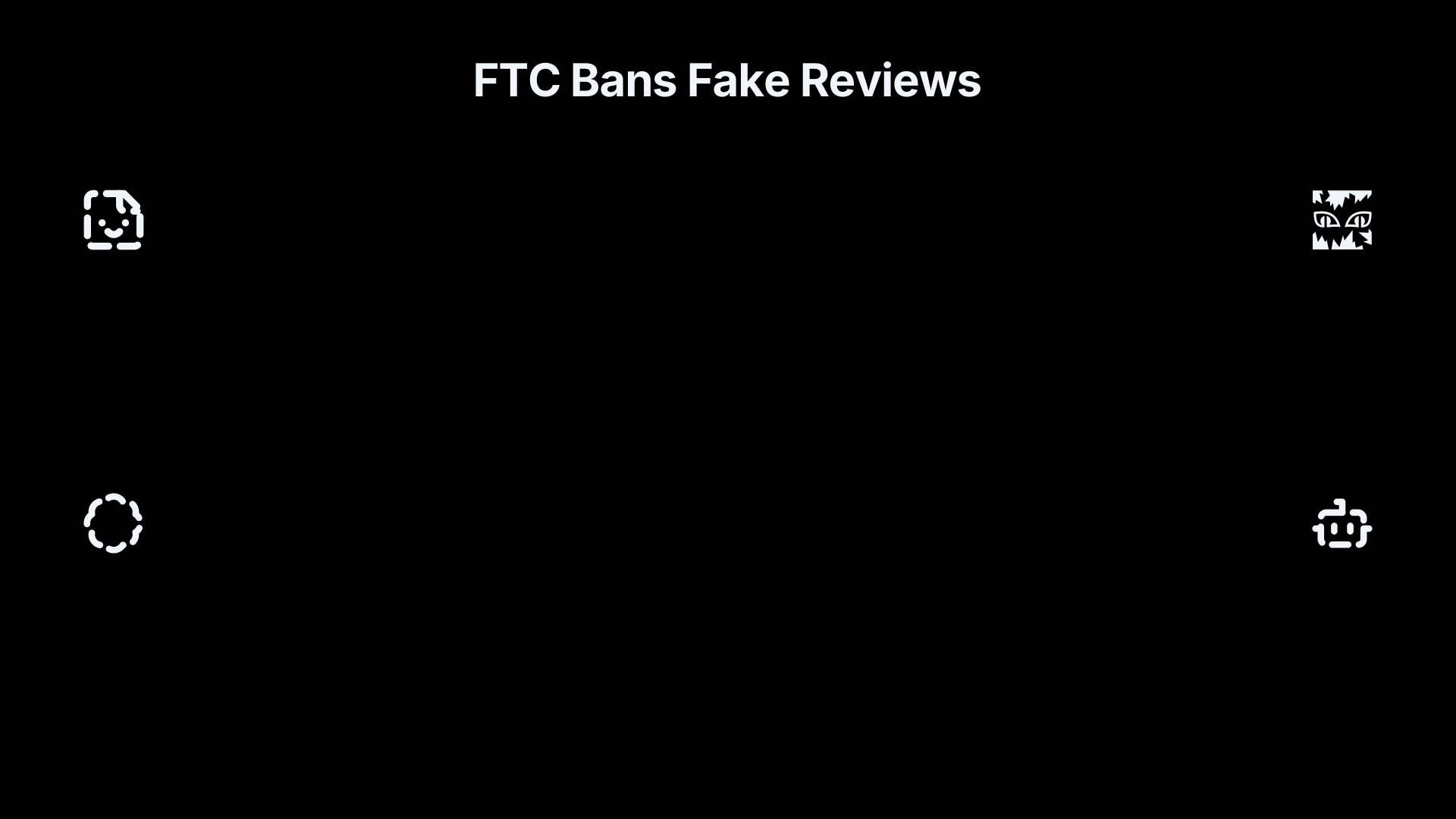 Within advertising and consumer persuasion, this becomes a fallacy-like shortcut: “many people rated it highly, therefore it must be good”. That inference weakens when the visible reviews do not accurately represent genuine customer experience. Fake reviews, hidden negative feedback, undisclosed incentives and biased sampling can all make a product appear more widely approved than the underlying evidence warrants. Regulatory action in both the United States and the United Kingdom reflects growing concern that review systems can be manipulated in ways that mislead consumers.[Federal Trade Commission]ftc.govfederal trade commission announces final rule banning fake reviews testimonialsFederal Trade CommissionFederal Trade Commission Announces Final Rule Banning…14 Aug 2024 — The Federal Trade Commission today announc…[Federal Trade Commission]ftc.govfederal trade commission announces final rule banning fake reviews testimonialsFederal Trade CommissionFederal Trade Commission Announces Final Rule Banning…14 Aug 2024 — The Federal Trade Commission today announc…
Why Ratings Feel Like Consumer Evidence
Star ratings are persuasive because they appear to aggregate many independent judgements into a simple signal. Instead of reading hundreds of individual experiences, consumers see a number such as 4.7 out of 5 and treat it as a summary of collective opinion.
This shortcut is often reasonable. If a large and representative group of verified customers reports similar experiences, the average rating may provide useful information. The difficulty is that consumers rarely see the entire process behind the score. They see the output rather than the conditions under which the data were collected.
Research on online rating systems has shown that ratings are vulnerable to both social influence and selection effects. Reviewers may be influenced by existing ratings, while the people who choose to leave reviews may differ significantly from the overall customer population. As a result, the displayed average can reflect the behaviour of a particular subset of users rather than a neutral sample of all buyers.[ResearchGate]researchgate.netResearch Gate Social Influence Bias in Online Ratings: A Field ExperimentSocial Influence Bias in Online Ratings: A Field ExperimentMay 13, 2016 — This study addresses the issues of social influence…
The persuasive force of ratings also comes from social proof. Consumers often interpret high ratings as evidence that “people like me” have tested the product and approved it. Marketing research has repeatedly found that social proof is one of the strongest influences during purchasing decisions because it reduces uncertainty.[We Are Roast]weareroast.comWe Are Roast Stars in Their Eyes?The Science of Online Reviews and…The power of reviews was proved in this paper, with Google's extensive research showing that 'social…
The logical risk emerges when consumers move from “many people seem satisfied” to stronger conclusions such as:
- The product is objectively superior.
- The product is suitable for me.
- The product’s claims have been independently verified.
- Negative experiences are rare.
A star rating alone cannot establish any of those conclusions.
How Manufactured Social Proof Distorts Ratings
The most obvious distortion is the fake review. Businesses, intermediaries or individuals may create reviews that do not represent genuine customer experiences. Because review scores influence visibility and sales, there is a strong incentive to inflate ratings artificially.
Regulators have increasingly treated this as a serious consumer protection issue. In 2024, the US Federal Trade Commission finalised a rule prohibiting the sale or purchase of fake reviews and testimonials, including reviews generated by people without genuine experience and certain forms of AI-generated review fraud. The rule also targets other deceptive practices that can create false impressions of popularity or satisfaction.[Federal Trade Commission]ftc.govfederal trade commission announces final rule banning fake reviews testimonialsFederal Trade CommissionFederal Trade Commission Announces Final Rule Banning…14 Aug 2024 — The Federal Trade Commission today announc…[Federal Trade Commission]ftc.govfederal trade commission announces final rule banning fake reviews testimonialsFederal Trade CommissionFederal Trade Commission Announces Final Rule Banning…14 Aug 2024 — The Federal Trade Commission today announc…
The problem extends beyond completely fabricated reviews. Manufactured social proof can arise through several mechanisms:
Review purchasing. Businesses pay for positive reviews or organise review campaigns that create the appearance of spontaneous customer enthusiasm.[GOV.UK]GOV.UKfake reviews4 Apr 2025 — The CMA also held a webinar to help businesses who publish customer reviews understand what steps they should take to comply…
Insider reviews. Employees, owners or associates post favourable reviews without disclosing their connection to the business. Regulators specifically identify this as a deceptive practice.[Federal Trade Commission]ftc.govfederal trade commission announces final rule banning fake reviews testimonialsFederal Trade CommissionFederal Trade Commission Announces Final Rule Banning…14 Aug 2024 — The Federal Trade Commission today announc…
Undisclosed incentives. Customers receive discounts, rewards or benefits in exchange for reviews without clearly revealing the incentive. This can skew the visible feedback toward positivity.[GOV.UK]GOV.UKFake and misleading online reviews tradingThe Competition and Markets Authority (CMA) carried out a programme of work to tackle the tradi…
AI-assisted review generation. Generative AI has reduced the cost and effort required to produce large volumes of convincing reviews. Recent research suggests that people often struggle to distinguish AI-generated reviews from genuine ones.[arXiv]arxiv.orgLarge Language Models as 'Hidden Persuaders': Fake Product Reviews are Indistinguishable to Humans and MachinesJune 16, 2025…
In each case, the resulting rating may look like independent evidence even though the underlying opinions are not independent at all.
When Missing Reviews Matter as Much as Fake Ones
A review system can become misleading even if every visible review was written by a real customer.
The reason is selection. Consumers typically see only the reviews that remain visible after moderation, ranking and filtering decisions. If negative experiences are disproportionately hidden, the displayed rating can create an exaggerated impression of satisfaction.
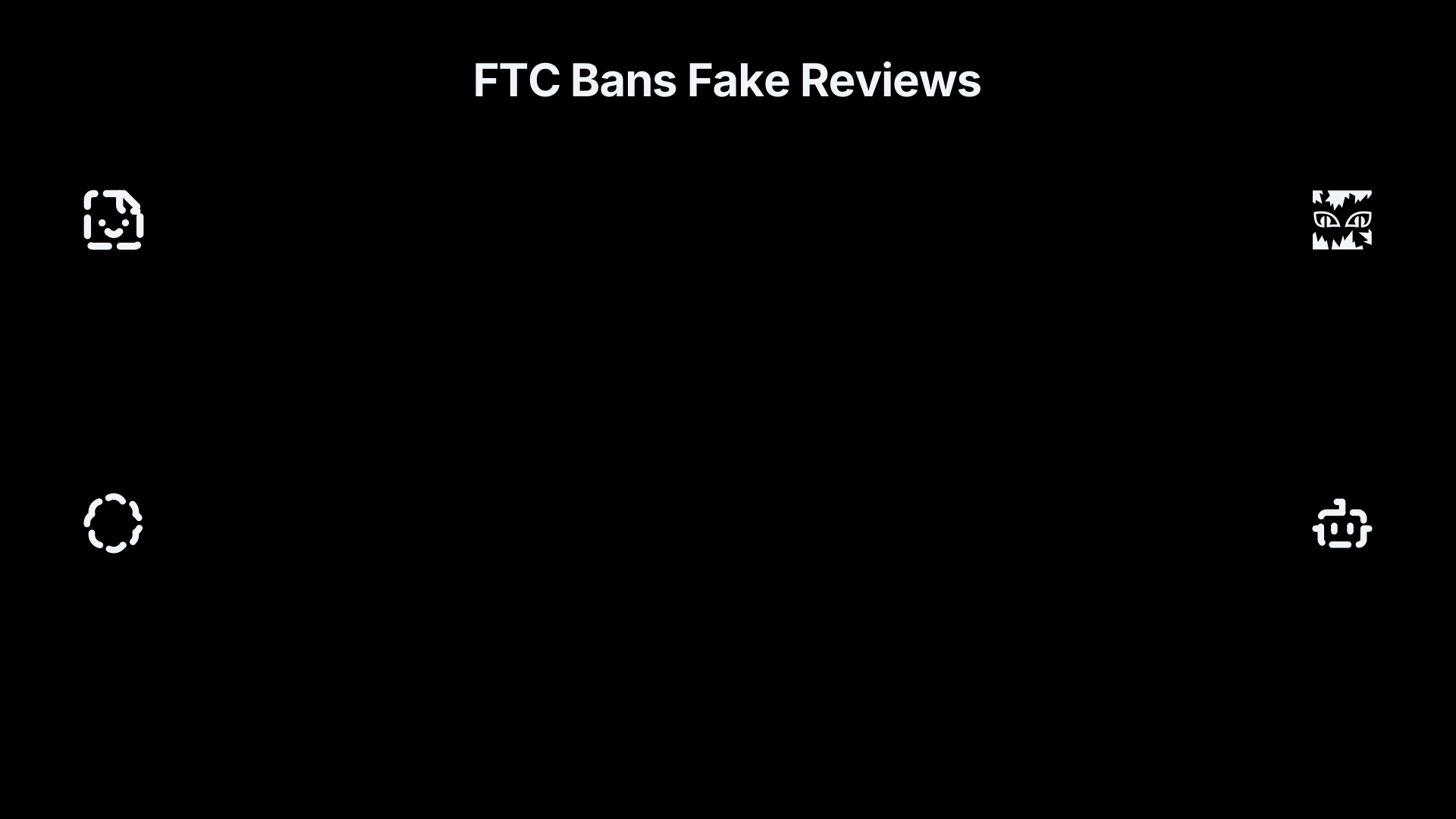
One of the most cited examples involved Fashion Nova. According to the FTC, the company automatically published many positive reviews while delaying or withholding large numbers of lower-rated reviews. Consumers therefore saw a rating environment that appeared substantially more favourable than the full body of customer feedback.[New York Post]nypost.comfashion nova suppressed negative online reviews 2 4m going to customersFashion Nova must refund about $2.4 million to over 148,351 consumers who purchased items before November 21, 2019, and made a valid clai…
This illustrates an important evidential point. A rating average is only as trustworthy as the process used to collect and display reviews. A platform that publishes all genuine reviews presents a different kind of evidence from a platform that selectively displays favourable ones.
Regulators increasingly emphasise this distinction. Recent UK guidance highlights concerns not only about fake reviews but also about practices that suppress, filter or distort genuine consumer feedback.[GOV.UK]GOV.UKfake and misleading reviews 5 businesses under cma investigationand misleading reviews: 5 businesses under CMA…27 Mar 2026 — Five companies now under investigation as the CMA steps up its work to ta…[GOV.UK]GOV.UKreviewsThe CMA will investigate whether these websites are taking sufficient measures to protect consumers from fake and misleading revie…
Why Large Numbers Do Not Always Mean Strong Evidence
Consumers often assume that a large review count guarantees reliability. While sample size matters, large numbers can still conceal important weaknesses.
A product with 20,000 reviews may appear more trustworthy than one with 200 reviews. Yet several questions remain:
- Were reviews collected from verified purchasers?
- Were incentives disclosed?
- Were negative reviews removed?[nypost.com]nypost.comfashion nova suppressed negative online reviews 2 4m going to customersFashion Nova must refund about $2.4 million to over 148,351 consumers who purchased items before November 21, 2019, and made a valid clai…
- Did reviews come from a short promotional period?
- Did the platform actively detect suspicious activity?
The average score alone cannot answer these questions.
Even genuine reviews can become biased through social influence. Studies of online review systems have found that exposure to existing ratings can affect subsequent ratings. Early positive signals may therefore influence later reviewers and gradually amplify a favourable impression beyond what independent evaluations would have produced.[ResearchGate]researchgate.netResearch Gate Social Influence Bias in Online Ratings: A Field ExperimentSocial Influence Bias in Online Ratings: A Field ExperimentMay 13, 2016 — This study addresses the issues of social influence…
This does not mean highly rated products are unreliable. It means that the number itself should be treated as evidence with limitations rather than as conclusive proof.
Practical Checks Before Trusting the Average
Consumers do not need to ignore reviews altogether. Ratings remain useful when interpreted carefully.
Several checks can improve judgement:
Look beyond the average score. A 4.6-star rating may mean something different if it comes from 50 reviews rather than 50,000.
Read a sample of negative and middling reviews. Three-star and four-star reviews often provide more balanced information than extreme praise or criticism.
Check whether reviews are verified purchases. Verification does not eliminate manipulation, but it raises the evidential standard.
Watch for suspicious patterns. Large clusters of highly similar reviews, repetitive language or sudden bursts of praise can indicate coordinated activity.
Look for disclosure of incentives. If reviewers received discounts, gifts or rewards, that information may affect how much weight their opinions deserve.
Consider multiple platforms. Consistent ratings across different review environments are generally more persuasive than ratings visible only in one location.
Examine recent reviews. A high historical average may conceal recent declines in quality or service.
These checks do not guarantee accuracy, but they help distinguish genuine customer evidence from manufactured impressions of consensus.
The Fallacy Behind Manufactured Ratings
The persuasive power of review ratings depends on a simple assumption: many independent customers reached similar conclusions. When that assumption is false, the rating becomes a weaker form of evidence than it appears.
Manufactured social proof exploits the gap between appearance and reality. Consumers see what looks like broad public endorsement and infer quality, reliability or trustworthiness. Yet the visible consensus may have been shaped by fake reviews, hidden criticism, incentives, biased sampling or platform design choices. The resulting fallacy is not merely that a product is popular. It is the stronger and less justified conclusion that apparent popularity proves merit.
For that reason, star ratings are best treated as a starting point for evaluation rather than as proof in themselves. The more opaque the review system, the more cautious consumers should be about treating a numerical average as reliable evidence.
Amazon book picks
Further Reading
Books and field guides related to Can Star Ratings Become Manufactured Proof?. Use these as the next step if you want deeper reading beyond the article.
Thinking, Fast and Slow
Explains heuristics that make ratings seem more persuasive than they are.
The Art of Thinking Clearly
Helps readers spot reasoning errors around popularity signals.
eBay marketplace picks
Marketplace Samples
Example marketplace items related to this page. Use the search link to explore similar finds on eBay.






Endnotes
1.
Source: ftc.gov
Title: federal trade commission announces final rule banning fake reviews testimonials
Link:https://www.ftc.gov/news-events/news/press-releases/2024/08/federal-trade-commission-announces-final-rule-banning-fake-reviews-testimonials
Source snippet
Federal Trade CommissionFederal Trade Commission Announces Final Rule Banning...14 Aug 2024 — The Federal Trade Commission today announc...
2.
Source: ftc.gov
Title: consumer reviews testimonials rule questions answers
Link:https://www.ftc.gov/business-guidance/resources/consumer-reviews-testimonials-rule-questions-answers
Source snippet
Federal Trade CommissionThe Consumer Reviews and Testimonials Rule: Questions...8 Nov 2024 — The Commission's Rule on the Use of Consume...
3.
Source: GOV.UK
Title: fake reviews
Link:https://www.gov.uk/government/publications/fake-reviews
Source snippet
4 Apr 2025 — The CMA also held a webinar to help businesses who publish customer reviews understand what steps they should take to comply...
4.
Source: researchgate.net
Title: Research Gate Social Influence Bias in Online Ratings: A Field Experiment
Link:https://www.researchgate.net/publication/303030394_Social_Influence_Bias_in_Online_Ratings_A_Field_Experiment
Source snippet
Social Influence Bias in Online Ratings: A Field ExperimentMay 13, 2016 — This study addresses the issues of social influence...
Published: May 13, 2016
5.
Source: GOV.UK
Link:https://www.gov.uk/cma-cases/fake-and-misleading-online-reviews
Source snippet
Fake and misleading online reviews tradingThe Competition and Markets Authority (CMA) carried out a programme of work to tackle the tradi...
6.
Source: assets.publishing.service.gov.uk
Link:https://assets.publishing.service.gov.uk/media/67eeb64fe9c76fa33048c790/CMA208_-_Fake_reviews_guidance.pdf
Source snippet
GOV.UKCMA208 - Fake reviews guidance4 Apr 2025 — It covers fake reviews, concealed incentivised reviews and requires traders not to publi...
7.
Source: arxiv.org
Link:https://arxiv.org/abs/2506.13313
Source snippet
Large Language Models as 'Hidden Persuaders': Fake Product Reviews are Indistinguishable to Humans and MachinesJune 16, 2025...
Published: June 16, 2025
8.
Source: connect.cma.gov.uk
Link:https://connect.cma.gov.uk/40900/widgets/133670/documents/91151
Source snippet
with consumer law if you publish online reviews4 Sept 2025 — This document provides a non-exhaustive overview of the new banned practice...
9.
Source: GOV.UK
Title: fake and misleading reviews 5 businesses under cma investigation
Link:https://www.gov.uk/government/news/fake-and-misleading-reviews-5-businesses-under-cma-investigation
Source snippet
and misleading reviews: 5 businesses under CMA...27 Mar 2026 — Five companies now under investigation as the CMA steps up its work to ta...
10.
Source: GOV.UK
Link:https://www.gov.uk/cma-cases/online-reviews
Source snippet
reviewsThe CMA will investigate whether these websites are taking sufficient measures to protect consumers from fake and misleading revie...
11.
Source: weareroast.com
Title: We Are Roast Stars in Their Eyes?
Link:https://weareroast.com/resources/guides/stars-in-their-eyes-the-science-of-online-reviews-and-how-brands-should-use-them/
Source snippet
The Science of Online Reviews and...The power of reviews was proved in this paper, with Google's extensive research showing that 'social...
12.
Source: reuters.com
Title: US FTC finalizes ban on companies buying and selling fake online reviews The U.S
Link:https://www.reuters.com/business/retail-consumer/us-ftc-finalizes-ban-fake-online-reviews-2024-08-14/
Source snippet
Federal Trade Commission (FTC) has finalized a ban on the sale and purchase of fake online reviews. This new rule targets the trafficking...
13.
Source: nypost.com
Title: fashion nova suppressed negative online reviews 2 4m going to customers
Link:https://nypost.com/2025/02/05/business/fashion-nova-suppressed-negative-online-reviews-2-4m-going-to-customers/
Source snippet
Fashion Nova must refund about $2.4 million to over 148,351 consumers who purchased items before November 21, 2019, and made a valid clai...
Published: November 21, 2019
Additional References
14.
Source: uk.practicallaw.thomsonreuters.com
Link:https://uk.practicallaw.thomsonreuters.com/w-046-5309?contextData=%28sc.Default%29&transitionType=Default
Source snippet
on fake and misleading consumer reviewsThis note examines the prohibition on publishing consumer review information in a misleading way a...
15.
Source: research.cbs.dk
Link:https://research.cbs.dk/files/98732009/1640479_Enhancing_Online_Review_Platform_Performance_Factorcs_Influencing_Ratings_and_Number_of_Reviews.pdf
Source snippet
Influencing Ratings and Number of Reviewsby B Kim — The objective of this study is to gain a better understanding of the relationship bet...
16.
Source: reddit.com
Link:https://www.reddit.com/r/technology/comments/1g9b7cb/ftcs_rule_banning_fake_online_reviews_goes_into/
Source snippet
FTC's rule banning fake online reviews goes into effectYou Can Now Get Fined $51,744 for Writing a Fake Review Online | The FTC's ban on...
17.
Source: aoshearman.com
Title: cma targets fake online reviews in expanding consumer enforcement programme
Link:https://www.aoshearman.com/en/insights/cma-targets-fake-online-reviews-in-expanding-consumer-enforcement-programme
Source snippet
CMA targets fake online reviews in expanding consumer...31 Mar 2026 — The UK Competition and Markets Authority (CMA) has opened five con...
18.
Source: hoganlovells.com
Title: ftc publishes final rule banning fake consumer reviews and testimonials
Link:https://www.hoganlovells.com/en/publications/ftc-publishes-final-rule-banning-fake-consumer-reviews-and-testimonials
Source snippet
publishes final rule banning fake consumer reviews...11 Sept 2024 — The Final Rule prohibits the sale and purchase of fake consumer revi...
19.
Source: maynardnexsen.com
Title: publication ftc issues final rule banning fake reviews and testimonials
Link:https://www.maynardnexsen.com/publication-ftc-issues-final-rule-banning-fake-reviews-and-testimonials
Source snippet
FTC Issues Final Rule Banning Fake Reviews and...16 Aug 2024 — The new rule makes clear that the use of false or misleading reviews and...
20.
Source: keystonelaw.com
Title: what does the cma crackdown on fake online reviews mean for businesses
Link:https://keystonelaw.com/keynotes/what-does-the-cma-crackdown-on-fake-online-reviews-mean-for-businesses/
Source snippet
What does the CMA crackdown on fake online reviews...1 Jul 2025 — The publisher has responsibility for preventing and taking steps to re...
22.
Source: ai-law.co.uk
Title: how businesses can handle fake reviews and legal issues on trustpilot
Link:https://ai-law.co.uk/how-businesses-can-handle-fake-reviews-and-legal-issues-on-trustpilot/
Source snippet
How Businesses Can Handle Fake Reviews and Legal...12 Aug 2025 — New UK legislation now makes it illegal for businesses to publish or su...
23.
Source: stampedsupport.stamped.io
Title: 29877379192987 Complying with the FTC Final Rule for Reviews
Link:https://stampedsupport.stamped.io/hc/en-us/articles/29877379192987-Complying-with-the-FTC-Final-Rule-for-Reviews
Source snippet
with the FTC Final Rule for Reviews7 Oct 2024 — The Federal Trade Commission has announced a final rule, effective October 15, 2024, aime...
Published: October 15, 2024
Topic Tree