Within Tu Quoque
When Whataboutism Dodges the Real Issue
Whataboutism can expose double standards, but it often dodges the original accusation instead of answering it.
On this page
- How the counteraccusation changes the subject
- When comparison is genuinely relevant
- How to return to the original claim
Page outline Jump by section
Introduction
Whataboutism is one of the most recognisable forms of tu quoque reasoning in public debate. Instead of answering a criticism, the target responds with a counteraccusation: “What about your side?” or “What about this other case?” The move can sometimes expose genuine double standards, but it often functions as a deflection. Rather than addressing whether the original charge is true, justified, or supported by evidence, the discussion shifts to the critic’s consistency, motives, or past behaviour. As a result, the audience’s attention moves away from the issue under examination and towards a new dispute. Logical analyses generally treat this pattern as a variant of tu quoque because it attempts to blunt criticism through allegations of hypocrisy rather than by directly answering the criticism itself.[Encyclopedia Britannica]britannica.comEncyclopedia Britannica Whataboutism | Definition, Examples, Etymology, LogicalEncyclopedia BritannicaWhataboutism | Definition, Examples, Etymology, Logical…May 13, 2026 — Whataboutism, the rhetorical practice of…[Stanford Encyclopedia of Philosophy]plato.stanford.eduEncyclopedia of Philosophy FallaciesIt involves not accepting a view or a recommendation because the espouser him…Read more…
 In public arguments, the challenge is not merely identifying whataboutism but distinguishing between a relevant comparison and a diversion. The difference determines whether the exchange clarifies the issue or obscures it.
How the Counteraccusation Changes the Subject
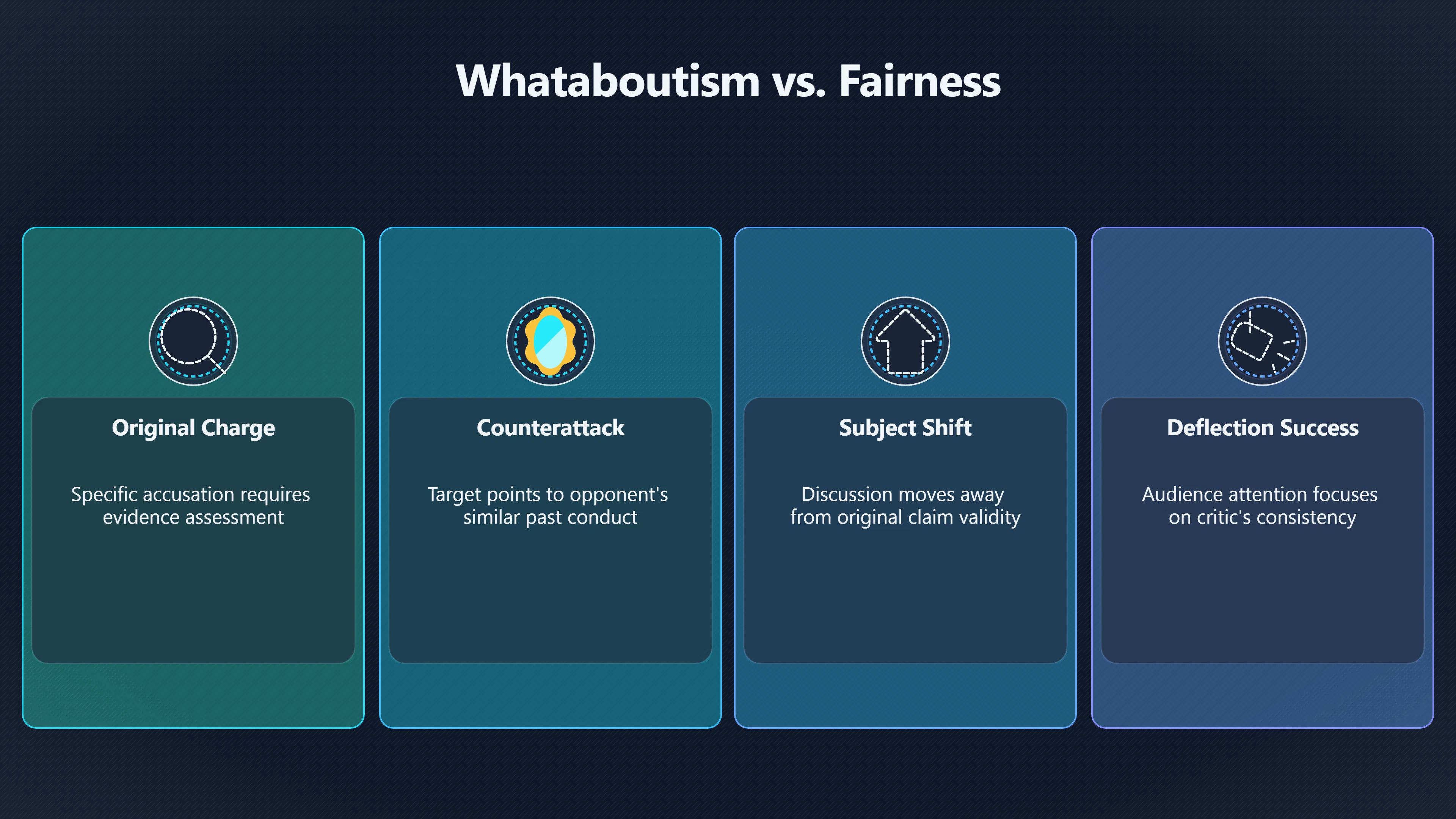
The mechanism of whataboutism is simple. A criticism is raised against a person, organisation, government, or movement. Instead of responding to that criticism, the target redirects attention elsewhere.
A typical pattern looks like this:
- A specific accusation is made.
- The accused points to similar behaviour by another party.
- Discussion shifts to the other party’s conduct.
- The original accusation receives little or no examination.
The rhetorical power of the move comes from its emotional appeal. People dislike hypocrisy and often view inconsistent criticism as unfair. By highlighting an opponent’s inconsistency, the accused can make the audience feel that the critic lacks moral standing. Yet even if the critic is inconsistent, the original accusation may still be correct. The truth of a claim does not automatically depend on the character of the person making it.[stanford]plato.stanford.eduEncyclopedia of Philosophy FallaciesIt involves not accepting a view or a recommendation because the espouser him…Read more… Encyclopedia of Philosophy[Internet Encyclopedia of Philosophy]iep.utm.eduInternet Encyclopedia of PhilosophyFallaciesTu Quoque. The Fallacy of Tu Quoque occurs in our reasoning if we conclude that someone's arg…
Consider a public official accused of misusing public funds. A whataboutist reply might be: “What about the opposition party’s spending scandal?” The comparison may be factually accurate. However, it does not answer whether the official misused funds. The conversation has shifted from evaluating one allegation to comparing competing allegations.
This is why many descriptions of whataboutism emphasise deflection. The issue under discussion is displaced by a different issue, often one that is politically advantageous to the speaker. FinMasters[Encyclopedia Britannica]britannica.comEncyclopedia Britannica Whataboutism | Definition, Examples, Etymology, LogicalEncyclopedia BritannicaWhataboutism | Definition, Examples, Etymology, Logical…May 13, 2026 — Whataboutism, the rhetorical practice of…[Merriam-Webster]merriam-webster.comn from one's own deeds…
Why the Move Can Be Persuasive
Whataboutism survives because it exploits a real concern: fairness.
Many audiences believe criticism should be applied consistently. If a commentator condemns one group for behaviour they excuse in another group, that inconsistency may matter. Exposing double standards can therefore appear relevant and persuasive.
The difficulty is that two separate questions become tangled together:
- Is the criticism being applied fairly?
- Is the criticised conduct actually wrong?
A whataboutist response often encourages the audience to answer the second question by focusing on the first. Once attention shifts to fairness, the original claim can disappear from view entirely.
This dynamic is especially common in political disputes, where public attention is limited and narratives compete for dominance. The strategic value of whataboutism lies less in disproving an accusation than in preventing sustained scrutiny of it. Researchers studying public discourse and online communication frequently describe whataboutism as a narrative-disrupting or attention-diverting tactic because it changes the frame of discussion.[arXiv]arxiv.orgPaying Attention to Deflections: Mining Pragmatic Nuances for Whataboutism Detection in Online DiscourseFebruary 15, 2024…

When Comparison Is Genuinely Relevant
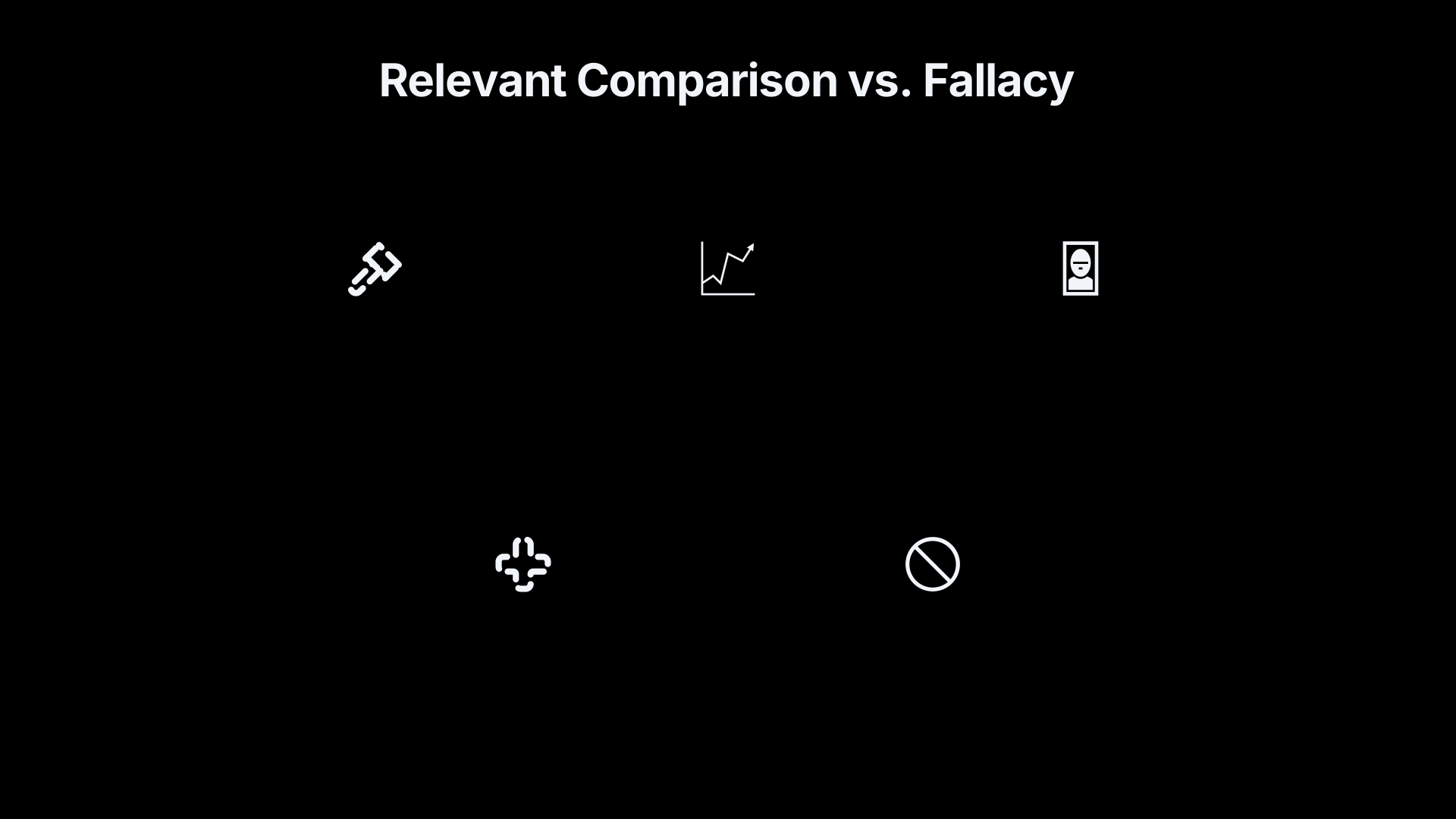
Not every “what about” response is fallacious.
Sometimes comparison is necessary to evaluate whether a standard is being applied consistently. If a regulator punishes one company for conduct routinely tolerated in others, pointing to comparable cases may reveal selective enforcement. If a politician condemns a practice they previously defended, highlighting that inconsistency may provide evidence about credibility or sincerity.[PhilPapers]philpapers.orgTu Quoque Arguments and the Significance of Hypocrisyby SF Aikin · 2008 · Cited by 39 — Though textbook tu quoque arguments are…
A useful test is to ask what conclusion the comparison is supposed to support.
A comparison may be relevant when it argues:
- A rule is being enforced unevenly.
- Similar cases are being treated differently.
- The critic’s credibility or authority is at issue.
- The broader pattern matters for understanding the specific case.
A comparison becomes whataboutist deflection when it argues, explicitly or implicitly:
- “Others did it too, therefore this criticism is invalid.”
- “Your side behaved similarly, therefore I do not need to answer.”
- “The existence of another problem cancels this problem.”
The distinction is subtle but important. Evidence of hypocrisy may show that a critic is inconsistent. It does not automatically show that the criticised conduct is acceptable. Informal logic scholars have argued that some hypocrisy arguments are relevant to questions of authority or practicality, while remaining irrelevant as direct refutations of the original claim.[PhilPapers]philpapers.orgTu Quoque Arguments and the Significance of Hypocrisyby SF Aikin · 2008 · Cited by 39 — Though textbook tu quoque arguments are…
How to Return to the Original Claim
One of the most effective responses to whataboutism is to separate the comparison from the accusation.
A discussion can acknowledge the secondary issue without allowing it to replace the primary one. For example:
- “That may be true, but does it answer the allegation being discussed?”
- “We can examine both cases, but first let’s determine whether this claim is correct.”
- “Even if the critic is inconsistent, is the criticism itself justified?”
These responses redirect attention to the question that was originally raised.
Another useful approach is to treat the comparison as an additional issue rather than a substitute issue. If both sides engaged in the same misconduct, then both cases may deserve scrutiny. The existence of one wrong does not eliminate the need to evaluate another.
This method preserves the potentially valuable insight contained in the comparison while preventing the conversation from abandoning the original subject.
The Core Risk of Whataboutism
The central danger of whataboutism is not that it always involves false comparisons. Often the comparisons are accurate. The problem is that accuracy alone does not make them responsive.
A public argument begins with a specific claim that requires assessment. Whataboutism changes the audience’s attention from that claim to the behaviour of someone else. In doing so, it converts a question about evidence, responsibility, or truth into a question about comparative guilt and hypocrisy.[Encyclopedia Britannica]britannica.comEncyclopedia Britannica Whataboutism | Definition, Examples, Etymology, LogicalEncyclopedia BritannicaWhataboutism | Definition, Examples, Etymology, Logical…May 13, 2026 — Whataboutism, the rhetorical practice of…[Merriam-Webster]merriam-webster.comby another is similar or worse.Read more…
For that reason, whataboutism is best understood as a distinctive form of tu quoque deflection. It may uncover genuine double standards, and those double standards may themselves deserve criticism. Yet exposing hypocrisy is not the same thing as answering an accusation. The critical question remains unchanged: does the comparison help evaluate the original claim, or does it merely distract from it? When the latter occurs, whataboutism has succeeded in changing the subject without resolving the issue.[yourlogicalfallacyis.com]yourlogicalfallacyis.comYour logical fallacy is tu quoqueThis fallacy is also known as the appeal to hypocrisy. It is commonly employed as an effective red herri…[Stanford Encyclopedia of Philosophy]plato.stanford.eduEncyclopedia of Philosophy FallaciesIt involves not accepting a view or a recommendation because the espouser him…Read more…[3quillbot.com]quillbot.com”Whataboutism is a broader tactic…
Amazon book picks
Further Reading
Books and field guides related to When Whataboutism Dodges the Real Issue. Use these as the next step if you want deeper reading beyond the article.
How to Win Every Argument
Directly covers fallacious argumentative moves, including techniques that resemble tu quoque and whataboutist deflection.
Thinking, Fast and Slow
Explains cognitive biases and flawed reasoning patterns that help audiences understand why deflections and whataboutism can be persuasive.
The Demon-Haunted World
Teaches evidence-based reasoning and how to resist rhetorical distractions from the central issue.
An Illustrated Book of Bad Arguments
Helps readers quickly recognize when an argument shifts attention away from the original claim.
eBay marketplace picks
Marketplace Samples
Example marketplace items related to this page. Use the search link to explore similar finds on eBay.







Endnotes
1.
Source: britannica.com
Title: Encyclopedia Britannica Whataboutism | Definition, Examples, Etymology, Logical
Link:https://www.britannica.com/topic/whataboutism
Source snippet
Encyclopedia BritannicaWhataboutism | Definition, Examples, Etymology, Logical...May 13, 2026 — Whataboutism, the rhetorical practice of...
Published: May 13, 2026
2.
Source: plato.stanford.edu
Title: Encyclopedia of Philosophy Fallacies
Link:https://plato.stanford.edu/entries/fallacies/
Source snippet
It involves not accepting a view or a recommendation because the espouser him...Read more...
3.
Source: merriam-webster.com
Link:https://www.merriam-webster.com/wordplay/whataboutism-origin-meaning
Source snippet
n from one's own deeds...
4.
Source: finmasters.com
Link:https://finmasters.com/whataboutism/
Source snippet
When People Counter Accusations with...2 May 2021 — Whataboutism is a type of logical fallacy that occurs when a person attempts to dive...
Published: May 2021
5.
Source: arxiv.org
Link:https://arxiv.org/abs/2402.09934
Source snippet
Paying Attention to Deflections: Mining Pragmatic Nuances for Whataboutism Detection in Online DiscourseFebruary 15, 2024...
Published: February 15, 2024
6.
Source: arxiv.org
Title: arXiv Extremism & Whataboutism: A Case Study on Bangalore Riots
Link:https://arxiv.org/abs/2109.10526
7.
Source: philpapers.org
Link:https://philpapers.org/rec/AIKTQA
Source snippet
Tu Quoque Arguments and the Significance of Hypocrisyby SF Aikin · 2008 · Cited by 39 — Though textbook tu quoque arguments are...
8.
Source: merriam-webster.com
Link:https://www.merriam-webster.com/dictionary/whataboutism
Source snippet
by another is similar or worse.Read more...
9.
Source: quillbot.com
Link:https://quillbot.com/blog/frequently-asked-questions/whats-the-difference-between-tu-quoque-fallacies-and-whataboutism/
Source snippet
”Whataboutism is a broader tactic...
10.
Source: yourlogicalfallacyis.com
Link:https://yourlogicalfallacyis.com/tu-quoque
Source snippet
Your logical fallacy is tu quoqueThis fallacy is also known as the appeal to hypocrisy. It is commonly employed as an effective red herri...
11.
Source: finmasters.com
Title: Tu Quoque Fallacy
Link:https://finmasters.com/tu-quoque-fallacy/
Source snippet
Definition and ExamplesTu quoque is a fallacy in which someone asserts that their opponent's argument must be invalid because it is incon...
12.
Source: plato.stanford.edu
Title: category mistakes
Link:https://plato.stanford.edu/entries/category-mistakes/
Source snippet
Mistakes - Stanford Encyclopedia of Philosophyby O Magidor · 2019 · Cited by 172 — Category mistakes are sentences such as 'The number tw...
13.
Source: britannica.com
Link:https://www.britannica.com/topic/propaganda
Source snippet
Propaganda is the dissemination of information—facts, arguments, [rumours]({{ 'rumours/' | relative_url }}), half-truths, or lies—to influence public opinion.Read more...
14.
Source: britannica.com
Link:https://www.britannica.com/topic/fallacy
Source snippet
Logic, Definition & ExamplesFeb 13, 2026 — Fallacy, in logic, erroneous reasoning that has the appearance of soundness. In logic an argum...
15.
Source: britannica.com
Link:https://www.britannica.com/topic/fallacy/Verbal-fallacies
Source snippet
Ambiguity, [Red Herring]({{ 'red-herring/' | relative_url }}), Straw ManFeb 13, 2026 — These fallacies, called fallacies of ambiguity, arise when the conclusion is achieved thr...
16.
Source: iep.utm.edu
Link:https://iep.utm.edu/fallacy/
Source snippet
Internet Encyclopedia of PhilosophyFallaciesTu Quoque. The Fallacy of Tu Quoque occurs in our reasoning if we conclude that someone's arg...
17.
Source: Wikipedia
Title: Tu quoque
Link:https://en.wikipedia.org/wiki/Tu_quoque
Source snippet
Tu quoqueTu quoque, literally "you, too", is a rhetorical technique that intends to discredit the opponent's argument by attacking th...
18.
Source: informallogic.ca
Link:https://informallogic.ca/index.php/informal_logic/article/view/543/506
Source snippet
Tu Quoque Arguments and the Significance of Hypocrisyby SF Aikin · 2008 · Cited by 39 — Abstract: Though textbook tu quoque arguments are...
19.
Source: Wikipedia
Link:https://en.wikipedia.org/wiki/Whataboutism
Source snippet
WhataboutismWhataboutism" or "whataboutery refers to the propaganda strategy of responding to an accusation with a counter-accusation...
Additional References
20.
Source: philosophypages.com
Link:https://www.philosophypages.com/lg/e06a.htm
Source snippet
Fallacies of RelevanceThe fallacies of [relevance]({{ 'relevance/' | relative_url }}), for example, clearly fail to provide adequate reason for believing the truth of their c...
21.
Source: philosophicalsociety.com
Link:https://www.philosophicalsociety.com/HTML/LogicalFallacies.html
Source snippet
Logical FallaciesInconsistency, moreover, may raise issues of hypocrisy or double standards, but it does not bear upon the argument at ha...
22.
Source: dictionary.com
Link:https://www.dictionary.com/browse/whataboutism
Source snippet
WHATABOUTISM Definition & Meaninga conversational tactic in which a person responds to an argument or attack by changing the subject to f...
23.
Source: scholarlypublications.universiteitleiden.nl
Link:https://scholarlypublications.universiteitleiden.nl/access/item%3A4107772/view
Source snippet
About Whataboutism?Whataboutist moves are appeals to evidence about whether one has assessed the total evidence, and so need not be failu...
24.
Source: filosoficas.unam.mx
Link:https://www.filosoficas.unam.mx/docs/680/files/Whataboutisms-SemiInv.pdf
Source snippet
quoque arguments are whataboutisms where the excluded cases include at least one of the parties involved in the [debate]({{ 'debate/' | relative_url }}). If, for example...
25.
Source: researchgate.net
Title: Research Gate(PDF) The Rhetoric of “Whataboutism” in American
Link:https://www.researchgate.net/publication/342741261_The_Rhetoric_of_Whataboutism_in_American_Journalism_and_Political_Identity
Source snippet
whataboutism” is used to name the logical fallacy, “tu quoque” (Latin for “you. also”), which is an attempt to defend against criticism b...
26.
Source: philosophy.stackexchange.com
Title: how is pointing out whataboutism a form of tu quoque fallacy
Link:https://philosophy.stackexchange.com/questions/64723/how-is-pointing-out-whataboutism-a-form-of-tu-quoque-fallacy
Source snippet
is "pointing out whataboutism" a form of tu quoque...21 Jul 2019 — The accusation of whataboutism is itself a form of tu quoque fallacy...
27.
Source: dictionary.cambridge.org
Title: Dictionary WHATABOUTISM | English meaning
Link:https://dictionary.cambridge.org/dictionary/english/whataboutism
Source snippet
Cambridge DictionaryWHATABOUTISM | English meaning - Cambridge Dictionary7 days ago — WHATABOUTISM definition: 1. the practice of answeri...
28.
Source: teachthought.com
Title: Teach Thought What Is A Whataboutism?
Link:https://www.teachthought.com/critical-thinking-posts/what-is-a-whataboutism/
Source snippet
What Is A Whataboutism? - TeachThoughtWhat Is A Whataboutism? Whataboutism is a rhetorical deflection that avoids answering a claim by sh...
29.
Source: facebook.com
Link:https://www.facebook.com/groups/nigerianteachers/posts/4172816779610343/
Source snippet
sms are deflected by raising corresponding...Read more...
Topic Tree